
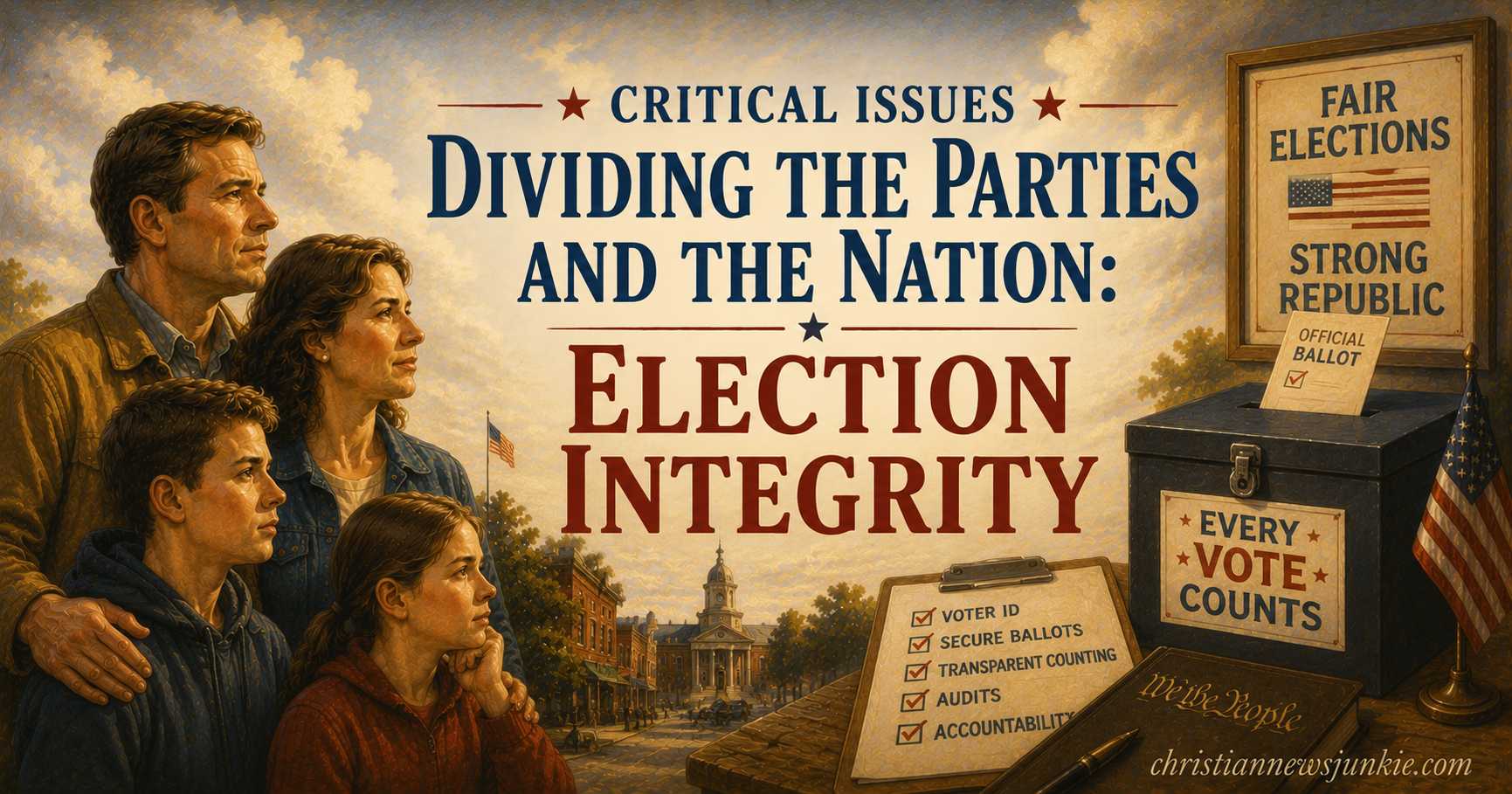
Election integrity is not a fringe concern, nor is it a recent invention of partisan politics.
It sits at the foundation of a constitutional republic. If citizens cannot trust that elections are conducted honestly, transparently, and according to the law, then every downstream political outcome becomes suspect.
Laws may still be enforced, courts may still function, and taxes may still be collected—but the moral authority of the governing system begins to erode.
In the American system, elections are not merely procedural events. They are the primary mechanism by which consent of the governed is expressed.
When that mechanism is widely questioned, social trust weakens, civic participation declines, and political conflict intensifies. A nation can survive disagreements over policy; it struggles to survive sustained doubt about the legitimacy of its governing process.
Public Concern and Relevance
Polling over the past several election cycles shows that election integrity consistently ranks as a top concern for American voters, particularly following the 2020 election and subsequent changes to voting procedures.
Surveys from Gallup, Pew Research Center, and Rasmussen Reports indicate that a significant portion of the electorate—often a majority within Republican voters and a substantial minority among independents—believe U.S. elections are vulnerable to fraud or administrative abuse.
Even among Democrats, trust in elections drops sharply when their preferred candidates lose.
This pattern reveals something important: election integrity concerns are not simply about one party losing.
They reflect a broader anxiety about whether modern election systems—especially those involving mass mail-in voting, ballot harvesting, and extended counting periods—can be adequately safeguarded against error, manipulation, or abuse.
Americans should care about election integrity because elections determine:
• Who writes the laws
• Who enforces them
• Who appoints judges
• How public funds are allocated
• Which moral and cultural values are normalized by the state
When confidence in elections declines, citizens become more cynical, less engaged, and more susceptible to radical narratives that promise stability through extra-constitutional means.
Economic Implications
While election integrity may not appear to have an immediate economic impact in the way taxation or inflation does, its effects are real and cumulative.
Markets respond to stability and predictability. Prolonged disputes over election outcomes, legal challenges, and unclear transitions of power create uncertainty.
Uncertainty discourages investment, complicates long-term planning for businesses, and weakens confidence in institutions responsible for enforcing contracts and property rights.
Additionally, disputed elections often lead to costly litigation, emergency legislation, and federal or state intervention—all funded by taxpayers.
States that repeatedly change election rules through executive action or court orders rather than legislatures introduce regulatory unpredictability that affects employers, employees, and local governments alike.
Election integrity also intersects with public spending priorities. Policies enacted by officials whose legitimacy is widely questioned face increased resistance, leading to inefficiency, legal challenges, and social unrest—each of which carries economic costs.
Public Safety and Social Stability
Public safety is indirectly but meaningfully affected by election integrity.
When large portions of the population believe elections are unfair or manipulated, trust in law enforcement, courts, and political leadership diminishes.
History shows that societies with contested or distrusted elections experience:
• Increased political polarization
• Higher likelihood of protests and riots
• Declining respect for lawful authority
• Radicalization of political rhetoric
This is not unique to the United States. Globally, election disputes often precede periods of unrest. While the U.S. has stronger institutions than many nations, it is not immune to the destabilizing effects of perceived illegitimacy.
When citizens believe lawful avenues for political change are closed or corrupted, some will seek extra-legal alternatives. Even when such actions are condemned, the underlying conditions that produce them deserve serious attention.
Humanitarian and Ethical Concerns
Election integrity is also a moral issue. Vulnerable populations—including the elderly, the disabled, and non-English-speaking citizens—are disproportionately affected by complex or loosely regulated voting systems.
For example, aggressive ballot harvesting practices can expose elderly voters to coercion or manipulation. Weak verification standards may allow third parties to “assist” voters in ways that compromise the secrecy and independence of the ballot. These practices, when poorly regulated, open the door to exploitation under the guise of inclusion.
There is also an ethical obligation to ensure that lawful voters are not disenfranchised by fraud or administrative negligence. Even small-scale irregularities, when ignored or dismissed, undermine the principle of equal representation.
Institutional Impact
Perhaps the most significant consequence of election integrity failures is institutional decay. Courts, legislatures, and executive offices derive legitimacy not merely from legal authority but from public trust.
When election rules are altered rapidly, inconsistently applied, or enforced selectively, institutions appear partisan rather than neutral. Over time, citizens begin to view government not as a referee but as a player—one that writes the rules mid-game.
This perception damages the credibility of democratic institutions and makes future reforms more difficult, as every proposed change is viewed through a lens of suspicion.
Articles in the Critical Issues series require more time to read than most content on this site. They are intentionally written as thorough, in-depth examinations of their subjects.
The Republican Perspective on Election Integrity
From the Republican point of view, election integrity is inseparable from the rule of law.
The party’s position is built around the conviction that elections must be secure, transparent, and verifiable in order to be legitimate.
Republicans generally argue that access to voting and protection of the vote are not opposing values but complementary ones. In their view, a system that is easy to manipulate ultimately harms lawful voters, especially those whose votes are diluted or nullified by fraud or administrative abuse.
Core Principles in the 2024 Republican Party Platform
The 2024 Republican Party platform places election integrity within a broader commitment to constitutional governance and equal application of the law. The platform emphasizes several recurring themes:
• Elections should be conducted according to laws passed by legislatures, not altered by executive fiat or judicial improvisation
• Voter eligibility must be verified
• Ballots should be traceable and auditable
• Transparency should take precedence over administrative convenience
In the platform’s discussion of elections and constitutional order, Republicans stress the importance of voter identification requirements, accurate voter rolls, and chain-of-custody protections for ballots (2024 Republican Party Platform, sections addressing constitutional governance and election administration).
The underlying assumption is straightforward: voting is a civic duty, not an anonymous entitlement detached from citizenship or legal status.
Just as other civic functions require identity verification, Republicans argue that voting should as well.
Legislative Priorities at the Federal Level
At the federal level, Republican lawmakers have repeatedly introduced legislation aimed at strengthening election safeguards.
Common proposals include:
• Requiring government-issued photo identification for federal elections
• Prohibiting non-citizens from voting in federal contests
• Limiting ballot harvesting by third parties
• Ensuring that Election Day, rather than prolonged voting windows, remains central
Republicans often point to existing federal laws that prohibit non-citizen voting and argue that enforcement mechanisms are insufficient. While cases of large-scale fraud may be difficult to prove after the fact, Republicans maintain that prevention—not prosecution—is the proper standard for election administration.
Statements by Republican leaders in Congress frequently emphasize that even the perception of fraud is damaging. They argue that systems which cannot be easily explained to the public or independently verified undermine confidence regardless of intent.
State-Level Republican Action
Republican-led states have been the primary laboratories for election integrity reforms.
Following the 2020 election, states such as Florida, Georgia, Texas, and Arizona passed legislation tightening voting procedures.
Common reforms enacted or proposed by Republican governors and legislatures include:
• Mandatory voter ID for in-person and mail voting
• Regular maintenance and auditing of voter rolls
• Limits on absentee ballot eligibility
• Restrictions on unsupervised ballot drop boxes
• Criminal penalties for election interference
Republican governors have framed these laws as “election confidence” measures rather than voter suppression. Florida’s election reforms, for example, are frequently cited by Republicans as proof that secure elections can coexist with high voter turnout.
Transparency and Audits
Republicans tend to favor post-election audits as a routine feature of election administration.
They argue that audits should not be treated as accusations but as quality-control measures similar to financial audits in private industry.
The push for forensic audits in certain states has been controversial, but Republican lawmakers generally defend the concept while acknowledging that execution matters. Their position is that resistance to audits signals insecurity rather than confidence in election outcomes.
This emphasis reflects a broader Republican belief that sunlight strengthens institutions. If elections are secure, Republicans argue, then transparency should only reinforce that reality.
Internal Party Disagreements
While Republicans broadly agree on the need for election integrity, there is some disagreement over tone and strategy.
Establishment-oriented Republicans often prefer incremental reforms and cautious rhetoric, emphasizing stability and institutional trust.
More populist Republicans argue that institutional failures have already occurred and that stronger language and more aggressive reforms are necessary.
Despite these differences, both factions generally support voter ID laws, ballot security measures, and legislative—not administrative—control of election rules.
Philosophical Assumptions
At a deeper level, the Republican approach reflects a “constrained” view of human nature. The assumption is not that election officials are malicious by default, but that systems should be designed with the expectation of human error, bias, and temptation.
From this perspective, safeguards are not insults; they are acknowledgments of reality.
Republicans often draw analogies to financial controls, criminal justice procedures, and constitutional checks and balances. Trust, they argue, must be earned and verified.
The Democrat Perspective on Election Integrity
The Democrat Party approaches election integrity through a markedly different framework than Republicans.
While Democrats affirm the importance of “secure elections” in principle, their emphasis overwhelmingly centers on access, participation, and the removal of what they describe as “barriers” to voting.
In practice, Democrats tend to define election integrity less in terms of verifiability and enforcement, and more in terms of inclusivity and turnout.
This difference is not merely tactical; it flows from deeper assumptions about power, inequality, and the role of government.
Core Themes in the 2024 Democrat Party Platform
In the 2024 Democrat Party platform, election-related language is primarily framed around “protecting democracy,” “expanding access to the ballot,” and “combating voter suppression.”
The platform repeatedly asserts that voting restrictions—particularly voter ID laws, limits on mail-in voting, and reductions in early voting—disproportionately harm minority, low-income, elderly, and young voters (2024 Democrat Party Platform, sections addressing democracy, civil rights, and voting access).
Democrats argue that modern American elections already have sufficient safeguards and that additional security measures risk disenfranchising lawful voters. Their official position maintains that the greater danger lies not in fraud, but in exclusion.
The platform supports:
• Expanded early voting periods
• No-excuse absentee and mail-in voting
• Automatic and same-day voter registration
• Opposition to strict voter ID requirements
• Federal oversight of state election laws
Democrats often describe election administration as a civil rights issue rather than a procedural one, placing it within the historical narrative of Jim Crow laws and racial discrimination.
Federal Legislation and Leadership Statements
At the federal level, Democrats have consistently supported sweeping national legislation aimed at standardizing election procedures across states. The most prominent example is the For the People Act (H.R. 1) and later iterations of the John Lewis Voting Rights Advancement Act.
These bills sought to:
• Override state voter ID laws
• Mandate expanded mail-in voting
• Restrict states’ ability to clean voter rolls
• Centralize election oversight at the federal level
Democrat leaders defended these proposals as necessary to “save democracy,” while critics argued they would weaken safeguards and undermine federalism.
Public statements by Democrat lawmakers frequently dismiss concerns about voter fraud as exaggerated, rare, or politically motivated.
The phrase “no evidence of widespread fraud” is often used to close debate rather than engage the underlying question of whether systems are sufficiently robust to prevent abuse.
Progressive Influence and Underlying Presuppositions
Progressive ideology has significantly shaped the Democrat approach to election integrity. At its core is a belief that disparities in outcomes are evidence of systemic injustice. From this view, unequal voter participation rates are assumed to result from oppression rather than personal choice, logistical differences, or cultural factors.
This leads to several key presuppositions:
• Government must actively engineer equal outcomes in participation
• Security measures are suspect if they produce uneven demographic effects
• Institutions are viewed through a power-oppressor framework
• Intent is emphasized over structural risk
As a result, Democrats often treat election safeguards as moral threats rather than neutral protections. Administrative convenience and inclusivity are prioritized over verification and auditability.
Actions Versus Stated Principles
“In politics, what you DO is what you believe. Everything else is cottage cheese.” — Senator Joseph N. Kennedy
This quote provides a useful lens for evaluating Democrat behavior. While the Democrat Party claims to support election integrity, its actions frequently reveal a selective application of standards.
For example, Democrats demand rigorous scrutiny of elections in foreign countries or Republican-led states, while resisting audits, transparency measures, or procedural challenges within their own jurisdictions.
Calls for “trusting the system” often appear only when outcomes favor Democrat candidates.
During the Biden administration, the executive branch supported litigation against state-level election reforms while promoting expansive interpretations of federal authority over elections.
Courts were often asked to intervene in ways that bypassed legislatures—the very bodies constitutionally tasked with setting election rules.
Consistency of Standards
A recurring criticism is that Democrats apply election standards asymmetrically. Allegations of election interference are treated as grave threats when they involve foreign actors or disfavored candidates, yet dismissed as conspiracy theories when raised domestically.
Democrats also tend to reject voter ID requirements despite overwhelming public support for such measures across racial and socioeconomic lines. This resistance persists even when free IDs are provided, raising questions about whether the objection is truly about access.
Progressive Governance at State and City Levels
Progressive (woke) Democrat states and cities provide practical examples of how this philosophy operates in governance. States such as California, New York, Oregon, Washington, Illinois, and Massachusetts have expanded mail-in voting, limited voter roll maintenance, and resisted tighter verification standards.
Major cities—including Los Angeles, Chicago, New York City, Portland, Seattle, and Washington, DC—have adopted election policies that emphasize participation while minimizing enforcement. Critics argue that these jurisdictions prioritize ideological signaling over institutional resilience.
Authoritarian Tendencies by Other Means
While Democrats often portray themselves as defenders of democracy against authoritarianism, critics note a pattern of coercive behavior exercised indirectly. Rather than overt repression, Democrats frequently rely on:
• Federal mandates overriding state authority
• Corporate and media pressure to silence dissent
• Labeling critics as “threats to democracy”
• Administrative rule-making without legislative approval
This approach allows centralized control while maintaining the rhetoric of inclusion and compassion.
How Each Party Criticizes the Other on Election Integrity
At this stage, it becomes important to step outside each party’s self-description and examine how Republicans and Democrats interpret one another’s actions and motivations. These criticisms are not merely rhetorical; they reflect fundamentally different assumptions about human nature, power, and institutional trust. While partisan exaggeration exists on both sides, there are also serious, sincere critiques raised by thoughtful interlocutors that deserve fair treatment.
Republican Criticisms of the Democrat Approach
Republicans commonly argue that the Democrat Party treats election integrity concerns as illegitimate by default.
In their view, Democrats have redefined skepticism itself as a moral failing rather than a civic responsibility.
From the Republican perspective, several criticisms stand out.
First, Republicans argue that Democrats systematically conflate election security with voter suppression. They contend that this rhetorical move shuts down debate and prevents reasonable reforms. Voter ID requirements, signature verification, and roll maintenance are portrayed as discriminatory regardless of evidence to the contrary.
Second, Republicans suspect that Democrats benefit politically from looser election standards. While Democrats rarely state this openly, Republicans observe that expanded mail-in voting, same-day registration, and ballot harvesting tend to favor urban, progressive constituencies where Democrat margins are strongest.
A particularly credible Republican suspicion is that Democrats seek to nationalize election rules in order to override state-level reforms enacted by Republican legislatures. Federal control reduces local accountability and allows partisan enforcement through administrative agencies.
Republicans also question Democrat resistance to audits and transparency. If elections are secure, Republicans ask, why oppose routine verification? To them, this resistance signals fear of scrutiny rather than confidence in outcomes.
Democrat Criticisms of the Republican Approach
Democrats, for their part, view Republican election integrity efforts as thinly veiled attempts to suppress votes among demographic groups that increasingly favor Democrats.
From their perspective, Republican rhetoric about fraud is seen as a strategy to delegitimize elections Republicans lose, thereby undermining democracy itself. Democrats argue that repeated claims of fraud erode trust and encourage anti-democratic behavior.
Democrats also criticize Republican state laws as unnecessary, citing studies that claim voter fraud is rare. They frame election security efforts as solutions in search of a problem and accuse Republicans of prioritizing partisan advantage over democratic participation.
Another common Democrat critique is that Republican emphasis on legislative authority over elections ignores the realities of modern voting. Emergencies, population mobility, and evolving technology, they argue, require administrative flexibility.
Evaluating the Credibility of These Criticisms
When examined carefully, both sets of criticisms contain elements of truth and overreach.
Republicans are correct that systems can be flawed even in the absence of proven fraud. Engineering disciplines, financial systems, and legal safeguards all operate on prevention rather than post-crisis proof. Demanding “evidence of widespread fraud” before strengthening systems misunderstands risk management.
At the same time, Democrats are correct that irresponsible rhetoric can damage trust. Claims made without evidence, or language suggesting elections are illegitimate regardless of process, can inflame tensions and discourage civic participation.
The deeper divide lies not in facts alone but in standards. Republicans emphasize process integrity even at the cost of inconvenience. Democrats emphasize participation even at the cost of reduced verification.
Strategic Motives and Observations
A serious Republican concern is that Democrats view elections instrumentally rather than institutionally.
The suspicion is not that Democrats want chaos, but that they are willing to tolerate procedural ambiguity if it reliably produces favorable outcomes.
This concern is reinforced by patterns such as:
• Selective outrage over election interference
• Opposition to voter ID despite high public support
• Willingness to change rules close to elections, as evidenced through the judicial activism of Democrat Marc Elias related to the 2020 election
• Reliance on courts and agencies rather than legislatures
Democrats counter-suspect that Republicans exploit election integrity fears to justify minority rule. They argue that Republicans focus on procedural purity to offset demographic trends unfavorable to their coalition.
These suspicions persist because both parties can point to evidence supporting their narratives.
The Unresolved Tension
Ultimately, this conflict reflects an unresolved tension between democracy as a participatory ideal and democracy as a lawful process. One side prioritizes access; the other prioritizes trustworthiness.
Without agreement on which value is foundational, debates over election integrity will remain volatile. Trust cannot be commanded, and participation cannot be coerced without consequence.
Other Parties and Their Views on Election Integrity
While Republicans and Democrats dominate American electoral politics, other parties—most notably the Libertarian Party—offer distinct perspectives on election integrity. These positions are often framed as principled alternatives, yet they reveal important limitations when examined through a biblical and institutional lens.
The Libertarian Party Perspective
The Libertarian Party generally approaches election integrity through the lens of maximal individual liberty and minimal state involvement. Libertarians affirm the importance of fair elections but tend to resist regulatory mechanisms that require identity verification, centralized oversight, or enforcement infrastructure.
Common Libertarian positions include:
• Opposition to voter ID requirements on the grounds of personal freedom
• Skepticism toward centralized election administration
• Emphasis on voluntary compliance rather than enforcement
• Distrust of both state and federal election authorities
Libertarians often argue that government involvement itself is the primary threat to election integrity. From this perspective, fraud is less dangerous than state overreach, and the cure is often seen as worse than the disease.
Where the Libertarian Position Falls Short
This approach suffers from a significant internal contradiction. Elections are inherently collective, not purely individual, acts. They require shared standards, enforcement, and trust in institutions. A system built entirely on voluntary compliance assumes a level of civic virtue that history—and Scripture—does not support.
By minimizing enforcement, the Libertarian position risks producing elections that are theoretically free but practically unverifiable. Freedom without structure quickly becomes chaos, and chaos benefits the most organized and aggressive actors rather than the most principled ones.
Libertarian reluctance to draw firm boundaries also leaves elections vulnerable to manipulation by private interests, activist groups, or foreign actors. In attempting to restrain the state, the Libertarian model often empowers unaccountable forces.
Minor Parties and Protest Movements
Other minor parties and political movements tend to treat election integrity instrumentally. When they believe the system disadvantages them, they criticize its legitimacy; when it offers opportunity, they defend it.
Few offer comprehensive, workable frameworks for election administration. Most rely on abstract appeals to fairness without addressing enforcement, verification, or dispute resolution.
Biblical Evaluation of These Positions
From a biblical standpoint, civil government is ordained by God to restrain evil and promote order (Romans 13:1–4). That mandate includes the administration of justice, which necessarily involves standards, rules, and enforcement.
A political philosophy that resists authority altogether misunderstands the biblical role of government. While government power must be limited and accountable, it must also be real. Election integrity requires lawful authority exercised transparently and justly—not the absence of authority.
A Biblical Perspective on Election Integrity and Christian Voting
For the Christian, election integrity is not merely a technical or partisan issue. It is a moral one.
Scripture does not speak directly to modern voting systems, but it does speak extensively about justice, honesty, lawful authority, and the responsibility of God’s people to seek the good of the societies in which they live.
These principles provide a clear framework for evaluating competing political claims.
Justice, Honesty, and Equal Weights
The Bible repeatedly condemns dishonest scales and unequal measures. While these passages are often applied to commerce, the underlying principle is broader: systems that determine outcomes must be fair, transparent, and consistent (Proverbs 11:1; Proverbs 20:23).
An election is, in effect, a moral weighing system. Each lawful vote is meant to carry equal weight. Any practice—whether fraud, negligence, or deliberate ambiguity—that distorts that balance violates biblical principles of justice.
From a Christian standpoint, the absence of proven fraud is not sufficient. Systems must be designed to prevent injustice, not merely respond to it after the fact. Scripture consistently emphasizes proactive righteousness rather than reactive damage control.
Human Nature and the Need for Guardrails
The biblical view of human nature is realistic rather than idealistic. Human beings are created in the image of God, yet fallen and inclined toward self-interest and deceit (Genesis 3; Romans 3:23).
This has direct implications for election systems. A biblical worldview does not assume universal goodwill or perfect neutrality among administrators, activists, or political actors. It recognizes the need for safeguards, accountability, and external checks.
From this perspective, election integrity measures such as voter verification, transparent procedures, and auditable results are not expressions of distrust in particular people groups. They are acknowledgments of universal human fallenness.
Lawful Authority and Process
Scripture affirms that civil authorities are instituted by God to maintain order and punish wrongdoing (Romans 13:1–7).
At the same time, authority is not unlimited. It must operate within defined boundaries.
In the American constitutional system, those boundaries include legislatively enacted election laws. When election rules are altered through executive orders, emergency decrees, or judicial reinterpretations—especially close to elections—Christians should be concerned. Such actions undermine the rule of law and blur accountability.
A biblical respect for authority includes respect for process. Ends do not justify means, even when the stated goal is increased participation or compassion.
Party Alignment from a Conservative Christian Perspective
When comparing party positions, conservative Christians will generally find greater alignment with the Republican emphasis on election integrity, transparency, and rule-based administration.
This does not mean Republicans are beyond criticism. Christians must never offer blind allegiance to any party. However, the Republican insistence on verification, legislative authority, and auditability reflects a worldview more consistent with biblical teachings on justice and order.
By contrast, the Democrat tendency to subordinate process to outcomes, dismiss legitimate concerns, and centralize control raises serious biblical concerns. Good intentions cannot excuse systemic vulnerabilities or the erosion of lawful authority.
Weighing Election Integrity Among Other Issues
Election integrity is foundational but not ultimate. Christians must weigh it alongside other moral issues.
For example, Scripture assigns extraordinary moral gravity to the protection of innocent life. Issues such as abortion rightly carry greater weight than tax policy or regulatory disputes. However, election integrity undergirds the ability to address all other issues through lawful means.
A compromised electoral system threatens every downstream moral concern by weakening the legitimacy of the decision-making process itself.
Christians should therefore assign election integrity significant—but not exclusive—importance when evaluating candidates and parties.
The Christian Voter’s Responsibility
Voting is not salvific. It does not establish the kingdom of God. Yet in a constitutional republic, it is one of the lawful means by which Christians may seek the welfare of their nation (Jeremiah 29:7).
A Christian voter should seek candidates who:
• Respect lawful authority and process
• Promote justice rather than expediency
• Speak truthfully about human nature
• Accept accountability and transparency
Faithfulness, not political victory, is the standard.
Conclusion — Election Integrity and the Christian Duty to Seek the Nation’s Good
Election integrity ultimately returns us to first principles.
A constitutional republic depends on lawful consent. When elections are conducted transparently, consistently, and according to the law, citizens can accept outcomes they dislike because they trust the process that produced them.
When that trust collapses, every political disagreement becomes existential.
For Christians, this concern carries additional weight. Scripture calls God’s people to pursue justice, love truth, and respect lawful authority—not selectively, but consistently. A society that treats its most fundamental civic mechanism casually or ideologically is a society that is sawing through the branch on which it sits.
The Duty to Seek the Welfare of the Nation
The prophet Jeremiah instructed God’s people to seek the welfare of the city where they dwelt, even while living under imperfect rulers (Jeremiah 29:7).
In the American context, voting in a constitutional republic is one of the primary means by which citizens may pursue that welfare.
Voting is not a mere expression of preference. It is an act of stewardship. Christians are called to steward truth, justice, and order in the public square just as they are in private life. That includes caring about how leaders are chosen, not merely who is chosen.
Election integrity matters because it protects the moral legitimacy of governance. Without it, even good policies are tainted by suspicion, and even righteous laws lose their persuasive authority.
Avoiding Despair and Cynicism
Christians must also resist two equal and opposite temptations.
The first is naïveté—the assumption that systems need no safeguards because officials are well-intentioned. Scripture does not support such optimism about human nature.
The second is despair—the belief that corruption is so pervasive that participation is pointless. That posture abdicates responsibility and leaves the public square to those least concerned with righteousness.
The Christian response is neither blind trust nor cynical withdrawal, but principled engagement grounded in truth.
Final Reflections
Election integrity is not about guaranteeing outcomes. It is about honoring process. It is about equal weights and honest measures. It is about acknowledging human fallenness while still striving for justice.
When evaluated carefully, the Republican emphasis on verification, transparency, and legislative authority aligns more closely with a biblical worldview than the Democrat emphasis on outcome-driven access and centralized control. That conclusion does not sanctify any party, but it does help clarify priorities for the Christian voter.
Ultimately, Christians vote not because politics saves, but because obedience matters. Faithfulness in small things—including civic responsibility—reflects trust in a sovereign God who rules over nations, kings, and elections alike (Daniel 2:21).
S.D.G.,
Robert Sparkman
rob@christiannewsjunkie.com
RELATED CONTENT
Party platforms
If you want to read the party platforms yourself, here are the links:
Republican Party 2024 Platform
Concerning the Related Content section, I encourage everyone to evaluate the content carefully.
If I have listed the content, I think it is worthwhile viewing to educate yourself on the topic, but it may contain coarse language or some opinions I don’t agree with.
Feel free to offer your comments below. Respectful comments without expletives and personal attacks will be posted and I will respond to them.
Comments are closed after sixty days due to spamming issues from internet bots.
You can always send me an email at rob@christiannewsjunkie.com if you want to comment on something afterwards, though.
It should be noted that on some matters, I am expressing my convictions or opinions on the matter. My convictions and opinions are strongly influenced by a conservative, Christian (biblical) worldview.
At times, like any other human being, my remarks will reflect my own intuition and bias. I am subject to error, although I speak from a clean concience, knowing that I will ultimately be held accountable for my words.
If you have evidence that I am wrong about a material statement of fact, provide the evidence and I will gladly review it and make revisions if merited. Obviously, there are some assertions that are matters of opinion that I will not change, but I always strive to be truthful.
I will continue to add videos and other items to the Related Content section as opportunities present themselves.
I recommend these Youtube channels and commentators for good content on politics and news from a Christian and/or conservative worldview: Albert Mohler, Allie Beth Stuckey, Bill O’Reilly, CBN News, Hugh Hewitt, John Anderson Media (Australia), Nick Freitas, Ruthless Podcast (language warning), Scott Jennings, The Hot Zone with Chuck Holton, Vince Dao, and Verdict with Ted Cruz.
Albert Mohler’s channel on Youtube has a daily episode called The Briefing with Albert Mohler that I highly recommend. Allie Beth Stuckey’s channel is top-notch, too.
For livestreaming of political protests and riots by conservative commentators, check out Nate Friedman, Cam Higby, James Klug, and Nick Shirley. I don’t agree with the perspectives of all these commentators and the language of protesters is often obscene. Most news outlets will not cover these illegal assemblies, though, because it doesn’t promote their narrative.
Depictions of Jesus Christ are used in some illustrations. I realize that some including conservative Presbyterians consider this to be idolatry. I respectfully disagree with their position on this matter as the commandment forbids worshiping such depictions, and I do not worship these illustrations.