
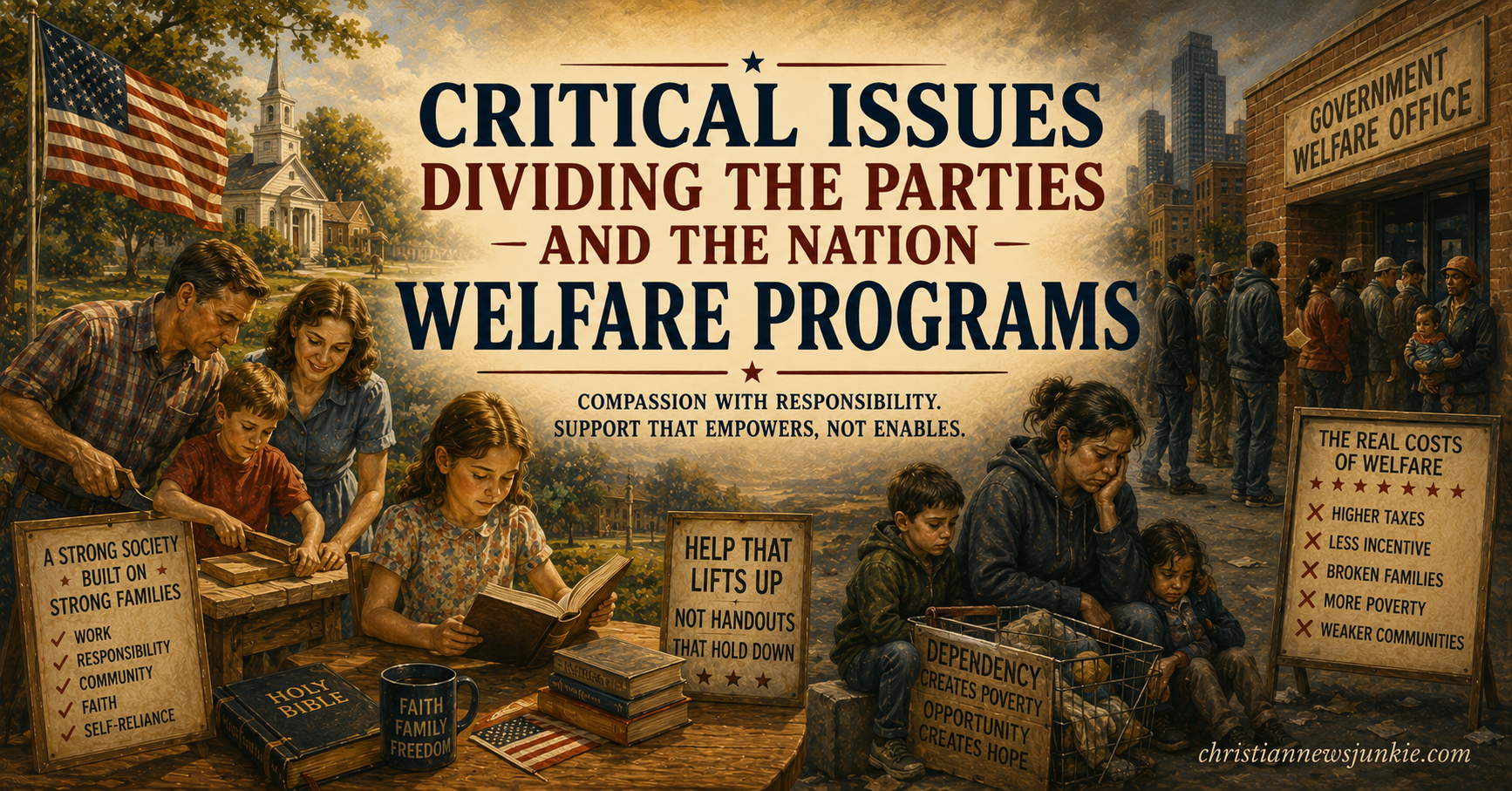
Before examining partisan positions, the term welfare programs must be defined carefully.
Sloppy definitions lead to sloppy thinking, and sloppy thinking leads to bad policy.
In contemporary political debate, the word “welfare” is often used imprecisely to refer to any government benefit, which obscures meaningful distinctions between social insurance, entitlement programs, and means-tested assistance.
Defining Welfare Programs
For the purposes of this article, welfare programs refer specifically to means-tested government assistance programs designed to provide material support to individuals or households with limited income or resources.
These programs are funded by taxpayers and administered by federal, state, or local governments, often in partnership with non-governmental agencies.
Importantly, this definition explicitly excludes:
- Social Security retirement benefits
- Social Security Disability Insurance (SSDI)
- Medicare
These programs function as social insurance systems, not welfare.
Eligibility is based primarily on prior work history and payroll tax contributions, not income thresholds.
While one may criticize these programs on fiscal or demographic grounds, they are categorically different from welfare.
Included under the welfare umbrella are programs such as:
- Supplemental Nutrition Assistance Program (SNAP / food stamps)
- Temporary Assistance for Needy Families (TANF)
- Supplemental Security Income (SSI)
- Housing assistance programs (e.g., Section 8 vouchers, public housing)
- Medicaid (means-tested healthcare assistance)
- Earned Income Tax Credit (EITC) and Child Tax Credit (refundable portions)
- State-level cash assistance, housing subsidies, and energy assistance programs
The common thread is means-testing: benefits are provided based on financial need rather than earned entitlement.
This distinction matters because debates about welfare are not debates about whether the elderly should receive retirement benefits or whether the disabled deserve care.
They are debates about dependency, incentives, moral responsibility, fiscal sustainability, and the proper role of government.
Why Welfare Programs Matter to American Voters
Welfare policy is not an abstract ideological issue. It directly affects the daily lives of working Americans, the integrity of families, the sustainability of public finances, and the social cohesion of the nation.
Several factors explain why welfare programs consistently rank as a high-salience political issue:
- Scale and Cost
Combined federal and state spending on means-tested welfare programs exceeds one trillion dollars annually when healthcare, housing, food assistance, and refundable tax credits are included. This represents a substantial portion of government expenditure and competes directly with national defense, infrastructure, and debt servicing. - Workforce Participation
Welfare policy shapes incentives around work, marriage, and family formation. Programs that penalize earned income or marriage can unintentionally discourage self-sufficiency, even when intentions are benevolent. - Taxpayer Burden
Welfare programs are funded by the labor of working citizens. For middle- and lower-income taxpayers—many of whom are themselves financially stretched—the question is not theoretical: Is this system fair, effective, and sustainable? - Intergenerational Effects
Long-term dependency can become multigenerational, especially when welfare structures replace family responsibility, community accountability, and local charity. - Cultural and Moral Consequences
Welfare policy reflects deeper assumptions about human nature: whether people are best motivated by responsibility and consequence, or by centralized provision and insulation from risk.
Economic Impact on the Common American Citizen
From an economic perspective, welfare programs affect Americans in both visible and hidden ways.
On the visible side, benefits such as food assistance and housing subsidies undeniably alleviate immediate material hardship. During economic downturns, these programs act as automatic stabilizers, increasing spending when unemployment rises.
However, the hidden costs are often ignored in public debate:
- Marginal Tax Traps: As recipients earn more income, benefits are withdrawn, sometimes at effective marginal tax rates exceeding those paid by high earners. This discourages upward mobility.
- Labor Market Distortions: Generous or poorly structured benefits can reduce labor force participation, particularly among able-bodied adults.
- Inflationary Pressure: Subsidized demand for housing and healthcare, when supply is constrained, drives prices higher for everyone—including those not receiving benefits.
- Public Debt: Persistent deficit spending to fund welfare contributes to long-term fiscal instability, shifting the burden to future generations.
Historical experience reinforces these concerns. The major expansion of welfare programs during the mid-20th century coincided with rising dependency rates in certain communities, despite sustained economic growth. While correlation does not prove causation, the pattern prompted serious reassessment even among policymakers who initially championed expansion.
Public Safety and Social Stability Considerations
Welfare policy also intersects with public safety and social order.
Communities characterized by long-term dependency often experience:
- Lower workforce attachment
- Higher rates of family fragmentation
- Increased exposure to crime and substance abuse
This does not mean welfare recipients are criminals—an unfair and inaccurate caricature—but it does mean policy structures influence social outcomes. When welfare becomes a substitute for family, church, and community, the social fabric weakens.
Urban housing projects of the late 20th century provide a sobering historical example. Concentrated poverty, combined with government-managed dependency, produced environments marked by crime, neglect, and despair.
Many of these projects were later demolished after policymakers acknowledged their unintended consequences.
Why Voters Should Care Now
In the mid-2020s, welfare policy has become even more pressing due to:
- Rising national debt and interest costs
- Declining trust in institutions
- Slowing labor force growth
- Increased strain on state and local budgets
- Expanding eligibility and benefit levels under progressive governance
These pressures force a fundamental question: Is the welfare state helping Americans regain independence, or entrenching dependency while exhausting public resources?
Republicans and Democrats answer this question very differently. Their answers are rooted not merely in policy preferences, but in competing visions of human nature, responsibility, and the purpose of government.
That divide sets the stage for examining each party’s position in detail.
Articles in the Critical Issues series require more time to read than most content on this site. They are intentionally written as thorough, in-depth examinations of their subjects.
The Republican Perspective on Welfare Programs
The Republican approach to welfare programs is shaped by a core conviction: government assistance should be temporary, targeted, accountable, and subordinate to work, family responsibility, and civil society.
Republicans generally argue that welfare should function as a safety net—not a way of life—and that poorly designed programs undermine both human dignity and fiscal sustainability.
While there are disagreements within Republican ranks over tactics and emphasis, the party has maintained a relatively consistent philosophical posture on welfare since the late 20th century.
Foundational Principles Guiding the Republican View
At the risk of oversimplification, the Republican perspective rests on several interlocking principles:
First, work is morally formative. Employment is not merely a means of income but a source of dignity, discipline, and social integration. Welfare programs that weaken the connection between work and provision are viewed as harmful to individuals and communities alike.
Second, family and local institutions precede the state. Republicans emphasize that families, churches, charities, and local communities are better suited than federal bureaucracies to address long-term need with compassion and accountability.
Third, government programs require strict oversight. Because welfare programs are funded by taxpayers, Republicans stress that fraud, waste, and abuse are not minor administrative issues but moral failures that betray public trust.
Fourth, dependency is a social danger. Republicans argue that multi-generational reliance on welfare corrodes personal responsibility and contributes to broader social breakdown.
These principles are reflected repeatedly in Republican platform language, legislative priorities, and executive actions.
The 2024 Republican Party Platform on Welfare
The 2024 platform of the Republican Party addresses welfare primarily under sections dealing with economic opportunity, family policy, and fiscal responsibility. While the platform does not always use the word “welfare” explicitly, its policy commitments are unmistakable.
Key platform themes include:
- Requiring work or job training for able-bodied adults receiving benefits
- Strengthening eligibility verification to prevent fraud and improper payments
- Opposing expansion of benefits that discourage employment or marriage
- Ensuring that welfare programs prioritize citizens and lawful residents
- Returning flexibility to states while enforcing federal accountability standards
The platform frames welfare reform not as punishment of the poor, but as restoration of incentives that lift people out of poverty rather than trapping them within it.
Legislative Actions and Statements by Republican Lawmakers
Republican lawmakers at both the federal and state level have repeatedly focused on integrity, eligibility, and fraud prevention in welfare programs.
In Congress, Republican members of the House and Senate have:
- Pushed for work requirements for SNAP and Medicaid
- Opposed blanket waivers that suspend eligibility checks
- Called for citizenship verification in federally funded assistance programs
- Demanded audits of emergency-era benefit expansions
These efforts intensified after the COVID-era expansions revealed significant vulnerabilities in welfare administration.
Emergency flexibility, while understandable in crisis conditions, created openings for large-scale fraud that persisted long after the emergency ended.
Republicans argue that failure to reinstate safeguards was not accidental, but ideological.
Welfare Fraud as a Central Republican Concern
Among Republican voters, fraud in welfare programs is not a fringe concern. It is viewed as both an economic injustice and a violation of the social contract.
Fraud takes multiple forms:
- False income reporting
- Duplicate enrollment across states
- Identity theft and synthetic identities
- Improper payments to ineligible recipients
However, in recent years, fraud related to illegal aliens has become a flashpoint issue.
Republicans argue that when immigration enforcement collapses, welfare integrity collapses with it.
Illegal Aliens and Welfare Program Abuse
Although federal law formally restricts most welfare benefits to citizens and lawful residents,
Republicans point out that policy loopholes, administrative non-enforcement, and state-level expansions have rendered these restrictions increasingly meaningless.
Key Republican concerns include:
- Use of taxpayer-funded state programs that mirror federal welfare benefits but lack citizenship verification
- Emergency Medicaid and related healthcare programs becoming de facto permanent benefits
- Fraudulent identities used to access housing, food assistance, and cash aid
- Children as eligibility anchors, even when parents are unlawfully present
Republicans argue that sanctuary policies and progressive governance have effectively decoupled welfare eligibility from legal status, shifting costs to taxpayers without their consent.
From the Republican perspective, this is not compassion—it is institutionalized lawlessness.
Republican State and Local Leadership Examples
Republican governors and state legislatures have moved aggressively to counter these trends.
Examples include:
- Reinstating or strengthening work requirements for public assistance
- Requiring citizenship or lawful presence verification for state-funded aid
- Auditing welfare rolls to remove ineligible recipients
- Refusing participation in federal programs that weaken accountability
At the city and county level, Republican officials have frequently clashed with progressive counterparts over whether local taxpayers should be compelled to fund welfare benefits for those who entered the country unlawfully.
These disputes highlight a fundamental difference in worldview: Republicans prioritize the integrity of law and fiscal responsibility, while Democrats emphasize access and inclusivity—even at the expense of enforcement.
Intra-Republican Disagreements
While Republicans are broadly aligned on welfare principles, disagreements do exist.
Some factions emphasize compassionate conservatism, favoring targeted assistance paired with faith-based partnerships.
Others focus more heavily on budgetary restraint and enforcement, warning that even well-intentioned programs can spiral out of control.
There are also tactical debates over:
- How strict work requirements should be
- Whether states or the federal government should administer programs
- How quickly benefits should phase out as income rises
These disagreements, however, occur within a shared moral framework. Republicans are debating how best to limit dependency—not whether dependency should be normalized.
To summarize, the Republican position on welfare programs can be fairly characterized as follows:
Welfare should exist, but it should be limited, temporary, lawful, and accountable.
It should support work, strengthen families, protect taxpayers, and operate within the rule of law.
Fraud—especially fraud connected to illegal immigration—is not a peripheral issue but a central indictment of current welfare administration under progressive governance.
Republicans argue that ignoring fraud is not compassion. It is negligence.
The Democrat Perspective on Welfare Programs
The Democrat approach to welfare programs is rooted in a fundamentally different view of government, responsibility, and social obligation.
Where Republicans tend to see welfare as a limited safety net that must be tightly regulated, Democrats generally view welfare as a primary instrument of social justice and economic equity, administered centrally by the state.
This divergence is not merely a policy disagreement. It reflects contrasting assumptions about human behavior, structural inequality, and the legitimacy of state power in redistributing resources.
Foundational Principles Guiding the Democrat View
At the core of the Democrat perspective are several governing assumptions.
First, poverty is primarily structural, not behavioral.
Democrats typically argue that economic hardship results from systemic factors such as discrimination, historical injustice, wage stagnation, and unequal access to opportunity.
As a result, welfare programs are framed less as temporary assistance and more as corrective mechanisms.
Second, government is viewed as the most reliable guarantor of equity.
While Democrats may acknowledge the role of private charity and community organizations, they generally argue that these institutions are insufficient in scale and consistency to meet widespread need.
Third, access is prioritized over enforcement.
Democrats frequently warn that strict eligibility rules, work requirements, or fraud controls risk excluding vulnerable populations who need assistance.
Fourth, dependency is downplayed as a policy concern.
Democrats are more likely to interpret long-term reliance on welfare as evidence of unmet need rather than program failure.
These assumptions shape both platform language and real-world governance.
The 2024 Democrat Party Platform on Welfare
The 2024 platform of the Democratic Party emphasizes welfare programs under headings related to economic justice, racial equity, healthcare access, housing security, and child welfare.
Key themes include:
- Expansion of eligibility for food, housing, and healthcare assistance
- Opposition to work requirements viewed as “punitive”
- Increased benefit levels and reduced administrative barriers
- Framing welfare as a right rather than conditional aid
- Explicit linkage between welfare expansion and equity goals
The platform language consistently emphasizes access, inclusion, and equity, while concerns about fraud, abuse, or fiscal sustainability receive comparatively little attention.
Legislative Actions and Statements by Democrat Lawmakers
Democrat lawmakers at the federal level have repeatedly supported:
- Suspension or elimination of work requirements
- Broad waivers of eligibility verification
- Emergency expansions that become permanent
- Increased federal matching funds to incentivize state expansion
During and after the COVID era, many Democrats argued that traditional safeguards were outdated or discriminatory. Temporary measures—such as relaxed identity verification and expedited enrollment—were defended as compassionate responses to crisis conditions.
Republicans counter that many of these “temporary” measures were never meaningfully rolled back.
The Democrat Approach to Welfare Fraud
Democrats do not generally deny that fraud exists within welfare programs. However, they tend to reframe the issue in several predictable ways.
First, fraud is often described as statistically insignificant relative to total program spending. This framing minimizes concern by focusing on percentages rather than absolute dollar losses.
Second, enforcement is portrayed as potentially harmful to legitimate recipients. Democrats frequently argue that aggressive fraud prevention creates “chilling effects” that discourage needy individuals from applying.
Third, attention is redirected toward corporate welfare or tax avoidance, shifting the moral focus away from individual misuse of benefits.
From the Democrat perspective, the greater moral danger is under-enrollment, not overpayment.
Illegal Aliens and Welfare: The Democrat Position
The most contentious divide between the parties concerns welfare access for illegal aliens.
Officially, Democrats maintain that federal law restricts most welfare benefits to citizens and lawful residents.
In practice, however, Democrat-led states and cities have aggressively expanded state-funded programs that function as welfare by another name.
Common Democrat arguments include:
- Basic assistance is a humanitarian necessity, regardless of legal status
- Denying benefits to illegal aliens harms children and families
- Immigration status should not determine access to healthcare or housing
- Enforcement-focused narratives are characterized as xenophobic
As a result, Democrat jurisdictions often provide:
- Taxpayer-funded healthcare coverage
- Cash assistance or guaranteed income programs
- Housing subsidies and emergency shelter
- Food assistance through state or local programs
Republicans argue that this amounts to parallel welfare systems deliberately designed to bypass federal restrictions.
Democrat State and City Leadership Examples
Democrat governors and mayors frequently present welfare expansion as a moral imperative.
Progressive states have:
- Removed work requirements entirely
- Extended benefits to non-citizens using state funds
- Refused to cooperate with federal eligibility verification
- Normalized welfare dependence as a permanent condition
Major cities governed by Democrats have openly advertised benefit availability to migrant populations, even as local budgets strain and services for citizens deteriorate.
In these jurisdictions, concerns about fraud—particularly fraud tied to identity misuse or unlawful presence—are often dismissed as politically motivated.
Intra-Democrat Disagreements
There are disagreements within the Democrat coalition, though they are often muted.
More moderate Democrats express concern about:
- Fiscal sustainability
- Voter backlash
- Local budgetary collapse
- Public resentment toward perceived unfairness
However, these concerns are frequently overridden by progressive activists and advocacy groups that exert disproportionate influence within the party.
As a result, the center of gravity continues to move toward expansion without enforcement.
The Democrat position on welfare programs can be summarized as follows:
Welfare is an essential tool for achieving equity and justice, and barriers to access should be minimized—even at the expense of enforcement, fiscal discipline, or citizenship distinctions.
Fraud is treated as a secondary concern, while inclusion is elevated as the primary moral good.
Republicans view this as reckless. Democrats view Republican concerns as callous.
This unresolved conflict sets the stage for examining alternative frameworks, including the Libertarian perspective.
The Libertarian Perspective on Welfare Programs
The Libertarian position on welfare programs differs sharply from both Republicans and Democrats, though it overlaps partially with Republican concerns about dependency, fraud, and government overreach.
The Libertarian Party approaches welfare through a fundamentally individualist and market-oriented lens.
Libertarians generally view most government welfare programs as illegitimate exercises of state power that distort markets, undermine voluntary charity, and violate personal liberty.
Core Libertarian Assumptions
Libertarians begin with several presuppositions:
First, coercive redistribution is morally suspect. Because welfare programs are funded through taxation, Libertarians argue they involve compelled transfers of wealth that would be immoral if done privately.
Second, markets allocate resources more efficiently than governments. Welfare programs are seen as bureaucratic substitutes for price signals, personal judgment, and voluntary exchange.
Third, civil society should replace state welfare. Families, churches, mutual-aid societies, and private charities are viewed as more humane, accountable, and adaptable than centralized programs.
Fourth, government welfare creates perverse incentives. Libertarians agree with Republicans that welfare discourages work and responsibility, but they go further by rejecting most state intervention altogether.
Libertarians Compared to Republicans and Democrats
Libertarians often align rhetorically with Republicans when criticizing welfare fraud, waste, and dependency. However, they diverge sharply when Republicans argue for reforming welfare rather than abolishing it.
Unlike Republicans, Libertarians generally oppose:
- Work requirements enforced by the state
- Means-testing administered by federal agencies
- Government oversight of charity
- Immigration-based restrictions on welfare (some factions support open borders with no welfare access; others oppose both)
Unlike Democrats, Libertarians reject:
- Welfare as a right
- Equity-based redistribution
- Identity-based policy design
- Expansion of benefits regardless of fiscal cost
From the Libertarian perspective, welfare debates between Republicans and Democrats miss the deeper issue: the state has assumed a role never intended for it.
Why the Libertarian Position Remains Secondary
While intellectually coherent, the Libertarian position remains politically marginal. Libertarians lack governing coalitions, legislative majorities, and executive authority at scale.
For this reason, their perspective is included here for philosophical contrast, not as a viable governing alternative. In practice, American welfare policy is shaped almost entirely by Republican and Democrat frameworks.
Progressivism, “Equity,” and the Transformation of Welfare Policy
To understand the modern Democrat position on welfare, one must understand the influence of Progressivism—often referred to in contemporary discourse as wokeness, Cultural Marxism, political correctness, identity politics, critical theory/intersectionality, or Neo-Marxism.
These terms are not identical, but they share a family resemblance: they prioritize group identity and outcomes over individual responsibility and equal treatment under the law.
Equity vs. Equality: A Crucial Distinction
Traditional American political thought emphasized equality—equal protection, equal opportunity, and equal application of the law.
Progressive ideology replaces this with equity, which focuses on equalized outcomes across aggregated identity groups such as race, ethnicity, gender, immigration status, or perceived historical disadvantage.
In the context of welfare programs, this shift has profound consequences.
- Equality asks whether rules are applied fairly.
- Equity asks whether statistical outcomes align with predetermined group benchmarks.
This means welfare policy is no longer evaluated by whether it encourages independence or fairness, but by whether it produces the “correct” demographic results.
How Equity Shapes Welfare Distribution
Under an equity framework, disparities in welfare usage or outcomes are assumed to be evidence of injustice rather than differences in behavior, culture, or circumstance.
As a result:
- Eligibility standards are relaxed or removed
- Enforcement mechanisms are portrayed as discriminatory
- Fraud controls are deprioritized
- Identity categories become proxies for moral claims
Most critically, equity assumes that unequal outcomes require corrective redistribution, even if doing so disadvantages individuals outside the favored identity groups.
Who Bears the Cost of Equity-Based Welfare
Equity-driven welfare policy necessarily produces winners and losers, even if this reality is rhetorically denied.
Those who often bear the cost include:
- Working-class citizens who narrowly exceed eligibility thresholds
- Taxpayers who receive no benefits but fund expanding programs
- Legal immigrants who followed the law but receive fewer benefits than illegal aliens
- Communities where services are diverted to satisfy equity mandates
Under an equity framework, individual suffering outside preferred identity groups is treated as morally irrelevant, or worse, as evidence of “privilege.”
This represents a decisive moral shift away from classical liberal and biblical concepts of justice.
Equity as a Governing Presupposition, Not a Policy Tool
It is important to emphasize that equity is not merely a policy preference—it is a governing assumption.
Once equity becomes the goal:
- Fraud becomes secondary to access
- Law becomes subordinate to outcomes
- Citizenship becomes morally arbitrary
- Scarcity is denied until collapse forces recognition
This explains why Democrat leadership often appears indifferent to welfare fraud involving illegal aliens.
From a Progressive perspective, enforcing restrictions that produce unequal outcomes is itself unjust.
Understanding equity is essential to understanding why welfare policy has evolved as it has—and why bipartisan consensus is increasingly impossible.
Do Democrat Actions Match Their Official Platform?
“In politics, what you DO is what you believe. Everything else is cottage cheese.”
— Senator Joseph N. Kennedy
This observation provides a fitting framework for evaluating the Democrat Party’s approach to welfare programs.
Party platforms are aspirational documents. Governance reveals actual priorities.
When Democrat rhetoric about compassion, fairness, and equity is measured against administrative behavior—particularly during the Biden administration and in progressive states and cities—a pattern emerges.
That pattern suggests that equity-driven ideology consistently overrides concerns about legality, fraud prevention, fiscal sustainability, and equal treatment of citizens.
Stated Platform Commitments vs. Operational Reality
Officially, Democrats claim to support:
- Efficient and accountable administration
- Protection of vulnerable populations
- Responsible stewardship of taxpayer funds
- Rule-based eligibility with humane discretion
In practice, however, Democrat leadership has repeatedly:
- Suspended or weakened verification systems
- Discouraged enforcement actions
- Expanded eligibility without corresponding safeguards
- Reframed fraud concerns as moral failures rather than governance failures
This disconnect is not accidental. It flows directly from the Progressive equity framework discussed in Section V.
Equity as the Governing Filter
Under equity-based reasoning, the central question is not “Is this lawful or fair?” but “Does this advance preferred group outcomes?”
As a result:
- Fraud enforcement is seen as exclusionary
- Citizenship requirements are treated as morally arbitrary
- Administrative rigor is viewed as a barrier to justice
- Individual harm is tolerated if aggregate identity outcomes improve
This explains why Democrat leadership frequently applies different standards to different groups, while insisting that no inconsistency exists.
Case Studies from the Biden Administration
The Biden administration (2021–2024) provides a concentrated illustration of how Democrat welfare governance operates when unconstrained by divided government.
1. Suspension of Welfare Safeguards
During and after the COVID emergency, the administration:
- Extended SNAP emergency allotments well beyond crisis conditions
- Maintained Medicaid enrollment protections that prevented eligibility reviews
- Discouraged states from removing ineligible recipients
Subsequent audits revealed millions of recipients who no longer qualified, including individuals with increased income, duplicate enrollments, and unverifiable identities.
Rather than restoring safeguards promptly, the administration framed enforcement as a threat to equity.
2. Identity and Citizenship Verification Failures
Multiple federal programs under the Biden administration relied on self-attestation rather than verification for eligibility. This created ideal conditions for fraud, particularly involving illegal aliens.
Examples included:
- Use of temporary or non-standard identification
- Lack of cross-agency data sharing
- Reliance on NGO intermediaries with minimal oversight
When concerns were raised, administration officials routinely dismissed them as exaggerated or politically motivated.
3. Normalization of Welfare Access for Illegal Aliens
Although federal law formally restricts most benefits, the administration:
- Encouraged states to use federal block grants flexibly
- Expanded emergency and categorical eligibility pathways
- Declined to enforce restrictions tied to lawful presence
In effect, welfare access for illegal aliens became de facto policy, even if not formally codified.
This represents a clear divergence between written law and operational practice.
4. Rhetorical Minimization of Fraud
When confronted with evidence of fraud, administration officials frequently:
- Quoted low percentage estimates rather than dollar losses
- Shifted attention to corporate tax avoidance
- Warned against “stigmatizing narratives”
The underlying message was clear: fraud enforcement was less important than preserving access and optics.
Case Studies from Progressive States and Cities
Democrat-led states and cities provide further evidence that the Biden-era approach was not an anomaly but part of a broader ideological pattern.
Progressive States
States such as California, Colorado, Illinois, Massachusetts, Minnesota, New York, Oregon, and Washington have:
- Created state-funded welfare programs explicitly open to illegal aliens
- Removed work requirements entirely
- Limited cooperation with federal verification systems
- Redirected funds from citizen services to meet equity benchmarks
In several cases, budget shortfalls followed, forcing cuts to education, public safety, or infrastructure—burdens disproportionately borne by working citizens.
Progressive Cities
Cities including Los Angeles, Chicago, New York City, Seattle, Portland, Denver, Boston, San Francisco, Oakland, Sacramento, and Washington, D.C. have:
- Advertised benefit availability to migrant populations
- Funded cash assistance and housing with local tax dollars
- Reduced fraud oversight to accelerate enrollment
- Treated citizen complaints as moral failings
In these jurisdictions, law-abiding residents often receive fewer services than newcomers, a direct consequence of equity-based prioritization.
Selective Standards and Moral Inconsistency
A recurring feature of Democrat welfare governance is selective moral accounting.
- Fraud committed by favored groups is minimized
- Fraud enforcement is described as oppressive
- Resource scarcity is denied until collapse occurs
- Citizens who object are framed as selfish or intolerant
This is not accidental hypocrisy. It is the logical outcome of a worldview that prioritizes group outcomes over individual justice.
Soft Authoritarian Tendencies
While Democrats often accuse Republicans of authoritarian impulses, welfare governance under progressive leadership reveals its own authoritarian traits:
- Centralized control over resource distribution
- Suppression of dissenting data or narratives
- Moral coercion through language and labeling
- Administrative rulemaking that bypasses legislatures
When equity becomes non-negotiable, democratic accountability weakens.
Measured by actions rather than rhetoric, Democrat leadership has consistently departed from its stated commitments to accountability and fairness in welfare programs. The Biden administration and progressive state governments have prioritized equity-driven outcomes over legality, fraud prevention, and equal treatment of citizens.
Examining the Issue from the Perspective of the Opposition
Political debates over welfare programs are rarely resolved by statistics alone. They are driven by competing visions of human nature, responsibility, and governance. Understanding how each side critiques the other—and how those critiques are answered—helps clarify what is truly at stake.
Constrained vs. Unconstrained Visions of Governance
Political economist Thomas Sowell famously distinguished between constrained and unconstrained visions of human nature.
A constrained vision assumes that human beings are morally limited, prone to self-interest, and shaped by incentives. Institutions must therefore restrain behavior, channel responsibility, and respect trade-offs.
An unconstrained vision assumes that social problems are primarily the result of flawed systems rather than flawed people. With sufficient expertise, compassion, and political will, government can redesign outcomes toward justice.
Applied to welfare:
- Republicans largely operate from a constrained vision. They emphasize incentives, enforcement, and unintended consequences.
- Democrats, especially Progressives, operate from an unconstrained vision. They emphasize intent, equity, and outcomes.
- Libertarians share the constrained view of human nature but reject state solutions altogether.
- Biblical Christians affirm a constrained vision grounded in doctrine of sin, responsibility, and moral accountability.
This philosophical divide explains why debates over welfare so often feel irresolvable.
Common Criticisms Raised by Each Side
Criticisms of the Republican Position
Opponents of the Republican approach commonly argue:
- Work requirements are punitive and ignore economic realities
- Welfare fraud is exaggerated for political effect
- Restrictions harm children and vulnerable populations
- Emphasis on legality lacks compassion
- Republican policies favor the wealthy while disciplining the poor
These critiques often appeal to moral sentiment and aggregate outcomes.
Republican Counter-Responses
Republicans typically respond:
- Work requirements promote dignity and long-term independence
- Fraud is measurable, costly, and corrosive to public trust
- Children are harmed more by dependency than discipline
- Law is meaningless if selectively enforced
- Compassion without accountability produces cruelty in the long run
From the Republican perspective, refusing to confront fraud and dependency is not kindness—it is neglect.
Criticisms of the Democrat Position
Opponents of Democrat welfare policies raise a different set of concerns:
- Equity prioritizes group outcomes over individual justice
- Fraud enforcement is intentionally weakened
- Illegal aliens receive benefits ahead of citizens
- Welfare expansion creates permanent dependency
- Fiscal costs are ignored until crisis forces retrenchment
These criticisms focus on sustainability and fairness.
Democrat Counter-Responses
Democrats typically reply:
- Equity corrects historical injustice
- Enforcement disproportionately harms marginalized groups
- Citizenship distinctions are morally arbitrary
- Dependency reflects unmet need, not moral failure
- Economic growth or taxation will cover costs
Critics argue these responses deny scarcity and trade-offs, treating resources as infinite so long as moral intent is affirmed.
Equity as a Central Fault Line
At the heart of the opposition critique lies equity.
Under equity-driven welfare policy:
- Outcomes matter more than rules
- Identity groups replace individuals as moral units
- Losses suffered by non-favored groups are justified as necessary corrections
- Fraud becomes morally ambiguous if it advances preferred outcomes
This creates a moral inversion where some people must suffer so others can be statistically elevated, even when both groups are poor or struggling.
Republicans argue that this violates both fairness and common sense. Biblical Christians argue it violates justice itself.
Tone-Deaf Statements and Revealed Blind Spots
Tone-deaf statements often expose the limits of each party’s vision.
Democrat Blind Spots
Statements minimizing welfare fraud as “rare” while billions are lost, or dismissing citizen objections as “privilege,” reveal an inability to acknowledge trade-offs.
When leaders imply that legality is optional in pursuit of equity, public trust erodes.
Claims that welfare access for illegal aliens has “no impact” on citizens ring hollow to communities facing service cuts and tax increases.
Republican Blind Spots
Republicans sometimes understate the short-term hardship caused by abrupt benefit reductions or speak too abstractly about incentives without addressing real suffering.
When compassion is communicated poorly, it creates openings for caricature.
Still, Republicans generally acknowledge trade-offs, whereas Democrats often deny their existence.
Opposition critiques of welfare policy reflect deeper worldview differences rather than mere policy disagreements.
Republicans and biblical Christians emphasize limits, incentives, and justice.
Democrats and Progressives emphasize intent, outcomes, and equity—even when those outcomes require unequal treatment and tolerated abuse.
Understanding these visions clarifies why compromise is increasingly rare: the disagreement is not over methods, but over reality itself.
Credible Suspicions About Party Strategies and Motives
When welfare policy is examined over time rather than election cycle by election cycle, patterns emerge.
These patterns give rise to credible suspicions about the strategic motives of each party—suspicions grounded not in conspiracy theories, but in observable incentives, leadership statements, and repeated behavior.
A Necessary Clarification
Suspicion does not require assuming malicious intent. Political actors often pursue strategies they sincerely believe are just, even when those strategies produce harmful outcomes. The question here is not whether party leaders mean well, but whether their incentives and ideological commitments reliably produce certain results.
Suspicions Regarding the Democrat Strategy on Welfare
1. Welfare Expansion as a Political Stabilizer
A long-standing suspicion among critics is that Democrat leadership views welfare expansion as a way to stabilize and grow its electoral coalition.
The logic is straightforward:
- Welfare recipients are more dependent on government programs
- The party that expands and protects those programs becomes politically indispensable
- Opposition to expansion can be framed as cruelty or bigotry
This dynamic does not require explicit coordination. It emerges naturally from incentive structures.
When welfare eligibility is expanded to include illegal aliens and non-citizens through state and local programs, critics reasonably ask whether political loyalty is being cultivated through dependency, even if indirectly.
2. Equity as Moral Armor
Equity language also functions strategically.
By framing welfare distribution in terms of identity-based outcomes, Democrat leaders gain a powerful rhetorical shield:
- Objections can be dismissed as racist, xenophobic, or oppressive
- Fiscal concerns can be reframed as moral failures
- Enforcement debates can be short-circuited by appeals to historical injustice
This creates an environment in which policy failure becomes morally insulated from criticism.
Equity does not merely guide policy—it disarms opposition.
3. The Tolerance of Fraud as a Feature, Not a Bug
Another credible suspicion is that fraud tolerance is not merely administrative negligence, but an accepted cost of maintaining open-access systems.
Aggressive fraud prevention:
- Slows enrollment
- Creates negative headlines
- Requires enforcement partnerships
- Produces politically inconvenient data
From an equity-driven perspective, these costs outweigh the benefits of accountability. As a result, fraud is acknowledged abstractly but avoided operationally.
Critics argue that this effectively sacrifices taxpayer trust for ideological purity.
4. Redistribution as Moral Compensation
Finally, some critics observe that modern Democrat welfare policy increasingly functions as moral compensation for perceived historical or structural wrongs.
Under this framework:
- Present individuals are treated as stand-ins for historical groups
- Welfare becomes reparative rather than supportive
- Suffering by non-favored groups is rationalized as necessary correction
This raises serious ethical concerns, especially when working-class citizens are asked to bear costs for policies from which they derive no benefit.
Suspicions Regarding the Republican Strategy on Welfare
Republicans are not immune from suspicion, though the nature of the concerns differs.
1. Overreliance on Rhetoric of Abuse
Critics argue that some Republicans overemphasize fraud and abuse without adequately addressing transitional hardship for those genuinely trying to escape poverty.
When enforcement language dominates compassion language, it can appear that policy is driven more by resentment than reform.
2. Political Caution Over Structural Reform
Another suspicion is that Republican leadership sometimes avoids deeper structural reform—such as simplifying benefit cliffs or decentralizing assistance—out of fear of media backlash or electoral consequences.
This can lead to incrementalism that preserves flawed systems, even while condemning them rhetorically.
3. Selective Fiscal Discipline
Republicans are also criticized for inconsistently applying fiscal restraint, particularly when welfare reform conflicts with other political priorities.
This inconsistency can undermine credibility, even when core principles are sound.
Why These Suspicions Matter
Suspicion becomes corrosive when trust erodes.
In a low-trust society, voters assume hidden motives, strategic manipulation, and ideological bad faith. Welfare policy, because it directly involves money, dependency, and identity, is especially vulnerable to this erosion.
When citizens believe that:
- Welfare is used to engineer political outcomes
- Equity is used to justify unequal treatment
- Fraud is tolerated for ideological reasons
They stop believing official explanations altogether.
These suspicions connect directly to the next section:
- We will examine high-trust vs. low-trust societies and how declining trust magnifies welfare conflict
- We will assess how fraud, identity-based equity, and selective enforcement accelerate social fragmentation
High-Trust, Low-Trust Societies, and the Welfare State
Welfare policy does not operate in a cultural vacuum.
Its success or failure is profoundly shaped by the level of trust within a society—trust between citizens, trust in institutions, and trust that laws will be applied fairly.
As American society has shifted from relatively high trust to increasingly low trust, welfare programs have become both a symptom and a driver of social fragmentation.
What Is a High-Trust Society?
In a high-trust society:
- Citizens generally believe others are playing by the same rules
- Laws are enforced consistently
- Institutions are expected to act competently and honestly
- Fraud is viewed as aberrational and morally unacceptable
- Assistance is understood as temporary and reciprocal
High-trust systems can tolerate welfare programs because abuse is limited, norms are shared, and enforcement is expected rather than contested.
Mid-20th-century America approximated this model. Welfare expansion occurred within a cultural context that still assumed work, family responsibility, and social shame for dependency.
What Is a Low-Trust Society?
In a low-trust society:
- Citizens assume rules are selectively enforced
- Group identity replaces shared moral norms
- Institutions are viewed as politicized
- Fraud is expected rather than exceptional
- Welfare becomes permanent rather than transitional
Under these conditions, every expansion of welfare generates suspicion, resentment, and conflict—especially among those who fund the system but do not benefit from it.
Modern America increasingly fits this description.
How Welfare Policy Accelerates Trust Breakdown
Several features of contemporary welfare governance accelerate the transition to low trust.
1. Selective Enforcement
When welfare rules are enforced strictly for some groups and loosely—or not at all—for others, citizens conclude that fairness no longer exists.
Equity-based prioritization intensifies this perception. When outcomes rather than rules determine enforcement, trust collapses because no one knows what the rules actually are.
2. Fraud Tolerance
In high-trust systems, fraud is aggressively punished to preserve legitimacy. In low-trust systems, fraud is tolerated or minimized to protect narratives.
As welfare fraud—especially fraud involving unverifiable identities or illegal aliens—becomes widely reported yet weakly addressed, citizens reasonably infer that institutions no longer serve them equally.
Once fraud appears systemic rather than incidental, trust cannot survive.
3. Identity-Based Redistribution
When welfare policy is explicitly justified on identity-based equity grounds, it signals that group membership matters more than conduct.
This creates moral resentment among those outside favored groups, particularly working-class citizens who obey the law, pay taxes, and receive little assistance.
The message received is not “we are all in this together,” but “some are entitled and others are obligated.”
Republican vs. Democrat Interpretations of Trust Decline
Republicans generally interpret declining trust as evidence that:
- Welfare programs have expanded beyond their moral limits
- Enforcement has been abandoned
- Equity ideology has displaced justice
- Lawlessness has been normalized
From this view, restoring trust requires reasserting boundaries, reestablishing enforcement, and reaffirming the legitimacy of citizenship distinctions.
Democrats tend to interpret declining trust differently.
They argue that:
- Distrust reflects historical injustice
- Enforcement worsens alienation
- Equity is necessary to rebuild legitimacy
- Resistance to redistribution is rooted in bias
This creates a feedback loop: policies intended to restore trust through equity instead accelerate distrust among those who perceive themselves as unfairly burdened.
Illegal Aliens, Welfare, and Trust Collapse
No issue illustrates this divide more starkly than welfare access for illegal aliens.
In a high-trust society, citizens might tolerate limited humanitarian assistance if enforcement were otherwise firm and transparent.
In a low-trust society, where:
- Borders appear unenforced
- Welfare rules are inconsistently applied
- Fraud is under-policed
- Equity rhetoric dismisses objections
Citizens conclude that the system is no longer reciprocal.
Republicans suspect that Democrats intend—whether explicitly or implicitly—to use welfare expansion and demographic change to reshape political outcomes. Democrats deny this intention. However, reasonable suspicion arises from behavior, not denial.
Trust cannot be rebuilt through rhetoric alone.
Welfare and the Psychology of Resentment
Low-trust welfare systems generate resentment not because people oppose helping the poor, but because they oppose being treated as instruments rather than citizens.
When working families see:
- Benefits flowing to those who broke the law
- Enforcement portrayed as cruelty
- Equity used to justify unequal burdens
They withdraw moral consent—even if they continue paying taxes.
At that point, welfare ceases to be a safety net and becomes a symbol of state partiality.
High-trust societies can sustain welfare programs. Low-trust societies cannot—at least not without deepening division.
Modern welfare governance, shaped by equity ideology, selective enforcement, and fraud tolerance, has pushed the United States toward low trust.
Republicans seek to reverse this through enforcement and limits. Democrats seek to overcome it through redistribution and identity-based equity.
These approaches are not merely different. They are mutually incompatible.
Media Distortion and the Welfare Debate
Public understanding of welfare policy does not arise organically.
It is mediated—often heavily—by legacy media institutions that select which facts are emphasized, which are minimized, and which are framed as morally suspect.
On welfare programs, this mediation has not been neutral.
How Media Framing Shapes Welfare Perception
Mainstream media coverage of welfare typically follows a predictable pattern:
- Expansion is framed as compassion
- Enforcement is framed as cruelty
- Fraud is framed as rare or overstated
- Equity is framed as moral progress
- Citizenship distinctions are framed as exclusion
This framing does not require explicit coordination. It emerges from newsroom cultures that largely share Progressive assumptions about equity, structural injustice, and the role of government.
Minimization of Welfare Fraud
One of the most consistent distortions involves welfare fraud.
When fraud is reported, coverage often:
- Emphasizes low percentage estimates rather than absolute dollar losses
- Buries fraud stories deep in articles or omits them entirely
- Quotes advocacy groups warning about “stigmatization”
- Frames enforcement efforts as politically motivated
As a result, readers are conditioned to believe fraud is trivial—even when audits and inspector general reports reveal billions in improper payments.
Coverage by outlets such as The New York Times and CNN frequently treats fraud as an unfortunate but secondary concern, while devoting extensive attention to anecdotal hardship stories that reinforce expansion narratives.
Illegal Aliens and Welfare: The Media Blind Spot
Media distortion is especially evident regarding welfare access for illegal aliens.
Common tactics include:
- Referring to benefits as “humanitarian aid” rather than welfare
- Avoiding discussion of taxpayer funding
- Treating citizenship verification as a right-wing talking point
- Failing to connect welfare access to immigration enforcement failures
When state or local governments provide cash assistance, housing, or healthcare to illegal aliens, coverage often focuses on moral intent while ignoring opportunity costs borne by citizens.
In effect, the public is shielded from understanding trade-offs.
Equity as an Unquestioned Moral Premise
Another major distortion involves the treatment of equity.
Rather than presenting equity as a contested ideological framework, media outlets routinely present it as:
- The natural evolution of civil rights
- A moral necessity beyond debate
- A corrective to “systemic bias”
Alternative views—such as the argument that equity sacrifices individual justice, tolerates fraud, and punishes lawful behavior—are often dismissed as reactionary or insensitive.
This narrows the Overton window and discourages honest debate.
Selective Use of Language
Language choices matter.
Media outlets often use:
- “Undocumented” instead of illegal
- “Access barriers” instead of enforcement
- “Disparities” instead of differences
- “Investment” instead of spending
These linguistic choices are not neutral. They pre-load moral conclusions and bias readers toward expansionist interpretations.
When Republicans Are Covered
Republican welfare positions are often portrayed through caricature:
- Enforcement becomes “punishment”
- Work requirements become “attacks on the poor”
- Fraud prevention becomes “dog whistles”
Rarely is the Republican case presented in full: that welfare without limits erodes trust, incentivizes dependency, and harms the very communities it claims to help.
Consequences of Media Distortion
The cumulative effect of distorted coverage is significant:
- Citizens feel gaslit when lived experience contradicts reporting
- Trust in media collapses alongside trust in institutions
- Policy debates become moralized rather than empirical
- Legitimate concerns are dismissed rather than addressed
This accelerates polarization and drives citizens to alternative media ecosystems—often of uneven quality.
Media institutions have not merely reported on welfare policy; they have shaped the moral lens through which it is understood.
By minimizing fraud, obscuring citizenship distinctions, and treating equity as unquestionable virtue, the media has distorted the welfare debate and undermined public trust.
Understanding this distortion is essential before turning to the biblical evaluation of welfare, which grounds justice not in identity or outcomes, but in moral responsibility and ordered compassion.
A Biblical Perspective on Welfare Programs
A biblical evaluation of welfare programs begins from a fundamentally different starting point than secular political ideologies. Scripture does not treat the state as the primary agent of compassion, nor does it define justice in terms of equalized outcomes across groups. Instead, it emphasizes personal responsibility, ordered charity, moral accountability, and limited civil authority.
This distinction is essential, because many contemporary welfare debates implicitly assume theological premises that Scripture does not support.
Human Nature and Moral Responsibility
The Bible presents human beings as morally accountable creatures, created in the image of God but affected by sin. This has two immediate implications for welfare policy.
First, poverty is real and often tragic, and God commands His people to care for the poor, the widow, the orphan, and the sojourner (Deuteronomy 10:18–19; Proverbs 19:17). Neglect of genuine need is sinful.
Second, sin distorts incentives. Scripture repeatedly warns against sloth, exploitation, and dependency (Proverbs 6:6–11; 2 Thessalonians 3:10).
Aid that removes responsibility does not honor the recipient; it harms him.
Biblical compassion is therefore neither harsh nor permissive. It is truthful.
The Order of Loves and Ordered Charity
Christian charity follows an order of loves—a prioritization of responsibility that begins closest to home and moves outward.
Scripture teaches:
- Individuals are responsible to work and provide for themselves where possible (Genesis 2:15; 2 Thessalonians 3:12).
- Families bear primary responsibility for their members (1 Timothy 5:8).
- The church bears responsibility for believers in genuine need (Acts 4:32–35; 1 Timothy 5:3–16).
- Care for strangers and outsiders follows—but does not replace—these prior obligations (Leviticus 19:34).
Modern welfare systems invert this order by making the state the first resort rather than the last, often displacing family, church, and community.
The Amish model illustrates an alternative: strong internal accountability, communal support, and minimal reliance on government welfare. Their system works precisely because it assumes moral obligation, not entitlement.
The Proper Role of Civil Government
Romans 13 assigns civil government a limited but vital role: to uphold justice, restrain evil, and preserve order. It does not assign the state the role of universal provider.
When government assumes responsibilities that belong to families and churches, two distortions occur:
- Statism emerges—the implicit belief that the state, rather than God, is the ultimate provider.
- Moral formation is outsourced to bureaucracy, which cannot disciple, exhort, or restore.
This is not merely inefficient; it is idolatrous, elevating government to a place Scripture reserves for God alone.
Equity vs. Biblical Justice
Biblical justice is individual, proportional, and impartial. It condemns favoritism and partiality (Leviticus 19:15; James 2:1).
Progressive equity, by contrast:
- Treats identity groups as moral units
- Justifies unequal treatment to engineer outcomes
- Tolerates injustice to individuals in service of aggregates
From a biblical perspective, this is a corruption of justice, not an advancement of it.
Scripture never commands equal outcomes. It commands righteous judgment.
Welfare Fraud and Moral Accountability
Fraud is not a technical problem in Scripture. It is a moral one.
Scripture condemns theft, false witness, and dishonest gain (Exodus 20:15–16; Proverbs 11:1). Welfare fraud—whether committed by citizens or illegal aliens—is sin, not a social misunderstanding.
Policies that tolerate fraud under the banner of equity do not show mercy. They normalize dishonesty and degrade both giver and recipient.
Why Biblical Christians Align Most Closely with Republicans
Biblical Christians do not find perfect alignment with any political party. However, they align most consistently with the Republican position on welfare for several reasons:
- Republicans affirm work, responsibility, and accountability.
- Republicans acknowledge moral limits and unintended consequences.
- Republicans resist equity frameworks that violate impartial justice.
- Republicans allow space for family, church, and local charity to function.
While Republicans sometimes fail to communicate compassion well, their framework is far more compatible with biblical anthropology than Democrat or Libertarian alternatives.
Libertarians undervalue the biblical role of civil authority. Democrats overvalue it. Republicans, at their best, occupy a more defensible middle ground.
A biblical worldview affirms compassion without surrendering responsibility, generosity without erasing accountability, and justice without partiality. Welfare systems that replace moral obligation with entitlement, law with outcomes, and God with government ultimately harm the people they claim to help.
For these reasons, biblical Christians—while never uncritical—find the Republican approach to welfare programs substantially closer to Scripture than its alternatives.
Voting with Biblical Discernment
Christians are called to live faithfully within the world God has placed them in, not withdraw from it.
In a constitutional republic, voting is one of the ordinary means by which Christians may seek the good of their neighbors.
Scripture does not command allegiance to a political party, but it does require moral discernment (Philippians 1:9–10). That discernment must be applied honestly, without naïveté, sentimentality, or ideological captivity.
Weighing Issues According to Moral Gravity
Not all political issues carry the same moral weight. A mature Christian recognizes a hierarchy of concerns.
For example:
- Issues involving the sanctity of human life carry greater moral gravity than disputes over tax rates.
- Policies that undermine justice, truth, and moral accountability deserve greater scrutiny than those involving administrative efficiency.
- Systems that encourage dependency, dishonesty, or partiality must be judged more severely than those that merely reflect prudential disagreement.
On welfare policy, the biblical concern is not whether aid exists, but how it is structured and what it produces.
Why Biblical Christians Should Vote Republican as a Rule
While no party perfectly reflects a biblical worldview, the Republican Party is currently far more open to candidates who hold biblical convictions.
Key realities must be acknowledged plainly:
- Republicans permit biblical Christians to argue openly for moral responsibility, work, family, and justice.
- Democrats increasingly treat biblical moral claims as obstacles to progress.
- Progressive equity ideology is fundamentally incompatible with biblical justice.
- Republicans resist statism more than their alternatives.
For these reasons, biblical Christians should ordinarily support Republican candidates, even while holding them accountable.
This is not blind loyalty. It is comparative moral reasoning.
Scripture and Civic Responsibility
Christians are commanded to seek wisdom, act justly, and love their neighbors (Micah 6:8). Voting is one way—though not the only way—these obligations may be expressed.
When Christians abstain from civic engagement out of apathy or fear, they leave moral decisions to others who may not share their commitments.
Seeking the Welfare of the Nation
The prophet Jeremiah instructed God’s people to “seek the welfare of the city” where they lived, even under imperfect governance (Jeremiah 29:7). This principle applies to Christians today.
Responsible Voting as Civic Stewardship
Voting is not salvific, nor is it ultimate. But it is a form of stewardship.
Christians should:
- Vote with informed conscience
- Refuse to outsource moral judgment to media or experts
- Reject both cynicism and utopianism
Welfare policy, because it touches money, dependency, law, and compassion, demands particular care.
Other Means of Faithful Engagement
Voting is not the only way Christians seek national welfare.
Other faithful means include:
- Personal charity and generosity
- Supporting church-based assistance ministries
- Mentoring and employment assistance
- Prayer for governing authorities (1 Timothy 2:1–2)
The Christian who votes responsibly but neglects personal charity has missed the point. Likewise, the Christian who gives generously but abdicates civic responsibility bears partial blame for harmful policy.
Christian Liberty and Conscience
It must also be acknowledged that some Christians believe voting violates their conscience. Scripture allows for this under the doctrine of Christian liberty (Romans 14).
Such believers should not be coerced or shamed. However, they are still obligated to pray, act justly, and love their neighbors through other means.
Key Takeaways and Concluding Remarks
This article has examined welfare programs through political, cultural, and biblical lenses. Several conclusions emerge clearly.
Republican Position
- Welfare should be limited, lawful, and accountable
- Work and responsibility are morally formative
- Fraud—especially involving illegal aliens—undermines trust
- Citizenship distinctions matter
Democrat Position
- Welfare is a primary tool of equity and redistribution
- Outcomes matter more than rules
- Enforcement is viewed as exclusionary
- Fraud is minimized in service of access
Libertarian Position
- Government welfare is illegitimate coercion
- Civil society should replace the state
- Individual liberty outweighs redistribution
Biblical Perspective
- Charity must be ordered and personal
- Justice must be impartial, not identity-based
- The state is limited; God is the provider
- Dependency is not compassion
Final Assessment
Modern welfare debates are not merely technical disagreements. They are worldview conflicts—about human nature, justice, responsibility, and the role of government.
Progressive equity ideology has reshaped welfare policy in ways that tolerate fraud, punish law-abiding citizens, and erode trust. Republicans, while imperfect, offer a framework more compatible with biblical truth and social sustainability.
Christians should vote accordingly, give generously, and never confuse government programs with godly compassion.
S.D.G.,
Robert Sparkman
rob@christiannewsjunkie.com
RELATED CONTENT
Concerning the Related Content section, I encourage everyone to evaluate the content carefully.
If I have listed the content, I think it is worthwhile viewing to educate yourself on the topic, but it may contain coarse language or some opinions I don’t agree with.
Feel free to offer your comments below. Respectful comments without expletives and personal attacks will be posted and I will respond to them.
Comments are closed after sixty days due to spamming issues from internet bots.
You can always send me an email at rob@christiannewsjunkie.com if you want to comment on something afterwards, though.
It should be noted that on some matters, I am expressing my convictions or opinions on the matter. My convictions and opinions are strongly influenced by a conservative, Christian (biblical) worldview.
At times, like any other human being, my remarks will reflect my own intuition and bias. I am subject to error, although I speak from a clean concience, knowing that I will ultimately be held accountable for my words.
If you have evidence that I am wrong about a material statement of fact, provide the evidence and I will gladly review it and make revisions if merited. Obviously, there are some assertions that are matters of opinion that I will not change, but I always strive to be truthful.
I will continue to add videos and other items to the Related Content section as opportunities present themselves.
I recommend these Youtube channels and commentators for good content on politics and news from a Christian and/or conservative worldview: Albert Mohler, Allie Beth Stuckey, Bill O’Reilly, CBN News, Hugh Hewitt, John Anderson Media (Australia), Nick Freitas, Ruthless Podcast (language warning), Scott Jennings, The Hot Zone with Chuck Holton, Vince Dao, and Verdict with Ted Cruz.
Albert Mohler’s channel on Youtube has a daily episode called The Briefing with Albert Mohler that I highly recommend. Allie Beth Stuckey’s channel is top-notch, too.
For livestreaming of political protests and riots by conservative commentators, check out Nate Friedman, Cam Higby, James Klug, and Nick Shirley. I don’t agree with the perspectives of all these commentators and the language of protesters is often obscene. Most news outlets will not cover these illegal assemblies, though, because it doesn’t promote their narrative.
Depictions of Jesus Christ are used in some illustrations. I realize that some including conservative Presbyterians consider this to be idolatry. I respectfully disagree with their position on this matter as the commandment forbids worshiping such depictions, and I do not worship these illustrations.