
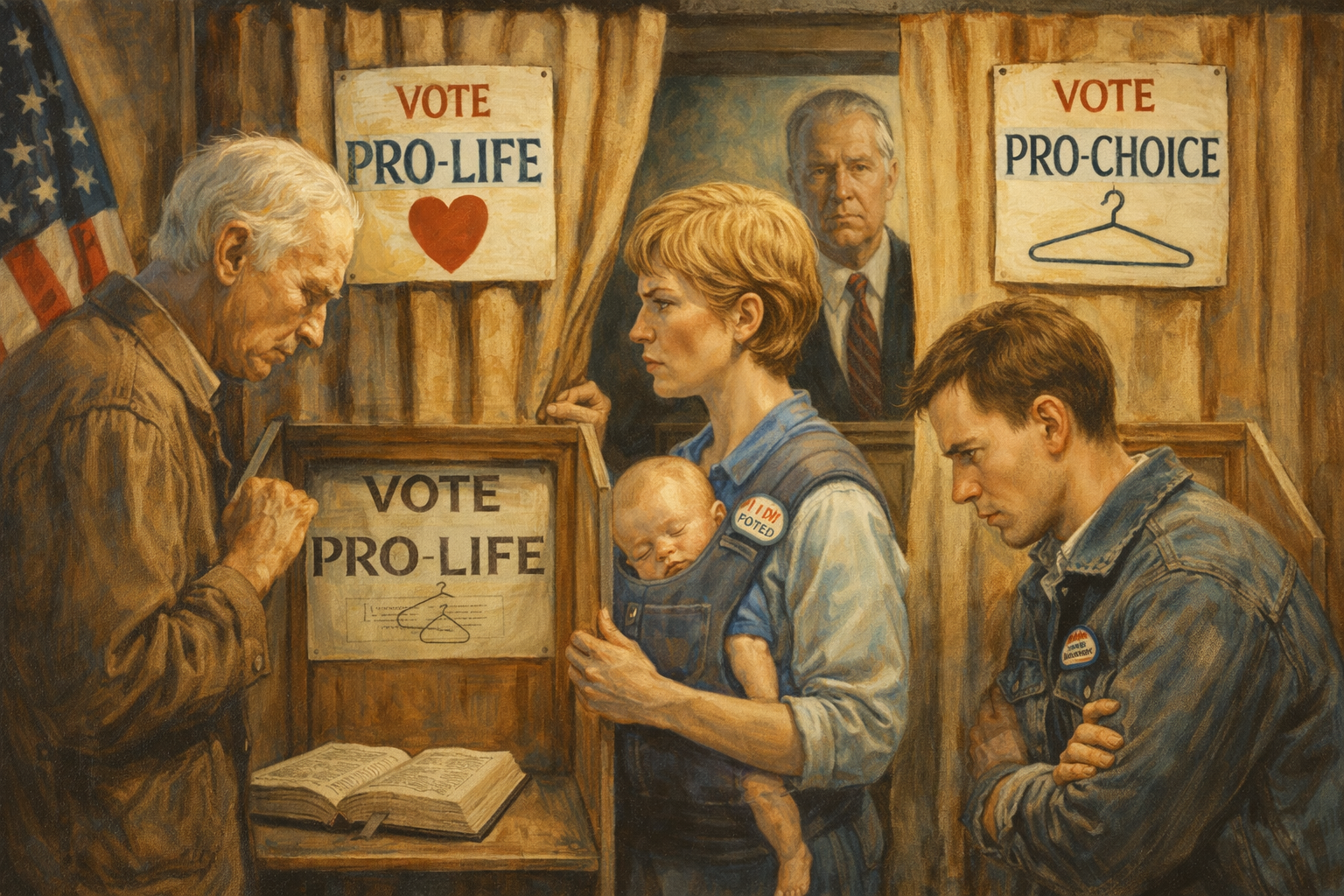
Abortion is not a peripheral policy dispute. It is one of the most morally serious, socially consequential, and politically divisive issues in American life. Unlike debates over tax rates, regulatory policy, or even foreign affairs, abortion directly concerns the deliberate ending of developing human life. For this reason alone, it commands sustained attention from voters across generations, religious traditions, and political affiliations.
At its core, the abortion debate forces Americans to answer foundational questions that no society can avoid indefinitely: What is a human being? When does human life begin? Who has the authority to decide whether a life has value? These are not merely religious questions, nor are they purely scientific. They are moral and philosophical questions with unavoidable legal consequences.
Why American Citizens Should Care
Abortion affects far more than individual women or families. It has broad implications for demographics, economics, social stability, and the moral character of a nation.
Since the legalization of abortion nationwide in 1973 under Roe v. Wade, estimates indicate that over 60 million abortions have occurred in the United States. When secondary demographic effects are considered—children who were never born, families that were never formed, future generations that never existed—the cumulative population impact is often estimated at 120 to 150 million fewer Americans than would otherwise exist today. That is not a speculative number pulled from ideology; it is a sober demographic observation.
This population deficit matters. A shrinking or stagnating population places enormous pressure on entitlement programs such as Social Security and Medicare, which rely on a growing workforce to support an aging population. Fewer workers supporting more retirees is not a theoretical concern—it is already a fiscal reality. Nations facing long-term population decline, such as Japan and parts of Western Europe, are struggling to maintain economic vitality, workforce stability, and intergenerational support systems. The United States is not immune to the same pressures.
Economic and Social Consequences
The abortion debate is often framed narrowly as a matter of “reproductive rights,” but that framing obscures wider economic and social consequences.
First, abortion intersects with workforce participation and family formation. The Sexual Revolution and second-wave feminism reshaped expectations around marriage, childbearing, and career prioritization. While many women have benefited from expanded educational and professional opportunities, the normalization of abortion has also contributed to a cultural environment in which pregnancy is frequently viewed as a problem to be solved rather than a life to be protected. This has downstream effects on marriage rates, birth rates, and family stability.
Second, abortion has public-policy implications that affect taxpayers. Public funding—whether direct or indirect—for abortion services, abortion-related healthcare, and associated legal and regulatory infrastructure draws resources away from alternatives such as prenatal care, adoption services, maternal support programs, and family assistance. Even when federal law restricts direct funding, state and local policies often circumvent those limits through creative budgeting and nonprofit partnerships.
Third, abortion affects public trust. When legal definitions of personhood, viability, or medical necessity shift depending on political power, citizens grow cynical about institutions meant to protect the vulnerable. This erosion of trust contributes to a broader cultural fragmentation already evident in many areas of American life.
Legal Developments and Renewed Relevance
The Supreme Court’s 2022 decision in Dobbs v. Jackson Women’s Health Organization returned abortion policy largely to the states. Far from resolving the issue, Dobbs intensified it. State legislatures, governors, ballot initiatives, courts, and federal lawmakers have since engaged in a patchwork struggle to define abortion access, limits, and protections.
Polling consistently shows that abortion ranks among the top five issues influencing voter behavior, particularly among women, religious voters, and younger adults. It routinely affects turnout, candidate selection, and party alignment. Importantly, abortion does not divide voters simply along party lines; it exposes fractures within parties, especially among Republicans who disagree over federal versus state authority and incremental versus absolute restrictions.
Why This Issue Persists
Abortion persists as a defining issue because it sits at the intersection of life, liberty, law, and morality. It cannot be resolved by technical policy tweaks alone. It reflects competing worldviews about human dignity, autonomy, responsibility, and the role of government.
For voters seeking to act responsibly—especially those guided by moral or religious convictions—abortion demands careful evaluation of party platforms, candidate behavior, and institutional consistency. Understanding how Republicans, Democrats, Libertarians, and biblical Christians approach this issue is essential for informed participation in American civic life.
Articles in the Critical Issues series require more time to read than most content on this site. They are intentionally written as thorough, in-depth examinations of their subjects.
The Republican Perspective on Abortion
The Republican Party’s position on abortion has undergone both continuity and tension over the past fifty years. While the party has historically presented itself as the political home for pro-life Americans, internal disagreements have intensified in the post-Dobbs era, particularly regarding the appropriate role of federal versus state authority. Even so, the Republican Party remains, by a wide margin, the political coalition most open to limiting abortion and protecting unborn life.
Core Commitments in the 2024 Republican Platform
The 2024 Republican Party platform reflects a deliberate recalibration following the Supreme Court’s Dobbs decision. Rather than advancing a single national abortion standard, the platform emphasizes state-level decision-making, citing constitutional limits and federalism principles. The platform affirms that the Constitution does not confer a right to abortion and recognizes the authority of states to legislate in this area (2024 GOP Platform, section on Constitutional Governance and Federalism).
Importantly, the platform also acknowledges the legitimacy of moral opposition to abortion, expresses support for protecting unborn children where possible, and affirms parental rights, conscience protections for healthcare workers, and restrictions on taxpayer funding of abortion (Hyde Amendment principles). The absence of an explicit national abortion ban has disappointed some social conservatives, but it reflects a strategic decision rather than a moral reversal.
In short, the Republican platform no longer mandates a single nationwide policy, but it continues to frame abortion as a serious moral issue rather than an unquestioned civil right.
Legislative Behavior at the Federal Level
At the federal level, Republican lawmakers consistently vote in ways that restrict abortion access, even when they disagree about ultimate strategy.
In the U.S. House and Senate, Republicans have supported:
- Bans on late-term abortions, particularly after fetal viability
- The Born-Alive Abortion Survivors Protection Act
- Restrictions on chemical abortion distribution by mail
- Conscience protections for doctors, nurses, and pharmacists
- Prohibitions on federal funding for abortion providers
Republican senators such as Josh Hawley, Ted Cruz, Mike Lee, Marco Rubio, and James Lankford have articulated abortion not merely as a medical procedure but as a matter of human rights for the unborn. House members aligned with the House Freedom Caucus have often gone further, advocating for stronger protections and clearer moral language.
At the same time, other Republicans—particularly those representing swing states—have adopted a more incremental approach. They emphasize gestational limits, parental notification laws, and regulatory oversight rather than absolute bans.
Republican Leadership at the State Level
The post-Dobbs era has revealed the true center of gravity for Republican abortion policy: the states.
Republican governors and legislatures in states such as Texas, Florida, Tennessee, Mississippi, Oklahoma, South Dakota, and Indiana have enacted significant abortion restrictions. These include:
- Trigger laws banning most abortions
- Heartbeat bills
- Expanded support for adoption and pregnancy resource centers
- Enhanced penalties for illegal abortion providers
Florida’s 15-week abortion limit, signed by Governor Ron DeSantis and later tightened, reflects an approach similar to European gestational limits, a point frequently emphasized by Republicans seeking to counter accusations of extremism.
Indiana’s Republican legislature enacted one of the first post-Dobbs statewide abortion bans, despite internal party resistance and intense public pressure. That episode illustrates both the strength of pro-life convictions among Republican lawmakers and the political costs associated with acting on them.
Internal Disagreements Within the Republican Party
Significant disagreement exists within the Republican Party, but it is largely strategic rather than philosophical.
The main points of division include:
- Federal vs. state authority: Some Republicans argue for national protections for unborn life; others insist that constitutional limits require state-level action.
- Incrementalism vs. abolition: Some favor gradual restrictions that can survive legal scrutiny and public opinion; others argue that moral clarity requires stronger, immediate protections.
- Electoral pragmatism: Party leadership worries that maximalist positions may alienate suburban and younger voters, particularly women.
Figures such as Donald Trump have emphasized that returning abortion to the states fulfills a long-standing Republican goal, while declining to endorse a national ban. This has frustrated some social conservatives but reassured others who prioritize judicial restraint and federalism.
Why Pro-Life Voters Still Gravitate Toward Republicans
Despite internal tensions, the Republican Party remains the only major party that allows pro-life Americans to meaningfully participate, influence policy, and win elections without abandoning their convictions.
Democrats, by contrast, have largely expelled pro-life voices from positions of influence. Republicans still debate how best to protect life; Democrats debate how to expand abortion access further.
For voters who believe abortion involves the taking of innocent human life, this distinction is decisive. The Republican Party may argue internally about methods and timing, but it has not redefined abortion as a positive social good. That difference matters.
The Democrat Perspective on Abortion
The Democrat Party’s position on abortion is markedly different from that of Republicans—not only in policy outcomes, but in moral framing, rhetorical emphasis, and institutional enforcement. Over the past several decades, the party has moved from treating abortion as a tragic but legally protected option to defending it as a fundamental and non-negotiable right, central to its broader vision of personal autonomy and social equality.
Today, abortion is not merely one issue among many for Democrats; it functions as a litmus test of ideological loyalty.
The 2024 Democrat Party Platform
The 2024 Democrat Party platform affirms abortion access as a core civil right and explicitly supports the codification of Roe v. Wade standards into federal law. The platform endorses abortion access with minimal restrictions, opposes state-level limitations, and rejects fetal viability as a meaningful legal boundary (2024 Democratic Platform, sections on Health Care and Reproductive Freedom).
The platform further supports:
- Federal protection for abortion access nationwide
- Elimination of gestational limits viewed as “medically unnecessary”
- Opposition to parental notification or consent laws
- Full repeal of the Hyde Amendment and similar funding restrictions
- Government enforcement against states that restrict abortion
Notably, the platform rarely uses language acknowledging moral complexity, fetal development, or competing rights claims. Instead, abortion is framed almost exclusively as a matter of women’s autonomy, healthcare access, and equality.
Congressional Democrats and Legislative Action
Democrat lawmakers in Congress have consistently voted to expand abortion access and invalidate state restrictions.
Prominent legislative efforts include:
- The Women’s Health Protection Act, which would override nearly all state-level abortion regulations
- Votes to repeal Hyde Amendment protections
- Support for taxpayer funding of abortion domestically and internationally
- Opposition to born-alive protections for infants surviving abortion attempts
Statements from Democrat leaders often emphasize that abortion should be available “without restriction,” language that has raised concern even among some voters who support early-term abortion but oppose late-term procedures.
While a small number of Democrat politicians historically claimed to be “personally opposed but politically supportive” of abortion rights, that posture has largely disappeared. Pro-life Democrats have been marginalized, primaried, or pressured to conform. Party leadership has made clear that support for abortion access is mandatory, not optional.
Democrat Governors, States, and Cities
At the state and city level, Democrat leadership has pursued some of the most permissive abortion policies in the developed world.
States such as California, New York, Illinois, Massachusetts, Minnesota, Colorado, Oregon, and Washington have enacted laws that:
- Allow abortion through all nine months of pregnancy under broad definitions of health
- Shield abortion providers from out-of-state legal action
- Fund abortion services with taxpayer money
- Remove reporting requirements and parental involvement protections
New York’s Reproductive Health Act reclassified abortion as healthcare and removed unborn children from the state’s homicide statutes prior to birth. California has pursued policies that protect abortion providers from accountability and expanded funding for abortion-related travel and services.
Cities such as New York City, Chicago, Los Angeles, Seattle, Boston, and Washington, D.C. have further entrenched abortion access through municipal funding, public messaging campaigns, and institutional partnerships with abortion providers.
Internal Disagreements Within the Democrat Party
Unlike Republicans, meaningful disagreement within the Democrat Party on abortion is minimal.
Where disagreements exist, they are typically tactical rather than substantive—focused on messaging, timing, or electoral optics rather than moral limits. There is little debate over whether abortion should be restricted; the dominant question is how aggressively abortion access should be protected and expanded.
Attempts to introduce gestational limits, conscience protections, or fetal pain legislation have been rejected as unacceptable compromises. Democrat leadership increasingly frames any restriction—no matter how modest—as an attack on women’s rights.
Moral Framing and Language
One of the most striking features of the Democrat approach is its use of euphemistic and abstract language.
Terms such as “reproductive justice,” “bodily autonomy,” and “healthcare access” are used to reframe abortion away from questions of life and death. References to the unborn child are avoided or minimized, often replaced with clinical terminology or legal abstractions.
Critics argue that this language functions to distance the public from the moral reality of abortion. By contrast, Democrats argue that moral pluralism requires neutrality and that restricting abortion imposes religious beliefs on others.
Why the Democrat Position Is Viewed as Extreme by Critics
International comparisons often undermine Democrat claims of moderation. Many European nations—frequently cited as progressive models—enforce abortion limits between 12 and 15 weeks. By contrast, Democrat-backed policies often allow abortion well beyond fetal viability, with few enforceable safeguards.
This has led critics, including some who support early-term abortion, to argue that the Democrat Party has embraced a position out of step with both historical norms and global standards.
For voters concerned about the moral status of unborn life, institutional integrity, and limits on government power, the Democrat Party’s abortion stance represents a sharp departure from any conception of compromise.
The Libertarian Perspective on Abortion
The Libertarian position on abortion is distinct from both the Republican and Democrat parties, though it overlaps with each at certain points. Libertarianism is built on a single core principle: individual liberty, often articulated as the non-aggression principle—the idea that no person has the right to initiate force against another. Where abortion becomes difficult for Libertarians is precisely at the point where the definition of “another” is disputed.
Because Libertarian philosophy prioritizes autonomy and minimal government intervention, abortion exposes internal tensions within the movement rather than a unified moral consensus.
The Libertarian Party Platform
The most recent Libertarian Party platform reflects this unresolved tension. Rather than declaring abortion either a protected right or a moral wrong, the platform largely removes the issue from federal jurisdiction and treats it as a matter of individual conscience. It emphasizes that government should not act as an arbiter in deeply personal moral decisions and opposes federal involvement in abortion policy.
In practice, the platform:
- Rejects federal abortion mandates or bans
- Opposes government funding of abortion
- Treats abortion as a private moral decision rather than a public justice issue
- Emphasizes bodily autonomy and freedom from state coercion
This approach allows Libertarians to avoid internal fracture but results in a position that many critics view as morally evasive.
Philosophical Differences with Republicans and Democrats
Libertarians differ from Republicans primarily on the role of government. While many Republicans believe government has a legitimate duty to protect unborn life, Libertarians are skeptical of expanding state power even for moral purposes. They tend to view abortion as a tragic personal choice rather than a crime warranting government intervention.
Libertarians differ from Democrats on scope and coercion. Although Libertarians may share Democrat language around autonomy, they reject taxpayer funding of abortion, regulatory mandates, and the use of state power to enforce ideological conformity. Libertarians oppose compelling doctors, hospitals, or citizens to participate in abortion-related activity.
Internal Division Among Libertarians
Abortion remains one of the most divisive issues within Libertarian circles.
Some Libertarians argue that the unborn child qualifies as a rights-bearing individual, making abortion a violation of the non-aggression principle. These Libertarians often align morally with pro-life Republicans, even if they differ on legal enforcement.
Others argue that the unborn child does not possess independent rights until birth, or that enforcing those rights would require unacceptable state intrusion into a woman’s body. These Libertarians align more closely with Democrats on outcome, though not on funding or regulatory expansion.
The Libertarian Party’s refusal to resolve this disagreement leaves its official position intentionally ambiguous.
Alignment in Practice
In real-world politics, Libertarians are not a dominant electoral force, and their impact on abortion policy is largely indirect.
When Libertarians influence Republican coalitions, they tend to push for:
- Decentralization of abortion law
- Resistance to federal mandates
- Protection of conscience rights
When they influence Democrat coalitions, they typically resist:
- Government funding of abortion
- Speech restrictions around abortion advocacy
- Coercive healthcare regulations
However, because Libertarians lack significant legislative power, their position on abortion remains tangential to the main policy struggle between Republicans and Democrats.
Why the Libertarian Position Is Presented Here Only Briefly
As noted at the outset of this article, the Libertarian perspective is included for completeness rather than emphasis. While Libertarian philosophy raises important questions about government authority and personal liberty, it does not currently shape abortion policy in a decisive way.
For voters concerned with actual governance outcomes, abortion remains a contest primarily between Republican and Democrat visions. Libertarian ideas may influence rhetoric at the margins, but they do not determine the direction of law.
Progressive Principles and Their Influence on the Democrat Position on Abortion
To understand the modern Democrat position on abortion, it is not enough to examine party platforms or legislative votes alone. One must also understand the Progressive worldview that increasingly shapes how Democrat leaders think, speak, and govern. Upon first use, the term Progressive is often associated—imprecisely but usefully for orientation—with wokeness, Cultural Marxism, political correctness, and Neo-Marxism. These terms are not identical, but they describe overlapping ways of interpreting power, identity, and moral authority in modern politics.
Progressivism provides the moral logic behind the Democrat Party’s abortion stance.
Core Progressive Presuppositions
At the heart of Progressive thought is a set of presuppositions that differ sharply from both classical liberalism and biblical Christianity.
First, moral authority is relocated. Rather than grounding moral truth in nature, tradition, or divine revelation, Progressivism locates moral authority in lived experience, personal identity, and perceived oppression. In this framework, moral claims are validated not by objective standards but by whether they advance autonomy and reduce power imbalances.
Second, human identity is redefined. The individual is no longer understood primarily as a moral agent accountable to transcendent standards, but as a bearer of rights whose highest good is self-expression. Obligations—to family, community, or unborn life—are treated as negotiable constraints rather than moral duties.
Third, power analysis replaces moral reasoning. Progressive frameworks tend to interpret social issues through an oppressor–oppressed lens. In the abortion debate, women are cast as the oppressed class and unborn children are either ignored or treated as extensions of the woman’s body rather than distinct moral subjects.
How Progressivism Shapes Abortion Advocacy
Within this worldview, abortion is reframed not as a tragic moral dilemma, but as a necessary tool of liberation.
Pregnancy is interpreted primarily as a potential threat to autonomy. Motherhood, particularly when unplanned, is treated as a structural disadvantage imposed by biology and reinforced by social norms. Abortion is therefore justified as a corrective mechanism that allows women to participate equally in economic and social life.
This framing explains why Progressive rhetoric increasingly celebrates abortion rather than tolerating it reluctantly. Language has shifted from “safe, legal, and rare” to slogans that emphasize pride, empowerment, and resistance. Abortion becomes not merely permissible, but morally virtuous when framed as an act of self-determination.
Rejection of Biological and Moral Limits
Progressivism is deeply skeptical of natural limits—biological, moral, or social. This skepticism extends to fetal development.
Scientific facts about embryology are often acknowledged in isolation but stripped of moral significance. Viability, heartbeat, neurological development, and pain perception are treated as irrelevant to rights claims. What matters, in Progressive logic, is not what the unborn child is, but whether recognizing its humanity would constrain autonomy.
This helps explain why Progressive lawmakers resist gestational limits, parental involvement laws, or conscience protections. Each of these acknowledges a competing moral claim that Progressivism cannot easily accommodate.
Institutional Enforcement of Progressive Orthodoxy
Progressivism does not merely persuade; it enforces conformity.
Within Democrat institutions, dissent on abortion is treated as unacceptable. Pro-life Democrats are excluded from leadership, denied funding, and targeted in primaries. Healthcare professionals who object to abortion on moral grounds face professional and legal pressure. Religious institutions are increasingly viewed as obstacles rather than partners in civil society.
This enforcement reflects a Progressive belief that opposition to abortion is not merely mistaken, but harmful. Once disagreement is categorized as harm, coercion becomes justified.
Why This Matters for Voters
Understanding the Progressive foundations of the Democrat position clarifies why compromise on abortion has become nearly impossible. The issue is no longer about balancing competing rights or minimizing harm. It is about advancing a comprehensive worldview that prioritizes autonomy above all else.
For voters—especially those with biblical or traditional moral commitments—this represents more than a policy disagreement. It signals a fundamental clash over the nature of truth, authority, and human dignity.
Do Democrat Actions Match Their Official Platform?
“In politics, what you DO is what you believe. Everything else is cottage cheese.”
— Senator Joseph N. Kennedy
This blunt observation is an effective lens through which to evaluate the Democrat Party’s position on abortion. Party platforms describe ideals; actions reveal convictions. When the behavior of Democrat leadership is examined—particularly during periods of unified control—the consistency between rhetoric and action becomes unmistakable.
Platform Commitments Versus Practical Governance
The Democrat Party platform claims to champion healthcare, compassion, equity, and freedom of choice. In practice, Democrat leadership has pursued abortion policy in ways that prioritize ideological purity over moral consistency, often applying standards to others that they exempt themselves from.
While Democrats insist that abortion restrictions constitute unacceptable government intrusion, they show little hesitation in using government power to:
- Mandate compliance from medical professionals
- Override state legislatures
- Penalize religious institutions
- Suppress dissenting viewpoints in public and professional spaces
This asymmetry raises legitimate questions about whether the stated commitment to “choice” is genuine or selectively applied.
The Biden Administration as a Case Study
The Biden administration provides the clearest example of how Democrat actions align with Progressive ideology rather than restrained governance.
Following the Dobbs decision, the administration:
- Directed federal agencies to expand access to chemical abortion
- Encouraged interstate abortion travel
- Sought to use federal land and facilities to facilitate abortions
- Attempted to reinterpret existing law to bypass congressional limits
- Opposed nearly all state-level abortion restrictions regardless of gestational age
The administration also consistently opposed conscience protections, framing moral objections as barriers to healthcare. This position places religious doctors, nurses, and hospitals in an untenable position: violate conscience or face professional consequences.
These actions reveal that Democrat leadership does not merely support abortion access—it seeks to institutionalize abortion as a protected entitlement, enforced by federal authority.
Progressive States and Cities in Practice
State and municipal governments controlled by Progressive Democrat leadership illustrate the same pattern.
In states such as California, New York, Illinois, Massachusetts, Minnesota, Colorado, Oregon, and Washington, lawmakers have:
- Removed abortion limits entirely or defined “health” so broadly that limits are meaningless
- Eliminated parental notification requirements
- Expanded taxpayer funding for abortion services
- Created legal shields for abortion providers against accountability
- Restricted data collection that could enable public oversight
Cities like New York City, Chicago, Los Angeles, Seattle, Portland, San Francisco, Boston, Denver, and Washington, D.C. have gone further by embedding abortion advocacy into public institutions, education systems, and healthcare networks.
The consistent theme is not neutrality, but promotion.
Inconsistencies and Double Standards
Democrat leadership often accuses abortion opponents of imposing morality through law. Yet Democrats routinely legislate moral norms in other areas—speech, employment, education, and healthcare—without hesitation.
This reveals an inconsistency: moral imposition is objectionable only when it conflicts with Progressive priorities.
Moreover, while Democrats emphasize women’s autonomy, they frequently minimize or dismiss the moral agency of women who regret abortions, oppose abortion, or choose motherhood under difficult circumstances. These women are often marginalized within Progressive narratives because their experiences challenge the ideological script.
Authoritarian Tendencies Under Progressive Governance
When opposition is framed as harm, authoritarian impulses follow naturally.
Evidence of soft or hard leftist authoritarianism includes:
- Government pressure on speech related to abortion
- Professional penalties for dissenting medical opinions
- Use of regulatory agencies to enforce ideological compliance
- Efforts to delegitimize religious moral reasoning in public life
These patterns are not isolated. They appear repeatedly in jurisdictions where Progressive Democrats exercise long-term control.
When judged by actions rather than slogans, Democrat leadership has not merely upheld its platform—it has exceeded it in scope and intensity. The party’s behavior reflects a deeper Progressive commitment to redefining abortion as an unquestionable social good, protected and promoted by the state.
For voters concerned about limits on power, moral consistency, and institutional integrity, this record deserves serious scrutiny.
Examining Each Party’s Position from the Perspective of the Opposition
A serious voter should be able to understand not only what each party claims, but also how each party’s position is criticized by thoughtful opponents. This section presents common criticisms raised by honest interlocutors, followed by typical counter-responses offered by Republicans, Democrats, and others. The goal is clarity, not caricature.
Common Criticisms of the Republican Position on Abortion
Criticism 1: Republicans want to control women’s bodies.
Opponents argue that abortion restrictions prioritize fetal life at the expense of women’s autonomy, health, and freedom. They claim Republican policies treat women as means rather than moral agents.
Republican Counter-Response:
Republicans generally respond that abortion restrictions are not about controlling women, but about protecting a second human life. The argument is that society routinely limits individual autonomy when it harms others. Laws against assault, neglect, or abuse do not “control bodies”; they protect vulnerable persons. From this perspective, abortion is unique only because the victim is unseen.
Criticism 2: Republican abortion laws are extreme and out of step with public opinion.
Critics cite polling showing public discomfort with total abortion bans and argue Republicans risk electoral backlash.
Republican Counter-Response:
Republicans note that most Americans support significant abortion limits, especially after the first trimester. They argue that Democrat-backed policies allowing abortion through all nine months are far more extreme than Republican proposals. Republicans also point out that moral questions are not resolved by polling alone; civil rights protections have often preceded public consensus.
Criticism 3: Abortion bans endanger women’s health.
Opponents claim restrictions delay medical care and put women at risk during pregnancy complications.
Republican Counter-Response:
Republicans counter that legitimate medical emergencies are already addressed in law and that confusion often results from activist-driven misinformation rather than statutory language. They argue that abortion and women’s healthcare are deliberately conflated to generate fear and that improving maternal care does not require unrestricted abortion access.
Common Criticisms of the Democrat Position on Abortion
Criticism 1: Democrats support abortion without meaningful limits.
Opponents argue that Democrat policies ignore fetal development and allow morally indefensible late-term abortions.
Democrat Counter-Response:
Democrats typically respond that late-term abortions are rare and usually involve medical complications. They argue that lawmakers should not interfere in complex medical decisions and that any restriction risks unintended harm.
Criticism 2: Democrat rhetoric dehumanizes the unborn.
Critics argue remembering only the woman in abortion discussions erases the moral reality of the child.
Democrat Counter-Response:
Democrats respond that granting moral or legal status to the unborn threatens women’s rights and bodily autonomy. They argue that recognizing fetal personhood would create legal chaos and criminalize pregnancy outcomes.
Criticism 3: Democrat policies are inconsistent with global norms.
Opponents point out that many European nations impose stricter abortion limits than Democrat-backed policies.
Democrat Counter-Response:
Democrats argue that U.S. healthcare systems, legal structures, and social safety nets differ from those of Europe and that comparisons are misleading. They maintain that access, not restriction, best ensures women’s health.
Critiques of the Libertarian Position
Criticism: Libertarians avoid the moral core of the issue.
Both Republicans and Democrats argue that Libertarian neutrality fails to address whether abortion involves the taking of human life.
Libertarian Counter-Response:
Libertarians reply that moral disagreement does not justify expanding government power and that individuals, families, and civil society—not the state—should bear moral responsibility for abortion decisions.
Why These Critiques Matter
This exchange of criticism reveals a deeper truth: abortion is not merely a policy dispute, but a clash of worldviews. Each party’s counter-arguments reflect its foundational assumptions about human nature, authority, and the role of law.
For voters, understanding these critiques helps separate emotional appeals from substantive reasoning and clarifies what is truly at stake.
Credible Suspicions About Party Strategies and Motives
When evaluating abortion policy, voters are right to look beyond stated intentions and examine patterns of behavior, incentives, and political advantage. This section does not assume bad faith reflexively, but it does acknowledge that political parties act strategically. In a low-trust environment, reasonable suspicion is not cynicism; it is prudence.
Republican Motives and Strategic Behavior
Critics of the Republican Party often suspect that abortion is used primarily as a mobilization tool rather than a policy objective. According to this critique, Republicans emphasize pro-life rhetoric during campaigns but retreat once in office to avoid electoral backlash or media pressure.
There is some evidence that this criticism has partial merit. For decades after Roe v. Wade, Republican leadership frequently campaigned on overturning the decision while taking incremental or symbolic action. Judicial nominations became the primary mechanism for progress, which insulated lawmakers from direct accountability while still energizing pro-life voters.
However, Dobbs fundamentally altered this dynamic. The long-term judicial strategy succeeded, and Republicans were forced to confront the consequences of their own rhetoric. The resulting internal conflict—over federal bans, state authority, and political risk—suggests not mere manipulation, but genuine disagreement about governance in a post-Roe world.
A more charitable interpretation is that Republicans are torn between:
- Moral conviction about protecting unborn life
- Constitutional constraints and federalism
- Electoral realities in a culturally divided nation
The party’s struggle appears less like deception and more like an unresolved tension between principle and prudence.
Democrat Motives and Strategic Behavior
Suspicions about Democrat motives tend to focus on power consolidation and ideological enforcement.
Many observers argue that abortion functions as a keystone issue for the Democrat coalition. It unites disparate interest groups—feminists, secular progressives, healthcare bureaucracies, and activist nonprofits—under a single moral banner. By framing abortion as a civil right, Democrats justify expansive federal authority, regulatory control, and judicial intervention.
There is also credible concern that abortion is used to:
- Secure long-term political loyalty through dependency on state-funded services
- Justify the marginalization of religious institutions and dissenting professionals
- Reinforce Progressive ideological commitments to autonomy and identity politics
Statements from Democrat leaders frequently portray abortion opponents not as fellow citizens with moral concerns, but as threats to democracy or public safety. This rhetoric lowers the threshold for coercive policy responses.
Leadership Statements and Behavioral Signals
Leadership behavior often reveals priorities more clearly than platforms.
Democrat leaders have repeatedly stated that abortion access must be protected “by any means necessary,” including court-packing proposals, agency rulemaking, and executive action that bypasses legislative processes. These approaches suggest a willingness to expand power rather than negotiate limits.
Republican leaders, by contrast, often signal caution—even hesitation—once abortion policy shifts from theory to enforcement. While this frustrates some supporters, it also reflects an awareness of constitutional boundaries and public division.
Strategic Asymmetry Between the Parties
One notable asymmetry is that Democrats appear willing to lose voters over abortion in order to maintain ideological consistency, while Republicans appear willing to soften policy to retain broader coalitions. This difference reflects contrasting visions of politics: one treats abortion as non-negotiable doctrine; the other treats it as a morally serious issue constrained by governance realities.
Why These Suspicions Matter
Voters must assess not only what parties say, but what they are likely to do when unrestrained. Historical patterns suggest that when Democrats control institutions, abortion access expands rapidly and dissent narrows. When Republicans control institutions, progress is slower, uneven, and often contested internally.
Understanding these motives helps voters anticipate future outcomes rather than relying on campaign assurances.
High-Trust, Low-Trust Societies and the Abortion Debate
Abortion does not exist in a cultural vacuum. It is profoundly shaped by the level of social trust within a society—trust in institutions, trust in fellow citizens, trust in authority, and trust in moral norms. As American society has shifted from relatively high trust to increasingly low trust, the abortion debate has become more polarized, more absolutist, and more resistant to compromise.
Understanding this dynamic helps explain why abortion now functions as a permanent political fault line rather than a policy question capable of resolution.
High-Trust Societies and Moral Consensus
High-trust societies share a broad moral framework, even when disagreements exist at the margins. Citizens assume that institutions act in good faith, that laws reflect shared values, and that fellow citizens are not seeking to exploit the system.
In such societies, abortion is often treated as a tragic exception rather than a normalized practice. Social expectations emphasize:
- Marriage and family stability
- Communal responsibility for children
- Moral limits on autonomy
- Support structures that reduce pressure to abort
Historically, American society functioned closer to this model. While abortion existed, it was not celebrated, institutionalized, or framed as a positive social good. The assumption was that pregnancy created moral obligations that extended beyond individual preference.
The Shift to a Low-Trust Environment
Modern America increasingly resembles a low-trust society.
Citizens distrust:
- Government motives
- Media representations
- Medical authorities
- Judicial neutrality
- Each other’s intentions
In this environment, abortion becomes a proxy battle for deeper fears. Republicans suspect Democrats will use abortion to expand federal power, marginalize religion, and redefine human life by decree. Democrats suspect Republicans will use abortion laws to punish women, impose religious morality, and control private behavior.
Neither side trusts the other to act responsibly if given authority.
How Republicans View Abortion in a Low-Trust Context
Republicans often view abortion policy through a lens of institutional skepticism. They worry that:
- Vague legal standards will be exploited by activist judges
- Medical discretion will be stretched to justify virtually any abortion
- Regulatory agencies will enforce ideological compliance
- Cultural elites will redefine norms without democratic consent
These concerns are not hypothetical. Past experiences with judicial activism and bureaucratic expansion have reinforced Republican mistrust. As a result, Republicans increasingly favor clear statutory limits, decentralized authority, and bright-line rules.
How Democrats View Abortion in a Low-Trust Context
Democrats, operating within the same low-trust environment, reach the opposite conclusion. They fear that:
- State governments will weaponize abortion restrictions
- Religious institutions will gain undue influence
- Women will be denied care due to political interference
- Unequal enforcement will harm vulnerable populations
Because Democrats distrust state-level governance in conservative regions, they prefer centralized federal authority and judicial enforcement. In their view, only national mandates can guarantee uniform rights.
The Feedback Loop of Distrust
Low trust creates a self-reinforcing cycle.
Each side interprets the other’s actions as confirmation of bad faith. Republicans see Democrat resistance to any limit as evidence of moral radicalism. Democrats see Republican restrictions as proof of authoritarian intent. As trust erodes, compromise becomes politically dangerous and morally suspect.
This dynamic explains why abortion policy has moved toward absolutism on both sides, even as public opinion remains more nuanced.
Why This Matters for the Future
Abortion will remain a volatile issue as long as American society lacks shared moral assumptions and institutional credibility. Without trust, even reasonable proposals are interpreted as threats.
For voters, recognizing this low-trust context helps explain why abortion debates feel intractable and emotionally charged. It also clarifies why policies that might function in a cohesive society fail in a fragmented one.
Media Distortion and Misrepresentation of the Abortion Debate
No modern political issue is shaped more by media framing than abortion. While journalists often claim neutrality, coverage patterns, word choice, story selection, and omission of context have repeatedly distorted public understanding of where Republicans and Democrats actually stand. This distortion does not require overt propaganda; it often operates through selective emphasis and strategic silence.
Structural Media Bias on Abortion
Most major national media institutions operate within a cultural environment that largely accepts Progressive assumptions about autonomy, sexuality, and moral authority. As a result, abortion is typically framed as a settled right rather than a contested moral issue.
Common structural patterns include:
- Treating abortion as healthcare by default
- Framing restrictions as “attacks” or “rollbacks”
- Describing Democrat positions as protective and Republican positions as punitive
- Centering political narratives around activist organizations rather than affected families
This framing subtly instructs the audience on which position is reasonable before arguments are even presented.
Misrepresentation of the Republican Position
Republican abortion policies are frequently portrayed as extreme, even when they resemble policies common in other developed nations.
For example:
- Fifteen-week abortion limits are often described as “near-total bans,” despite being comparable to European standards.
- Medical exception language is routinely portrayed as vague or dangerous without examining statutory text.
- Individual cases are highlighted without clarification of whether laws were misapplied, misunderstood, or misreported.
Media coverage often fails to distinguish between intentional abortion bans and regulations aimed at protecting fetal life while allowing medical care, leaving audiences with the impression that Republicans oppose women’s healthcare broadly.
Sanitizing the Democrat Position
In contrast, Democrat-backed abortion policies are frequently insulated from scrutiny.
Late-term abortion allowances are rarely discussed in detail. When they are mentioned, coverage emphasizes rarity rather than legality. The moral implications of abortion through all nine months are typically avoided, and questions about fetal pain, viability, or personhood are treated as fringe or religious concerns.
Additionally, media outlets often omit the fact that many Democrat policies exceed the abortion access permitted in countries routinely praised as progressive.
Language as a Tool of Persuasion
Language choices play a critical role in shaping perception.
Terms such as “reproductive justice,” “pregnancy tissue,” and “termination” abstract the reality of abortion, while emotionally charged terms are reserved for restrictions rather than procedures. Visual imagery, when used, focuses almost exclusively on protesting crowds or distressed women, rarely on unborn life or adoption alternatives.
This linguistic asymmetry is not accidental. It reflects an editorial judgment about which moral claims deserve public legitimacy.
Notable Incidents of Distortion
Several high-profile cases illustrate these dynamics:
- Media amplification of worst-case narratives before facts are verified
- Failure to correct inaccuracies once initial emotional impact has been achieved
- Selective use of expert commentary aligned with Progressive advocacy groups
- Dismissal of dissenting medical or ethical perspectives as ideological rather than substantive
In many cases, retractions or clarifications—if issued at all—receive minimal coverage compared to the original claims.
Why Media Distortion Matters
Media framing shapes voter perception long before ballots are cast. When one party’s position is consistently framed as compassionate and the other’s as cruel, democratic deliberation is compromised.
A well-informed electorate requires more than access to information; it requires honest presentation of competing moral claims. When journalism functions as advocacy, trust erodes further, reinforcing the low-trust dynamics discussed earlier.
For voters, recognizing media distortion is not about dismissing all reporting, but about reading critically, comparing sources, and seeking primary texts rather than relying on headlines.
A Biblical Perspective on Abortion
A biblical Christian approach to abortion begins from a fundamentally different starting point than secular political frameworks. Rather than asking first what is legal, popular, or autonomous, Scripture asks what is true, what honors God, and what upholds the dignity of human beings created in His image.
This perspective does not arise from party loyalty. It arises from theological conviction.
The Moral Status of Human Life
The Bible consistently affirms that human life is created by God, belongs to God, and bears His image (Genesis 1:26–27). Human worth is not conferred by development, ability, independence, or social usefulness. It is inherent.
Scripture speaks of God’s knowledge and purpose for human beings prior to birth. Passages such as Psalm 139:13–16 describe God’s active involvement in forming life in the womb. Jeremiah 1:5 speaks of divine calling before birth. These texts are not scientific treatises, but they unmistakably affirm the continuity of personal identity from the womb onward.
For biblical Christians, this establishes a moral boundary: deliberately ending innocent human life is prohibited (Exodus 20:13). Abortion, therefore, cannot be morally neutral.
Compassion Without Moral Evasion
Biblical Christianity does not deny the reality of hardship, fear, or trauma surrounding pregnancy. Scripture consistently calls God’s people to protect the vulnerable, care for the poor, and show compassion to those in distress (James 1:27).
However, compassion in Scripture is never severed from moral truth. The Bible does not present moral dilemmas as excuses for violating God’s law, but as occasions for sacrificial love, communal responsibility, and creative obedience.
This distinction matters. The biblical response to crisis pregnancy emphasizes support, protection, and restoration, not the elimination of the vulnerable party.
Comparing Party Positions to a Biblical Worldview
When the Republican, Democrat, and Libertarian positions are measured against biblical principles, clear differences emerge.
- Democrat Position: The Democrat framework places ultimate moral authority in personal autonomy. From a biblical perspective, this elevates human will above God’s sovereignty and denies the moral status of unborn life. The result is a view incompatible with the biblical teaching on the sanctity of life.
- Libertarian Position: Libertarianism rightly questions the abuse of state power, but it struggles to account for the government’s God-ordained role in restraining evil and protecting the innocent (Romans 13:1–4). Moral neutrality toward the taking of life is not a biblically viable option.
- Republican Position: While not explicitly theological, the Republican Party’s general opposition to abortion and openness to protecting unborn life aligns most closely with biblical ethics. Importantly, the Republican coalition allows biblical Christians to participate, advocate, and influence policy without requiring them to deny core convictions.
This alignment is not perfect. No political party fully embodies biblical righteousness. Yet alignment is comparative, not absolute.
Worldview Differences at the Root
The abortion debate ultimately reflects competing worldviews:
- Secular Progressivism prioritizes autonomy and power redistribution.
- Libertarianism prioritizes freedom from coercion.
- Biblical Christianity prioritizes obedience to God and the protection of life.
These worldviews cannot be harmonized without distortion. Christians should not expect secular systems to arrive at biblical conclusions apart from biblical premises.
Why This Matters for Christian Voters
For biblical Christians, abortion is not one issue among many of equal weight. It involves the direct taking of innocent life. Scripture consistently assigns heightened moral seriousness to such matters (Proverbs 6:16–17).
This does not mean other issues are irrelevant. It does mean that abortion carries unique moral gravity that should shape voting decisions, advocacy, and public witness.
Encouraging Biblically Informed Voting on Abortion
For biblical Christians, voting is not merely a civic exercise; it is a moral act shaped by conscience, stewardship, and responsibility before God. While Scripture does not prescribe modern electoral systems, it does provide principles that guide how believers should evaluate leaders and policies—especially on matters involving the protection of innocent life.
Weighing Issues with Moral Seriousness
Not all political issues carry equal moral weight. Scripture itself recognizes degrees of moral gravity. Proverbs 24:11 commands God’s people to “rescue those who are being taken away to death,” underscoring the urgency of defending life when it is threatened. Jesus likewise condemned the neglect of “the weightier matters of the law” (Matthew 23:23).
Abortion falls squarely into this category. It involves the intentional ending of human life and therefore deserves greater moral weight than disputes over taxation levels, regulatory frameworks, or infrastructure spending. A mature Christian voter should recognize this distinction.
This does not mean that economic policy, national defense, or social welfare are unimportant. It means that when policies conflict, the protection of life must take precedence.
Party Alignment and Moral Responsibility
In the current American political landscape, biblical Christians face a constrained set of options. Of the major parties, the Republican Party—despite internal disagreements—remains the only one that:
- Publicly acknowledges the moral seriousness of abortion
- Allows pro-life convictions within its leadership and voter base
- Advances policies that limit or restrict abortion access
- Welcomes religious arguments in the public square
By contrast, the Democrat Party has made abortion access a defining and non-negotiable commitment. Its platform, leadership behavior, and institutional enforcement leave little room for biblical Christian participation without compromise.
For this reason, biblical Christians seeking to vote in alignment with their convictions will, as a general rule, find Republican candidates more compatible with a biblical worldview on abortion.
Scripture and Civic Responsibility
Romans 13 teaches that governing authorities are instituted by God to reward good and restrain evil. While this does not sanctify every government action, it does affirm that law has a moral purpose. Voting for leaders who will use their authority to protect life aligns with this biblical understanding.
Additionally, Proverbs 31:8–9 calls believers to “open your mouth for the mute” and defend the rights of the poor and needy. Unborn children, who cannot advocate for themselves, fit squarely within this category.
Avoiding False Moral Equivalence
Some argue that voting should focus on a broad balance of issues rather than a single concern. While prudence is necessary, this reasoning can easily drift into false moral equivalence, treating issues of convenience as equal to issues of life and death.
A biblical approach does not demand political perfection. It demands moral clarity. Voting for candidates who support abortion without meaningful limits requires believers to subordinate clear biblical teaching to secondary concerns.
Voting with Humility and Resolve
Christians should vote neither triumphalistically nor despairingly. Political outcomes are not salvific, but they are consequential. Faithfulness requires acting according to conscience while trusting God with results.
Encouraging biblically informed voting is not about party loyalty; it is about aligning civic action with moral truth.
The Christian’s Duty to Seek the Welfare of the Nation
Biblical Christianity does not permit withdrawal from concern for the common good. While the church’s mission is not political, Christians are nonetheless called to live as faithful citizens within the nations God has placed them. This includes a duty to seek the welfare of society, even when that society does not share biblical convictions.
The Biblical Basis for Civic Concern
The prophet Jeremiah instructed the Jewish exiles in Babylon to “seek the welfare of the city where I have sent you into exile, and pray to the LORD on its behalf” (Jeremiah 29:7, ESV). This command was given to a people living under pagan rule, reminding believers that concern for national well-being does not depend on ideal circumstances.
Similarly, the New Testament calls Christians to pray for kings and governing authorities “that we may lead a peaceful and quiet life, godly and dignified in every way” (1 Timothy 2:1–2, ESV). This assumes engagement, awareness, and moral concern—not apathy.
Responsible Voting as One Means of Obedience
In representative systems such as the United States, voting is one legitimate means by which Christians may seek the welfare of their nation. Casting a ballot is not the sum total of civic responsibility, but it is a meaningful expression of stewardship.
Responsible voting involves:
- Evaluating candidates and policies through a biblical moral lens
- Prioritizing issues involving justice and the protection of life
- Refusing to separate personal faith from public reasoning
- Accepting imperfect choices without abandoning moral clarity
On abortion, responsible voting means opposing policies that normalize or expand the destruction of unborn life and supporting candidates who, however imperfectly, seek to restrain it.
Other Faithful Means Beyond Voting
Scripture does not reduce civic faithfulness to elections alone. Christians may also seek the welfare of their nation through:
- Prayer and fasting for leaders and institutions
- Supporting crisis pregnancy centers and adoption ministries
- Providing material, emotional, and spiritual support to mothers and families
- Peaceful advocacy and public witness
- Teaching moral truth within families and churches
These actions often outlast election cycles and demonstrate that pro-life convictions are rooted in love, not mere political alignment.
Christian Liberty and Conscience
It must be acknowledged that some Christians conclude, after prayer and reflection, that participation in voting violates their conscience. Scripture allows room for such conclusions.
Romans 14 teaches that believers may differ on disputable matters and must not judge one another’s consciences when Scripture does not issue a direct command. While Christians should encourage moral responsibility, they must also respect liberty where Scripture grants it.
Abstention from voting does not exempt believers from prayer, moral witness, or compassion. Nor does voting confer moral superiority.
Holding Conviction Without Hostility
Christians are called to speak truth with gentleness and respect (1 Peter 3:15). Seeking the welfare of the nation does not justify cruelty, dishonesty, or contempt for those who disagree.
At the same time, biblical love does not require moral silence. Faithfulness involves holding firm convictions while extending grace to those shaped by different worldviews.
The Christian duty to seek the welfare of the nation encompasses both public responsibility and personal faithfulness. Voting—especially on issues as grave as abortion—is one important expression of that duty, but it is never the only one.
Conclusion
After examining abortion through political, cultural, and biblical lenses, several conclusions emerge with clarity. While reasonable people may disagree on strategy or emphasis, the underlying differences between the parties—and between secular and biblical worldviews—are substantial and enduring.
Condensed Summary of Party Positions
Republican Party:
The Republican Party treats abortion as a morally serious issue involving the protection of unborn life. While divided over strategy—particularly federal versus state authority—the party remains the primary political home for pro-life Americans. Republican policy generally seeks to limit abortion, protect conscience rights, restrict taxpayer funding, and affirm the legitimacy of moral objections. Though imperfect and often cautious, the party allows biblical Christians to advocate openly and influence outcomes.
Democrat Party:
The Democrat Party treats abortion as a fundamental right central to its vision of autonomy and equality. Its platform and governing behavior consistently seek to expand abortion access, remove restrictions, and marginalize dissent. Moral limits, fetal development, and conscience protections are subordinated to ideological commitments. In practice, the party enforces conformity and uses state power aggressively to institutionalize abortion access.
Libertarian Party:
The Libertarian position emphasizes personal liberty and minimal government involvement. While internally divided on the moral status of the unborn, the party generally avoids treating abortion as a public justice issue. As a result, its position lacks practical influence and moral resolution, rendering it secondary in real-world policy debates.
Biblical Christian Perspective:
Biblical Christianity affirms the sanctity of human life from conception, grounding human dignity in God’s creative authority rather than autonomy or consensus. From this perspective, abortion involves the unjust taking of innocent life and demands moral opposition. While no political party fully embodies biblical righteousness, the Republican Party aligns most closely with this worldview on abortion and permits faithful Christian participation.
Overarching Observations
First, abortion is not merely a policy disagreement; it is a worldview conflict. Positions on abortion flow from deeper beliefs about human nature, moral authority, and the purpose of law.
Second, the cultural shift toward low trust has hardened positions and reduced space for compromise. Media distortion, ideological enforcement, and institutional overreach have further polarized the debate.
Third, neutrality is itself a moral position. Attempts to treat abortion as morally ambiguous or purely private fail to account for the gravity of what is at stake.
Final Reflections
For American voters—and especially for biblical Christians—abortion demands careful, sober judgment. It requires distinguishing between imperfect allies and openly hostile ideologies, between strategic disagreement and moral denial.
Faithful citizenship does not guarantee political success. It requires obedience, clarity, and courage. In an age of confusion and pressure to conform, moral seriousness remains a rare and necessary virtue.
S.D.G.,
Robert Sparkman
rob@christiannewsjunkie.com
RELATED CONTENT
Party platforms
If you want to read the party platforms yourself, here are the links:
Republican Party 2024 Platform
Concerning the Related Content section, I encourage everyone to evaluate the content carefully.
If I have listed the content, I think it is worthwhile viewing to educate yourself on the topic, but it may contain coarse language or some opinions I don’t agree with.
I use words that reflect the “woke” culture and their re-definitions sometimes. It is hard to communicate effectively without using their twisted vocabulary. Rest assured that I do not believe gender ideology or “Progressivism”. Words and phrases like “trans man”, “trans women” , “transgender”, “transition” or similar words and phrases are nonsensical and reflect a distorted, imaginary worldview where men can become women and vice-versa. The word “Progressive” itself is a propagandistic word that implies the Progressives are the positive force in society, whereas in reality their cultic belief system is very corrosive to mankind.
Feel free to offer your comments below. Respectful comments without expletives and personal attacks will be posted and I will respond to them.
Comments are closed after sixty days due to spamming issues from internet bots. You can always send me an email at rob@christiannewsjunkie.com if you want to comment on something afterwards, though.
I will continue to add videos and other items to the Related Content section as opportunities present themselves.