
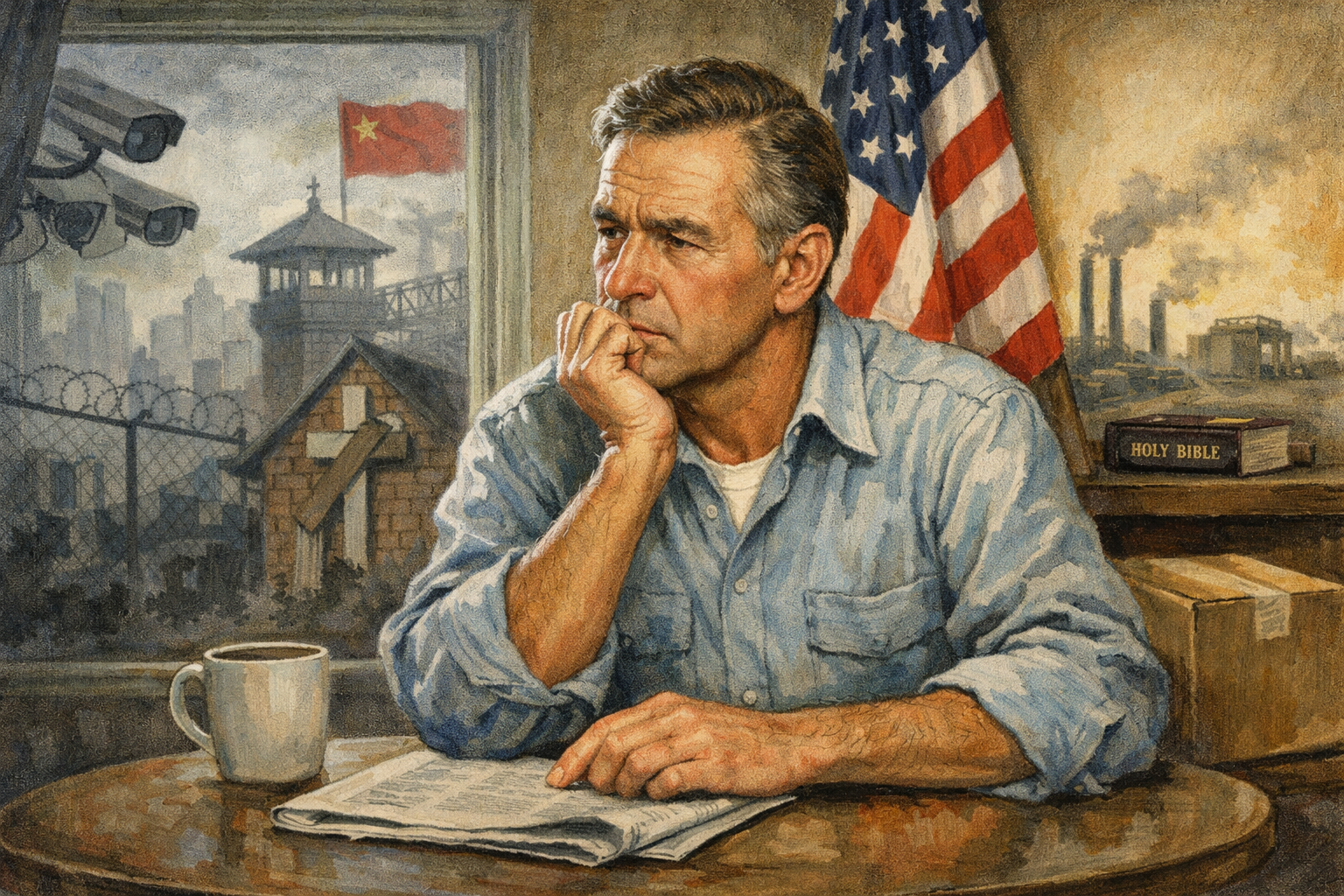
American foreign policy toward China is no longer an abstract concern reserved for diplomats, think tanks, or defense analysts. It has become a kitchen-table issue that affects jobs, prices, national security, religious liberty, and America’s long-term survival as a free and sovereign nation. For this reason alone, China policy deserves careful attention from American voters.
China is not merely another trading partner or geopolitical rival. It is a centralized, authoritarian state governed by the Chinese Communist Party (CCP), which openly rejects Western liberal democracy, suppresses religious freedom, controls speech, and seeks regional—and eventually global—dominance. How the United States responds to this reality shapes economic stability, public safety, technological leadership, and the moral credibility of the nation.
For voters attempting to evaluate Republican and Democrat positions, China policy functions as a revealing stress test. It exposes how each party understands power, human nature, economic interdependence, national sovereignty, and moral responsibility on the world stage. These are not theoretical disagreements; they produce real-world consequences that reach into nearly every American household.
China’s Relevance in Everyday American Life
China now touches American life in ways that would have been unthinkable a generation ago. The United States imports hundreds of billions of dollars’ worth of goods from China annually, making American consumers dependent on Chinese manufacturing for everything from electronics and pharmaceuticals to clothing and household products. While inexpensive goods have lowered short-term costs, they have also hollowed out domestic manufacturing, weakened supply-chain resilience, and increased strategic vulnerability.
The COVID-19 pandemic exposed the danger of this dependence. Medical supply shortages, pharmaceutical bottlenecks, and manufacturing disruptions revealed how deeply American health and safety had become tied to Chinese production decisions. Voters witnessed firsthand how foreign policy failures translate into domestic emergencies.
China also plays a central role in global energy markets, rare-earth mineral supply chains, and advanced technologies such as artificial intelligence, telecommunications, and semiconductors. Decisions made in Beijing increasingly influence whether American factories operate, whether U.S. technology remains competitive, and whether the military retains a strategic edge.
Economic Impact on American Workers and Consumers
From an economic standpoint, U.S.–China policy directly affects employment, wages, and price stability. Decades of bipartisan trade policy—particularly China’s admission into the World Trade Organization—accelerated offshoring of American manufacturing jobs. Entire regions of the country experienced industrial decline as production moved overseas, often to factories operating under labor conditions illegal in the United States.
This economic displacement is not evenly distributed. Working-class communities, especially in the Midwest and Rust Belt, bore the brunt of these decisions. For voters in these regions, China policy is inseparable from questions of economic dignity, opportunity, and national loyalty.
China’s use of intellectual property theft, forced technology transfer, and state subsidies has further distorted global markets. American companies that follow the rules must compete against Chinese firms backed by the full power of an authoritarian state. This undermines free enterprise, discourages innovation, and penalizes ethical business practices.
Public Safety and National Security Concerns
China policy also has direct implications for American public safety. Cyber-espionage, intellectual property theft, influence operations, and military expansion in the Indo-Pacific region present ongoing challenges. The Chinese government has invested heavily in cyber capabilities that target U.S. infrastructure, corporations, universities, and government agencies.
Military developments—from naval expansion to missile technology—raise concerns about regional stability and the security of allies. Taiwan, South Korea, Japan, and the Philippines all factor into U.S. security commitments. A weak or incoherent China policy increases the likelihood of conflict, miscalculation, or coercion.
Closer to home, concerns have emerged regarding Chinese land purchases near military installations, Confucius Institutes on university campuses, and influence operations targeting state and local governments. These developments heighten voter awareness that foreign policy failures are no longer distant or theoretical.
Human Rights and Moral Responsibility
Beyond economics and security lies a moral dimension that cannot be ignored. The Chinese government’s treatment of ethnic and religious minorities—particularly Uyghur Muslims and Christians—raises profound ethical questions for Americans who believe human dignity is not granted by the state.
Reports of mass surveillance, forced labor, internment camps, destruction of churches, and suppression of religious practice stand in stark contrast to American values. How U.S. leaders respond—or fail to respond—to these abuses communicates what the nation truly believes about human rights and moral accountability.
For Christian voters especially, silence or appeasement in the face of religious persecution abroad demands scrutiny. Foreign policy is one of the clearest arenas where stated values collide with political convenience.
Why Voters Must Pay Attention
China policy is not a single-issue concern. It intersects with economic justice, national defense, technological leadership, religious liberty, and moral credibility. It tests whether leaders are willing to confront uncomfortable truths or prefer soothing narratives that delay necessary action.
Polling data consistently shows rising public concern about China’s influence, economic practices, and military ambitions. Trust in China as a partner has declined sharply across party lines, even as disagreements persist over how forcefully the United States should respond.
For voters preparing to cast a ballot, understanding where each party stands on China is not optional. It is foundational. A nation that misunderstands its primary geopolitical rival risks economic decline, strategic defeat, and moral compromise.
Articles in the Critical Issues series require more time to read than most content on this site. They are intentionally written as thorough, in-depth examinations of their subjects.
The Republican Perspective on China Foreign Policy
From the Republican perspective, China represents the most serious long-term geopolitical challenge facing the United States. While Republicans do not speak with perfect unanimity on tactics, there is broad agreement on the central diagnosis: the Chinese Communist Party is an adversarial regime whose goals fundamentally conflict with American sovereignty, economic independence, national security, and moral commitments.
Core Republican Diagnosis: Strategic Rival, Not Partner
Modern Republican foreign policy increasingly rejects the older assumption—dominant in the 1990s and early 2000s—that economic engagement with China would naturally lead to political liberalization. That theory has collapsed under the weight of reality. Instead of democratizing, China consolidated authoritarian power, expanded state surveillance, suppressed dissent, and leveraged economic integration to its own advantage.
The Republican Party’s 2024 platform reflects this reassessment by framing China as a strategic competitor and systemic threat, not merely a trade partner. The platform emphasizes national sovereignty, supply-chain security, military readiness, and resistance to economic coercion (2024 GOP Platform, National Security and Foreign Policy sections).
Republicans argue that treating China as a normal trading partner ignores the ideological nature of the CCP, which explicitly seeks to displace American influence globally while maintaining internal control through repression.
Economic Nationalism and Supply-Chain Security
A defining feature of the Republican approach is economic realism. Republicans increasingly emphasize reshoring critical industries, protecting intellectual property, and reducing reliance on Chinese manufacturing—especially in pharmaceuticals, semiconductors, rare-earth minerals, and defense-related technologies.
Legislation supported by Republican lawmakers has sought to:
- Restrict Chinese access to sensitive technologies
- Penalize intellectual property theft
- Limit Chinese ownership of strategic American assets
- Incentivize domestic manufacturing and allied production
Republicans argue that economic efficiency divorced from national security is reckless. Cheap goods are not truly cheap if they weaken the nation’s industrial base or expose Americans to coercion during crises. This perspective gained traction during the COVID-19 pandemic, when supply shortages revealed the dangers of outsourcing essential production to a geopolitical rival.
Human Rights and Religious Persecution
Republicans have been more vocal than Democrats in condemning China’s human rights abuses, particularly against Uyghur Muslims and Christians. Republican lawmakers have led efforts to label China’s actions in Xinjiang as genocide and to restrict imports tied to forced labor.
From the Republican worldview, religious freedom is not a negotiable cultural preference but a universal human right. The systematic destruction of churches, imprisonment of pastors, forced ideological “re-education,” and state-controlled religious institutions are treated as moral outrages that demand a response.
Republicans often argue that economic engagement without moral accountability amounts to complicity. While acknowledging that sanctions and pressure have limits, they maintain that silence and accommodation signal weakness and moral confusion.
Military Deterrence and Indo-Pacific Strategy
On defense policy, Republicans emphasize deterrence. A credible military presence in the Indo-Pacific is viewed as essential to preventing conflict—not provoking it. Taiwan occupies a central place in this strategy, both as a democratic partner and as a critical node in global semiconductor production.
Republican leaders have supported:
- Increased defense spending focused on naval and missile capabilities
- Strengthening alliances with Japan, South Korea, Australia, and India
- Clear signaling that aggression against Taiwan would carry severe consequences
Republicans argue that ambiguity and hesitation invite miscalculation. Peace is preserved not by wishful thinking, but by strength clearly communicated.
Concerns About Influence Peddling and Elite Entanglement
A recurring Republican concern involves the entanglement of American political and corporate elites with Chinese interests. Republicans argue that decades of globalization created perverse incentives for policymakers to downplay China’s abuses in order to protect business relationships.
Specific scrutiny has been directed toward alleged influence peddling involving Democratic figures and the Biden family. While Republicans acknowledge that investigations must be evidence-based, they argue that even the appearance of compromised judgment undermines public trust and weakens America’s negotiating position.
From the Republican standpoint, leaders who personally benefit from Chinese-linked business arrangements cannot credibly confront Chinese aggression or coercion.
Internal Republican Debates
While the party is largely unified in its skepticism of China, disagreements remain over emphasis and execution. Some Republicans prioritize economic decoupling, while others caution against total disengagement that could harm American exporters and allies.
There is also debate between traditional free-market conservatives and newer economic nationalists over the appropriate level of government intervention. However, these disagreements occur within a shared framework that recognizes China as a hostile authoritarian power rather than a benign partner.
Importantly, these debates are about means, not ends. The end goal—protecting American sovereignty, prosperity, and moral integrity—is widely shared.
Underlying Worldview
At its core, the Republican approach reflects a constrained view of human nature and power. Governments, especially authoritarian ones, are not assumed to act benevolently when given opportunity. Incentives matter. Power seeks expansion. Moral claims without enforcement are easily ignored.
This realism leads Republicans to favor strength, deterrence, accountability, and clear-eyed assessment over optimistic theories about inevitable progress through trade.
The Democrat Perspective on China Foreign Policy
The Democrat Party’s approach to China foreign policy is more internally divided and rhetorically complex than the Republican position. While Democrats increasingly acknowledge that China poses strategic challenges, their policy instincts often reflect competing priorities: economic interdependence, multilateral cooperation, climate diplomacy, and Progressive (wokeness, Cultural Marxism, political correctness, identity politics, critical theory/intersectionality, Neo-Marxism) assumptions about global governance and power.
As a result, Democrat policy toward China frequently oscillates between confrontation and accommodation, producing mixed signals that concern critics both inside and outside the party.
Official Platform Language and Stated Commitments
The 2024 Democrat Party platform frames China as a “competitor,” not an enemy, emphasizing the need to “responsibly manage competition” while avoiding escalation. The platform stresses:
- Multilateral engagement through international institutions
- Cooperation on global challenges such as climate change and public health
- Targeted responses to unfair trade practices
- Defense of human rights through diplomacy rather than broad economic disengagement
(2024 Democrat Platform, Foreign Policy and National Security sections)
The language is deliberately calibrated. Democrats seek to avoid framing the relationship in civilizational or ideological terms, preferring a technocratic tone that emphasizes process, norms, and global coordination.
Economic Interdependence and Managed Competition
Democrats generally resist full economic decoupling from China. While acknowledging supply-chain vulnerabilities, they argue that wholesale disengagement would raise consumer prices, disrupt global markets, and alienate allies.
Instead, Democrat lawmakers often advocate for:
- “Selective decoupling” in sensitive sectors
- Continued trade in consumer goods
- Regulatory cooperation where possible
- International pressure through the World Trade Organization and allied frameworks
This approach reflects a belief that global economic integration can still serve as a stabilizing force—even when dealing with authoritarian regimes.
Critics argue that this confidence persists despite decades of evidence that China exploits open markets without reciprocating openness.
Human Rights: Rhetoric vs. Priority
Democrat leaders routinely condemn China’s human rights abuses in speeches and resolutions. Official statements denounce the treatment of Uyghurs, restrictions on religious freedom, and suppression of dissent in Hong Kong.
However, Democrats tend to place human rights alongside a long list of competing priorities rather than treating them as decisive factors in policy decisions. Climate cooperation, economic stability, and diplomatic engagement often take precedence in practice.
Progressive factions within the party sometimes frame criticism of China cautiously, expressing concern about fueling “anti-Asian sentiment” domestically. While the concern for racial harmony is understandable, critics argue that it has occasionally been used to blunt necessary moral clarity regarding CCP abuses.
Climate Change as a Central Constraint
One of the most significant influences on Democrat China policy is climate ideology. China is the world’s largest emitter of greenhouse gases, making cooperation with Beijing a central pillar of Democrat climate strategy.
This dependency creates tension. Democrats often hesitate to impose strong economic or diplomatic penalties on China for fear of undermining climate agreements. Republicans argue that this gives China leverage, allowing it to extract concessions while continuing environmental practices that contradict public commitments.
From the Democrat perspective, climate change represents a global existential threat that justifies compromise in other areas. From the Republican perspective, this prioritization distorts policy and enables exploitation.
Progressive Assumptions Shaping Policy
Progressive ideology plays a subtle but powerful role in shaping Democrat attitudes toward China. Progressivism (wokeness, Cultural Marxism, political correctness, identity politics, critical theory/intersectionality, Neo-Marxism) tends to view Western power with suspicion and to interpret global conflict through frameworks of historical guilt and systemic oppression.
Within this worldview:
- Western nations are often seen as primary drivers of global injustice
- Authoritarian regimes are sometimes treated as reactive rather than responsible actors
- Power disparities are emphasized over moral agency
This lens can soften moral judgments against non-Western authoritarian states while intensifying criticism of American actions. Critics argue that this leads to asymmetrical standards—where U.S. behavior is scrutinized relentlessly while CCP actions are contextualized or minimized.
Legislative and Leadership Signals
Democrat lawmakers have supported some restrictive measures against China, including limited sanctions and export controls. However, these actions are often paired with language emphasizing continued engagement and dialogue.
At the executive level, the Biden administration has sent mixed signals—strengthening certain military alliances while maintaining extensive economic ties and reopening high-level diplomatic channels.
Democrat governors and mayors, particularly in Progressive strongholds, have also pursued trade missions and investment relationships with China, sometimes downplaying security concerns in favor of economic development.
Internal Party Divisions
There are genuine divisions within the Democrat Party. More centrist Democrats express concern about China’s military ambitions and economic coercion, while Progressive factions prioritize global governance frameworks and ideological critiques of American power.
These divisions result in cautious, incremental policy rather than decisive shifts. The party often speaks firmly while acting carefully.
Underlying Worldview
At root, the Democrat approach reflects a more unconstrained vision of governance. Institutions, norms, and cooperative frameworks are trusted to restrain bad actors. Moral progress is assumed to be achievable through engagement, dialogue, and shared global goals.
Critics argue that this approach underestimates the ideological commitments of the CCP and overestimates the power of persuasion in the absence of credible consequences.
The Libertarian Perspective on China Foreign Policy
The Libertarian Party occupies a distinct and limited position in American foreign policy debates, including policy toward China. While Libertarians are not a dominant force in national elections, their perspective is worth brief examination because it highlights philosophical differences that help clarify why Republicans and Democrats diverge as they do.
Libertarian views on China are shaped less by geopolitical rivalry and more by foundational commitments to non-intervention, free markets, and skepticism toward state power—both foreign and domestic.
Core Libertarian Framework
According to the most recent Libertarian Party platform, foreign policy should prioritize peace, voluntary trade, and minimal entanglement in international conflicts. Libertarians generally oppose:
- Military intervention absent direct threats
- Economic sanctions that distort markets
- Trade restrictions imposed for strategic or moral reasons
- Nation-building or ideological confrontation
Applied to China, this framework leads Libertarians to favor economic engagement while opposing military escalation or aggressive containment strategies.
Trade and Economic Relations
Libertarians typically support free trade with China, arguing that voluntary exchange benefits consumers and reduces incentives for conflict. From this perspective, tariffs, export controls, and industrial policy are viewed as harmful interventions that raise prices and invite retaliation.
Unlike Republicans, Libertarians are less concerned with supply-chain nationalism or reshoring mandates. They argue that markets—not governments—should determine production locations and investment flows.
Critics counter that this approach ignores the reality that China’s economy is not a free market. Because Chinese firms operate within a state-controlled system, trade is not truly voluntary or reciprocal, undermining the Libertarian assumption of symmetrical exchange.
Human Rights and Moral Restraint
Libertarians generally condemn human rights abuses in China but resist using state power to address them. Sanctions, they argue, punish ordinary people rather than political elites and entangle the U.S. in moral crusades abroad.
This restraint flows from a broader Libertarian skepticism toward using government authority for moral enforcement, especially beyond national borders.
From a biblical or conservative perspective, this posture is often viewed as morally insufficient. While restraint can prevent overreach, it can also result in passivity in the face of genuine evil.
Military and Security Concerns
Libertarians tend to oppose increased military presence in the Indo-Pacific and question U.S. commitments to allies such as Taiwan. They argue that defensive posture should be strictly limited to direct threats to American territory.
This sharply contrasts with the Republican emphasis on deterrence and alliance-building. Republicans view deterrence as a means of preventing war; Libertarians worry it increases the likelihood of entanglement.
Alignment with Other Parties
On China policy, Libertarians occasionally overlap with Democrats in opposing tariffs and military escalation, but they diverge sharply from Progressive ideology. Libertarians do not share the Progressive suspicion of American power rooted in identity or historical guilt frameworks. Their skepticism is structural, not ideological.
At the same time, Libertarians diverge from Republicans by rejecting national-interest arguments that justify state intervention in markets or assertive foreign policy.
Why the Libertarian Position Remains Peripheral
The Libertarian approach struggles to gain traction because it assumes a world where economic freedom naturally moderates political behavior. China’s authoritarian model challenges this assumption directly.
For voters concerned with national survival, religious liberty abroad, and long-term strategic stability, the Libertarian position often appears insufficiently serious about power realities.
For this reason, while Libertarian ideas surface in debates, they do not meaningfully shape U.S.–China policy outcomes.
Progressive Principles and Their Influence on Democrat China Policy
To understand why Democrat policy toward China often appears conflicted or hesitant, it is necessary to examine the influence of Progressive ideology. Progressivism (wokeness, Cultural Marxism, political correctness, identity politics, critical theory/intersectionality, Neo-Marxism) does not merely supply policy preferences; it supplies a framework for interpreting power, history, and moral responsibility.
This framework profoundly shapes how many Democrats understand China, the United States, and the relationship between them.
Power Reversal and Moral Asymmetry
A central Progressive assumption is that Western nations—especially the United States—are historically dominant, exploitative actors whose power must be restrained. Non-Western states are frequently viewed through a lens of grievance, historical victimhood, or reactive development.
Applied to China, this produces moral asymmetry:
- American actions are scrutinized for imperialism, hypocrisy, or overreach
- Chinese actions are contextualized as responses to Western pressure or historical humiliation
This does not require explicit admiration for the Chinese Communist Party. Rather, it results in softened moral judgment and reduced urgency when confronting CCP abuses.
Progressive frameworks often emphasize outcomes over agency. Structural explanations replace moral accountability. As a result, authoritarian behavior is interpreted as a symptom rather than a choice.
Suspicion of National Sovereignty
Progressivism tends to view strong national sovereignty with suspicion. Borders, national interests, and independent decision-making are often portrayed as obstacles to global cooperation.
This predisposition affects China policy by encouraging:
- Reliance on international institutions to restrain CCP behavior
- Preference for multilateral pressure rather than bilateral strength
- Reluctance to assert uniquely American interests
The assumption is that global norms, agreements, and institutions can substitute for power-based deterrence. Critics argue that this assumption collapses when dealing with regimes that selectively ignore norms while exploiting institutions.
Economic Globalism and Elite Consensus
Progressive ideology aligns closely with economic globalism. Global supply chains, international regulatory bodies, and transnational corporations are viewed as engines of equity and efficiency.
Within this framework, disrupting economic integration with China is often seen as regressive, nationalistic, or destabilizing. Concerns raised by working-class Americans about job loss or industrial decline are sometimes reframed as protectionist or xenophobic.
This produces a policy bias toward maintaining economic ties even when evidence suggests those ties benefit authoritarian elites more than ordinary citizens—both Chinese and American.
Climate Absolutism as a Policy Constraint
Progressive climate ideology treats climate change as the overriding moral and political issue of the age. This belief constrains China policy in a unique way.
Because China is indispensable to global emissions agreements, Progressives often treat confrontation with Beijing as subordinate to climate cooperation. This elevates environmental objectives above human rights, national security, and economic independence.
Critics argue that this approach grants China effective veto power over Western policy by making cooperation on climate the prerequisite for meaningful resistance elsewhere.
Language Management and Moral Relativism
Progressive political culture places heavy emphasis on language discipline. Terms like “genocide,” “persecution,” and “totalitarianism” are often avoided or diluted to prevent diplomatic friction or domestic backlash.
This linguistic caution bleeds into policy. If moral clarity is softened at the rhetorical level, decisive action becomes harder to justify.
By contrast, Republicans argue that clarity in language is the first step toward clarity in action.
Practical Policy Outcomes
The cumulative effect of Progressive presuppositions is a China policy that:
- Acknowledges abuses rhetorically
- Avoids decisive economic or diplomatic confrontation
- Prioritizes global consensus over unilateral strength
- Treats American assertiveness as a greater danger than authoritarian expansion
This does not mean all Democrats consciously endorse these assumptions. However, they shape the institutional culture in which decisions are made.
Why This Matters to Voters
Voters evaluating Democrat China policy must understand that inconsistencies are not merely tactical. They reflect deeper philosophical commitments about power, guilt, and moral responsibility.
Where Republicans emphasize deterrence and accountability, Progressives emphasize restraint and reconciliation—even when evidence suggests the latter empowers authoritarian actors.
Understanding this distinction helps voters move beyond surface-level rhetoric and assess whether policy outcomes align with stated values.
Do Democrat Actions Match Their Platform on China?
Senator Joseph P. Kennedy famously observed, “In politics, what you DO is what you believe. Everything else is cottage cheese.” That maxim provides a useful lens for evaluating Democrat leadership on China. Party platforms and speeches communicate intent, but actions reveal priorities. When examined carefully, a noticeable gap emerges between Democrat rhetoric on China and the practical behavior of Democrat leadership—particularly under the Biden administration.
Stated Commitments vs. Operational Reality
The Democrat platform speaks forcefully about defending human rights, protecting American workers, and confronting unfair trade practices. In theory, these commitments would demand sustained pressure on an authoritarian regime that engages in forced labor, religious persecution, intellectual property theft, and military intimidation.
In practice, however, Democrat leadership has often pursued de-escalation and accommodation, even when doing so undermines those stated commitments. Sanctions have been selective and narrow. Trade relationships have largely remained intact. High-level diplomatic engagement has resumed with minimal public concessions from Beijing.
The result is a policy posture that signals concern but avoids meaningful cost imposition.
Human Rights: Selective Moral Enforcement
Democrat leaders frequently invoke human rights language when addressing domestic political opponents, but apply it inconsistently in foreign policy. China’s treatment of Uyghurs and Christians is widely documented, yet these abuses rarely function as deal-breakers in negotiations.
There is little evidence that human rights concerns meaningfully constrain trade, climate talks, or diplomatic engagement. This selective enforcement creates the impression that moral standards are flexible when economic or ideological priorities intervene.
Critics argue that this double standard undermines credibility and signals to authoritarian regimes that moral condemnation without consequence is largely symbolic.
Influence Peddling and Conflicts of Interest
Concerns about influence peddling have further complicated public trust. Republicans have raised questions regarding business relationships between members of the Biden family and Chinese-linked entities. While investigations must be grounded in evidence, the broader issue is one of appearance and incentive.
When political elites or their families profit from relationships with foreign adversaries, even indirectly, it weakens the moral authority of policy decisions. It also feeds public suspicion that economic entanglements discourage robust confrontation.
Democrat leadership has often dismissed these concerns as partisan attacks rather than addressing the underlying transparency issue. This response has done little to reassure skeptical voters.
Climate Policy as a Policy Override
One of the clearest inconsistencies between platform language and behavior is the prioritization of climate cooperation. Despite China’s continued expansion of coal-fired power plants and its status as the world’s largest emitter, Democrat leaders have treated climate collaboration as a non-negotiable priority.
This has resulted in a pattern where China faces limited consequences for environmental hypocrisy while the United States imposes costly restrictions on itself. Critics argue that this asymmetry reflects ideological commitment rather than strategic realism.
If human rights and national security were truly equal priorities, climate considerations would not consistently override them.
Soft Authoritarian Tendencies
Another concern raised by critics is the emergence of soft authoritarian tendencies within Progressive governance. While not comparable to China’s totalitarianism, Democrat-led administrations have increasingly favored centralized control, regulatory enforcement, and narrative management.
This posture can produce a degree of ideological sympathy—or at least reduced urgency—when dealing with authoritarian systems abroad. When domestic dissent is treated as a problem to be managed rather than debated, foreign authoritarianism appears less alien.
The overlap is philosophical rather than conspiratorial: both systems prioritize administrative expertise, centralized decision-making, and compliance over dissent.
Case Studies: Progressive States and Cities
Progressive state and city administrations often mirror these national patterns. Trade delegations, investment partnerships, and academic exchanges with China have continued at the state and municipal level, sometimes with minimal security scrutiny.
Cities such as San Francisco, New York, Seattle, and Washington, D.C. have maintained economic and cultural engagement while downplaying geopolitical risk. Critics argue this reflects a broader Progressive tendency to prioritize global integration over national resilience.
Signposting the Core Inconsistency
To summarize the mismatch:
- Rhetoric: Strong condemnation of abuses and unfair practices
- Behavior: Limited confrontation and continued engagement
- Justification: Climate urgency, global stability, diplomatic norms
- Outcome: Reduced leverage and mixed signals
The question for voters is not whether Democrats say the right things, but whether their actions produce outcomes consistent with those claims.
Each Party’s Position Viewed from the Opposition
One of the most clarifying ways to evaluate China policy is to examine how each party’s position appears when viewed through the eyes of its critics. This exercise exposes blind spots, internal tensions, and tone-deaf rhetoric that often undermines credibility. It also helps voters separate serious disagreements from caricature.
Before doing so, it is helpful to briefly introduce Thomas Sowell’s distinction between constrained and unconstrained visions of human nature and governance, because this framework explains many of the disagreements surrounding China policy.
Constrained vs. Unconstrained Visions
A constrained vision assumes that human nature is flawed, power is dangerous, and institutions must be designed to restrain ambition and abuse. This vision emphasizes incentives, deterrence, accountability, and historical realism.
An unconstrained vision assumes that human behavior can be shaped and improved through education, institutions, and moral progress. It emphasizes cooperation, expertise, and good intentions, often trusting systems to self-correct.
Applied to China policy:
- Republicans tend to operate from a constrained vision
- Democrats—especially Progressives—tend toward an unconstrained vision
This philosophical divide explains why the parties often talk past one another.
How Democrats Critique the Republican Position
Primary Democrat Criticisms
- Republicans are accused of exaggerating the China threat to justify military spending
- Tariffs and decoupling are portrayed as economically reckless and inflationary
- Strong rhetoric is said to increase the risk of war
- Republicans are criticized for “Cold War thinking” and zero-sum framing
Democrats often argue that Republican policies substitute confrontation for strategy and emotion for diplomacy.
Republican Counter-Responses
Republicans respond that:
- China’s behavior—not Republican rhetoric—drives tension
- Deterrence reduces the risk of war rather than increases it
- Economic pain is the cost of long-term independence, not a failure of policy
- History shows that wishful thinking toward authoritarian regimes ends badly
Republicans argue that Democrats mistake restraint for wisdom and confuse engagement with influence.
Tone-Deaf Democrat Statements
Democrat leaders have sometimes undermined their credibility by minimizing China’s threat or emphasizing “partnership” language after repeated CCP provocations. Statements suggesting that competition can be indefinitely “managed” without consequence strike critics as dangerously naive.
How Republicans Critique the Democrat Position
Primary Republican Criticisms
- Democrats are accused of prioritizing climate and global governance over national security
- Engagement is viewed as appeasement dressed in diplomatic language
- Human rights rhetoric is seen as selective and inconsistent
- Progressive ideology is blamed for moral asymmetry and reluctance to confront authoritarianism
Republicans often argue that Democrats fear being perceived as “too tough” more than they fear strategic failure.
Democrat Counter-Responses
Democrats reply that:
- Republicans underestimate the economic cost of confrontation
- Military posturing risks escalation and miscalculation
- Global challenges require cooperation, not unilateralism
- Moral absolutism complicates diplomacy
They argue that Republicans oversimplify complex systems and undervalue institutional leverage.
Tone-Deaf Republican Statements
Some Republican leaders undermine their own case by using overly theatrical language or vague calls for confrontation without specifying policy mechanisms. Loose rhetoric about “decoupling from everything” or casual references to regime change provide easy targets for critics.
Blind Spots on Both Sides
Republican Blind Spots
- Underestimating short-term economic disruption
- Assuming allies will always align automatically
- Occasionally conflating strength with volume or rhetoric
Democrat Blind Spots
- Overestimating institutional influence
- Underestimating ideological commitment of the CCP
- Confusing intentions with outcomes
Each party highlights the other’s failures while often ignoring its own structural weaknesses.
Why This Matters for Voters
Understanding these critiques helps voters distinguish between:
- Legitimate caution and ideological paralysis
- Necessary deterrence and reckless escalation
- Moral clarity and performative outrage
China policy rewards realism and punishes illusion. Voters should ask not which arguments sound kinder or smarter, but which assumptions about power, incentives, and human nature are more consistent with history.
Credible Suspicions About Party Motives and Strategies
Beyond stated principles and public rhetoric, voters often attempt to infer motives. While speculation must be handled responsibly, certain patterns of behavior justify reasonable suspicion about the strategic aims and incentives driving each party’s approach to China.
This section does not allege conspiracies. It examines incentives, consistency, and observable outcomes—using leaders’ own words and actions as evidence.
Republican Motives: National Strength or Political Leverage?
Common Suspicions Raised by Critics
Critics of the Republican Party sometimes argue that China policy is used as a political instrument rather than a coherent strategy. They claim Republicans:
- Emphasize China to rally nationalist sentiment
- Use economic confrontation to appeal to displaced workers
- Invoke national security to justify defense spending increases
Some critics suggest that Republican rhetoric occasionally outruns policy precision, creating the impression of toughness without always delivering long-term planning.
Evidence That Counters These Suspicions
However, Republican behavior over the past decade provides substantial counterevidence:
- Sustained focus on supply-chain security even when politically costly
- Willingness to accept higher consumer prices due to tariffs
- Bipartisan willingness to confront corporate interests benefiting from China
These actions suggest that Republican concern with China is not merely rhetorical. It reflects a belief that economic pain now is preferable to strategic collapse later.
Tone-Deaf Republican Statements
Occasionally, Republican leaders undermine credibility by framing China policy as a matter of national pride rather than strategic necessity. Language implying inevitability of conflict or using imprecise “enemy” rhetoric without clarifying policy goals fuels unnecessary fear.
Democrat Motives: Stability, Ideology, or Elite Protection?
Common Suspicions Raised by Critics
Democrats face deeper skepticism regarding motives because of repeated discrepancies between rhetoric and action. Critics suspect that Democrat leadership:
- Prioritizes economic stability to protect elite and corporate interests
- Avoids confrontation to preserve climate negotiations
- Downplays CCP abuses to avoid ideological contradictions
- Protects political figures with financial or relational exposure to China
These suspicions are amplified by transparency failures and dismissive responses to legitimate oversight questions.
Evidence Supporting These Concerns
Observable behavior strengthens these suspicions:
- Rapid normalization of diplomatic relations after public condemnations
- Limited economic consequences imposed on China despite repeated provocations
- Continued reliance on Chinese supply chains even after national security warnings
When climate cooperation is repeatedly cited as justification for restraint—despite China’s noncompliance—critics reasonably infer ideological prioritization over national interest.
Tone-Deaf Democrat Statements
Statements minimizing China’s threat or framing CCP aggression as “misunderstandings” undermine confidence. Language emphasizing “guardrails” and “responsible competition” without corresponding enforcement mechanisms reinforces perceptions of weakness.
Strategic Incentives at Work
Republican Incentive Structure
- Electoral support from working-class and national-security voters
- Pressure to demonstrate tangible resistance to authoritarian expansion
- Incentive to reduce corporate dependence on foreign regimes
Democrat Incentive Structure
- Alliance with global economic and academic elites
- Ideological commitment to multilateral governance
- Dependence on climate diplomacy narratives
- Sensitivity to Progressive activist pressure
Neither party operates in a vacuum. Incentives shape priorities even when intentions are sincere.
Why Suspicion Is Not Cynicism
Healthy skepticism is not nihilism. Voters are not required to assume malicious intent to recognize patterns that suggest misaligned priorities.
China policy demands trustworthiness because consequences are long-term and often irreversible. When leaders obscure motives, shift standards, or resist accountability, suspicion becomes a rational response rather than a partisan reflex.
High-Trust, Low-Trust Societies, and China Policy
One of the most overlooked dynamics shaping the China debate is the erosion of trust within American society. Understanding the distinction between high-trust and low-trust societies helps explain why Republican and Democrat voters interpret the same facts about China so differently—and why suspicion has become a defining feature of this issue.
What Is a High-Trust Society?
A high-trust society is one in which citizens generally believe that:
- Institutions act in good faith
- Leaders apply rules consistently
- Agreements will be honored
- Information is shared honestly
Such societies can tolerate complexity, delayed outcomes, and negotiated solutions because trust functions as social capital. Historically, the United States operated as a high-trust society, especially during the mid-20th century.
What Is a Low-Trust Society?
In a low-trust society, citizens assume:
- Elites protect themselves first
- Rules are applied selectively
- Language is manipulated
- Agreements are exploited
Low-trust environments produce skepticism, polarization, and demand for visible enforcement rather than assurances.
How Trust Decline Affects China Policy
American trust has declined sharply due to:
- Elite failures in trade and globalization
- Repeated intelligence and policy errors
- Inconsistent application of moral standards
- Institutional defensiveness instead of accountability
China policy sits squarely in this trust collapse.
Republican voters—particularly working-class voters—largely interpret decades of engagement with China as a betrayal. Promises that free trade would strengthen America and liberalize China proved false. As trust eroded, tolerance for technocratic reassurance vanished.
Democrat voters and leaders, by contrast, often retain higher institutional trust. They are more inclined to believe that:
- Experts can manage competition
- International institutions constrain bad actors
- Norms eventually shape behavior
This divergence explains why identical policy language produces radically different reactions.
Republican Trust Deficit Toward Democrats
Republicans increasingly suspect that Democrat leaders:
- Say one thing publicly and do another privately
- Protect elite economic interests
- Downplay risks that inconvenience ideological priorities
Even when Democrats deny malicious intent, the pattern of behavior sustains suspicion.
This mirrors the immigration example you referenced: Democrats deny intentional demographic manipulation, yet their policies predictably produce outcomes that benefit their political coalition. The same logic applies to China—intent may be denied, but incentives and results remain.
Democrat Trust Deficit Toward Republicans
Democrats, for their part, often distrust Republican motives, suspecting:
- Manufactured fear for political gain
- Reckless escalation tendencies
- Simplistic nationalism
They fear that Republican China policy could trigger economic instability or military conflict.
China as a Low-Trust Actor
Complicating matters further, China itself operates as a low-trust actor:
- Agreements are selectively enforced
- Transparency is minimal
- Strategic deception is normalized
When a low-trust society negotiates with a low-trust regime through low-trust domestic institutions, outcomes degrade rapidly.
Republicans argue this reality requires deterrence and enforcement. Democrats argue it requires better frameworks and cooperation. The disagreement is not merely policy—it is a dispute over how trust functions in the real world.
Why This Matters for Voters
In a low-trust environment, voters gravitate toward:
- Clear lines
- Enforceable consequences
- Measurable outcomes
China policy shaped by trust-based assumptions is increasingly rejected by a public that feels misled.
Understanding this helps explain why China has become a defining issue for Republicans—and a liability for Democrats who continue to emphasize reassurance over results.
Media Distortion and the China Policy Debate
Media coverage plays a decisive role in shaping how Americans understand China policy. Because most voters do not read party platforms or legislation directly, they rely on journalists and commentators to interpret events, frame risks, and assign responsibility. When media narratives distort or selectively emphasize aspects of the debate, public understanding suffers—and policy accountability weakens.
Narrative Framing and Selective Emphasis
A recurring pattern in mainstream media coverage is asymmetrical framing. Republican actions toward China are frequently described using charged language—“aggressive,” “provocative,” “escalatory”—while Democrat actions are framed as “measured,” “responsible,” or “diplomatic,” even when the substance differs only marginally.
For example, tariffs imposed under Republican administrations are often portrayed primarily as economic self-harm, with limited discussion of intellectual property theft, forced labor, or strategic vulnerability. When Democrats maintain or selectively adjust the same tariffs, coverage tends to emphasize continuity and pragmatism rather than contradiction.
This framing trains audiences to associate firmness with recklessness and restraint with wisdom, regardless of outcomes.
Downplaying Human Rights in Practice
Media outlets regularly acknowledge China’s human rights abuses, but coverage is often compartmentalized. Reports on Uyghur internment camps, religious persecution, and surveillance technology are treated as standalone moral stories rather than integrated into trade, climate, or diplomatic reporting.
As a result, viewers may condemn abuses in theory while failing to connect them to policy decisions that enable or tolerate those abuses. When Democrats prioritize climate cooperation or economic engagement, media coverage rarely asks whether those choices undermine human rights commitments.
Republican efforts to link trade policy to forced labor or religious persecution are frequently dismissed as politicization rather than moral consistency.
Language Policing and Rhetorical Asymmetry
Another distortion involves language management. Media outlets often scrutinize Republican terminology—such as references to “the Chinese Communist Party” rather than “China”—as inflammatory or xenophobic, even when the distinction is analytically precise.
By contrast, euphemistic language used by Democrat leaders—such as “guardrails,” “competition,” or “strategic patience”—is rarely interrogated for clarity or effectiveness.
This asymmetry discourages direct speech and rewards ambiguity, even when ambiguity obscures reality.
Minimizing Progressive Influence
Media coverage also tends to minimize or deny the influence of Progressive ideology on China policy. Discussions of identity politics, critical theory, or ideological hostility toward Western power are often dismissed as partisan talking points rather than examined as real drivers of policy priorities.
As a result, voters may struggle to understand why human rights concerns are subordinated to climate goals or why moral clarity evaporates in multilateral forums.
Selective Use of Expert Authority
Expert commentary frequently reinforces institutional consensus. Analysts drawn from academic, diplomatic, or NGO backgrounds often share similar assumptions about global governance and engagement. Dissenting voices—especially those emphasizing deterrence, sovereignty, or moral accountability—are more likely to be framed as ideological rather than analytical.
This narrows the range of acceptable debate and reinforces trust in approaches that have already failed to deliver promised outcomes.
Consequences for Democratic Accountability
When media coverage obscures inconsistencies and shields leaders from scrutiny, voters are deprived of the information needed to hold officials accountable. China policy becomes a matter of tone rather than results, and failure is rebranded as complexity.
For voters attempting to assess party competence, this distortion matters deeply. A free press is meant to clarify power, not protect it.
A Biblical Perspective on U.S.–China Foreign Policy
A biblical perspective on foreign policy does not provide a detailed policy manual, but it does offer governing principles that shape moral judgment, political restraint, and responsibility before God. Scripture speaks clearly about human nature, the purpose of civil authority, the limits of power, and the obligation to pursue justice without illusion.
When applied to China policy, these principles illuminate why biblical Christians tend to align more closely with the Republican approach—even while recognizing that no political party fully embodies biblical ethics.
Human Nature and the Reality of Power
Scripture presents a sober view of human nature. Fallen man does not drift naturally toward righteousness when given power; he gravitates toward control, self-preservation, and domination (Genesis 8:21; Jeremiah 17:9). This realism undercuts the assumption that authoritarian regimes can be reliably transformed through trade, dialogue, or institutional inclusion.
From a biblical standpoint, the Chinese Communist Party must be evaluated not by its stated intentions, but by its fruit. A regime that suppresses religious worship, surveils its citizens, lies systematically, and imprisons dissenters is not morally neutral. It is acting consistently with fallen human authority unchecked by accountability.
This reality aligns more closely with the constrained vision emphasized by conservatives than with Progressive optimism about institutional reform.
The God-Ordained Role of Civil Government
Romans 13 teaches that civil authorities are instituted by God to restrain evil and reward good. Governments exist not merely to manage economic efficiency, but to uphold order, justice, and peace.
Applied internationally, this principle suggests that a nation has a legitimate moral obligation to:
- Defend its people
- Protect its sovereignty
- Resist regimes that threaten peace and freedom
A government that refuses to confront evil abroad under the guise of neutrality or global harmony risks failing its God-given responsibility at home.
China’s persecution of Christians—through church demolitions, imprisonment of pastors, and state-controlled religious institutions—places it squarely in the category of regimes that oppose God’s moral order. Scripture does not permit indifference to such persecution.
Justice, Not Utopianism
Biblical justice is concrete, limited, and grounded in truth. It does not confuse intentions with outcomes, nor does it sacrifice righteousness for the promise of future harmony.
Progressive approaches often mirror utopian impulses condemned implicitly in Scripture: the belief that centralized power, expertise, or global systems can overcome human sin. The Tower of Babel stands as a warning against precisely this mindset—human unity pursued apart from submission to God (Genesis 11:1–9).
China’s technocratic authoritarianism is a modern echo of this impulse. A biblical worldview recognizes that such systems may achieve efficiency, but at the cost of truth, freedom, and dignity.
Moral Clarity Without Crusading
A biblical approach does not require reckless militarism or endless intervention. Scripture cautions against pride, overconfidence, and unnecessary bloodshed (Proverbs 16:18; Matthew 26:52).
However, restraint is not the same as passivity. Silence in the face of evil is not neutrality—it is tacit permission. A nation may pursue peace while still naming injustice and imposing consequences proportionate to wrongdoing.
This balance explains why biblical Christians often support deterrence, economic pressure, and moral clarity—while rejecting both isolationism and globalist idealism.
Alignment of Worldviews
When comparing party positions:
- Republicans largely operate within assumptions consistent with biblical realism about power, sin, and accountability
- Democrats, particularly under Progressive influence, often reflect Enlightenment and Neo-Marxist assumptions about moral progress through systems
- Libertarians underestimate the biblical role of civil authority in restraining evil
Biblical Christians align most closely with Republicans not because Republicans are righteous, but because their framework allows Christians to speak, act, and influence policy without surrendering core convictions.
Why This Matters for Christian Voters
Foreign policy is not morally neutral. Decisions about trade, diplomacy, and deterrence affect real people created in the image of God—both abroad and at home.
A biblical Christian cannot evaluate China policy solely through economic convenience or diplomatic tone. The suppression of truth, worship, and human dignity demands a response shaped by justice, humility, and courage.
Voting with Biblical Discernment on China Policy
Scripture does not command Christians to align with a political party, but it does command them to exercise wisdom, pursue justice, and love their neighbor. In a representative republic, voting is one of the ordinary means by which Christians may seek the good of their nation and restrain evil.
China policy is an area where this responsibility becomes especially clear.
Voting as Moral Stewardship
Voting is not merely an expression of preference; it is an act of stewardship. When citizens are granted influence over public authority, they bear responsibility for how that authority is exercised. Proverbs repeatedly commends prudence, foresight, and moral seriousness in leadership (Proverbs 29:2).
A Christian voter must therefore ask:
- Which policies restrain evil most effectively?
- Which leaders speak truth without illusion?
- Which framework best acknowledges human sin and the dangers of unchecked power?
On China policy, these questions cannot be answered by tone or rhetoric alone. They require examination of outcomes and governing assumptions.
Weighting Issues Appropriately
Biblical wisdom requires moral prioritization. Not all political issues carry equal weight. Scripture consistently treats the sanctity of human life, justice for the oppressed, and protection of the innocent as foundational concerns.
Foreign policy intersects with these priorities when it enables or resists:
- Forced labor and human trafficking
- Religious persecution
- Systematic deception and coercion
- Threats to national survival
A mature Christian recognizes that while taxation levels and regulatory debates matter, they do not carry the same moral gravity as policies that enable mass oppression or weaken a nation’s ability to protect life and liberty.
Why Biblical Christians Tend to Support Republicans
While no party fully represents biblical ethics, the Republican Party has consistently allowed space for biblical Christians to participate openly within its ranks. Republican China policy more closely reflects:
- Moral realism about power
- Willingness to confront evil rather than rationalize it
- Respect for national sovereignty
- Serious concern for religious liberty
Democrat China policy, especially under Progressive influence, often subordinates these concerns to climate ideology, global consensus, and institutional preservation.
Libertarian policy, while valuing liberty, tends to minimize the biblical role of civil authority in restraining evil.
For these reasons, biblical Christians generally align with Republicans—not out of blind loyalty, but because the framework permits faithful engagement without surrendering conviction.
Scriptural Guardrails
Christians must avoid two errors:
- Treating politics as salvific
- Withdrawing from public responsibility out of cynicism
Psalm 146 warns against trusting princes for ultimate deliverance, while Jeremiah 29:7 commands God’s people to seek the welfare of the city where they live.
Voting is one limited but meaningful way to pursue that welfare.
China Policy as a Test Case
China policy exposes whether leaders:
- Name evil honestly
- Protect the vulnerable
- Resist the seduction of comfort and profit
- Accept short-term costs for long-term justice
Christians should favor candidates who demonstrate courage, clarity, and consistency in these areas—even when doing so is politically costly.
The Christian’s Duty to Seek the Welfare of the Nation
Scripture consistently teaches that God’s people are not detached observers of the societies in which they live. While their ultimate citizenship is in heaven, Christians are called to live responsibly, prayerfully, and constructively within their earthly nations.
This duty includes—but is not limited to—how Christians think about foreign policy and their nation’s posture toward regimes such as Communist China.
Seeking the Nation’s Welfare
Jeremiah’s instruction to the Jewish exiles in Babylon remains instructive: “Seek the welfare of the city where I have sent you into exile, and pray to the LORD on its behalf” (Jeremiah 29:7, ESV). Though spoken to a displaced people, the principle applies broadly. God’s people are to seek peace, stability, and justice where they reside, even under imperfect governments.
In a constitutional republic, this obligation naturally includes informed civic participation. Foreign policy decisions—especially those involving hostile powers—directly affect a nation’s welfare, security, and moral posture.
Voting as One Means, Not the Only Means
Voting is a legitimate and often necessary means of seeking the nation’s good, but it is not the only one. Scripture does not reduce faithfulness to ballot casting. Christians may also pursue the welfare of their nation through:
- Prayer for leaders and authorities (1 Timothy 2:1–2)
- Public witness and truthful speech
- Supporting institutions that defend religious liberty
- Teaching and discipling others to think biblically about power and justice
- Economic decisions that reflect moral consistency
Voting, therefore, should be understood as part of a larger posture of faithfulness, not a substitute for it.
Respecting Christian Liberty and Conscience
Scripture also recognizes that faithful believers may differ in how they apply biblical principles to political participation. Romans 14 teaches that matters not explicitly commanded or forbidden may be governed by conscience.
Some Christians believe voting is a moral duty. Others refrain from voting because they believe it entangles them in compromise or exceeds their conscience. Scripture allows room for both positions when held sincerely and humbly.
What Scripture does not permit is apathy, ignorance, or indifference to justice. Whether voting or abstaining, Christians remain responsible to seek truth, pray earnestly, and act with integrity.
Praying for Leaders in a Dangerous World
China policy highlights the gravity of leadership decisions. Scripture commands prayer for kings and those in authority “that we may lead a peaceful and quiet life, godly and dignified in every way” (1 Timothy 2:2, ESV).
Christians should pray that:
- Leaders act with wisdom rather than fear
- Moral clarity is not sacrificed for convenience
- The persecuted church is remembered
- Peace is preserved through strength and justice
Prayer is not political disengagement; it is spiritual warfare in a fallen world.
Why This Duty Matters Now
China’s rise presents one of the most consequential tests of American leadership in modern history. Decisions made today will shape economic independence, religious liberty, and global stability for generations.
Christians who seek the welfare of their nation cannot ignore such stakes. Faithfulness requires attention, discernment, and humility before God.
Key Takeaways and Concluding Remarks
China foreign policy is not a peripheral issue. It sits at the intersection of economics, national security, moral responsibility, and the future of American self-government. As this article has shown, the divide between the parties is not merely tactical—it is philosophical.
Condensed Party Positions
Republican Position (Summary)
Republicans increasingly view China as an adversarial authoritarian regime whose ambitions threaten American sovereignty, economic independence, and global stability. Their approach emphasizes deterrence, supply-chain security, moral clarity regarding human rights abuses, and resistance to elite entanglements that weaken national resolve. While Republicans debate tactics, they largely agree that engagement without leverage has failed.
Democrat Position (Summary)
Democrats acknowledge competition with China but tend to prioritize managed engagement, multilateral institutions, climate cooperation, and global stability. Progressive ideological assumptions often soften moral judgment and reduce urgency. The gap between rhetoric and action—especially on human rights and economic dependence—has generated growing skepticism among voters.
Libertarian Position (Summary)
Libertarians favor non-intervention, free trade, and minimal state involvement. Applied to China, this leads to economic engagement and resistance to deterrence strategies. While consistent within their philosophy, this position underestimates the reality of authoritarian power and the biblical role of civil government in restraining evil.
Biblical Christian Perspective (Summary)
Biblical Christianity affirms realism about human nature, the legitimacy of civil authority, and the moral obligation to resist injustice. While no party fully embodies biblical ethics, the Republican framework allows Christians to participate openly, speak truthfully, and advocate for policies that better align with these principles—particularly on China.
What Voters Should Take Away
Several conclusions emerge clearly:
- Engagement alone does not reform authoritarian regimes
- Economic convenience must not override moral responsibility
- Power unrestrained by accountability grows abusive
- Language without enforcement produces illusion, not justice
- Trust must be earned through consistent action
China policy reveals whether leaders understand these realities—or prefer comforting abstractions.
Final Reflections
The rise of Communist China is not merely a geopolitical event. It is a test of whether free nations still believe in truth, courage, and moral clarity. History does not reward societies that outsource responsibility, confuse intentions with outcomes, or trade principle for short-term comfort.
For Christian voters especially, China policy demands seriousness. The persecution of believers abroad, the erosion of national independence, and the temptation to appease evil in the name of peace are not theoretical concerns. They are present realities.
A faithful response requires discernment, humility, and resolve—grounded not in party loyalty, but in a biblical understanding of human nature, justice, and authorit
S.D.G.,
Robert Sparkman
rob@christiannewsjunkie.com
RELATED CONTENT
Party platforms
If you want to read the party platforms yourself, here are the links:
Republican Party 2024 Platform
Concerning the Related Content section, I encourage everyone to evaluate the content carefully.
If I have listed the content, I think it is worthwhile viewing to educate yourself on the topic, but it may contain coarse language or some opinions I don’t agree with.
I use words that reflect the “woke” culture and their re-definitions sometimes. It is hard to communicate effectively without using their twisted vocabulary. Rest assured that I do not believe gender ideology or “Progressivism”. Words and phrases like “trans man”, “trans women” , “transgender”, “transition” or similar words and phrases are nonsensical and reflect a distorted, imaginary worldview where men can become women and vice-versa. The word “Progressive” itself is a propagandistic word that implies the Progressives are the positive force in society, whereas in reality their cultic belief system is very corrosive to mankind.
Feel free to offer your comments below. Respectful comments without expletives and personal attacks will be posted and I will respond to them.
Comments are closed after sixty days due to spamming issues from internet bots. You can always send me an email at rob@christiannewsjunkie.com if you want to comment on something afterwards, though.
I will continue to add videos and other items to the Related Content section as opportunities present themselves.