
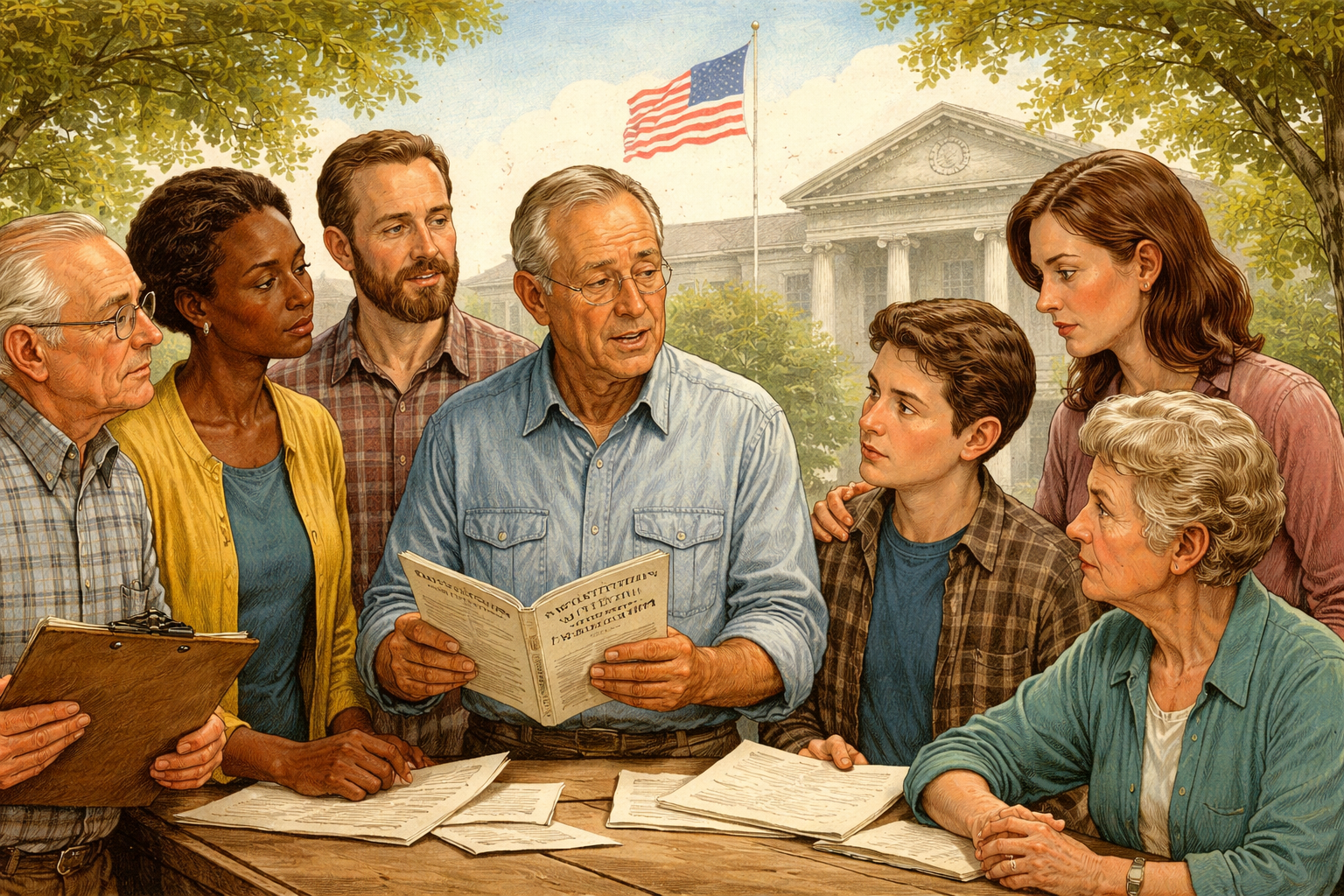
Few political phrases carry as much moral weight in American public life as civil rights.
It is a term that evokes the nation’s highest ideals—liberty, equality before the law, and protection from unjust government power.
Because of this moral weight, civil rights has become one of the most contested and misused concepts in modern political debate.
For voters attempting to make responsible decisions, clarity on this issue is no longer optional.
At its core, civil rights concerns the relationship between the individual citizen and the state.
Civil rights asks a basic question: What legal protections does a person possess simply by virtue of being human and a citizen, and how far may the government go in restricting, favoring, or burdening one group over another?
How a society answers that question shapes its laws, institutions, economy, and public trust.
Historically, American civil-rights discussions arose from concrete injustices that were explicitly enforced by law.
Slavery, segregation, denial of voting rights, and unequal access to public institutions were not merely social problems; they were codified and enforced by government power.
The post–Civil War amendments and later civil-rights legislation were designed to remove state-imposed barriers that violated the promise of equal protection under the law.
This historical grounding matters.
Civil rights were not originally conceived as guarantees of equal outcomes, equal representation by group identity, or perpetual government intervention to manage social disparities.
They were legal protections intended to restrain abuse of authority and to ensure that citizens were treated equally by the institutions that governed them.
Why Civil Rights Matter to Voters Today
Civil rights remain relevant because they directly influence how laws are written, enforced, and justified.
Decisions made in the name of civil rights affect:
• who may speak freely in public and online spaces
• how hiring, promotion, and education decisions are made
• whether laws are applied evenly or selectively
• how much power unelected bureaucracies exercise over daily life
Polling consistently shows that Americans are deeply concerned about fairness, free speech, public safety, and equal treatment—issues increasingly framed as civil-rights questions.
Disputes over hate-speech laws, compelled speech, religious-liberty exemptions, race-based admissions, and gender-identity policies are not abstract cultural debates. They determine whether citizens can live, work, worship, and speak without fear of legal penalty.
For the common American, civil-rights policy is not theoretical. It influences whether a small business owner can hire based on merit, whether a church or religious school may operate according to its convictions, whether parents retain authority over their children’s education, and whether citizens can criticize the government without reprisal.
Economic and Public-Safety Implications
Civil-rights policy has substantial economic consequences.
When the law shifts from equal treatment to group-based preferences, it alters incentives throughout the economy. Employers face increased compliance costs, legal exposure, and uncertainty about hiring standards. Educational institutions divert resources from instruction to administration and legal defense. Taxpayers ultimately fund these expansions of regulatory oversight.
Public safety is also affected. Selective enforcement of laws—often justified under civil-rights rationales—can weaken deterrence, erode trust in policing, and leave vulnerable communities exposed to higher crime rates. When citizens perceive laws are applied differently depending on identity, political alignment, or protected status, confidence in the justice system deteriorates.
American history provides cautionary examples. Periods of unequal enforcement, whether under Jim Crow or under modern policies that excuse criminal behavior under the banner of social justice, produce instability rather than harmony. Civil rights, properly understood, are meant to stabilize society by making the law predictable and impartial.
A Concept Under Strain
Today, the term civil rights is often stretched beyond its original legal meaning. It is increasingly used to justify expansive government power, speech regulation, and outcome-based policies rooted in theories of systemic oppression. These newer interpretations assume that unequal results are evidence of injustice, rather than asking whether the law itself is applied equally.
This shift represents a fundamental philosophical change—one that divides political parties, institutions, and even churches. Understanding that shift is essential for voters who wish to evaluate competing claims honestly.
With that foundation established, the next section examines how the Republican Party understands civil rights today, drawing from its 2024 platform, legislative actions, and statements by party leaders.
Articles in the Critical Issues series require more time to read than most content on this site. They are intentionally written as thorough, in-depth examinations of their subjects.
The Republican Perspective on Civil Rights
The Republican approach to civil rights is grounded in a classical liberal understanding of law, shaped by the Constitution’s emphasis on individual rights, equal protection, and limited government. Republicans generally view civil rights as protections that shield citizens from discrimination by the state, rather than tools the state uses to engineer social outcomes.
Core Principles
Republicans emphasize several consistent principles when addressing civil-rights questions:
• Equality before the law, not equality of outcome
• Individual rights rather than group-based entitlements
• Colorblind application of laws and policies
• Strong protections for free speech and religious liberty
• Skepticism toward expansive bureaucratic enforcement
These principles are reflected throughout the 2024 Republican Party Platform, which affirms equal protection while explicitly rejecting race-based preferences and compelled ideological conformity (Republican Platform, sections addressing equal protection, education, free speech, and religious liberty).
Civil Rights as Legal Protection, Not Social Engineering
Republicans generally argue that the civil-rights gains of the twentieth century succeeded because they removed government-imposed barriers rather than imposing new classifications. From this perspective, laws that sort citizens by race, sex, or ideology—even with benevolent intent—recreate the very injustices civil-rights legislation sought to abolish.
This explains Republican opposition to policies such as:
• Race-based admissions and hiring preferences
• Mandatory diversity, equity, and inclusion (DEI) programs
• Speech codes and compelled pronoun usage
• Federal overreach into local education and employment decisions
Republican lawmakers frequently cite Supreme Court precedent, including recent rulings limiting race-conscious admissions policies, as evidence that civil rights must remain tethered to constitutional limits.
Legislative and Leadership Examples
At the federal level, Republican members of Congress have consistently opposed legislation that expands civil-rights enforcement into areas of speech regulation and private association. Examples include resistance to the Equality Act as drafted, citing conflicts with religious liberty, parental rights, and freedom of conscience.
Republican state leaders have also acted to restrict DEI bureaucracies in public universities and agencies. States such as Florida and Texas have passed laws limiting race- and sex-based training requirements, arguing that such programs violate the principle of equal treatment.
Governors and attorneys general in these states frame their actions not as opposition to civil rights, but as a defense of neutral law enforcement and constitutional boundaries.
Internal Republican Disagreements
While Republicans broadly agree on core civil-rights principles, disagreements exist over tactics and emphasis. Some factions favor a more restrained rhetorical approach, wary of alienating moderate voters. Others argue that the scale of progressive institutional capture requires more aggressive legislative countermeasures.
Despite these differences, the party remains unified in rejecting civil rights as a justification for identity-based governance. Republicans argue that once civil rights are detached from individual equality, they become instruments of political power rather than safeguards of liberty.
The Democrat Perspective on Civil Rights
The Democratic Party approaches civil rights through a markedly different framework than Republicans. While Democrats continue to invoke the moral authority of the civil-rights movement of the twentieth century, their modern interpretation has expanded the concept far beyond legal equality before the law. Today, civil rights within the Democratic Party are commonly understood through the lenses of identity, power, and systemic inequality.
Rather than focusing primarily on whether laws are applied equally, Democrats increasingly evaluate civil rights by examining outcomes among demographic groups. Disparities are often treated as evidence of injustice, even when the law itself is facially neutral.
Civil Rights as Equity and Group Protection
The 2024 Democratic Party Platform emphasizes civil rights in terms of combating “systemic racism,” “structural inequities,” and “intersectional discrimination” (Democratic Platform, sections addressing civil rights, social justice, education, and economic equity). These terms reflect a philosophical shift away from individual rights toward group-based analysis.
Under this framework, civil rights policy seeks to:
• Elevate historically disadvantaged groups
• Use government authority to correct disparities
• Expand protected classes and legal remedies
• Regulate speech and conduct deemed harmful to group dignity
From the Democratic perspective, neutrality itself can be unjust if it preserves unequal outcomes. As a result, policies once considered discriminatory—such as race-conscious admissions or sex-based hiring goals—are now defended as necessary civil-rights tools.
Race, Sex, and Gender as Central Categories
Modern Democratic civil-rights policy places significant emphasis on race and gender identity. Democrats routinely support:
• Race-based admissions and hiring preferences
• Expanded anti-discrimination enforcement in private institutions
• Legal recognition of gender identity over biological sex
• Civil-rights protections tied to sexual orientation and gender identity
Democratic lawmakers argue that these measures are necessary to protect vulnerable populations from discrimination and social marginalization. Critics counter that such policies undermine equal protection by granting legal privileges based on identity rather than conduct.
Legislative and Leadership Examples
At the federal level, Democrats have consistently supported legislation such as the Equality Act, which would redefine sex discrimination in federal law to include sexual orientation and gender identity. Republican opponents have raised concerns that the bill would override religious-liberty protections, parental rights, and women’s sex-based spaces.
Democratic members of Congress frequently advocate for expanded authority for the Department of Justice, the Equal Employment Opportunity Commission, and the Department of Education to enforce civil-rights rules across schools, workplaces, and local governments.
At the state and city level, Democratic leadership in jurisdictions such as California, New York, Illinois, Oregon, and Washington has enacted policies requiring DEI compliance, gender-identity accommodations, and speech regulations in public institutions. Cities like San Francisco, Seattle, New York City, and Washington, D.C. have adopted civil-rights ordinances that go beyond federal law, often imposing penalties for noncompliance.
Internal Democratic Disagreements
While the Democratic Party presents a largely unified public posture on civil rights, internal divisions do exist. More moderate or traditional liberals occasionally express concern that aggressive identity-based policies risk alienating working-class voters or undermining free expression. However, these voices have diminished influence within the party.
Progressive activists and lawmakers increasingly set the agenda, framing dissent as moral failure rather than legitimate disagreement. As a result, debates within the party tend to focus on how far to go rather than whether the expanded civil-rights framework is appropriate.
A Fundamental Reorientation
The Democratic approach represents a fundamental reorientation of civil rights—from a shield protecting individuals against unjust government power to a mechanism for redistributing social power. Supporters view this as moral progress. Critics argue it replaces one form of inequality with another and invites permanent government intervention into private life.
Understanding this redefinition is essential for voters. While both parties claim the language of civil rights, they are often speaking about entirely different things.
Progressive Principles and Their Influence on Civil-Rights Policy
To understand the modern Democratic approach to civil rights, it is necessary to examine the Progressive ideological framework that increasingly shapes it. While many voters use the terms progressive, liberal, and Democrat interchangeably, Progressivism represents a distinct worldview with its own assumptions about human nature, power, justice, and the role of government.
Civil rights, under Progressive theory, are no longer primarily about restraining government abuse. Instead, they are viewed as tools for correcting structural inequalities embedded within society itself.
Underlying Presuppositions
Progressive civil-rights theory rests on several core assumptions that differ sharply from the traditional American understanding:
First, Progressivism assumes that power—not law—is the decisive factor in social outcomes. Institutions such as courts, schools, churches, businesses, and even families are analyzed primarily as power structures rather than moral or civic bodies.
Second, it assumes that group identity outweighs individual agency. People are evaluated largely according to racial, sexual, or gender categories rather than as individuals responsible for their own conduct. Under this view, unequal outcomes among groups are treated as presumptive evidence of injustice.
Third, Progressivism tends to reject the idea of neutrality. A “neutral” law is seen as perpetuating existing inequities. Therefore, the state is expected to take an active role in redistributing advantages and disadvantages in pursuit of equity.
These presuppositions explain why Progressive civil-rights advocacy often demands outcome parity, not merely legal fairness.
From Equality to Equity
One of the most significant Progressive shifts is the redefinition of equality. Traditional civil rights emphasized equality before the law. Progressive civil rights emphasize equity, meaning proportional representation and results across demographic groups.
Equity requires constant measurement, classification, and intervention. It necessitates bureaucracies to track disparities, enforce compliance, and punish deviation. In practice, this transforms civil rights from a limited legal safeguard into a permanent administrative regime.
This is why Progressive jurisdictions routinely expand civil-rights offices, diversity compliance departments, and enforcement mechanisms. What began as protection from discrimination becomes ongoing supervision of thought, speech, and behavior.
Speech, Conscience, and Compulsion
Progressive civil-rights frameworks increasingly treat speech itself as a civil-rights issue. Words are viewed not merely as expressions of belief but as instruments of harm. As a result, restrictions on speech—particularly dissenting speech—are justified as necessary protections.
This approach explains support for:
• Hate-speech regulations
• Compelled pronoun usage
• Punitive measures for “microaggressions”
• Mandatory ideological training in workplaces and schools
From a Progressive standpoint, freedom of conscience is subordinate to group protection. From a traditional civil-rights perspective, this represents a direct inversion of the First Amendment’s purpose.
Institutional Capture and Enforcement
Progressive civil-rights ideology relies heavily on institutional enforcement rather than democratic consent. Courts, federal agencies, school boards, accreditation bodies, and corporate compliance offices are used to implement policies that often lack broad public support.
This reliance on administrative power explains why many Progressive civil-rights advances occur through regulation, executive action, or judicial interpretation rather than legislation. The moral urgency of the cause is invoked to justify bypassing ordinary democratic constraints.
Why This Matters to Voters
This Progressive redefinition of civil rights fundamentally alters the relationship between citizens and the state. The government moves from umpire to manager, from referee to moral instructor. Citizens are no longer merely expected to obey the law, but to affirm approved beliefs.
For voters, the question is not whether discrimination is wrong—nearly all Americans agree on that. The question is whether civil rights should be used to limit power or to expand it.
That philosophical divide explains much of today’s political conflict and sets the stage for the next section, which examines whether Democratic leadership’s actions actually align with their stated civil-rights commitments.
Section V: Do Democrat Actions Match Their Civil-Rights Rhetoric?
“In politics, what you DO is what you believe. Everything else is cottage cheese.”
— Senator Joseph N. Kennedy
That observation is particularly relevant when evaluating modern civil-rights policy. Party platforms and public rhetoric are useful, but they are not decisive. What matters is how power is actually exercised when a party controls the executive branch, federal agencies, and aligned state governments.
When Democratic leadership’s actions are examined—especially during the Biden administration—a significant gap emerges between stated civil-rights commitments and real-world application.
Selective Application of Civil-Rights Standards
Democratic leaders frequently claim to champion equality, fairness, and protection for the vulnerable. Yet in practice, civil-rights enforcement is often selective and asymmetrical.
For example, Democrats regularly condemn discrimination in hiring and education while simultaneously endorsing race- and sex-based preferences. Policies that would be illegal if applied against favored groups are defended when applied against politically disfavored ones. This reveals an operative standard not of equality, but of directional justice—justice aimed at producing preferred outcomes.
Similarly, free-speech protections are celebrated in the abstract while being restricted in practice when speech challenges Progressive orthodoxy. Federal agencies have pursued investigations and guidance that chill speech on issues related to gender, race, and sexuality, often without clear legislative authorization.
Biden Administration Enforcement Patterns
Under the Biden administration, civil-rights enforcement expanded aggressively through executive action and regulatory reinterpretation rather than congressional debate.
Key examples include:
• Reinterpretation of Title IX to prioritize gender identity over biological sex
• Expanded Department of Education guidance pressuring schools to adopt gender policies without parental consent
• Department of Justice involvement in local education disputes framed as civil-rights violations
• Use of federal funding conditions to compel compliance with Progressive norms
These actions were justified as civil-rights protections, yet they often bypassed democratic processes and ignored legitimate competing rights—particularly those of parents, women, and religious institutions.
Double Standards and Exemptions
A recurring feature of Democratic civil-rights enforcement is the application of double standards. Religious organizations, small businesses, and politically conservative individuals are frequently denied exemptions that are routinely granted to Progressive-aligned groups.
For instance, faith-based institutions are told that long-standing beliefs regarding sex and marriage constitute discrimination, while ideological discrimination against traditional viewpoints is tolerated or encouraged in academic and corporate settings.
This asymmetry undermines claims of neutrality and reveals civil rights functioning as a political instrument, not a universal principle.
State and Local Progressive Governance
Progressive-controlled states and cities provide further evidence of this disconnect. Jurisdictions such as California, New York, Illinois, Oregon, Washington, and Massachusetts have enacted sweeping civil-rights ordinances that regulate speech, mandate ideological training, and penalize dissent.
Cities like Berkeley, Portland, Seattle, Minneapolis, Boston, and Washington, D.C. have expanded civil-rights enforcement into areas once governed by custom, conscience, and voluntary association. In many cases, enforcement is complaint-driven, vague, and punitive—creating fear rather than fairness.
Rather than fostering social trust, these policies often produce resentment, legal uncertainty, and withdrawal from civic life.
Authoritarian Tendencies
When civil rights are used to compel belief, silence opposition, or bypass democratic accountability, they take on an authoritarian character—even if implemented with benevolent language.
Soft authoritarianism appears when citizens are pressured through regulation and social penalties. Hard authoritarianism emerges when the coercive power of the state is openly deployed to enforce ideological conformity.
Under Democratic leadership, particularly in Progressive strongholds, both tendencies are increasingly visible. Civil rights become less about protection from power and more about submission to it.
What the Record Reveals
The evidence suggests that Democratic leadership’s civil-rights actions frequently depart from their stated commitment to fairness and equality. The platform language emphasizes justice and inclusion, but the operational reality reflects power consolidation, selective enforcement, and ideological control.
This gap between rhetoric and behavior is not accidental. It flows directly from the Progressive redefinition of civil rights itself.
The next section will step back and examine how each party’s critics view these positions, presenting common objections and the standard responses offered in defense.
Civil Rights Viewed from the Opposition
No political party interprets civil rights in a vacuum. Each side critiques the other, often sharply, and some of those criticisms are made in good faith by honest interlocutors rather than partisan caricatures. Examining these objections—and the counter-responses offered—helps voters distinguish principled disagreement from rhetorical excess.
Common Criticisms of the Republican Position
Critics of the Republican approach to civil rights commonly raise several objections.
First, Republicans are accused of being indifferent to historical injustice. Opponents argue that emphasizing colorblind law ignores the lingering effects of past discrimination and allows inequality to persist under the guise of neutrality.
Second, Republicans are often portrayed as prioritizing religious liberty and free speech at the expense of vulnerable groups. Critics claim that exemptions for religious institutions or conscience protections function as permission to discriminate.
Third, some argue that Republican resistance to expanded civil-rights enforcement enables private discrimination that the law should address, particularly in housing, employment, and education.
These criticisms resonate with voters who view government as a necessary corrective force when social norms fail.
Republican Counter-Responses
Republicans respond by distinguishing moral wrongs from legal authority. They argue that while prejudice is immoral, not every moral failure can or should be regulated by the state.
They further contend that equal application of the law is the only sustainable foundation for pluralistic society. Once legal standards vary by identity or ideology, civil rights cease to be universal and become political favors.
On religious liberty, Republicans emphasize that civil rights were historically designed to protect minority viewpoints, including religious dissenters. Compelling belief or conduct, they argue, violates the very freedoms civil rights were meant to secure.
Finally, Republicans note that many disparities arise from complex cultural, educational, and economic factors that law cannot resolve without producing new injustices.
Common Criticisms of the Democrat Position
Critics of the Democratic approach raise a different set of concerns.
First, Democrats are accused of redefining civil rights in ways that undermine equality before the law. Race- and sex-based preferences, critics argue, constitute legalized discrimination regardless of intent.
Second, Democratic civil-rights policies are said to erode free speech and freedom of conscience by labeling dissent as harm. This transforms disagreement into misconduct.
Third, opponents argue that Progressive civil-rights frameworks encourage grievance politics, permanent dependency on government intervention, and social fragmentation rather than cohesion.
Finally, critics warn that expansive administrative enforcement bypasses democratic accountability and concentrates power in unelected institutions.
Democrat Counter-Responses
Democrats respond that formal equality is insufficient when systemic barriers persist. They argue that ignoring disparities perpetuates injustice and that proactive measures are necessary to level the playing field.
They also maintain that speech can inflict real harm and that the government has a responsibility to protect marginalized groups from hostile environments, particularly in schools and workplaces.
Regarding bureaucratic enforcement, Democrats argue that civil-rights protections would be meaningless without strong oversight and that local resistance often necessitates federal intervention.
To critics who warn of overreach, Democrats reply that discomfort among privileged groups is not evidence of injustice but a sign of progress.
What This Exchange Reveals
This exchange exposes the core disagreement: whether civil rights exist to limit power or to redistribute it.
Republicans fear that civil rights untethered from neutrality become instruments of coercion. Democrats fear that civil rights constrained by neutrality entrench inequality.
Both sides claim moral seriousness. The difference lies in their assumptions about human nature, authority, and the proper scope of government.
Those assumptions—and the strategies they produce—will be examined next, as we explore credible suspicions regarding each party’s motives and political strategy.
Credible Suspicions About Party Strategies and Motives
Political parties rarely pursue civil-rights policy solely out of abstract principle. Civil rights carry immense moral authority, legal leverage, and electoral value. As a result, it is reasonable—and responsible—for voters to examine not only stated positions, but strategic incentives that shape how each party deploys civil-rights rhetoric and enforcement.
This section addresses credible suspicions, not speculative conspiracies. The goal is to identify observable patterns, incentives, and statements that reasonably raise questions about motive.
Republican Motives and Strategy
Critics sometimes suspect Republicans of using civil-rights language primarily as a defensive tool—to resist cultural change or protect existing social hierarchies. While this accusation is often exaggerated, Republicans do face genuine strategic incentives.
First, Republicans benefit politically from emphasizing constitutional restraint and distrust of centralized authority. Civil-rights skepticism aligns naturally with a broader limited-government philosophy and appeals to voters concerned about federal overreach.
Second, Republicans increasingly view civil-rights expansion as a mechanism used against them institutionally. Universities, corporations, media organizations, and bureaucracies often apply civil-rights standards selectively in ways that disadvantage conservative viewpoints. Republican resistance is therefore both philosophical and tactical.
Third, Republicans recognize that a colorblind, neutral legal framework minimizes political volatility. Once civil rights become outcome-driven, electoral coalitions shift toward identity blocs rather than shared citizenship—an environment Republicans generally view as destabilizing and corrosive.
In short, Republican motives are best understood as defensive and preservative: defending constitutional boundaries, preserving civic unity, and preventing civil rights from becoming an engine of ideological enforcement.
Democrat Motives and Strategy
Democrats, by contrast, have strong incentives to expand the scope of civil rights.
First, civil-rights expansion allows Democrats to mobilize identity-based coalitions. Framing political disagreements as civil-rights struggles transforms policy disputes into moral imperatives and reduces space for compromise.
Second, expanded civil-rights frameworks justify the growth of administrative power. Agencies, compliance offices, and enforcement mechanisms tend to align culturally and politically with Progressive ideology. This creates durable institutional influence independent of election cycles.
Third, civil-rights framing enables Democrats to delegitimize opposition. When dissenting views are labeled discriminatory or harmful, opponents are not merely wrong—they are morally suspect. This shifts debates from persuasion to enforcement.
Fourth, civil-rights policy increasingly functions as a substitute for consensus. Where persuasion fails, regulation succeeds. Progressive leadership often treats resistance as proof of injustice rather than disagreement.
These incentives do not require bad faith. They arise naturally from a worldview that sees power disparities as the central political problem.
Evidence in Rhetoric and Behavior
Statements by Democratic leaders frequently reinforce these suspicions. Language emphasizing “no room for debate,” “zero tolerance,” or “the right side of history” signals moral finality rather than democratic negotiation.
Similarly, the preference for executive action, regulatory reinterpretation, and judicial expansion—rather than legislation—suggests an urgency to entrench civil-rights policy beyond voter reversal.
Republican leaders, meanwhile, routinely warn of weaponized civil rights, citing examples where laws intended to protect minorities are used to punish ideological dissenters.
Why These Suspicions Matter
Healthy democracies depend on trust: trust that laws apply equally, that disagreement is permitted, and that power is constrained. When civil rights are perceived as tools for permanent political advantage, that trust erodes.
Suspicion alone does not prove wrongdoing. But patterns of behavior, incentives, and institutional alignment justify careful scrutiny—especially on an issue as foundational as civil rights.
This leads directly to the next question: how does declining social trust itself shape civil-rights debates and intensify political conflict?
Civil Rights in High-Trust and Low-Trust Societies
Civil rights do not exist in a cultural vacuum. How they are understood, enforced, and experienced depends heavily on the level of trust within a society—trust between citizens, trust in institutions, and trust that laws will be applied fairly.
Political conflict over civil rights in the United States cannot be fully understood apart from America’s transition from a relatively high-trust society to an increasingly low-trust society.
High-Trust Societies and Civil Rights
In a high-trust society, citizens generally believe that:
• Laws will be applied evenly
• Institutions operate in good faith
• Fellow citizens share basic moral assumptions
• Disagreement does not imply malice
In such societies, civil rights function primarily as guardrails, not control systems. Laws are written narrowly because social norms do much of the work. Government power can be restrained because most people voluntarily comply with shared expectations of behavior.
For much of American history—especially prior to the late twentieth century—civil rights operated within this high-trust framework. The assumption was that once discriminatory laws were removed, citizens would largely act justly without constant supervision.
Low-Trust Societies and Civil Rights Expansion
Low-trust societies operate very differently. When trust erodes, lawmakers assume bad faith. Institutions respond by expanding rules, surveillance, and enforcement. Civil rights shift from protection to management.
In today’s America, many Progressive policymakers openly operate under low-trust assumptions:
• Speech is presumed harmful
• Disagreement is presumed oppressive
• Institutions are presumed biased
• Neutrality is presumed unjust
Under these assumptions, expansive civil-rights enforcement becomes not just desirable, but necessary. Bureaucratic oversight replaces social trust. Compliance replaces consensus.
How Each Party Responds to Declining Trust
Republicans tend to interpret declining trust as evidence that government power must be more tightly constrained. They argue that once trust is gone, concentrating authority only increases the risk of abuse. From this perspective, civil rights must be narrowly defined to prevent weaponization.
Democrats tend to interpret declining trust as evidence that stronger enforcement is required. If institutions are biased and citizens are prone to harm, then civil rights must be aggressively policed to protect vulnerable groups.
These responses reflect fundamentally different diagnoses of the same problem.
The Feedback Loop Problem
Low-trust civil-rights enforcement often creates a feedback loop.
As laws become more intrusive and selective, citizens trust institutions less. As trust declines further, policymakers justify even more enforcement. Over time, civil rights cease to stabilize society and begin to destabilize it, fostering resentment, fear, and disengagement.
This is visible in jurisdictions where aggressive civil-rights enforcement has coincided with:
• Declining public confidence
• Increased social polarization
• Withdrawal from civic institutions
• Rising litigation and compliance costs
Rather than healing divisions, civil rights become another front in political warfare.
Why This Matters for Voters
Civil rights can either reinforce a shared civic culture or accelerate fragmentation. In high-trust contexts, they protect liberty. In low-trust contexts, they can become tools of coercion.
Voters must decide which path they believe restores trust: expanding authority to manage behavior, or restraining authority to preserve freedom.
That decision is shaped heavily by how media portrays each party’s position—an issue we now turn to directly.
Media Distortion of Civil-Rights Positions
The modern civil-rights debate does not occur on a neutral playing field. Legacy media institutions play a decisive role in shaping how voters understand the positions of both political parties. In many cases, media coverage does not merely report disagreements—it frames one side as morally suspect by default.
This matters because civil rights carry moral authority. How an issue is framed often determines which arguments are treated as legitimate and which are dismissed without serious consideration.
Patterns of Distortion
A recurring media pattern is the compression of motive. Republican objections to Progressive civil-rights expansions are frequently reduced to claims of animus or fear rather than principled disagreement. Concerns about free speech, due process, religious liberty, or constitutional limits are often omitted or minimized.
For example, opposition to race-based admissions is commonly described as opposition to diversity itself, rather than a defense of equal treatment. Resistance to gender-identity mandates is framed as hostility toward individuals rather than concern over compelled speech, parental rights, or women’s protections.
In contrast, Democratic civil-rights proposals are typically framed as compassionate, inevitable, and morally urgent. Questions about unintended consequences, constitutional conflict, or selective enforcement receive comparatively little attention.
Language as a Tool of Framing
Media language choices reveal underlying assumptions. Terms such as “voting rights,” “reproductive rights,” “trans rights,” or “civil-rights protections” are often used without explanation, embedding Progressive conclusions within the terminology itself.
Meanwhile, Republican proposals are described with loaded terms like “rollbacks,” “restrictions,” or “attacks,” even when they aim to restore prior legal standards. The result is asymmetrical moral framing rather than neutral reporting.
Selective Emphasis and Omission
Media outlets frequently highlight isolated incidents of discrimination to justify sweeping civil-rights expansion while downplaying or ignoring abuses of civil-rights enforcement.
Examples include:
• Limited coverage of compelled speech cases involving teachers and employees
• Minimal attention to parents losing access to information about their children’s schooling
• Sparse reporting on women displaced from sex-based spaces or athletics
• Underreporting of religious institutions facing legal penalties
These omissions shape public perception by presenting only one side of the civil-rights ledger.
The “Consensus Illusion”
Through repetition and uniform framing, media institutions often create the impression that Progressive civil-rights positions represent settled consensus, while Republican objections are fringe or reactionary.
This illusion discourages debate. Voters are less likely to examine arguments they are told are already resolved. Civil rights, rather than being deliberated democratically, are treated as pre-political truths immune from scrutiny.
Consequences for Democratic Deliberation
When media coverage consistently moralizes one side and pathologizes the other, trust deteriorates further. Citizens who feel misrepresented disengage. Others adopt increasingly absolutist positions.
Civil rights, once a shared moral language, become a rhetorical weapon.
Understanding media distortion does not require cynicism. It requires attentiveness to framing, language, and omission. Voters who recognize these patterns are better equipped to evaluate claims on their merits rather than their presentation.
The next section will step outside the Republican–Democrat binary to examine the Libertarian position on civil rights, which differs from both in important ways.
The Libertarian Perspective on Civil Rights
Libertarians approach civil rights from a framework that is distinct from both Republicans and Democrats. While Republicans emphasize constitutional tradition and Democrats emphasize equity and group protection, Libertarians center nearly all civil-rights analysis on individual liberty and non-aggression.
At first glance, Libertarian positions may appear similar to Republican views. In practice, however, the philosophical foundations differ in important ways.
Core Libertarian Principles
Libertarian civil-rights thinking rests on several core convictions:
• The individual, not the group, is the basic unit of moral concern
• Government power is inherently suspect and must be minimized
• Rights exist prior to the state and should not be expanded through regulation
• Voluntary association takes precedence over enforced equality
From this perspective, civil rights are primarily negative rights—protections against coercion—rather than claims upon others or the state.
Areas of Alignment with Republicans
Libertarians often align with Republicans in opposing:
• Race- and sex-based preferences
• Speech restrictions and compelled expression
• Expansive federal enforcement agencies
• Ideological mandates in education and employment
Like Republicans, Libertarians argue that civil rights lose legitimacy when they require constant bureaucratic oversight or compel private behavior beyond preventing force or fraud.
Key Differences from Republicans
Despite this alignment, Libertarians diverge from Republicans in several ways.
First, Libertarians are often less willing to use the state to protect religious institutions, family structures, or moral norms. Where Republicans may support limited government intervention to preserve social order, Libertarians typically resist such involvement entirely.
Second, Libertarians tend to oppose civil-rights enforcement even in cases where Republicans accept it as necessary. For example, Libertarians may argue that private businesses should retain full freedom of association, even if that includes discriminatory practices—an argument most Republicans reject as socially corrosive.
Third, Libertarians often dismiss historical and cultural considerations that Republicans view as essential. Their analysis is abstract and principle-driven rather than rooted in tradition or social cohesion.
Areas of Alignment with Democrats
On certain social issues, Libertarians may appear to align with Democrats—particularly where Democrats frame civil rights as personal autonomy. Libertarians may support broad freedom of expression in lifestyle choices and resist government regulation of private conduct.
However, this alignment is typically superficial. Libertarians oppose the enforcement mechanisms Democrats rely on, even when they agree with the underlying freedom claim.
Philosophical Bottom Line
Libertarians see civil rights as protections against coercion—full stop. They resist both Progressive outcome management and Republican moral guardianship.
This position appeals to voters deeply skeptical of government power. It also raises concerns about social fragmentation and the erosion of shared norms—concerns Republicans emphasize and Democrats attempt to manage through regulation.
Understanding the Libertarian position clarifies the final and most consequential comparison: how civil rights should be understood from a biblical Christian worldview.
A Biblical Perspective on Civil Rights and Political Alignment
A biblical Christian approach to civil rights begins from a fundamentally different starting point than any modern political ideology. Republicans, Democrats, and Libertarians all operate within Enlightenment-derived frameworks that prioritize autonomy, power, or procedure. Scripture begins elsewhere: with God, creation, moral order, and human accountability.
Civil rights, from a biblical perspective, are not self-generated claims, nor are they granted by the state. They arise from the fact that man is created in the image of God (Genesis 1:26–27). Human dignity is inherent, not negotiated, and it applies equally to all people.
Biblical Foundations Relevant to Civil Rights
Several biblical principles shape a Christian understanding of civil rights:
First, Scripture affirms equal moral worth. All people stand equally before God as image-bearers and equally guilty as sinners (Romans 3:23). No ethnic, social, or economic class possesses superior moral status.
Second, Scripture affirms moral responsibility. Individuals are accountable for their actions; guilt and righteousness are not transferable by group identity (Ezekiel 18:20). This stands in sharp contrast to Progressive frameworks that assign moral weight to group membership.
Third, Scripture affirms objective justice. God condemns partiality and favoritism, whether toward the rich or the poor (Leviticus 19:15). Justice must be impartial to be just at all.
Fourth, Scripture affirms limited human authority. Civil government is instituted by God to restrain evil and reward good, not to remake human nature or redefine moral reality (Romans 13:1–4).
These principles together support a civil-rights framework rooted in equal protection, impartial law, and restrained authority.
Evaluating the Political Parties Biblically
From this perspective, none of the political parties align perfectly with biblical Christianity.
The Democratic Party’s civil-rights framework conflicts most directly with Scripture. By redefining justice in terms of group outcomes, subordinating truth to power narratives, and compelling speech and belief, Progressive civil-rights ideology contradicts biblical teaching on impartiality, truth, and conscience.
Libertarianism, while valuing liberty, lacks a moral foundation. Its refusal to acknowledge God-ordained authority and moral limits leads to a civil-rights vision detached from responsibility, order, and the common good.
The Republican Party, though flawed and inconsistent, most closely aligns with biblical principles by affirming:
• Objective moral standards
• Equal application of the law
• Freedom of conscience and worship
• Limits on governmental authority
This alignment is not absolute or uncritical. Republicans sometimes compromise on moral clarity for political expediency. Nevertheless, the party’s framework allows biblical Christians to participate openly and advocate faithfully.
Why Alignment Is Not Identity
It is important to distinguish alignment from allegiance. Christians do not baptize a party. They evaluate policies, laws, and leaders in light of Scripture.
Biblical Christians align with Republicans not because the party is righteous, but because its civil-rights framework permits the free exercise of biblical conviction, whereas Progressive frameworks increasingly criminalize or marginalize it.
The Christian’s Priority Order
Finally, Scripture teaches that not all issues carry equal moral weight. While civil rights are important, they must be evaluated alongside matters such as the sanctity of life, the protection of the family, and the freedom of the church.
A mature Christian applies moral proportionality, resisting the temptation to absolutize secondary issues while remaining faithful on primary ones.
This moral ordering leads naturally to the next task: encouraging Christians to vote wisely, deliberately, and biblically.
Encouraging Biblically Faithful Voting
For the biblical Christian, voting is not merely a civic habit or an expression of personal preference. It is an act of moral stewardship. While Scripture does not command participation in democratic elections, it does require believers to act wisely, pursue justice, and love their neighbors within the providential circumstances God has placed them.
Voting, then, is one means—though not the only one—by which Christians may seek the good of their nation.
Voting as Moral Discernment
Biblical voting requires discernment, not party loyalty. Christians are called to evaluate candidates and policies according to their conformity to God’s moral order rather than emotional appeal, media narratives, or tribal pressure.
This means asking hard questions:
• Does this policy uphold the equal dignity of all image-bearers?
• Does it punish evil and reward good?
• Does it preserve freedom of conscience and worship?
• Does it restrain power rather than consolidate it?
Civil rights must be weighed alongside other moral concerns. A candidate’s position on civil rights cannot be isolated from his or her stance on life, family, truth, and authority.
Moral Weight and Proportionality
Scripture teaches that not all moral issues are equal in gravity. The unjust taking of innocent life carries greater moral weight than disputes over taxation or regulatory scope. The erosion of religious liberty has deeper long-term consequences than disagreements over administrative policy.
A mature Christian voter understands this hierarchy. Civil rights matter—but they must be assessed within a broader moral framework that prioritizes:
• The sanctity of life (Psalm 139; Proverbs 24:11–12)
• The integrity of the family (Genesis 2; Ephesians 5–6)
• The freedom of the church to preach and practice the gospel (Acts 5:29)
When civil rights are redefined in ways that threaten these goods, Christians must take notice.
Wisdom, Not Perfection
Christians must also resist the illusion of the perfect candidate. In a fallen world, every option is compromised. Biblical voting seeks the most just available option, not ideological purity.
This realism guards against cynicism on one hand and idolatry on the other. Political engagement is important, but it is not ultimate.
Civic Responsibility Without Coercion
Finally, Christians should encourage thoughtful participation without binding consciences where Scripture does not. Voting is a matter of prudence, not salvation. Believers may disagree in good faith on tactics while sharing the same moral commitments.
That balance leads naturally to the final reflections on civic duty and Christian liberty.
The Christian Duty to Seek the Welfare of the Nation
Scripture instructs God’s people to seek the welfare of the society in which they live (Jeremiah 29:7). This principle applies even when the culture is hostile, divided, or morally confused.
Seeking the nation’s welfare includes:
• Praying for leaders (1 Timothy 2:1–2)
• Speaking truth with clarity and charity
• Living as faithful witnesses in public and private life
• Using lawful means, including voting, to restrain evil and promote good
Responsible voting is one such means. It is not the only one, and it is not mandatory for every believer in every circumstance.
Christian Liberty and Voting
Some Christians, guided by conscience, choose not to vote. Scripture allows this liberty. Romans 14 reminds believers not to judge one another in matters where God has not issued a direct command.
However, prayer for governing authorities is not optional. Nor is obedience to God when human authority conflicts with divine command.
Whether voting or abstaining, the Christian’s posture must be one of humility, courage, and trust in God’s sovereignty.
Hope Beyond Politics
Ultimately, civil rights, political parties, and elections are temporary. Christ’s kingdom is not. Christians labor for justice not because they believe politics will save the world, but because obedience honors God and serves neighbor.
With that perspective, believers can engage firmly without despair and disagree without hatred.
S.D.G.,
Robert Sparkman
rob@christiannewsjunkie.com
RELATED CONTENT
Party platforms
If you want to read the party platforms yourself, here are the links:
Republican Party 2024 Platform
Concerning the Related Content section, I encourage everyone to evaluate the content carefully.
If I have listed the content, I think it is worthwhile viewing to educate yourself on the topic, but it may contain coarse language or some opinions I don’t agree with.
I use words that reflect the “woke” culture and their re-definitions sometimes. It is hard to communicate effectively without using their twisted vocabulary. Rest assured that I do not believe gender ideology or “Progressivism”. Words and phrases like “trans man”, “trans women” , “transgender”, “transition” or similar words and phrases are nonsensical and reflect a distorted, imaginary worldview where men can become women and vice-versa. The word “Progressive” itself is a propagandistic word that implies the Progressives are the positive force in society, whereas in reality their cultic belief system is very corrosive to mankind.
Feel free to offer your comments below. Respectful comments without expletives and personal attacks will be posted and I will respond to them.
Comments are closed after sixty days due to spamming issues from internet bots. You can always send me an email at rob@christiannewsjunkie.com if you want to comment on something afterwards, though.
I will continue to add videos and other items to the Related Content section as opportunities present themselves.