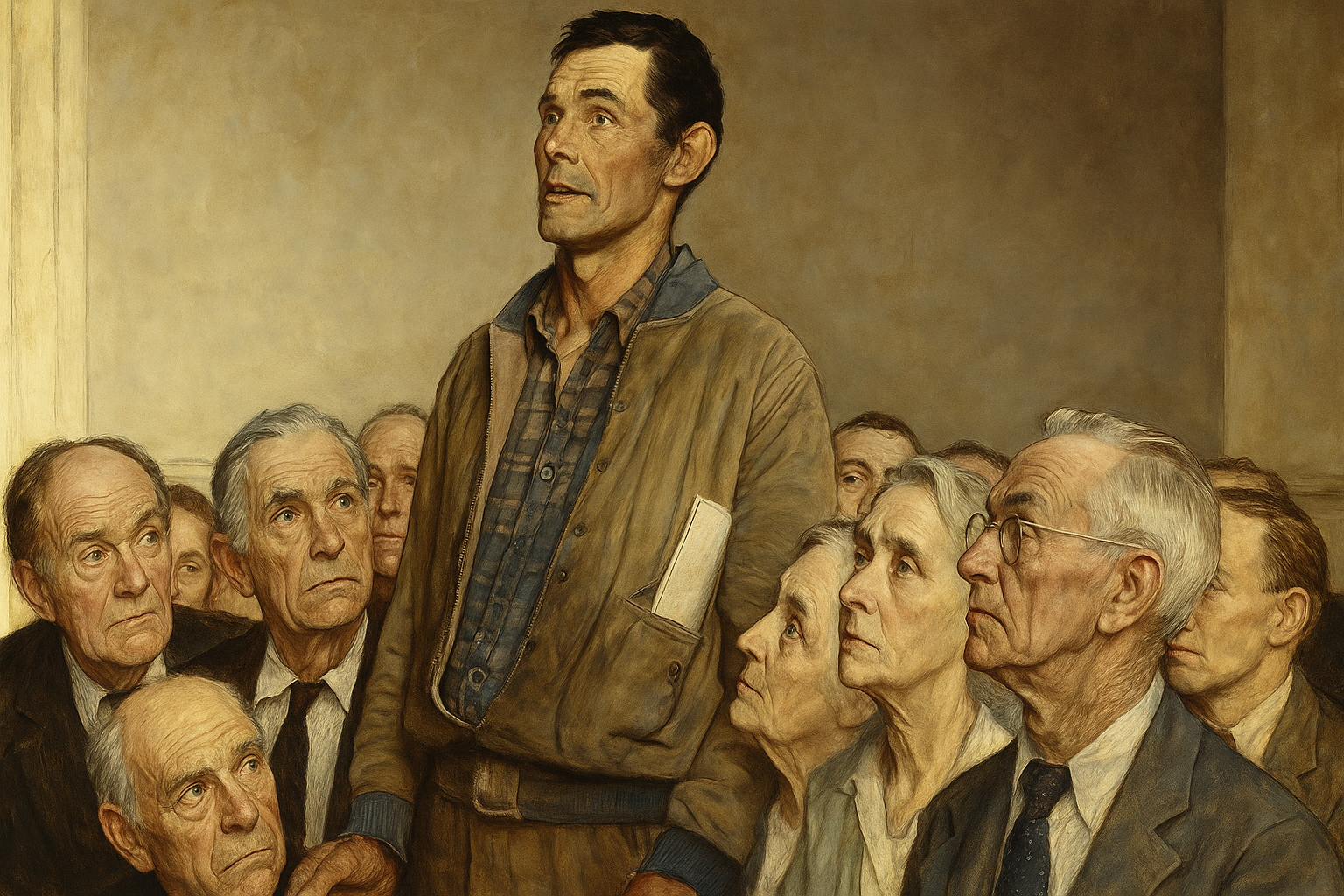
Free speech is not a fashionable abstraction or a luxury for polite societies. It is a structural necessity for a constitutional republic.
The First Amendment’s protection of speech, press, religion, assembly, and petition is not an ornament added for decoration; it is the load-bearing wall that allows every other liberty to stand.
At its core, free speech answers a simple but dangerous question: Who gets to decide what may be said?
In a free society, the answer is “the people, within narrow and clearly defined limits.” In an unfree society, the answer is “those in power,” often claiming benevolent intentions while enforcing silence through law, intimidation, or economic pressure.
Americans should care deeply about free speech because once speech is controlled, every other debate is already lost. Elections become symbolic. Courts become political. Science becomes propaganda. Religion becomes tolerated only when it echoes the moral preferences of the ruling class.
Why Free Speech Is Especially Relevant Today
Free speech has moved from a settled American principle to a contested political battlefield. This shift alone should alarm citizens. Rights that must be constantly “re-justified” are already halfway to being revoked.
Polling over the past decade consistently shows growing concern among Americans that people are afraid to speak openly about political, religious, and cultural issues.
Large percentages of Americans—especially younger adults—report self-censorship at work, in school, and even among friends. When citizens begin to weigh personal risk before expressing ordinary opinions, free speech exists only on paper.
At the institutional level, speech disputes now routinely involve:
- Universities disciplining students or faculty for speech deemed “harmful”
- Employers terminating employees for lawful speech made outside the workplace
- Social media companies coordinating with government officials on content moderation
- Financial institutions denying services based on ideological beliefs
None of these were normal features of American life a generation ago. Their rapid normalization signals a cultural shift away from free expression and toward managed discourse.
The Economic Impact of Free Speech Restrictions
Free speech is often discussed as a moral or constitutional issue, but it also has direct economic consequences.
Innovation depends on dissent. New ideas rarely begin as popular ideas. When speech is constrained—especially by informal but powerful pressures such as de-platforming, blacklisting, or reputational destruction—risk-taking declines. Entrepreneurs, researchers, journalists, and professionals learn quickly which conclusions are “safe” and which are career-ending.
This produces several economic effects:
- Fewer challenges to dominant ideas within industries
- Reduced innovation due to intellectual conformity
- Increased legal and compliance costs for businesses navigating speech rules
- Consolidation of power among large corporations better able to absorb political risk
Small businesses, independent journalists, and self-employed professionals are disproportionately harmed. Large corporations often adapt by aligning themselves with prevailing political narratives, while smaller actors are squeezed out.
Additionally, when speech is policed through corporate or bureaucratic mechanisms rather than law, citizens have little recourse. There is no jury, no due process, and no appeal grounded in constitutional protections.
Public Safety and Social Stability
Contrary to modern claims, suppressing speech does not reduce social tension. It increases it.
Open societies rely on speech as a pressure-release valve. Grievances expressed openly can be debated, corrected, or rejected. Grievances suppressed tend to radicalize underground, where they grow resentful and distorted.
History repeatedly shows that societies which silence dissent do not produce harmony; they produce volatility. When people believe they cannot speak freely, they stop trusting institutions. When institutions lose trust, legitimacy erodes. When legitimacy erodes, force fills the vacuum.
In practical terms, speech suppression contributes to:
- Declining trust in media and government
- Polarization driven by information silos
- Radicalization of marginalized viewpoints
- Increased likelihood of unrest when speech finally breaks through
A society that cannot argue peacefully will eventually fight destructively.
Humanitarian and Moral Concerns
Free speech is also a humanitarian issue because speech suppression always harms the vulnerable first.
Those without institutional power—religious minorities, political dissidents, whistleblowers, and social outsiders—depend on free speech protections more than anyone else. When speech is regulated based on subjective claims of “harm,” enforcement inevitably reflects the moral priorities of those in control.
Religious speech is particularly vulnerable. Christian moral claims about sexuality, family, human nature, and authority increasingly fall outside what progressive institutions consider acceptable. While outright criminalization may not occur immediately, softer forms of coercion—loss of employment, denial of services, exclusion from platforms—achieve similar ends.
From a Christian perspective, speech is not merely expressive but moral. Scripture consistently treats speech as an extension of the heart and conscience. To compel silence or false speech is to interfere with moral agency itself (Ephesians 4:25; Acts 5:29).
Legal and Institutional Developments
Recent years have seen free speech conflicts shift from traditional government censorship to hybrid arrangements involving government pressure, corporate enforcement, and administrative regulation.
This includes:
- Expanding definitions of harassment and hate speech
- Government agencies encouraging or pressuring private companies to regulate speech
- University speech codes enforced through disciplinary systems
- Professional licensing bodies penalizing lawful speech
While defenders argue these measures protect public welfare, critics note that vague standards and discretionary enforcement create powerful tools for ideological control. Once such tools exist, they rarely remain limited to their original targets.
The legal question is no longer simply whether the government may censor speech directly, but whether it may achieve the same result indirectly through aligned institutions.
Why the Common Citizen Should Care
Free speech is not primarily threatened in dramatic moments. It erodes quietly, through policies framed as reasonable, compassionate, or necessary.
By the time ordinary citizens feel its absence, the mechanisms restricting it are deeply entrenched.
For the average American, the issue is not whether extremists should be allowed to speak, but whether ordinary people can:
- Question prevailing narratives without punishment
- Speak their religious convictions publicly
- Participate in civic debate without fear of retaliation
- Raise concerns about policy without being labeled dangerous
A society that answers “no” to those questions is already moving away from self-government.
Articles in the Critical Issues series require more time to read than most content on this site. They are intentionally written as thorough, in-depth examinations of their subjects.
The Republican Position on Free Speech
The modern Republican position on free speech is best understood as defensive rather than revolutionary. Republicans are not attempting to invent a new theory of speech; they are attempting to preserve an older one. Their posture assumes that free speech is a pre-political right—something the government recognizes and protects, not something it grants or manages.
In practical terms, Republicans frame free speech as a constitutional guarantee that must be guarded against both direct government censorship and indirect coercion carried out through institutions acting in concert with political power.
Core Republican Principles on Free Speech
At the philosophical level, Republicans generally hold to the following assumptions:
- Speech is a natural liberty rooted in human dignity and conscience
- The First Amendment places strict limits on government involvement in speech regulation
- Political power tends to expand unless constrained
- Once speech regulation begins, it rarely remains limited or neutral
This view aligns with the Founders’ understanding that free speech exists precisely because those in power cannot be trusted to regulate truth fairly. The Constitution reflects suspicion of concentrated authority, not optimism about it.
The 2024 Republican Party Platform
The 2024 Republican Party platform explicitly frames free speech as under threat from political and cultural elites. The platform emphasizes opposition to censorship, viewpoint discrimination, and government collusion with private actors to suppress lawful speech.
Key themes in the platform include:
- Opposition to government pressure on social media companies to censor speech
- Defense of political and religious expression in public spaces
- Protection of parents, students, and educators from ideological speech mandates
- Resistance to the use of federal agencies as tools of information control
The platform repeatedly links free speech to self-government, arguing that citizens cannot make informed decisions if information is filtered or manipulated by authorities (2024 GOP Platform, sections on Constitutional Rights and Government Accountability).
Federal Republican Legislation and Advocacy
At the federal level, Republican lawmakers have focused heavily on exposing and limiting government involvement in content moderation.
Congressional investigations led by Republicans have examined communications between federal agencies and major technology platforms, raising concerns that government officials encouraged or pressured companies to remove or suppress certain viewpoints. Republicans argue that this arrangement functions as de facto government censorship, even if carried out by private companies.
Republican legislators have also:
- Introduced bills to restrict federal agencies from coordinating speech suppression
- Defended whistleblowers who revealed censorship-related communications
- Opposed expansions of “misinformation” and “disinformation” frameworks that lack clear legal definitions
Republicans generally argue that vague categories such as “harmful speech” or “misinformation” invite abuse because they depend on subjective judgments that change with political power.
Free Speech on College Campuses
Republicans have been particularly vocal about free speech restrictions in higher education.
Many Republican leaders point to universities as early testing grounds for speech control—where speech codes, bias response teams, and ideological litmus tests became normalized long before spreading to other institutions.
State-level Republican actions have included:
- Laws requiring public universities to protect viewpoint diversity
- Prohibitions on mandatory ideological statements for faculty
- Defunding or restructuring diversity bureaucracies that regulate speech
- Protection of student groups from viewpoint-based exclusion
Republicans argue that universities should train students to engage ideas, not shield them from disagreement.
Religious Speech and Conscience Protections
Republicans consistently frame religious speech as an inseparable component of free speech.
They have opposed:
- Policies that treat traditional Christian moral claims as discriminatory speech
- Professional penalties for expressing religious beliefs outside the workplace
- Restrictions on prayer or religious expression in public settings
From the Republican perspective, suppressing religious speech is not neutrality—it is ideological favoritism. They argue that excluding religious viewpoints from public debate effectively establishes a secular orthodoxy enforced by the state.
State and Local Republican Leadership
At the state level, Republican governors and legislatures have advanced free speech protections through:
- Anti-censorship laws targeting state agencies
- Protections for employees disciplined for lawful off-duty speech
- Restrictions on compelled speech related to political or social ideology
- Transparency requirements for government communications with tech companies
States such as Florida and Texas have become focal points for Republican-led free speech efforts, particularly regarding social media, education, and public employment.
These actions reflect a belief that states have a duty to act when federal institutions fail to protect constitutional liberties.
Internal Republican Disagreements
While Republicans are largely unified in opposing censorship, some internal tensions exist.
Disagreements arise over:
- How far states should go in regulating private technology companies
- Whether certain content restrictions (such as obscenity or national security matters) should be expanded
- The balance between free speech and corporate autonomy
However, these disagreements tend to be about means, not ends. Republicans broadly agree that speech suppression has gone too far and that existing power structures are hostile to dissenting viewpoints.
Summary of the Republican Position
In summary, the Republican position on free speech can be characterized as:
- Constitution-centered rather than outcome-centered
- Skeptical of government and bureaucratic authority
- Protective of religious and political dissent
- Focused on limiting indirect censorship mechanisms
- Concerned with long-term institutional abuse rather than short-term offense
Republicans view free speech not as a privilege conditioned on social harmony, but as a safeguard that preserves liberty precisely when speech is uncomfortable, unpopular, or disruptive.
The Democrat Position on Free Speech
The modern Democrat position on free speech represents a significant departure from the classical liberal understanding that once united both major parties.
While Democrats continue to affirm free speech rhetorically, their practical approach increasingly treats speech as a regulated social force rather than a protected natural right.
In short, Democrats tend to view speech less as a liberty to be defended and more as a tool whose consequences must be managed.
This shift explains why official commitments to free expression often coexist with policies that restrict, penalize, or condition speech in practice.
The Conceptual Shift: From Liberty to Harm Prevention
At the heart of the Democrat approach is a redefinition of the purpose of free speech.
Rather than asking, “Is the government allowed to restrict this speech?” the modern Democrat framework often asks, “Does this speech produce harm?” Once harm becomes the standard, the scope of regulation expands dramatically.
“Harm” in this context is not limited to direct threats or criminal conduct. It increasingly includes:
- Emotional distress
- Psychological discomfort
- Perceived marginalization
- Undermining of approved social narratives
- Disagreement with contested identity claims
Because these categories are subjective and elastic, they grant regulators wide discretion. What qualifies as harm today may be reclassified tomorrow, depending on political priorities.
The 2024 Democrat Party Platform
The 2024 Democrat Party platform affirms support for free speech in principle but frames it alongside competing priorities such as equity, inclusion, and public safety.
The platform emphasizes:
- Combating “misinformation” and “disinformation”
- Regulating online platforms to prevent “harmful content”
- Protecting vulnerable groups from “hate speech”
- Expanding government oversight of digital communication
Notably, the platform avoids narrow definitions of these terms. This ambiguity allows flexibility in enforcement but also raises concerns about arbitrary or politically motivated application (2024 Democratic Platform, sections on Democracy, Technology, and Civil Rights).
While Democrats assert that these measures protect democracy, critics argue that democracy cannot function if citizens are permitted to speak only within approved boundaries.
Federal Democrat Legislation and Executive Action
At the federal level, Democrat lawmakers have consistently supported expanded regulatory authority over speech, particularly in digital spaces.
Key patterns include:
- Advocacy for content moderation standards enforced through regulation
- Support for federal agencies addressing “information disorder”
- Resistance to legislation limiting government involvement in platform moderation
- Defense of partnerships between government and technology companies
During the Biden administration, executive agencies engaged in frequent communication with social media platforms regarding content related to elections, public health, and national security. While Democrats characterized this as responsible governance, Republicans and civil liberties advocates argued it crossed into unconstitutional coercion.
The underlying disagreement is not merely legal but philosophical: Democrats tend to trust institutional actors to manage speech responsibly, while Republicans do not.
Progressive Influence on Democrat Speech Policy
Progressive (woke) ideology has profoundly shaped the Democrat approach to free speech.
Progressivism treats society as a network of power relationships rather than a collection of equal citizens.
Speech, within this framework, is not neutral. It is viewed as either reinforcing or challenging power structures.
As a result:
- Speech is evaluated based on speaker identity
- Intent matters less than perceived impact
- Some viewpoints are treated as inherently illegitimate
- Neutral standards are replaced with equity-based outcomes
This explains why Democrats often support viewpoint-based restrictions while denying they are doing so. From the progressive perspective, restricting “harmful” speech is not censorship but justice.
Speech on College Campuses and Cultural Institutions
Democrat-aligned policymakers have largely defended speech restrictions in higher education.
Universities governed or influenced by Democrat leadership frequently:
- Enforce speech codes regulating political and social expression
- Maintain bias response systems that investigate lawful speech
- Mandate ideological training programs
- Punish dissent framed as “hostile” or “unsafe”
Democrats often argue these policies create inclusive environments. Critics counter that they suppress debate, enforce conformity, and train students to fear disagreement.
These campus norms have increasingly migrated into corporate, nonprofit, and government workplaces.
Religious and Moral Speech Under Democrat Governance
Religious speech presents a particular challenge for the Democrat framework.
Because many traditional Christian teachings conflict with progressive (woke) moral claims, Democrats often reclassify religious speech as discriminatory conduct rather than protected expression.
This is evident in:
- Professional discipline for expressing religious views
- Restrictions on faith-based organizations’ speech
- Attempts to separate “belief” from “expression,” protecting only the former
- Claims that religious freedom ends where emotional harm begins
Democrats typically frame these actions as neutrality, but in practice they privilege progressive moral assumptions over religious ones.
Discrepancy Between Platform and Practice
Democrats frequently insist they support free speech, yet their actions reveal a narrower definition than the public understands.
Senator Joseph N. Kennedy has an observation that is worth remembrance: “In politics, what you DO is what you believe. Everything else is cottage cheese.”
As his remark suggests, political belief is best measured by action rather than rhetoric.
Under Democrat leadership:
- Speech regulation has expanded
- Definitions of prohibited speech have broadened
- Enforcement has become more ideological
- Government influence over speech has increased
This gap between stated principle and practical behavior fuels public distrust.
Authoritarian Tendencies and Language Management
Democrat governance exhibits an increasing comfort with administrative control over speech.
Rather than outright bans, speech is managed through:
- Regulatory pressure
- Platform policies shaped by government guidance
- Licensing requirements
- Employment consequences
- Financial exclusion
This soft authoritarianism avoids dramatic confrontation while achieving similar results. Speech technically remains legal, but the cost of speaking becomes prohibitive.
Language itself is often reshaped to obscure these realities. Terms like “safety,” “equity,” and “responsibility” replace older words such as “liberty” and “rights.” This rhetorical shift signals a deeper transformation in how power and freedom are understood.
Summary of the Democrat Position
In summary, the Democrat approach to free speech can be characterized as:
- Outcome-oriented rather than rights-oriented
- Trusting of institutional authority
- Willing to regulate speech to achieve social goals
- Influenced heavily by progressive (woke) ideology
- Marked by tension between stated principles and actual practice
Democrats tend to believe free speech must be balanced against other priorities. Republicans tend to believe free speech is the mechanism by which those priorities must be debated.
That difference is not technical. It is civilizational.
Each Party’s Critique of the Other on Free Speech
This section examines how Republicans and Democrats interpret and criticize one another’s stated and unstated motives on free speech.
These critiques are not straw men; they are the strongest arguments serious, informed partisans raise when they believe the other side’s position threatens the republic.
Understanding these criticisms matters because political conflict is rarely about stated goals. It is about trust—or the lack of it.
Republican Critiques of the Democrat Approach
Republicans do not merely argue that Democrats are mistaken on free speech. They argue that Democrat policies create structural incentives for censorship regardless of intentions.
Critique 1: “Harm” Is an Elastic Justification for Power
Republicans argue that once “harm” replaces legality as the standard for regulating speech, there is no principled stopping point.
What counts as harm is determined by:
- Cultural trends
- Bureaucratic interpretation
- Political priorities
- Activist pressure
Republicans contend that this makes speech rights contingent rather than absolute. They point out that nearly all political speech offends someone, and that offense is increasingly treated as injury.
Counter-response from Democrats:
Democrats respond that modern communication technologies amplify harm in ways the Founders could not have anticipated, requiring updated safeguards.
Republican reply:
Republicans counter that technological scale does not justify abandoning constitutional principles. They argue that power expanded “temporarily” for emergencies rarely contracts afterward.
Critique 2: Government–Corporate Collusion Is Censorship by Proxy
Republicans suspect that Democrats intentionally use private companies as speech enforcers to evade constitutional limits.
They cite:
- Regular communications between federal agencies and platforms under the Biden administration
- Pressure campaigns framed as “guidance”
- Regulatory threats paired with compliance incentives
The concern is not that companies moderate content, but that government officials influence those decisions while maintaining plausible deniability.
Counter-response from Democrats:
Democrats argue that cooperation between government and industry is necessary to combat foreign interference and public misinformation.
Republican reply:
Republicans respond that once government defines truth, dissent becomes suspect by default. They argue that self-government requires citizens to assess information independently, not defer to state-approved narratives.
Critique 3: Viewpoint Discrimination Is Disguised as Neutral Policy
Republicans argue that Democrat-backed speech restrictions disproportionately target:
- Conservative viewpoints
- Religious expression
- Traditional moral claims
- Criticism of progressive ideology
They point to enforcement patterns rather than stated rules. Even facially neutral policies, Republicans argue, are applied asymmetrically.
Counter-response from Democrats:
Democrats deny viewpoint discrimination and claim enforcement targets harmful conduct, not ideology.
Republican reply:
Republicans respond that outcomes reveal intent. If enforcement consistently aligns with one ideological direction, neutrality is a fiction.
Critique 4: Authoritarianism Is Being Normalized Gradually
Republicans suspect that Democrats are reshaping public expectations so that speech control feels reasonable, even compassionate.
Rather than banning speech outright, restrictions are:
- Administrative
- Incremental
- Framed as protection
- Enforced socially rather than legally
Republicans argue this conditions citizens to accept limits they would once have rejected outright.
Democrat Critiques of the Republican Approach
Democrats do not view Republicans as defenders of liberty so much as selective absolutists who prioritize certain speech while ignoring consequences.
Critique 1: Republicans Ignore Real-World Harms
Democrats argue that Republican free speech absolutism fails to account for:
- Harassment
- Radicalization
- Disinformation
- Threats to democratic stability
They claim that unregulated speech environments disproportionately harm vulnerable populations and destabilize social cohesion.
Republican response:
Republicans reply that the solution to harmful speech is more speech, not enforced silence. They argue that empowering authorities to decide which ideas are dangerous creates far greater risks.
Critique 2: Corporate Freedom Is Inconsistently Applied
Democrats accuse Republicans of hypocrisy when they criticize content moderation by private companies.
If businesses have the right to operate freely, Democrats argue, they should be allowed to set speech standards on their platforms.
Republican response:
Republicans counter that corporate autonomy ends where government coercion begins. They distinguish between independent moderation and moderation influenced by political power.
Critique 3: Republicans Are Motivated by Cultural Grievance
Democrats suggest that Republican concern for free speech is driven less by principle and more by the perception that conservative views are losing cultural dominance.
From this perspective, Republicans are reacting to social change rather than defending neutral rights.
Republican response:
Republicans reply that rights matter most when they protect minority viewpoints. Losing cultural influence does not negate constitutional protections.
Mutual Suspicions and Strategic Motives
Both parties harbor deeper suspicions about one another’s long-term goals.
Republicans suspect Democrats ultimately seek:
- Narrative control
- Electoral advantage through information management
- Cultural reengineering via speech regulation
Democrats suspect Republicans seek:
- Protection for socially regressive views
- Immunity from accountability
- A return to cultural hierarchies challenged by modern “liberation” movements
These suspicions shape policy choices even when they are not publicly stated.
Observations Supporting Republican Concerns
Republicans point to:
- Disparate enforcement patterns targeting mainly conservatives
- Expansion of speech-related bureaucracies
- Increasingly vague definitions of prohibited speech
- Normalization of punitive social consequences
They argue these trends reveal intent regardless of stated commitments to free expression.
Observations Supporting Democrat Concerns
Democrats point to:
- Online harassment campaigns
- Extremist exploitation of open platforms
- Foreign disinformation operations
- Real-world violence linked to radical rhetoric
They argue that inaction represents negligence rather than principle.
Summary of the Conflict
This debate is not about whether speech has consequences. Both sides agree it does.
The real disagreement is over who should be trusted to manage those consequences.
Republicans answer: no one in power.
Democrats answer: responsible institutions, which inevitably is defined as those under their domination.
That difference explains nearly every policy dispute on free speech.
Other Political Parties and Free Speech
A Brief Examination of the Libertarian Position
While Republicans and Democrats dominate the national debate on free speech, other parties—most notably the Libertarian Party—offer distinct approaches that are worth examining, especially from a Christian worldview.
The Libertarian Understanding of Free Speech
Libertarians are the most rhetorically absolutist defenders of free speech in American politics. Their position is grounded in a strong emphasis on individual autonomy and minimal state interference.
At its best, the Libertarian view asserts:
- The government should almost never regulate speech
- Individuals, not institutions, should judge ideas
- Bad speech should be answered by voluntary social pressure rather than law
- The state is inherently untrustworthy as an arbiter of truth
In this respect, Libertarians often articulate the most uncompromising defense of First Amendment protections.
Where the Libertarian Position Aligns with Conservatives
Libertarians correctly identify several dangers that Republicans also recognize:
- Government censorship almost always expands
- Power once granted is rarely surrendered
- Speech regulation quickly becomes politicized
- Moral confidence in the state is misplaced
Their skepticism of centralized authority mirrors the Founders’ concerns and overlaps with the conservative tradition.
Where the Libertarian Position Falls Short
Despite this overlap, Libertarianism diverges sharply from a biblical worldview in its understanding of human nature and moral responsibility.
Libertarians tend to assume:
- Individuals are largely self-governing moral agents
- Freedom itself produces good outcomes
- Social order emerges spontaneously from voluntary interaction
- The state has no role in shaping moral culture
From a Christian perspective, these assumptions are incomplete. Scripture teaches that human beings are fallen, not neutral, and that freedom divorced from moral truth does not lead to flourishing (Romans 1; Jeremiah 17:9).
Libertarianism often fails to account for:
- The formative power of speech on culture
- The responsibility of civil government to restrain evil
- The role of law in promoting social order
- The reality that unregulated freedom can empower the strong against the weak
The Problem of Moral Neutrality
Libertarians frequently appeal to neutrality—arguing that the state should not favor any moral vision.
The biblical worldview rejects moral neutrality as an illusion. Every society enforces a moral framework, either explicitly or implicitly. The only question is which framework will dominate.
By refusing to acknowledge this, Libertarianism leaves a vacuum that is often filled by more aggressive ideological movements. In practice, the absence of moral clarity does not preserve freedom; it surrenders it to the loudest or most organized actors.
Libertarianism and Cultural Power
Another weakness in the Libertarian approach is its underestimation of non-state power.
Even if government abstains from speech regulation, corporations, media conglomerates, and cultural institutions can exert enormous coercive influence. Libertarians tend to treat these forces as voluntary and benign, ignoring their capacity to function as quasi-governments without accountability.
From a Christian standpoint, unchecked private power can be just as destructive as unchecked public power.
Summary of the Libertarian Position
The Libertarian Party:
- Offers a principled suspicion of government speech control
- Defends free expression more consistently than Democrats
- Overestimates human moral autonomy
- Underestimates the need for ordered liberty
- Lacks a coherent account of moral formation
While Libertarians may be strong allies in resisting censorship, their framework ultimately lacks the moral grounding necessary to sustain a free and virtuous society.
A Biblical Perspective on Free Speech
Evaluating the Issue Through a Conservative Christian Worldview
A biblical evaluation of free speech begins with a foundational clarification: Scripture does not treat speech as morally neutral. Words are not mere sounds; they are actions of the heart expressed through the mouth. Jesus teaches that speech flows from the abundance of the heart, revealing a person’s inner moral condition (Matthew 12:34).
This has two critical implications.
First, speech matters profoundly.
Second, the power to regulate speech is therefore morally dangerous.
The Biblical Nature of Speech
In Scripture, speech is:
- A gift from God
- A means of truth-telling
- A tool for moral instruction
- A vehicle for blessing or harm
God speaks the world into existence. Christ is called the Word. The gospel itself advances through proclamation. Christianity is, at its core, a speaking faith.
Because speech is so central to God’s design, Scripture consistently warns against falsehood, coercion, and silence imposed by unjust authority (Proverbs 12:22; Ephesians 4:25; Acts 4–5).
At the same time, Scripture condemns sinful speech—lies, slander, blasphemy, and cruelty—demonstrating that moral accountability for speech belongs to individuals, not the state.
The Role of Civil Government in Scripture
Romans 13 describes civil government as a minister of God for the punishment of evil and the praise of good.
Notably absent is any mandate for the state to manage belief, opinion, or lawful expression.
Biblically, government exists to:
- Restrain violence
- Protect life and property
- Maintain public order
- Punish criminal wrongdoing
Scripture does not authorize the state to police truth claims, emotional harm, or ideological conformity.
When governments attempt to control speech beyond these narrow bounds, they assume authority God has not granted them.
Speech, Conscience, and Christian Obedience
The apostles provide the clearest biblical precedent for resisting speech control. When commanded by authorities to stop speaking in the name of Christ, they responded that obedience to God must take precedence over obedience to men (Acts 5:29).
This does not endorse chaos or lawlessness. It establishes a hierarchy of authority. When the state commands silence where God commands proclamation, Christians are duty-bound to resist.
This principle remains relevant wherever speech is restricted to enforce ideological conformity.
Evaluating Party Positions Biblically
From a biblical standpoint:
The Democrat position errs by:
- Granting civil authorities moral jurisdiction over lawful speech
- Treating subjective claims regarding harm as justification for coercion
- Recasting dissent as moral threat
- Subordinating conscience to collective outcomes
These approaches conflict with Scripture’s warnings about concentrated power and the fallibility of human rulers.
The Libertarian position errs by:
- Assuming moral neutrality where Scripture denies it
- Underestimating the need for ordered restraint
- Detaching liberty from moral truth
While Libertarians correctly fear government overreach, they fail to anchor freedom in righteousness.
The Republican position most closely aligns with the biblical framework by:
- Treating speech as a pre-political right
- Limiting the scope of civil authority
- Defending conscience and religious expression
- Emphasizing constitutional restraint over outcome management
This does not mean Republicans always act consistently or wisely. It does mean their underlying assumptions are more compatible with biblical anthropology and the limits Scripture places on government.
How Christians Should Weigh This Issue
Christians must be aware of the tendency to elevate a secondary political issue above all others.
Free speech is critically important, but it is not the highest moral concern.
Scripture places the sanctity of human life above questions of taxation, regulation, or administrative policy (Psalm 139; Proverbs 6:16–17). Issues such as abortion rightly carry greater moral weight.
However, free speech is a protective issue and should be cherished and protected by the believer.
Without it, Christians lose the ability to speak truthfully about every other moral concern.
For instance, the government could attempt to restrict biblical counseling in relation to same sex attraction or gender dysphoria.
A Christian voter should therefore:
- Give free speech significant weight
- Recognize its instrumental role in preserving gospel proclamation
- Reject candidates who seek to silence lawful Christian expression
- Evaluate patterns of action rather than campaign rhetoric
Encouragement to the Christian Reader
Christians are not called to fear speech conflicts. Truth does not require coercion to prevail. But Christians are called to oppose unjust authority and defend the freedom to speak God’s truth openly.
Silence enforced by power is not peace. It is submission to a false order.
Conclusion — The Christian Duty to Seek the Welfare of the Nation
Scripture commands believers to seek the welfare of the city in which they live (Jeremiah 29:7).
In a constitutional republic, voting is one of the primary means by which citizens fulfill this obligation.
Free speech is not merely a personal liberty; it is a civic responsibility. A society that cannot speak freely cannot repent, reform, or renew itself.
Christians should vote with clear eyes:
- Aware of human sin
- Skeptical of concentrated power
- Loyal to God’s authority above all others
- Willing to defend liberty even when it protects unpopular speech
Preserving free speech does not guarantee righteousness, but losing it guarantees coercion.
S.D.G.,
Robert Sparkman
rob@christiannewsjunkie.com
RELATED CONTENT
Party platforms
If you want to read the party platforms yourself, here are the links:
Republican Party 2024 Platform
Concerning the Related Content section, I encourage everyone to evaluate the content carefully.
If I have listed the content, I think it is worthwhile viewing to educate yourself on the topic, but it may contain coarse language or some opinions I don’t agree with.
I use words that reflect the “woke” culture and their re-definitions sometimes. It is hard to communicate effectively without using their twisted vocabulary. Rest assured that I do not believe gender ideology or “Progressivism”. Words and phrases like “trans man”, “trans women” , “transgender”, “transition” or similar words and phrases are nonsensical and reflect a distorted, imaginary worldview where men can become women and vice-versa. The word “Progressive” itself is a propagandistic word that implies the Progressives are the positive force in society, whereas in reality their cultic belief system is very corrosive to mankind.
Feel free to offer your comments below. Respectful comments without expletives and personal attacks will be posted and I will respond to them.
Comments are closed after sixty days due to spamming issues from internet bots. You can always send me an email at rob@christiannewsjunkie.com if you want to comment on something afterwards, though.
I will continue to add videos and other items to the Related Content section as opportunities present themselves.