
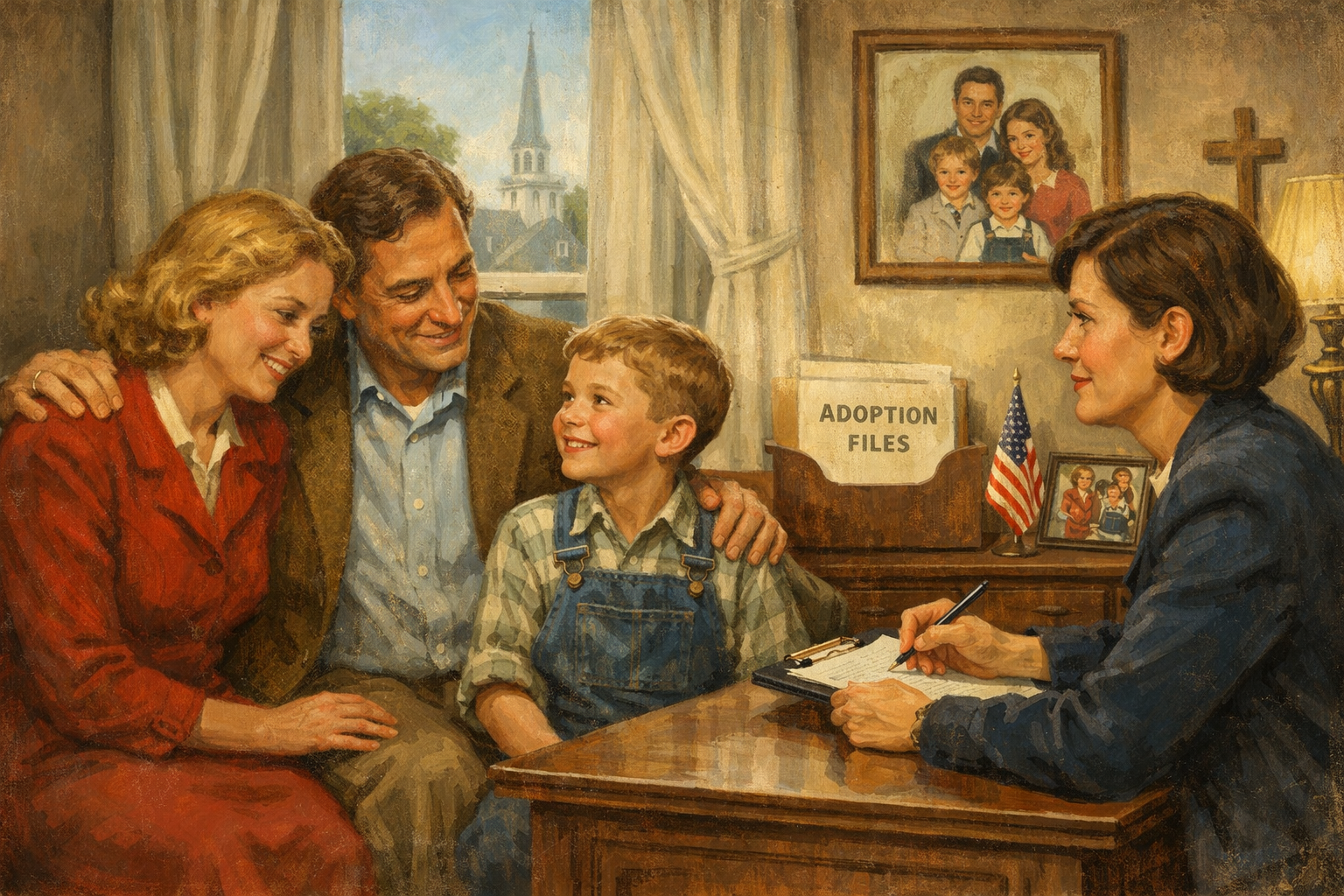
Few social issues expose the fault lines of modern America as clearly as gay adoption and foster parenting.
What at first glance appears to be a narrow question about family structure quickly expands into debates over human nature, children’s rights, the role of government, religious liberty, and the meaning of equality itself.
For this reason, gay adoption and fostering are not fringe concerns; they sit squarely at the intersection of culture, politics, and public policy.
At its core, this issue asks a simple but profound question: What does a child need, and who has the authority to decide?
The answer to that question differs dramatically depending on whether one approaches the subject from a traditional, biblical, progressive, or libertarian worldview.
As a result, voters increasingly recognize that positions on adoption and fostering are not isolated policy preferences but signals of deeper commitments that shape a candidate’s approach to law, education, religious freedom, and civil society.
A Divisive Issue With National Consequences
Gay adoption and foster parenting divide Americans not merely along party lines, but along competing visions of family and society.
For many voters, especially parents and grandparents, the issue is personal.
Adoption and foster care involve the most vulnerable members of society—children who have already experienced loss, instability, or trauma. Decisions about their placement are not abstract moral exercises; they have lifelong consequences.
Polling over the last decade consistently shows that while Americans have become more tolerant of same-sex relationships in general, they remain more divided when the discussion shifts from adult relationships to child-rearing.
Support declines when voters are asked whether the state should prioritize same-sex households over mother–father homes, or whether religious adoption agencies should be compelled to place children in homes that violate their religious convictions.
These distinctions matter to voters because they reveal whether the issue is about freedom and accommodation—or about coercion and ideological enforcement.
Legal developments have further heightened voter concern. Court rulings and administrative policies have increasingly treated opposition to gay adoption not as a matter of conscience, but as a form of unlawful discrimination.
This has led to the closure of long-standing Christian adoption agencies in multiple states, reducing placement capacity even as the number of children in foster care continues to rise. For many Americans, this raises an uncomfortable question: Are ideological commitments now being prioritized over the welfare of children?
Economic and Institutional Impacts
Beyond moral and cultural considerations, gay adoption and foster policies have tangible economic and institutional effects.
Foster care systems are heavily subsidized by taxpayers. When faith-based agencies are forced to shut down or withdraw from partnerships with the state, governments often face higher costs and reduced efficiency.
Religious organizations have historically provided foster and adoption services at lower cost, with deep community ties and long-term stability. Their exclusion creates service gaps that must be filled by state bureaucracies or newly created secular nonprofits, often at greater expense.
There is also an indirect economic cost associated with family instability.
Decades of social science research—much of it predating current political debates—demonstrates that children raised without both a mother and a father are statistically more likely to experience poverty, behavioral problems, educational underachievement, and involvement with the criminal justice system.
These outcomes translate into increased public spending on welfare, remedial education, and law enforcement. While individual cases vary, public policy must consider population-level effects rather than anecdotal exceptions.
Public safety is implicated as well. Foster care systems are already strained, and policies that prioritize ideological conformity over placement capacity risk leaving more children in group homes or temporary shelters.
These environments are consistently associated with poorer outcomes than stable family placements. Voters concerned about crime, social decay, and long-term community health are right to recognize that family policy is upstream from many of the problems governments later struggle to manage.
Children’s Rights Versus Adult Desires
One of the most significant shifts in this debate involves how rights are framed.
Traditionally, adoption policy focused on the rights and needs of the child.
Increasingly, however, the conversation has been reframed around the rights and desires of adults.
This shift is subtle but consequential. When the state treats access to children as an entitlement of adults, children risk being reduced from persons with inherent needs to accessories that validate adult identities or relationships.
This concern is often described in moral philosophy as the alienation of the goods.
In this context, it refers to the separation of parenting from the natural male–female union that produces children in the first place.
Motherhood and fatherhood are no longer seen as complementary roles rooted in biological and social reality, but as interchangeable functions detached from sex, marriage, and creation order.
Parenting becomes a modular commodity—transferable, customizable, and subject to personal preference rather than moral constraint.
Once this separation is accepted, additional practices follow logically.
Surrogacy, for example, treats reproduction as a service and the child as a product of contractual arrangements. The child is intentionally deprived of either a mother or a father by design, not by tragedy.
Many voters who are uneasy about gay adoption point to this development as evidence that the issue is not merely about compassion for orphans, but about redefining children to fit adult lifestyles.
It is not inappropriate to compare gay adoption and foster parenting to human trafficking in some contexts.
Why Voters Should Care
American citizens should care about gay adoption and foster parenting because it reveals how political leaders balance compassion with principle, rights with responsibilities, and freedom with coercion. It tests whether the state views children as wards to be protected or resources to be allocated in service of ideological goals. It also exposes whether claims of tolerance are applied consistently—or selectively enforced against religious and traditional communities.
Historically, societies that have weakened the family have not strengthened the state; they have burdened it. The American experiment has depended heavily on strong families to transmit moral norms, social trust, and civic responsibility across generations. When the family is redefined in law, those downstream effects are not optional—they are inevitable.
For voters, then, this issue is not simply about where one stands on sexuality. It is about whether public policy will continue to recognize the unique value of the mother–father family, or whether it will treat that model as just one lifestyle option among many, with no special claim on legal protection or public support. That decision will shape adoption systems, religious liberty, education policy, and the moral formation of future generations.
Articles in the Critical Issues series require more time to read than most content on this site. They are intentionally written as thorough, in-depth examinations of their subjects.
The Republican Perspective on Gay Adoption and Foster Parenting
The Republican Party’s position on gay adoption and foster parenting is best described as internally divided but structurally restrained. Unlike the Democrat Party, which has largely unified around a progressive redefinition of family, Republicans house multiple factions whose disagreements reflect deeper philosophical differences about marriage, the role of the state, and the nature of rights.
A Party Shaped by Federalism and Moral Pluralism
At the national level, the Republican Party has historically approached family policy through federalism—the belief that states, not Washington, should regulate domestic matters such as marriage, adoption, and foster care. This instinct has allowed Republicans with sharply different moral convictions to coexist within the same coalition.
The 2024 Republican Party platform does not explicitly endorse gay adoption as a positive good, nor does it declare a blanket prohibition. Instead, it emphasizes parental rights, religious liberty, and the importance of the natural family structure, while resisting federal mandates that would force states or faith-based agencies into ideological compliance. Where the platform does speak clearly is in its opposition to government coercion against religious individuals and institutions involved in child welfare (see sections addressing religious liberty, parental authority, and family integrity).
This omission is not accidental. It reflects the reality that Republicans are united more strongly around what the federal government must not do—namely, punish religious dissent—than around prescribing a single nationwide family model through statute.
Two Republican Camps: Accommodation vs. Moral Norms
Within the Republican coalition, there are two broad camps on gay adoption and fostering.
The first group might be described as accommodationist conservatives. These Republicans tend to separate sexual ethics from public policy and argue that as long as a household can meet baseline safety and financial requirements, the state should not discriminate based on sexual orientation. Figures commonly cited in this category include Republicans who come from more liberal denominations or secular backgrounds and who frame their position in terms of fairness, individual liberty, and social peace.
This camp often emphasizes that adoption is preferable to institutional care and argues that denying gay couples the ability to adopt could reduce placement opportunities. While this argument appeals to pragmatism, critics within the party contend that it treats the absence of a mother or father as morally neutral rather than as a loss to be mitigated.
The second group consists of social conservatives and religious traditionalists, who maintain that the state has a legitimate interest in prioritizing homes that reflect the natural family structure—one man and one woman—because this structure best corresponds to the needs of children. Senators such as Josh Hawley and others in this camp argue that adoption exists for the child, not for adults seeking validation, fulfillment, or equality.
For this group, the issue is not animus toward gay individuals but concern about intentional deprivation. They distinguish between children who lose a parent through death or divorce—a tragedy—and policies that deliberately place children into homes designed to exclude either maternal or paternal influence from the outset.
Republican Lawmakers and Legislative Action
Republican lawmakers at both the federal and state levels have generally focused their legislative energy on protecting religious adoption agencies rather than banning gay adoption outright. This distinction is crucial.
Numerous Republican-backed bills and state policies seek to ensure that faith-based organizations are not forced to violate their convictions as a condition of participating in foster and adoption systems. These efforts reflect the belief that pluralism can exist without uniformity, and that diversity of providers increases—not decreases—placement capacity.
Republicans have also raised concerns about surrogacy, particularly commercial surrogacy arrangements that involve third-party donors, contractual pregnancy, and intentional separation of children from biological parents. While not always framed explicitly in moral language, these objections often rest on unease about commodification and the transformation of children into products of adult contracts.
At the state level, Republican governors and legislatures have pursued policies that reaffirm parental rights, limit ideological requirements placed on foster parents, and resist the use of sexual orientation as a litmus test for suitability unless directly relevant to child safety. These leaders often argue that ideological screening reduces the pool of qualified foster parents at a time when systems are already overwhelmed.
Tension Between Winning Elections and Preserving Principles
One of the most significant challenges for Republicans on this issue is electoral pressure. Party strategists are acutely aware that younger voters and suburban moderates are more permissive on sexual ethics, even if they remain uneasy about government overreach. This has led some Republican leaders to soften their rhetoric, focusing narrowly on religious liberty rather than articulating a positive vision of the family.
Critics within the party warn that this approach risks conceding the moral ground. They argue that when Republicans refuse to articulate why mothers and fathers matter, they implicitly accept the progressive assumption that family structure is interchangeable. Over time, this silence may undermine even the religious liberty protections Republicans seek to preserve.
Nevertheless, the Republican Party remains the only major political coalition in which biblical Christians, traditional families, and faith-based child welfare providers are allowed meaningful participation. While imperfect and divided, it offers space for moral argument rather than enforcing ideological conformity from the top down.
In the next section, we will examine the Democrat Party’s position, where internal disagreement is far narrower, and where progressive assumptions about sexuality, identity, and state authority shape adoption and foster care policy far more aggressively.
The Democrat Perspective on Gay Adoption and Foster Parenting
The Democrat Party’s position on gay adoption and foster parenting is far more unified than that of Republicans and is driven by a clear ideological framework rooted in equality-of-outcome, identity politics, and an expansive view of state authority. Within Democrat ranks, opposition to gay adoption is no longer treated as a legitimate policy disagreement; it is increasingly framed as a moral failing akin to racism or sexism. This framing has profound implications for law, religious liberty, and the structure of child welfare systems.
Official Party Commitments and Platform Direction
The 2024 Democrat Party platform does not merely support gay adoption and fostering; it treats access to children as a civil right grounded in sexual orientation and gender identity. The platform consistently frames family policy through the lens of “non-discrimination,” “affirmation,” and “inclusion,” with little to no acknowledgment of competing interests such as religious conscience or the distinct developmental roles of mothers and fathers.
When adoption and foster care are mentioned, they are discussed primarily as mechanisms through which the state must ensure equal treatment of LGBTQ individuals. Notably absent is any sustained discussion of whether children have a right to a mother and a father, or whether certain family structures might be preferable from the child’s perspective. The child is implicitly repositioned from subject to object—the beneficiary of adult equality claims rather than the central moral agent.
This approach marks a decisive shift away from historic child-centered adoption policy toward adult-centered rights enforcement.
Democrat Lawmakers and Legislative Advocacy
Democrat lawmakers at the federal level have consistently supported legislation that expands sexual orientation and gender identity protections into adoption and foster care systems. These measures typically prohibit agencies receiving public funds from declining placements based on sexual conduct or marital structure, even when such refusals are grounded in longstanding religious doctrine.
Prominent Democrat legislators have argued that any restriction on gay adoption constitutes “state-sanctioned discrimination,” regardless of whether alternative agencies are available or whether the child is ultimately placed in a stable home. In this framework, pluralism is rejected in favor of uniform compliance. The presence of dissenting moral frameworks is treated as a problem to be eliminated rather than accommodated.
Democrat members of Congress have also supported measures that elevate sexual identity above religious conviction in civil rights hierarchies. This has resulted in policy environments where Christian adoption agencies are forced to choose between violating conscience or exiting the public square altogether.
State and Local Implementation: Progressive Governance in Action
The Democrat position becomes clearest at the state and municipal level, where progressive administrations exercise direct control over child welfare systems. In states such as California, Massachusetts, Illinois, New York, Oregon, and Washington, laws and administrative rules have effectively barred faith-based agencies from operating unless they fully affirm same-sex parenting arrangements.
These policies have led to the closure or withdrawal of numerous Christian adoption and foster care providers—organizations that had served vulnerable children for decades. In several cases, state officials openly acknowledged that religious agencies were not welcome unless they changed their beliefs. The result has been fewer placement options, longer wait times, and increased reliance on government-run systems.
Democrat leaders in major cities have gone further by imposing ideological screening on prospective foster parents. Individuals who express traditional views on marriage or sexuality—even when unrelated to child safety—have been deemed unfit to foster. This practice has narrowed the pool of caregivers at a time when foster systems are overwhelmed, particularly with older children and sibling groups.
The Role of Surrogacy and Reproductive Technology
Another defining feature of the Democrat approach is its uncritical support for commercial surrogacy and assisted reproductive technologies as extensions of adoption policy. While often framed as separate issues, they share the same underlying assumption: that adult desire for parenthood justifies the intentional reengineering of family structure.
Democrat lawmakers have generally opposed restrictions on surrogacy contracts, even when those contracts involve the premeditated separation of children from their biological parents. Concerns about exploitation of women, commodification of reproduction, or the psychological impact on children are typically dismissed as secondary to adult autonomy.
This represents a profound example of the alienation of the goods. Procreation, parenting, and marriage—once understood as an integrated moral ecosystem—are separated into discrete functions managed by contracts and courts. The state becomes the guarantor of adult fulfillment rather than the protector of natural bonds.
Minimal Internal Dissent
Unlike Republicans, Democrats exhibit very little internal disagreement on this issue. Lawmakers who hold traditional views on family structure have largely been marginalized or driven out of party leadership. Even religious Democrats tend to adopt progressive language when discussing adoption, often reframing theological concerns as private beliefs with no place in public policy.
This uniformity is enforced not only through party mechanisms but through cultural pressure. Dissenting voices are frequently accused of bigotry, regardless of intent or evidence. As a result, the Democrat Party has become a vehicle for enforcing a singular moral vision—one that treats opposition not as a legitimate difference of opinion but as a social harm requiring correction.
The Broader Implication for Voters
For voters, the Democrat position on gay adoption and foster parenting signals more than compassion for marginalized adults. It reveals a willingness to subordinate religious liberty, parental authority, and child-centered policy to an ideological commitment to sexual egalitarianism. It also demonstrates how quickly “tolerance” can give way to coercion when the state assumes moral supremacy.
In the next section, we will examine the Libertarian position, which approaches this issue from a radically different angle—one that minimizes both moral claims and state involvement, but in doing so raises its own set of concerns.
The Libertarian Perspective on Gay Adoption and Foster Parenting
The Libertarian position on gay adoption and foster parenting differs sharply from both Republican and Democrat approaches, not because it offers a competing vision of the family, but because it largely rejects the premise that the state should evaluate family structure at all. Libertarianism approaches the issue through a narrow lens of individual autonomy, voluntary association, and minimal government involvement. As a result, its position is internally consistent, but socially thin.
Core Libertarian Principles Applied to Adoption
Libertarians begin with the assumption that the individual is the primary moral unit, not the family, community, or nation. From this standpoint, adult rights take precedence, and state distinctions based on marital status, sex, or sexual orientation are viewed with suspicion. If two consenting adults can provide food, shelter, and safety, Libertarians generally argue that the state has no legitimate authority to deny them the opportunity to adopt or foster.
The most recent Libertarian Party platform reflects this logic by emphasizing personal liberty, equal treatment under the law, and resistance to moral regulation by government. Adoption and foster care are treated as contractual arrangements rather than moral or social institutions. The platform does not affirm any preferred family structure, nor does it recognize a normative role for mothers and fathers as distinct contributors to child development.
In this sense, Libertarians align more closely with Democrats on outcomes—supporting gay adoption and fostering—but for very different reasons. Where Democrats justify their position through equality and identity-based justice, Libertarians justify it through market logic and personal freedom.
Adoption as a Market Transaction
A defining feature of the Libertarian approach is its tendency to frame adoption as a voluntary exchange governed by contract rather than as a public trust oriented toward child welfare. This framework fits comfortably with privatization and deregulation but struggles to account for children as moral subjects rather than passive recipients of adult decisions.
Under a strictly Libertarian model, the state’s role is limited to preventing overt abuse or neglect. Questions about whether a child benefits from both a mother and a father are treated as subjective preferences rather than legitimate public concerns. The idea that children might have inherent claims on certain relational goods—such as maternal and paternal presence—is largely absent from Libertarian thought.
This omission becomes especially pronounced in discussions of surrogacy, which Libertarians often support enthusiastically as an expression of free choice. The contractual production of children, separation from biological parents, and commercialization of reproduction are not seen as ethical red flags so long as all parties consent. Critics argue that this approach ignores power imbalances, commodification, and long-term consequences for children.
Tension With Religious Liberty
While Libertarians often champion religious freedom in abstract terms, their framework offers limited protection for religious adoption agencies in practice. Because Libertarianism resists government involvement altogether, it tends to regard faith-based objections as private concerns rather than public goods worth preserving.
In situations where the state funds adoption services, Libertarians typically argue that agencies should either comply with non-discrimination rules or operate entirely privately without public support. This position offers little comfort to religious organizations that have historically partnered with the state to serve vulnerable children while maintaining their doctrinal commitments.
As a result, Libertarianism can unintentionally reinforce progressive outcomes by failing to defend institutional pluralism. By refusing to recognize that moral disagreement may require accommodation rather than elimination, the Libertarian approach leaves religious actors exposed when progressives control regulatory structures.
Why Libertarians Remain a Secondary Consideration
Despite its philosophical clarity, Libertarianism remains a marginal force in American politics. Its limited electoral influence and lack of governing experience mean that its views on gay adoption and foster parenting rarely shape policy directly. Instead, Libertarian ideas tend to exert indirect pressure—nudging Republicans toward procedural neutrality or Democrats toward market-based solutions.
For the purposes of this article, the Libertarian position is presented tangentially, not because it is unimportant, but because it lacks the institutional power to define national policy. Nevertheless, it serves as a useful contrast, highlighting how radically different assumptions about human nature and authority can lead to similar policy outcomes for very different reasons.
In the next section, we will examine Progressivism—also referred to as wokeness, Cultural Marxism, political correctness, and Neo-Marxism—and how its presuppositions have shaped the Democrat Party’s approach to gay adoption and foster parenting.
Progressive Principles and Their Influence on Gay Adoption and Foster Parenting
To understand the modern Democrat position on gay adoption and foster parenting, one must understand the influence of Progressivism (often described—imprecisely but familiarly—as wokeness, Cultural Marxism, political correctness, or Neo-Marxism). While these labels are not interchangeable, they point toward a shared set of assumptions that increasingly govern how family policy is framed, enforced, and defended.
Progressivism does not merely advocate policy preferences; it advances a comprehensive moral vision that reorders concepts such as authority, identity, and justice.
Core Progressive Presuppositions
At the heart of Progressive thought is a rejection of natural order in favor of social construction. Institutions such as marriage, motherhood, fatherhood, and even biological sex are treated not as realities rooted in nature or creation, but as human inventions shaped by power dynamics. If an institution produces unequal outcomes, Progressivism assumes the institution itself is unjust.
Applied to adoption and foster care, this logic yields a predictable conclusion: any preference for mother–father homes is interpreted as an expression of oppression rather than a recognition of child development. The question is no longer what arrangement best serves children, but which arrangements maximize adult equality.
In Progressive thinking, children are not primarily understood as dependent persons with distinct needs. Instead, they function as symbols within a broader struggle for social validation. Adoption becomes a stage upon which competing identity claims are resolved, rather than a remedial institution designed to address tragedy and loss.
Equality Reframed as Moral Absolutism
Progressives frequently frame their support for gay adoption in the language of equality. However, this equality is not procedural—equal treatment under the law—but substantive, meaning equal outcomes and equal social affirmation. Any policy that treats different family structures differently is therefore condemned, regardless of empirical evidence or moral reasoning.
This absolutized view of equality leaves no room for prudential judgment. The possibility that children may benefit uniquely from a mother and a father is dismissed not as mistaken, but as illegitimate. Once this assumption is in place, dissent becomes morally suspect by definition.
This explains why Progressive administrations are not content merely to allow gay adoption; they seek to eliminate dissenting institutions. Faith-based agencies are not tolerated as alternative providers because their existence undermines the narrative that all family forms are morally interchangeable.
Alienation of the Goods in Progressive Family Policy
Progressive ideology exemplifies the alienation of the goods by fragmenting what were once integrated human realities. Sex is severed from reproduction. Reproduction is severed from marriage. Parenting is severed from both. Each “good” is treated as a standalone entitlement rather than part of a moral ecology.
Once this fragmentation occurs, there is no principled stopping point. If parenting is a right disconnected from biology and marriage, then surrogacy, donor conception, and contractual parenthood follow naturally. The child becomes the final link in a chain of adult-centered claims—produced, transferred, and assigned according to preference rather than obligation.
Progressives often deny this commodifying effect, yet their policy architecture depends on it. Courts adjudicate parenthood not by natural relation but by intent. Bureaucracies assign children based on ideological criteria. Language itself is reshaped to obscure loss: “non-birthing parent,” “assigned parent,” or “gestational carrier” replace mother and father, minimizing the child’s severed bonds.
Power, the State, and Moral Enforcement
Progressivism views the state not as a neutral arbiter but as an engine of moral transformation. Laws are tools for reshaping social norms, not merely protecting rights. This explains why Progressive leaders are willing—even eager—to use licensing, funding conditions, and civil rights enforcement to compel conformity.
In adoption and foster care, this has produced a system where disagreement is punished. Foster parents are screened for ideological compliance. Agencies are threatened with defunding. Speech that once fell within the bounds of reasonable moral disagreement is now classified as harmful.
This enforcement reveals a contradiction at the heart of Progressive rhetoric. While claiming to champion diversity, Progressivism enforces a singular moral orthodoxy—one that cannot coexist with biblical Christianity or natural law reasoning.
Why This Matters for the Broader Debate
Understanding Progressive presuppositions helps explain why compromise on this issue is increasingly difficult. The conflict is not about logistics or compassion, but about competing moral authorities. Progressives reject the idea that moral truths exist prior to the state or beyond human construction. Biblical Christians and traditional conservatives reject the idea that the state may redefine human nature.
This clash shapes every downstream debate—from religious liberty to education to parental rights. Gay adoption and foster parenting are therefore not isolated issues; they are flashpoints revealing whether America will continue to recognize limits on political power grounded in nature and conscience, or whether ideological enforcement will replace moral persuasion.
In the next section, we will examine whether Democrat leadership’s actions actually match their stated principles, using concrete examples from federal, state, and city governments to test rhetoric against reality.
Do Democrat Actions Match Their Official Commitments?
“In politics, what you do is what you believe. Everything else is cottage cheese.”
—Senator Joseph N. Kennedy
This observation provides a useful test for evaluating the Democrat Party’s approach to gay adoption and foster parenting. While official platforms speak in the language of compassion, inclusion, and equality, governing actions reveal how these values are prioritized when they collide with competing concerns such as religious liberty, institutional pluralism, and child-centered policy.
When examined closely, Democrat leadership’s actions consistently move beyond stated commitments to fairness and into ideological enforcement.
Platform Language Versus Policy Reality
The Democrat Party platform presents its support for gay adoption as a matter of equal access and non-discrimination. In theory, this position could coexist with a pluralistic system that accommodates differing moral frameworks while expanding placement opportunities.
In practice, however, Democrat governance has taken a far more aggressive posture. Rather than ensuring access alongside conscience protections, Progressive administrations have pursued policies that eliminate dissenting providers altogether. The result is not neutrality, but moral uniformity imposed through state power.
This gap between rhetoric and action is where Kennedy’s observation becomes especially relevant.
Federal-Level Enforcement Under the Biden Administration
Under the Biden administration, federal agencies have reinterpreted civil rights law to treat sexual orientation and gender identity as categories that override religious conviction in child welfare contexts. Guidance from the Department of Health and Human Services has pressured states to condition foster and adoption funding on full ideological compliance.
Rather than allowing states to maintain diverse provider networks, federal policy has increasingly signaled that participation in public child welfare systems requires affirmation of Progressive sexual ethics. This approach effectively treats religious beliefs as disqualifying characteristics rather than protected liberties.
The administration has defended these policies as anti-discrimination measures, yet they apply discrimination logic selectively. Religious agencies are excluded because of their beliefs, not despite them.
State-Level Case Studies: Uniformity Over Capacity
Progressive states provide clearer evidence of how Democrat commitments function in practice.
In multiple jurisdictions—California, Massachusetts, Illinois, New York, Oregon, Washington, and Colorado—Christian adoption and foster agencies have been forced to close or withdraw after decades of service. In each case, officials argued that allowing these agencies to operate would “harm” LGBTQ individuals, even when alternative agencies were readily available.
The practical effect has been fewer placement options for children, especially older children and those with special needs. Yet these outcomes are treated as acceptable collateral damage in pursuit of ideological consistency.
This reveals a key inconsistency: while Democrats claim to prioritize children, they routinely sacrifice placement capacity to enforce moral compliance.
Ideological Screening of Foster Parents
Perhaps the clearest example of action revealing belief is the rise of ideological screening for foster parents in Progressive jurisdictions. Prospective foster parents have been rejected not for abuse, neglect, or instability, but for holding traditional views on marriage or refusing to affirm certain sexual identities.
This practice contradicts the stated Democrat emphasis on diversity and inclusion. In reality, diversity is welcomed only when it aligns with Progressive norms. Moral dissent is treated as a risk factor, even when no evidence exists that such views endanger children.
The standard applied is not safety, but affirmation.
When Adoption, Foster Care, and Surrogacy Begin to Resemble Human Trafficking
Any honest discussion of gay adoption, foster parenting, and surrogacy must grapple with a deeply uncomfortable question: At what point does the transfer of children from one set of adults to another cease to be child rescue and begin to resemble human trafficking?
Human trafficking is commonly understood as the buying, selling, or coercive transfer of persons—especially the vulnerable—for the benefit of others. While adoption and foster care are not inherently trafficking, certain modern practices blur the moral and legal lines in ways that deserve scrutiny.
In traditional adoption, the moral logic is clear: a child has lost parents through death, abandonment, or incapacity, and responsible adults step in to provide care. The transaction is oriented toward remedying loss. The child is not produced for adoption; adoption responds to tragedy.
Surrogacy reverses that logic. Children are intentionally brought into existence through contractual arrangements that predetermine separation from at least one biological parent—often both. Money changes hands. Legal documents assign parenthood based not on biological or marital bonds, but on adult intent and payment. In these cases, the child is not rescued from loss; the loss is planned.
When combined with same-sex parenting arrangements, this structure becomes even more troubling. The child is deliberately denied either a mother or a father by design, not by circumstance. The adult desire for parenthood drives the process, while the child’s right to natural bonds is treated as negotiable.
This is where the analogy to trafficking becomes unavoidable. While the language of “purchase” is often avoided, the reality is that children are transferred through systems involving contracts, payments, brokers, lawyers, fertility clinics, and agencies. The adult beneficiaries are clear. The child’s consent is neither possible nor considered.
International surrogacy raises even more serious concerns. Poor women in developing countries are routinely used as gestational carriers for wealthy Western clients. Power imbalances are obvious. Financial pressure is real. Once the child is born, he or she is removed across borders to satisfy contractual obligations. If these dynamics appeared in any other context, they would immediately trigger trafficking investigations.
Progressives often respond by insisting that all parties consent. But children cannot consent to their own commodification. Consent among adults does not erase exploitation when one party bears all the cost and none of the control.
From a biblical and child-centered perspective, the moral red flag is not sexual orientation per se, but intentional production and transfer of children to satisfy adult preferences. When children are treated as outcomes of contracts rather than gifts entrusted by God, the moral logic of trafficking—not care—begins to dominate.
Raising this concern is not inflammatory. It is necessary. A society that cannot distinguish between rescuing children and manufacturing them for distribution has lost its moral bearings.
Selective Application of Anti-Discrimination Principles
Democrat leadership frequently accuses conservatives of discrimination for opposing gay adoption, yet their own policies reveal selective moral enforcement. Christians are excluded from child welfare participation precisely because they refuse to affirm Progressive sexual ideology.
This is not neutrality. It is hierarchical moral judgment, where certain belief systems are elevated to protected status while others are penalized.
If discrimination is wrong in principle, it cannot be wrong only when practiced against favored groups. The Democrat Party’s unwillingness to apply its standards consistently exposes a deeper commitment—not to fairness, but to cultural transformation.
Soft and Hard Authoritarian Tendencies
While Democrat leaders often reject the label of authoritarianism, their behavior exhibits both soft and hard coercive tendencies. Soft coercion appears through licensing requirements, funding conditions, and bureaucratic pressure. Hard coercion emerges when agencies are shut down, parents are disqualified, or speech is regulated through threat of exclusion.
These measures are justified as necessary to protect vulnerable populations, yet they consistently suppress dissent rather than address demonstrable harm. The effect is a narrowing of the moral imagination and a shrinking of civil society’s role in caring for children.
What the Actions Reveal
When evaluated honestly, Democrat actions reveal a belief that the state—not families, churches, or communities—is the final arbiter of moral legitimacy. Adoption and foster care become instruments of ideological instruction rather than remedial institutions responding to human brokenness.
This does not mean Democrat leaders are insincere in their compassion. It means their compassion is subordinated to a worldview that prioritizes adult identity claims over competing goods—including religious liberty and, in many cases, the best interests of children.
In the next section, we will examine how each party critiques the other on this issue, identifying the strongest objections raised by honest interlocutors and the most credible counter-responses.
How Each Party Critiques the Other — Objections and Counter-Responses
No issue this morally charged survives without sharp criticism from all sides. Gay adoption and foster parenting provoke sincere concerns, rhetorical excess, and at times bad faith arguments. This section focuses on credible criticisms raised by honest interlocutors, followed by measured counter-responses, rather than caricatures.
Common Criticisms of the Republican Position
Criticism 1: Republicans are motivated by animus toward gay people, not concern for children.
Opponents argue that resistance to gay adoption reflects outdated prejudice rather than evidence-based reasoning. They point to individual same-sex households that appear stable and loving as proof that opposition is irrational.
Counter-Response:
The strongest Republican arguments do not focus on adult behavior but on child-centered policy. The concern is not whether some same-sex households function adequately, but whether the state should intentionally design family structures that deprive children of either maternal or paternal influence. Public policy must be shaped by general patterns and moral reasoning, not exceptional cases.
Criticism 2: Denying gay couples access to adoption leaves children in institutions.
Critics contend that restricting adoption options reduces placements and harms children who need homes now.
Counter-Response:
Republicans generally do not argue for eliminating gay adoption outright at the federal level. Instead, they resist mandating it while protecting pluralism. The closure of adoption agencies has overwhelmingly occurred due to Progressive exclusion of religious providers—not Republican restriction. Removing faith-based agencies reduces capacity more than allowing moral diversity ever did.
Criticism 3: Republicans inconsistently support family values while tolerating divorce and single parenting.
Progressives argue that conservatives selectively enforce moral standards.
Counter-Response:
Republicans distinguish between tragedy and design. Divorce, widowhood, and single parenting are acknowledged as painful realities requiring compassion. Gay adoption policies, by contrast, intentionally construct homes that exclude either mothers or fathers from the outset. The distinction is moral, not punitive.
Common Criticisms of the Democrat Position
Criticism 1: Democrats prioritize adult equality over children’s needs.
Conservatives argue that Democrats treat adoption as a civil right for adults rather than a service for children.
Counter-Response Offered by Democrats:
Democrats claim that loving homes are what matter most and that no evidence proves same-sex parenting is harmful.
Rebuttal:
This response sidesteps the moral question. The issue is not abuse versus love, but whether children have legitimate claims to both maternal and paternal presence. The absence of definitive harm does not justify intentional deprivation—especially when biological family structure has historically been the norm across cultures.
Criticism 2: Democrats use the state to punish religious dissent.
Critics argue that Progressive policies undermine religious liberty by forcing agencies and parents to conform or exit.
Counter-Response Offered by Democrats:
Democrats respond that public funding requires compliance with public values.
Rebuttal:
This logic collapses pluralism. Religious agencies did not change; the state did. Conditioning participation on ideological affirmation transforms public partnership into moral vetting. Historically, American governance accommodated moral diversity unless concrete harm was demonstrated.
Criticism 3: Democrat rhetoric about inclusion is selectively applied.
Conservatives note that Christians are excluded under the very anti-discrimination principles Democrats champion.
Rebuttal:
Democrats typically avoid engaging this contradiction directly. Instead, they redefine traditional beliefs as harmful conduct, exempting themselves from their own standards.
Mutual Misunderstandings That Obscure the Debate
Both parties sometimes talk past one another.
Republicans occasionally fail to articulate their case positively, relying on defensive appeals to religious liberty rather than explaining why mothers and fathers matter. This allows opponents to frame the issue as mere obstruction.
Democrats often refuse to acknowledge moral limits altogether, treating disagreement as evidence of bigotry. This forecloses genuine dialogue and accelerates polarization.
A productive debate requires recognizing that adoption policy is not merely about tolerance, but about competing visions of human flourishing, moral authority, and the limits of state power.
In the next section, we will examine credible suspicions about the strategies and motives of each party—not as conspiracy theories, but as reasonable inferences drawn from behavior, incentives, and public statements.
Credible Suspicions About Party Strategies and Motives
Discussions of political motive must be handled carefully. Not every outcome is the result of malice, and not every policy reflects a hidden agenda. At the same time, voters are not naïve. When patterns of behavior repeat across institutions, administrations, and jurisdictions, it is reasonable to ask why. This section examines credible suspicions, grounded in observable incentives and documented actions—not conspiracy theories.
Republican Motives and Strategic Calculations
Republican motivations on gay adoption and foster parenting tend to fall into two overlapping categories: principled restraint and electoral calculation.
From a principled standpoint, many Republicans genuinely believe that the federal government lacks the authority to redefine family structure. Their emphasis on states’ rights, parental authority, and religious liberty reflects a belief that civil society—not centralized power—is better suited to handle sensitive moral questions.
However, electoral incentives also play a role. Republican leaders are acutely aware that cultural attitudes toward sexuality have shifted, particularly among younger voters. As a result, some Republicans adopt a deliberately minimalist posture: defend conscience protections, avoid sweeping prohibitions, and allow states to decide. This approach reduces backlash but can appear evasive to social conservatives who want a clearer moral stance.
Critics within the party suspect that this strategic ambiguity risks conceding the moral narrative to Progressives. When Republicans refuse to articulate why the mother–father household matters, they implicitly accept the Progressive framing that all family structures are morally equivalent—differing only in social acceptance.
Nevertheless, there is little evidence that Republican resistance to gay adoption is driven by animus. The consistent emphasis on child welfare, pluralism, and institutional diversity suggests that most Republican opposition is rooted in worldview disagreement rather than hostility.
Democrat Motives and Ideological Incentives
The Democrat Party’s motivations are more ideologically coherent—and therefore more predictable. At the center is a commitment to identity-based equality as a primary moral good. Gay adoption functions symbolically within this framework as proof that sexual identity categories have achieved full social legitimacy.
From this perspective, any limitation on access to children represents an intolerable hierarchy of moral worth. Allowing religious agencies to operate according to their beliefs would imply that Progressive sexual ethics are optional rather than normative. This helps explain the insistence on uniform compliance rather than accommodation.
There are also institutional incentives. Progressive activists, NGOs, and advocacy organizations exert significant influence over Democrat policy formation. These groups view adoption and foster care as leverage points for broader cultural change. By reshaping family policy, they reshape education, healthcare, and speech norms downstream.
Some observers reasonably suspect that children, in this framework, become instruments of moral signaling. Adoption is not only about providing homes; it is about validating identities, normalizing redefined family structures, and disciplining dissenting institutions.
This does not require assuming bad intentions. Many Democrat leaders sincerely believe that enforcing affirmation reduces harm. The concern is that ideological certainty blinds policymakers to trade-offs, especially when those trade-offs are borne by children rather than activists.
The Question of Power Consolidation
Another credible suspicion involves the expansion of state authority. By displacing churches and private agencies from child welfare systems, Progressive governments consolidate control over licensing, placement standards, and ideological screening. This centralization increases bureaucratic power while weakening independent moral institutions.
Historically, societies that marginalize mediating institutions—family, church, community—do so at long-term cost. Voters who value decentralization are right to question whether current Democrat policies unintentionally (or intentionally) erode these buffers.
Why Suspicion Is Not Cynicism
It is important to distinguish suspicion from cynicism. To suspect motives is not to deny sincerity; it is to recognize incentives. Political systems reward certain behaviors. Over time, those rewards shape outcomes regardless of individual intent.
Republicans are incentivized to avoid cultural landmines. Democrats are incentivized to demonstrate moral progress through policy enforcement. These incentives explain much of what we observe without resorting to speculation.
In the next section, we will examine high-trust versus low-trust societies and how declining social trust has intensified this debate—particularly around whether institutions, families, or the state should be trusted to act in the best interests of children.
High-Trust and Low-Trust Societies — Why Trust Shapes This Debate
The debate over gay adoption and foster parenting cannot be fully understood without addressing the concept of high-trust versus low-trust societies. Trust functions as the social glue that allows families, institutions, and governments to operate with minimal coercion. When trust declines, the state expands. When trust is high, civil society flourishes.
This issue sits squarely within that dynamic.
What Is a High-Trust Society?
A high-trust society is one in which citizens generally believe that other people and institutions will act responsibly, honestly, and predictably. Shared moral norms reduce the need for regulation because behavior is constrained internally rather than externally.
Historically, the United States functioned as a relatively high-trust society precisely because it shared a broad moral consensus rooted in Christianity, natural law, and the nuclear family. Marriage between a man and a woman was understood not merely as a private arrangement, but as a public good. Adoption and foster care operated within that framework, aiming to approximate biological family structure as closely as possible after tragedy occurred.
In such a society, religious organizations were trusted partners in child welfare. Their moral convictions were viewed as assets rather than liabilities.
The Transition to a Low-Trust Framework
As shared moral assumptions fractured, trust declined. Disagreement over sexuality, marriage, and authority eroded the common ground that once guided policy. In response, Progressive governance adopted a low-trust posture—assuming that individuals and institutions holding traditional views are inherently suspect and must be regulated or excluded.
This shift explains much of the current adoption debate. Progressive policymakers do not trust religious agencies to place children “fairly.” They do not trust foster parents who dissent from sexual orthodoxy. They do not trust families to transmit moral norms without state oversight.
As a result, the state increasingly positions itself as the sole trustworthy actor—setting standards, policing beliefs, and enforcing compliance.
Republican Trust in Civil Society
Republicans, by contrast, tend to operate from a higher-trust assumption. They believe families, churches, and voluntary organizations—while imperfect—are better suited to nurture children than centralized bureaucracies. Their resistance to mandates on adoption reflects not indifference to children, but skepticism toward ideological overreach.
This difference in trust explains why Republicans emphasize pluralism. Allowing multiple types of adoption agencies to operate reflects confidence that diversity strengthens systems. Democrats, operating from a low-trust assumption, see diversity of moral frameworks as disorder requiring correction.
Trust, Children, and Risk Allocation
Every adoption policy allocates risk. The critical question is who bears it.
In Progressive systems, the risk of moral disagreement is eliminated by excluding dissenters, even if that reduces placement options. The risk is shifted to children who remain in care longer or enter less stable environments.
In more pluralistic systems, the risk of offense is tolerated in exchange for broader capacity and institutional diversity. Republicans argue that this allocation better serves children overall.
Low-trust societies tend to prioritize control over outcomes. High-trust societies prioritize relationships over regulation. Gay adoption policy reveals which instinct dominates.
The Feedback Loop of Distrust
Once trust erodes, policy choices accelerate its decline. When religious agencies are excluded, communities disengage. When parents are ideologically screened, fewer volunteers step forward. When dissent is punished, compliance replaces cooperation.
This creates a self-reinforcing loop: declining trust justifies more control, which further erodes trust.
Voters sense this intuitively. Even those who feel sympathy toward gay couples often recoil from systems that weaponize adoption policy to enforce belief. The concern is no longer merely about sexuality, but about whether the state can be trusted with unchecked moral authority.
In the next section, we will examine media distortion—how journalists and institutions often misrepresent Republican and Christian objections, simplify complex arguments, and frame dissent as malice rather than moral reasoning.
Media Distortion and Narrative Control
Media coverage plays a decisive role in shaping how voters understand gay adoption and foster parenting. For many Americans, journalism is not merely informative but interpretive—it tells them what the issue is really about and which moral instincts are acceptable. On this topic, media treatment has been consistently asymmetrical, flattening complex arguments and narrowing the range of respectable opinion.
Framing the Debate: Motive Substitution
One of the most common media distortions is motive substitution. Rather than engaging the stated concerns of conservatives and biblical Christians—child welfare, family structure, religious liberty—many media outlets substitute an easier explanation: prejudice.
Opposition to gay adoption is routinely described as “fear,” “hatred,” or “discomfort with difference.” This framing allows journalists to avoid addressing substantive claims about maternal and paternal complementarity, developmental outcomes, or the alienation of the goods. Once opposition is defined as irrational or immoral, argument becomes unnecessary.
This technique mirrors earlier media treatment of debates over marriage, gender identity, and parental rights. Complex moral reasoning is reduced to psychological defect.
Selective Humanization
Media outlets frequently humanize one set of actors while rendering others abstract or invisible. Gay couples seeking to adopt are portrayed through personal stories, photographs, and emotional appeals. Religious adoption agencies, by contrast, are presented as faceless institutions or “special interest groups,” stripped of history, mission, and community impact.
Children themselves are often absent from coverage, except as rhetorical props. Rarely are long-term outcomes discussed, nor is there serious engagement with the possibility that children might experience loss—not merely gain—when deprived of either a mother or a father by design.
This imbalance subtly trains audiences to empathize with adults while treating children as interchangeable beneficiaries.
Language as Moral Enforcement
Media language on this issue is rarely neutral. Terms such as “discrimination,” “exclusion,” and “denial of rights” are deployed without qualification, assuming the conclusion they are meant to prove. By contrast, words like “pluralism,” “conscience,” or “institutional diversity” are either omitted or framed skeptically.
Even the phrase “religious belief” is often modified with disclaimers, suggesting that such beliefs are outdated, subjective, or harmful. This linguistic framing reinforces the Progressive assumption that moral claims rooted in tradition lack legitimacy in public life.
Case Studies of Distortion
In coverage of adoption agency closures, journalists often imply that agencies “chose to shut down” rather than acknowledging that policy changes made continued operation impossible without violating core convictions. Responsibility is subtly shifted from the state to the dissenting institution.
Similarly, when foster parents are rejected for refusing to affirm certain sexual identities, stories focus on protecting vulnerable children from “harmful beliefs,” even when no evidence of mistreatment exists. The mere presence of dissent is treated as danger.
Rarely do media outlets ask whether ideological screening itself constitutes discrimination—or whether reducing the foster parent pool harms children.
The Absence of Historical Context
Another distortion is the erasure of historical norms. Media narratives often imply that mother–father households are merely one option among many, rather than the civilizational default across cultures and centuries. By stripping context, traditional positions are made to appear arbitrary rather than rooted.
This historical amnesia serves Progressive goals by portraying dissent as resistance to progress rather than fidelity to inherited wisdom.
Why Media Framing Matters
Media distortion does more than misinform; it shapes policy by constraining debate. Politicians take cues from coverage. Institutions fear reputational damage. Ordinary citizens self-censor.
When dissenting views are portrayed as morally suspect, the range of acceptable policy narrows. Adoption and foster care become tools for cultural enforcement rather than child-centered service.
For voters, recognizing media framing is essential. Disagreement does not equal hatred. Moral reasoning is not violence. And concern for children is not a pretext.
In the next section, we will turn explicitly to the biblical perspective, addressing creation order, adoption theology, biological belonging, and the proper role of compassion—integrating the clarifications you requested regarding adoption as both a real good and a profound biblical metaphor.
A Biblical Perspective on Gay Adoption and Foster Parenting
A biblical approach to adoption and foster parenting begins neither with politics nor with modern identity categories, but with creation order, human nature, and God’s purposes for family. Scripture treats children not as lifestyle accessories or instruments of self-fulfillment, but as image-bearers entrusted to adults for nurture, formation, and protection.
Creation Order and the Normative Family
The Bible presents the family as a created institution, not a social experiment. From the opening chapters of Genesis, marriage between a man and a woman is established as the context for procreation and child-rearing (Genesis 1:27–28; 2:24). Motherhood and fatherhood are not interchangeable roles; they are complementary offices rooted in both biology and divine design.
This does not mean Scripture is blind to the realities of a fallen world. Death, abandonment, infertility, and sin fracture families, leaving children without parents. Adoption and foster care emerge precisely as remedial institutions, responding to tragedy rather than redefining the norm.
The biblical logic runs in one direction: when the ideal is broken, we seek the best possible approximation—not a deliberate departure from it.
Adoption as a Genuine Good—Not a Second-Best Moral Act
Christians must be clear: adoption is not a consolation prize, nor is it morally inferior to biological parenting. Scripture consistently commands care for orphans and the fatherless (Psalm 68:5; James 1:27). The church has historically understood adoption as an act of mercy, love, and obedience.
At the same time, acknowledging adoption as a good does not require denying biological belonging as a meaningful good. Shared genetics, embodied continuity, and natural kinship matter. They shape identity, medical history, and a child’s sense of origin. Recognizing this reality is not cruelty; it is honesty.
The biblical worldview is able to hold both truths simultaneously:
- Children naturally belong with their biological mother and father.
- When that bond is broken, adoption is a redemptive response—not a redefinition of family.
Progressive frameworks often collapse this distinction, insisting that adoptive and biological family structures are morally identical in every respect. Scripture does not require that flattening.
God’s Use of Adoption as a Theological Analogy
One of the most profound affirmations of adoption comes from the way Scripture uses it to describe the believer’s relationship to God. Christians are said to be adopted as sons and daughters through Christ (Romans 8:15; Ephesians 1:5). This metaphor is not accidental.
Importantly, biblical adoption imagery presupposes loss. Believers are not God’s children by nature; they are brought into His family by grace. The power of the analogy depends on the reality that adoption addresses separation, not preference.
This strengthens—not weakens—the Christian case. God does not deny natural sonship; He restores what sin destroyed through adoption. Adoption is glorious precisely because it heals a rupture. It does not pretend the rupture never existed.
Thus, Christians can affirm adoption passionately while still rejecting policies that intentionally create fatherlessness or motherlessness by design.
Why This Matters for Gay Adoption
From a biblical perspective, the problem with gay adoption is not that gay individuals are uniquely sinful or incapable of affection. Scripture condemns all sexual sin without hierarchy and affirms the dignity of every person as an image-bearer.
The problem is structural and moral. Gay adoption policies institutionalize the alienation of the goods by separating parenting from the male–female union that gives rise to children in the first place. They do not respond to loss; they plan for it.
A child placed with two men or two women is not being rescued from tragedy into the closest approximation of a natural family. He or she is being placed into a household that, by definition, excludes either maternal or paternal presence permanently.
From the biblical standpoint, this is not an act of mercy but a category error—confusing adult desire with child need.
Compassion Without Capitulation
Biblical Christianity does not call believers to harshness or indifference. Christians should support adoption by married heterosexual couples, encourage foster care, and provide material and emotional support to vulnerable families. They should welcome sinners—including themselves—into the church with truth and grace.
What Christians must not do is surrender moral clarity for the sake of cultural approval. Compassion does not require affirming every arrangement the state declares permissible. Love does not demand silence when children bear the cost of adult ideology.
Political Alignment and Worldview Reality
When evaluated honestly, the biblical position aligns most closely with the Republican Party, not because Republicans are uniformly righteous or consistent, but because the party allows space for biblical moral reasoning to exist without coercion. Democrats, driven by Progressive ideology, treat biblical convictions as disqualifying.
Libertarians, while sometimes friendly to religious liberty rhetorically, lack the moral framework to defend the family as a public good.
This alignment is prudential, not absolute. Christians vote not for perfection, but for proximity to truth and the preservation of moral space.
In the next section, we will encourage responsible voting, weighing issues proportionally and grounding political participation in biblical wisdom rather than partisan loyalty.
Voting in Light of a Biblical Worldview
For the biblical Christian, voting is not an exercise in tribal loyalty or emotional reaction. It is an act of moral stewardship—a way of seeking the good of neighbor, community, and nation within a fallen world. Scripture does not command allegiance to any political party, but it does require discernment, wisdom, and proportional judgment.
Weighing Issues According to Moral Gravity
Not all political issues carry equal moral weight. A mature Christian understands that some policies involve prudential disagreement—tax rates, regulatory scope, or trade-offs in economic policy—while others touch directly on God’s created order and the protection of the vulnerable.
Issues such as abortion, marriage, family structure, and the moral formation of children occupy a higher category because they concern life, authority, and the transmission of values across generations. Gay adoption and foster parenting fall into this category because they directly affect children who lack power or voice.
Scripture repeatedly warns against treating moral evils as matters of indifference (Isaiah 5:20). Christians are therefore obligated to evaluate candidates not merely by tone or personality, but by whether their policies uphold or undermine foundational goods.
Why Christians Tend to Align With Republicans
In the current American political landscape, biblical Christians will, as a general rule, find greater alignment with Republican candidates. This is not because the Republican Party is uniformly virtuous or free from compromise, but because it remains open to participation by those who affirm biblical convictions.
Republicans are more likely to defend parental rights, protect religious liberty, resist ideological enforcement in child welfare, and preserve space for moral disagreement. Even when internal divisions exist, the party does not treat biblical Christianity as a threat requiring elimination.
By contrast, Democrat leadership increasingly regards traditional Christian beliefs as incompatible with public life. Voting for candidates who actively seek to marginalize or punish biblical convictions places Christians in the position of endorsing policies that contradict their own moral commitments.
Prudence, Not Perfection
Christians should resist the temptation to demand moral perfection from candidates in a fallen world. Scripture itself acknowledges that earthly rulers are imperfect instruments (Romans 13:1–4). The question is not whether a candidate is flawless, but whether their policies move society closer to justice and truth or further into confusion and coercion.
This requires honesty. A candidate’s rhetoric may sound compassionate while their policies produce harm. Conversely, a candidate’s personal failings do not automatically invalidate policies that protect the innocent or restrain evil.
Wisdom lies in evaluating what a candidate will do, not merely what they claim to believe.
Avoiding the Trap of Single-Issue Reductionism
At the same time, Christians should avoid reducing voting to a single issue detached from context. While some issues carry greater weight, others still matter. A coherent worldview considers the whole moral landscape.
That said, Scripture does not permit moral trade-offs that sacrifice the vulnerable for material gain. Economic prosperity cannot justify policies that undermine family structure or normalize the alienation of the goods. Christians are called to seek righteousness first, trusting that other goods flow from that foundation (Matthew 6:33).
Voting as an Act of Love
Ultimately, voting is an act of neighbor-love. It is a means of advocating for those who cannot advocate for themselves—especially children whose lives are shaped by laws they did not choose.
When Christians vote with clarity and courage, they testify that truth exists beyond the state, that children are not political tools, and that compassion must be tethered to reality.
In the next section, we will examine the Christian’s broader duty to seek the welfare of the nation, including voting, prayer, civic engagement, and the freedom of conscience affirmed in Scripture.
The Christian’s Duty to Seek the Welfare of the Nation
Scripture teaches that God’s people are never indifferent to the societies in which they live. While Christians ultimately belong to a heavenly kingdom, they are commanded to seek the good of their earthly nation as an expression of obedience, gratitude, and love of neighbor.
The prophet Jeremiah exhorted exiles in Babylon to “seek the welfare of the city where I have sent you into exile, and pray to the LORD on its behalf” (Jeremiah 29:7, ESV). This command was given not to a righteous nation, but to God’s people living under pagan rule. The principle applies with equal force today.
Responsible Voting as One Means of Faithfulness
Voting is one legitimate means—though not the only one—by which Christians may seek the welfare of their nation. In a representative republic, citizens exercise delegated authority. To refuse to consider how that authority is used is not neutrality; it is abdication.
Responsible voting involves more than expressing personal preference. It requires moral evaluation of policies and leaders, especially where laws shape the lives of the vulnerable. Adoption and foster care policy is one such area. Children without parents depend entirely on the moral vision embedded in law.
When Christians vote thoughtfully, they help restrain injustice, preserve space for truth, and support institutions that promote human flourishing. Voting does not redeem a nation, but it can slow decay and protect those at risk.
Other Biblically Faithful Means of Seeking the Common Good
Scripture does not reduce civic duty to voting alone. Christians are also called to:
- Pray for leaders (1 Timothy 2:1–2), regardless of party affiliation or personal admiration. Prayer acknowledges that authority ultimately rests with God.
- Engage locally, through church ministries, foster care support, adoption assistance, and charitable service. These acts embody the very compassion often discussed abstractly in policy debates.
- Speak truthfully, resisting both fear and flattery. Christians are commanded to bear witness to truth even when it is unpopular.
- Model healthy families, demonstrating by lived example what Scripture teaches about marriage, parenting, and responsibility.
These practices give credibility to political convictions. Advocacy without integrity rings hollow.
Christian Liberty and the Conscience of the Believer
Scripture also recognizes that faithful Christians may disagree about the use of political power. Romans 14 affirms liberty of conscience in matters where Scripture does not command a single course of action.
Some Christians conclude, in good faith, that voting compromises their conscience. Others may believe their participation has little effect or risks entanglement with worldly power. These positions should not be mocked or coerced. They fall within the bounds of Christian liberty.
What Scripture does not permit is indifference to justice. Whether through voting, prayer, service, or prophetic witness, Christians are called to care about the moral direction of their nation.
Citizenship Without Idolatry
Christians must guard against making politics ultimate. Nations rise and fall; Christ’s kingdom endures. Political engagement should therefore be marked by sobriety rather than hysteria, conviction rather than rage.
When Christians confuse party success with gospel advance, they undermine their own witness. When they withdraw entirely, they abandon their neighbor. Faithful citizenship navigates between these extremes.
Why This Matters for Adoption and Foster Care
Policies governing adoption and foster parenting reveal whether a nation understands children as gifts to be protected or instruments to be managed. Christians who care about the welfare of their nation cannot ignore laws that reshape family structure and marginalize moral dissent.
Seeking the nation’s welfare means advocating for systems that honor creation order, protect conscience, and prioritize the needs of children over adult ideology.
In the next section, we will provide key takeaways, summarizing the Republican, Democrat, Libertarian, and biblical positions on gay adoption and foster parenting, followed by concluding remarks.
Key Takeaways and Concluding Observations
After examining gay adoption and foster parenting from political, philosophical, and biblical perspectives, several clear conclusions emerge. While rhetoric often clouds the debate, the underlying disagreements are not mysterious. They stem from competing answers to foundational questions about human nature, authority, and the purpose of social institutions.
Republican Position: Pluralism With Moral Restraint
The Republican Party’s approach is marked by internal diversity but shared limits. Republicans tend to resist federal mandates, defend religious liberty, and emphasize parental rights and civil society. While some Republicans are accommodationist, the party as a whole does not treat gay adoption as a civil right that overrides conscience or child-centered reasoning.
Strengths of the Republican position include:
- A reluctance to use state power to enforce ideological conformity
- Protection of faith-based adoption and foster agencies
- Recognition—explicit or implicit—that family structure matters
Weaknesses include:
- Inconsistent articulation of why mothers and fathers matter
- Electoral caution that sometimes cedes moral ground
- Internal division that can dilute messaging
Nevertheless, Republicans remain the only major party that allows biblical Christians to participate openly and advocate for a child-centered vision of family.
Democrat Position: Equality Enforced by the State
The Democrat Party approaches gay adoption and foster parenting as matters of identity-based equality. In practice, this means treating access to children as a civil right grounded in sexual orientation and gender identity.
Strengths of the Democrat position include:
- Clear messaging and ideological consistency
- Emphasis on adult inclusion and affirmation
Weaknesses include:
- Prioritizing adult equality over child welfare
- Marginalizing religious dissent through coercive policy
- Collapsing moral disagreement into accusations of harm
- Expanding state authority at the expense of civil society
Democrat governance consistently reveals a willingness to sacrifice pluralism and institutional diversity to achieve ideological uniformity.
Libertarian Position: Autonomy Without Moral Structure
Libertarians approach this issue through individual liberty and minimal state involvement. While this position avoids coercion, it lacks a moral framework capable of defending the family as a public good.
Strengths include:
- Consistency in opposing state overreach
- Resistance to moral authoritarianism
Weaknesses include:
- Reduction of adoption to contract and consent
- Inability to account for children’s relational needs
- Minimal protection for religious institutions
Libertarianism offers procedural clarity but moral thinness.
Biblical Perspective: Truth, Compassion, and Moral Order
The biblical worldview affirms adoption as a beautiful and necessary good while maintaining the normative importance of biological family structure. Scripture recognizes loss, honors mercy, and refuses to redefine creation order to accommodate adult desire.
Key biblical principles include:
- Children are image-bearers, not accessories
- Motherhood and fatherhood are complementary goods
- Adoption is redemptive precisely because it addresses loss
- Compassion must never be severed from truth
This worldview aligns most closely with the Republican Party—not because of perfection, but because space remains for biblical moral reasoning without coercion.
Final Reflections
Gay adoption and foster parenting are not marginal issues. They expose whether a nation prioritizes children or adult ideology, pluralism or enforcement, truth or sentiment. The future of adoption policy will shape not only families, but the moral ecology of American life.
Citizens who care about the common good must look beyond slogans and ask what kind of society is being built—one ordered toward human flourishing, or one governed by shifting ideological demands.
S.D.G.,
Robert Sparkman
rob@christiannewsjunkie.com
RELATED CONTENT
Party platforms
If you want to read the party platforms yourself, here are the links:
Republican Party 2024 Platform
Concerning the Related Content section, I encourage everyone to evaluate the content carefully.
If I have listed the content, I think it is worthwhile viewing to educate yourself on the topic, but it may contain coarse language or some opinions I don’t agree with.
I use words that reflect the “woke” culture and their re-definitions sometimes. It is hard to communicate effectively without using their twisted vocabulary. Rest assured that I do not believe gender ideology or “Progressivism”. Words and phrases like “trans man”, “trans women” , “transgender”, “transition” or similar words and phrases are nonsensical and reflect a distorted, imaginary worldview where men can become women and vice-versa. The word “Progressive” itself is a propagandistic word that implies the Progressives are the positive force in society, whereas in reality their cultic belief system is very corrosive to mankind.
Feel free to offer your comments below. Respectful comments without expletives and personal attacks will be posted and I will respond to them.
Comments are closed after sixty days due to spamming issues from internet bots. You can always send me an email at rob@christiannewsjunkie.com if you want to comment on something afterwards, though.
I will continue to add videos and other items to the Related Content section as opportunities present themselves.