
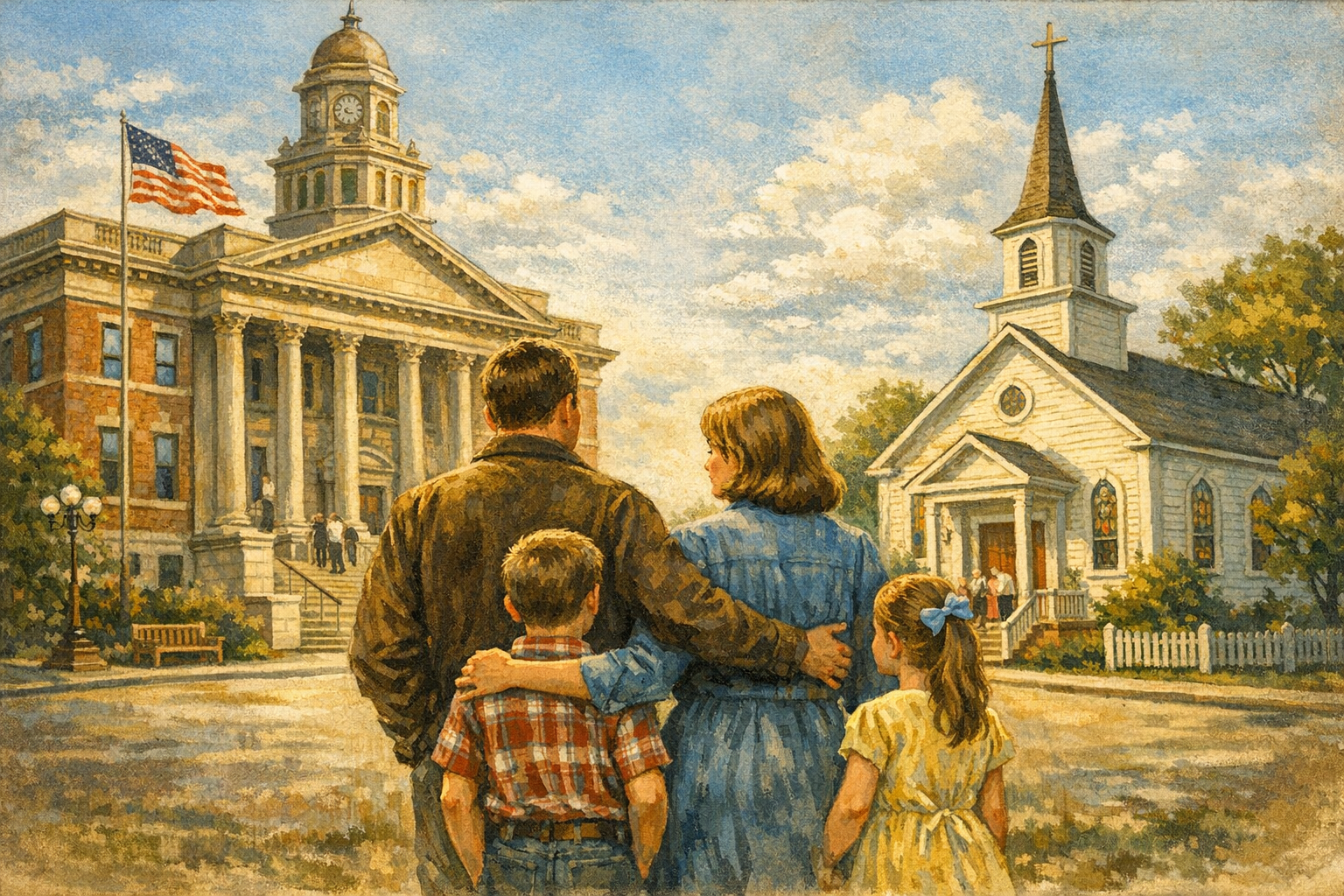
The question of gay marriage occupies a unique and enduring place in modern American political life because it is not merely a policy dispute. It is a disagreement about the nature of marriage itself, the role of the state in redefining long-standing social institutions, and the moral framework that undergirds law, family, and civil society. Unlike debates over tax rates or regulatory policy, this issue cuts directly into anthropology—what we believe a human being is—and teleology—what marriage is for.
For much of American history, marriage was understood in law and culture as a pre-political institution. The state did not create marriage; it recognized it. Marriage existed prior to government, rooted in biology, family formation, and social stability. The redefinition of marriage to include same-sex couples marked a profound departure from this understanding. This is why gay marriage continues to matter deeply to American voters even after its legalization by the Supreme Court in Obergefell v. Hodges (2015).
Many Americans were told that the issue was “settled” once the Court ruled. In reality, Obergefell resolved a legal question but intensified a cultural one. Since 2015, the scope of the dispute has expanded beyond whether same-sex couples can marry to whether dissent from the new definition of marriage is permitted at all. This has elevated the issue from a civil policy disagreement to a test case for religious liberty, freedom of conscience, and pluralism in a morally divided society.
Why This Issue Matters to Voters
Polling data consistently shows that while a majority of Americans now express general approval of same-sex marriage, significant fault lines remain—especially when questions turn to religious liberty, parental rights, education, and compelled participation. Support for gay marriage drops sharply when respondents are asked whether churches, Christian schools, adoption agencies, bakers, photographers, or counselors should be required to affirm or participate in same-sex weddings.
This distinction is crucial. Many voters who express personal tolerance or even approval of same-sex relationships grow uneasy when government power is used to punish dissent or force ideological conformity. As a result, gay marriage remains politically relevant not because Americans are constantly revisiting the wedding licenses themselves, but because of the downstream consequences flowing from the redefinition.
For Christian voters in particular, the issue has become a proxy for a larger question: Will the state respect the moral boundaries and institutional independence of the church, the family, and civil society—or will it insist upon ideological uniformity enforced by law?
Economic and Institutional Impact
While gay marriage is often framed as a purely “social” issue, it carries economic and institutional consequences that directly affect ordinary Americans.
First, the redefinition of marriage has reshaped family law. Marriage is not simply a romantic arrangement; it is a legal framework governing inheritance, taxation, parental rights, custody, adoption, medical decision-making, and benefits. Once marriage is redefined away from its biological and procreative foundation, the law must rely increasingly on contractual and bureaucratic mechanisms to assign parental roles and responsibilities. This tends to expand the power of the state while weakening the natural family as the primary social unit.
Second, there are implications for public education and employment. Following Obergefell, school curricula in many states and cities were revised to present same-sex marriage not merely as a legal reality but as a moral good equivalent to traditional marriage. Parents who object often discover that opting out is difficult or impossible. Teachers, counselors, and administrators have faced disciplinary action or termination for expressing traditional views of marriage, even when those views are grounded in long-standing religious belief.
Third, the issue affects the nonprofit and charitable sector. Faith-based adoption agencies have been forced to close in several states rather than comply with requirements to place children with same-sex couples. This reduces the number of agencies available to place children—particularly hard-to-place children—and shifts greater responsibility onto state systems already under strain.
From an economic standpoint, litigation, compliance costs, and regulatory expansion have grown as conflicts multiply between anti-discrimination law and religious liberty claims. These costs are ultimately borne by taxpayers, small business owners, and nonprofit institutions.
Public Safety and Social Stability Considerations
The connection between marriage and social stability has been documented extensively in social science literature. Stable, intact families—particularly those with married biological parents—are correlated with better outcomes for children across a range of metrics, including educational attainment, income mobility, behavioral health, and avoidance of criminal activity.
Supporters of gay marriage often argue that expanding marriage strengthens the institution by making it more inclusive. Critics respond that redefining marriage detaches it from its core social function: binding men and women to one another and to their children. Once marriage is understood primarily as an emotional bond between adults, its public purpose becomes harder to articulate, and its unique legal status becomes harder to justify.
This concern is not theoretical. Since the legalization of gay marriage, there has been increased pressure to further revise family norms, including debates over polyamory, non-exclusive partnerships, and the legal recognition of more fluid family structures. While these developments are often presented as unrelated, they share a common logic: if marriage is redefined based on adult desire rather than natural complementarity and child-rearing, there is no clear limiting principle.
Legal Developments and Institutional Momentum
Since Obergefell, federal and state governments have moved to entrench the redefinition of marriage legislatively. The most significant example is the Respect for Marriage Act (2022), which repealed the federal Defense of Marriage Act and required states to recognize same-sex marriages performed elsewhere. While supporters insisted the law included religious liberty protections, critics noted that these protections were narrow and largely symbolic.
Institutionally, major corporations, professional associations, universities, and media organizations have adopted explicit pro-gay-marriage positions, often tying them to diversity, equity, and inclusion frameworks. This has created an environment in which dissent is increasingly costly, particularly for individuals without significant economic or political power.
As a result, gay marriage is no longer simply a matter of private belief or personal conduct. It has become a gatekeeping issue, determining who may participate fully in professional, educational, and civic life without penalty.
Why an American Citizen Should Still Care
Even voters who believe the marriage debate is settled should care about how the issue continues to shape law and culture. The central question is no longer “Who can get married?” but “Who must affirm this redefinition, and at what cost?”
For conservatives, the concern is that the state has moved from neutrality to enforcement—using its power not merely to allow same-sex marriage but to suppress traditional moral convictions. For progressives, the issue represents an opportunity to accelerate cultural change by leveraging legal authority.
This tension ensures that gay marriage will remain a dividing line in American politics. It intersects with religious liberty, parental rights, free speech, and the proper limits of government authority. These are not abstract concerns. They affect families, churches, schools, businesses, and local communities across the country.
In short, gay marriage matters because it reveals how a society understands marriage, authority, freedom, and the relationship between law and moral truth. It is a bellwether issue—one that signals where American culture has been and where it may be heading next. Political Topic Series
Articles in the Critical Issues series require more time to read than most content on this site. They are intentionally written as thorough, in-depth examinations of their subjects.
The Republican Perspective on Gay Marriage
The Republican Party’s position on gay marriage is more internally divided than on almost any other major social issue. Unlike abortion, where there remains a strong and coherent pro-life consensus within the party’s leadership and base, gay marriage exposes a fault line between traditional social conservatives and a newer class of Republicans shaped by post-2015 cultural realities. Understanding this division is essential for voters who assume that “Republican” automatically signals opposition to same-sex marriage. That assumption is no longer reliable.
The 2024 Republican Party Platform
The 2024 Republican Party platform reflects this tension. Unlike earlier platforms that explicitly affirmed marriage as the union of one man and one woman, the most recent platform language is notably restrained. It emphasizes religious liberty, parental rights, and freedom of conscience rather than making a forceful call to overturn Obergefell v. Hodges. This shift does not represent unanimity but rather a strategic decision to prioritize winnable cultural ground while avoiding an issue many party leaders believe the courts have settled.
The absence of explicit opposition to gay marriage in the platform should not be read as endorsement. Instead, it reflects a coalition managing disagreement. Social conservatives remain influential within the party, but libertarian-leaning Republicans, donor-class moderates, and suburban swing voters exert countervailing pressure. The platform therefore stresses protections for churches and religious institutions rather than revisiting the legal definition of marriage itself.
Republicans Who Oppose Gay Marriage
A significant bloc of Republicans—particularly those aligned with evangelical Protestantism, traditional Catholicism, and Orthodox Judaism—continue to oppose gay marriage on moral, theological, and societal grounds. These Republicans tend to view marriage as a foundational institution oriented toward family formation and child-rearing, not merely a contractual arrangement between consenting adults.
This group includes many state-level leaders, especially in the South and Midwest, as well as members of Congress associated with the House Freedom Caucus and socially conservative Senate factions. Their opposition is typically framed not in terms of animus toward homosexual individuals but in terms of institutional preservation and constitutional restraint. They often argue that Obergefell represented judicial overreach and that redefining marriage through the courts bypassed democratic deliberation.
These Republicans are also more likely to resist subsequent legislation such as the Respect for Marriage Act, warning that it creates legal vulnerabilities for religious organizations and small businesses. For them, gay marriage is not an isolated issue but part of a broader cultural shift that marginalizes traditional Christianity in public life.
Republicans Who Support Gay Marriage
At the same time, a growing number of Republicans openly support gay marriage or have chosen not to oppose it politically. This group includes many elected officials from coastal states, suburban districts, and business-oriented wings of the party. Their support tends to fall into several identifiable categories.
First, there are Republicans who adopt a libertarian or classical liberal framework. They argue that government should not regulate private consensual relationships and that marriage equality is a matter of individual liberty. For these Republicans, support for gay marriage is consistent with broader commitments to limited government and personal autonomy, even if it conflicts with traditional moral teaching.
Second, there are Republicans whose views have been shaped by personal relationships. It is common for these lawmakers to cite a gay child, sibling, close friend, or staff member as a decisive influence. In these cases, opposition to gay marriage comes to be perceived as personally hurtful or socially exclusionary, even if it is rooted in long-standing moral beliefs. Emotional proximity often displaces institutional reasoning.
Third, ecclesiastical influence plays a role. Some Republicans who identify as Christian attend mainline Protestant denominations that have formally embraced same-sex marriage. The United Methodist Church, the Evangelical Lutheran Church in America (ELCA), and certain Episcopal dioceses have all moved in this direction. When a lawmaker’s church affirms gay marriage, political resistance to it is often weakened or abandoned altogether.
Liz Cheney is a well-known example. Raised in a politically conservative family, she nevertheless supported gay marriage early on, citing both personal conviction and evolving cultural norms. Her association with mainline Protestantism rather than confessional evangelicalism is frequently noted by analysts examining this divergence.
Senator Todd Young of Indiana: A Case Study
Senator Todd Young provides an instructive example of a Republican who identifies as a Christian yet supports gay marriage. Representing Indiana—a state with a strong evangelical presence—Young’s position stands in contrast to many of his constituents.
Several factors likely contribute to his stance. First, Young has cultivated an image as a pragmatic, institutionally minded Republican rather than a culture-war combatant. His political style emphasizes stability, national security, and bipartisan cooperation. In this framework, opposing gay marriage may be viewed as politically disruptive without offering a realistic path to reversal.
Second, there is little public evidence that Young’s church life is shaped by confessional evangelical theology. While he speaks openly about faith, his public statements suggest a broadly moralized but non-doctrinal Christianity—one that emphasizes civility and pluralism over clear theological boundaries. This type of Christianity is often more accommodating to prevailing cultural norms on sexuality.
Third, when examining Young’s legislative record, his support for gay marriage is not an isolated anomaly. While he votes reliably Republican on fiscal matters, defense, and judicial confirmations, he has shown a greater willingness than some peers to align with bipartisan or centrist positions on social and institutional questions. His support for the Respect for Marriage Act places him within a cohort of Republicans who prioritize social peace and legal finality over moral confrontation.
That said, it would be inaccurate to describe Senator Young as broadly liberal. His voting record does not align with progressive positions on abortion, taxation, or the size of government. Instead, he reflects a strain of modern Republicanism that accepts certain cultural outcomes of the sexual revolution while resisting others.
The Underlying Divide Within the Party
The Republican divide on gay marriage ultimately reflects competing visions of conservatism. One vision seeks to conserve inherited moral institutions and views marriage as a pre-political reality deserving protection. The other prioritizes political viability, individual liberty, and coalition maintenance in a culture that has largely embraced same-sex marriage.
This internal disagreement explains why Republican leaders often speak cautiously on the issue, emphasizing religious liberty rather than moral absolutes. It also explains why voters can no longer assume that a Republican candidate’s party affiliation signals a particular stance on gay marriage.
For socially conservative Christians, this reality creates both frustration and clarity. The Republican Party remains the only major political home where opposition to gay marriage is permitted and represented, but it is no longer uniformly championed. Understanding which Republicans stand where—and why—is therefore essential for informed voting and responsible civic engagement.
The Democrat Perspective on Gay Marriage
Unlike the Republican Party, where disagreement over gay marriage is real and persistent, the Democrat Party presents a far more unified front. Support for gay marriage is no longer merely a policy preference within Democratic ranks; it has become a moral litmus test. Opposition, even when framed in religious or philosophical terms, is treated as disqualifying. This uniformity did not emerge organically or instantaneously, but it is now firmly embedded in Democratic ideology, party discipline, and governance.
The 2024 Democrat Party Platform
The 2024 Democrat Party platform affirms gay marriage unequivocally and treats it as a civil rights achievement rather than a contested social policy. Marriage equality is presented not as a matter of legal tolerance but as a moral good that government has an obligation to defend, promote, and normalize. The platform frames opposition to gay marriage as discriminatory, regressive, and incompatible with democratic values.
This framing is important. By categorizing disagreement as discrimination, the platform implicitly justifies coercive state action against dissenters. Religious liberty is acknowledged only insofar as it does not interfere with the enforcement of sexual orientation and gender identity norms. In practice, this means that conscience protections are narrowly construed and often subordinated to anti-discrimination priorities.
The platform also links gay marriage to a broader constellation of sexual and gender policies, including gender identity recognition, LGBTQ-inclusive education, and expansive interpretations of civil rights law. Marriage is no longer treated as a distinct institution but as one component of a comprehensive sexual equality framework.
Legislative and Executive Advocacy
Democrat lawmakers at the federal level have been among the most aggressive proponents of gay marriage and its legal entrenchment. The Respect for Marriage Act serves as a defining example. While framed as a defensive measure to protect same-sex marriages from hypothetical judicial reversal, the law goes further by embedding recognition requirements across state lines and inviting litigation against institutions perceived as resistant.
Democratic senators and representatives overwhelmingly supported the bill, often using language that portrayed religious objections as outdated or harmful. Public statements from party leaders emphasized affirmation, visibility, and cultural normalization, rather than coexistence or pluralism.
At the executive level, Democratic administrations have consistently used regulatory power to advance this agenda. Federal agencies have interpreted anti-discrimination statutes to include sexual orientation and gender identity, even where such categories were not explicitly named in the original legislation. This approach relies heavily on administrative interpretation rather than legislative consensus, expanding executive authority while limiting avenues for dissent.
State and Local Democrat Leadership
Democratic state and city governments have often moved faster and further than federal authorities. In states such as California, New York, Massachusetts, Illinois, and Washington, same-sex marriage is not only recognized but actively reinforced through education policy, public funding conditions, and professional licensing standards.
Local governments in progressive cities have adopted ordinances requiring businesses, nonprofits, and even religiously affiliated organizations to comply with LGBTQ-affirming policies as a condition of operation or funding. In some jurisdictions, refusal to host same-sex weddings or provide services related to them has resulted in fines, lawsuits, or loss of professional credentials.
These measures are typically justified using civil rights language. However, critics argue that they reflect a shift from tolerance to enforcement—from allowing gay marriage to compelling participation in its celebration.
Internal Dissent Within the Democrat Party
While the Democrat Party is largely unified on gay marriage, pockets of historical dissent once existed. Some older Democrats, particularly those from religious or working-class backgrounds, expressed reservations in the early 2000s. That dissent has all but vanished.
Today, Democratic politicians who hold traditional views of marriage face intense pressure to conform or exit public life. Party primaries, donor networks, activist groups, and media allies enforce ideological consistency. As a result, even Democrats with personal religious convictions typically separate those beliefs from their public policy positions or reinterpret them to align with party doctrine.
The party’s progressive wing has further narrowed the boundaries of acceptable discourse. Gay marriage is no longer debated as policy; it is assumed as moral baseline. Questions about consequences, limits, or trade-offs are treated as suspect or malicious.
The Philosophical Foundation of the Democrat Position
The Democrat Party’s approach to gay marriage is rooted in a particular understanding of equality and autonomy. Marriage is defined primarily as a vehicle for adult self-expression rather than as a social institution oriented toward children or societal stability. Under this framework, any distinction based on sex or complementarity is presumed unjust unless proven otherwise.
This perspective aligns with broader progressive commitments to identity-based politics. Sexual orientation becomes a defining category, and recognition by the state becomes a form of moral validation. The law is not merely a neutral arbiter but an instrument for reshaping social norms.
From this vantage point, religious objections are tolerated only insofar as they remain private. Once expressed publicly or translated into institutional practice, they are viewed as barriers to equality that must be dismantled.
Consequences of Democrat Uniformity
The practical effect of the Democrat Party’s unified stance is a narrowing of the public square. By equating opposition with discrimination, the party forecloses meaningful debate and delegitimizes long-standing moral traditions. This creates a zero-sum dynamic in which one side’s affirmation requires the other side’s silence.
For voters, this clarity has both advantages and costs. On the one hand, the Democrat position is consistent and predictable. On the other hand, it leaves little room for compromise, accommodation, or pluralism in a religiously diverse nation.
Gay marriage, within the Democrat worldview, is not merely accepted—it is enforced, celebrated, and protected from challenge. This posture sets the stage for ongoing conflict with religious institutions, traditional families, and citizens who dissent on moral grounds.
The Libertarian Perspective on Gay Marriage
The Libertarian Party’s position on gay marriage is comparatively straightforward and has been so for decades. Libertarians generally support same-sex marriage, but for reasons that differ in important ways from the Democrat Party’s justification. Whereas Democrats frame gay marriage as a civil rights and moral equality issue, Libertarians frame it as a matter of individual liberty and government non-interference. This distinction matters, even if it leads to similar policy outcomes.
The Libertarian Party Platform
The most recent Libertarian Party platform affirms the principle that government should not define or regulate marriage at all. From the Libertarian perspective, marriage is viewed as a private contractual relationship rather than a public institution with a specific social purpose. Under this framework, the state’s involvement in marriage—whether heterosexual or homosexual—is seen as inherently problematic.
As a result, Libertarians typically support gay marriage not because they seek to affirm or normalize particular sexual relationships, but because they oppose government-imposed moral standards altogether. Their ideal solution is often the complete withdrawal of the state from marriage, leaving religious institutions, private organizations, and individuals free to define marriage as they see fit without legal consequence.
Alignment and Divergence from the Major Parties
On the surface, the Libertarian position aligns more closely with Democrats than Republicans, insofar as it supports the legal recognition of same-sex marriages. However, the philosophical foundations are quite different.
Democrats tend to view government as the guarantor and enforcer of moral equality, using law to reshape cultural norms and suppress perceived discrimination. Libertarians, by contrast, resist coercion in nearly all forms. They oppose compelled participation, mandated speech, and regulatory enforcement of moral conformity. In theory, this means Libertarians should be more protective of religious liberty than Democrats, even while supporting gay marriage itself.
This creates an interesting tension. A consistent Libertarian would oppose forcing a church, baker, or adoption agency to affirm or facilitate same-sex marriage. In practice, however, Libertarians lack sufficient political power to meaningfully influence how these conflicts are resolved, and their abstract commitment to non-interference often fails to translate into concrete legal protections.
Philosophical Differences
The Libertarian approach rests on a radically individualistic anthropology. Human beings are understood primarily as autonomous agents whose rights precede and outweigh communal or institutional claims. Marriage, in this view, has no inherent structure or purpose beyond what the participants assign to it.
This sharply contrasts with both the Republican social conservative view and the biblical Christian understanding of marriage. Republicans who oppose gay marriage typically argue that marriage serves a public function related to family stability and child-rearing. Biblical Christians go further, grounding marriage in divine design and moral order.
Libertarians reject both claims. They deny that the state has a legitimate interest in promoting any particular vision of the good life, including traditional family structures. As a result, while Libertarians may appear to be allies of conservatives on certain free speech or religious liberty questions, they ultimately lack a framework for defending marriage as an institution worth preserving.
Why the Libertarian Position Is Tangential
As you directed, it is important to present the Libertarian position without overstating its influence. Libertarians do not control major legislative bodies, executive offices, or judicial appointments. Their ideas shape discourse more than law.
For Christian and socially conservative voters, the Libertarian stance offers limited refuge. While it may promise freedom from government coercion in theory, it provides no moral defense of marriage itself and no guarantee that cultural pressure will not eventually produce legal compulsion through other political channels.
In short, Libertarians tend to agree with Democrats on the outcome—legal recognition of gay marriage—while disagreeing on the means and justification. They diverge sharply from Republicans and biblical Christians on the nature and purpose of marriage, even when they occasionally align on questions of individual liberty.
Progressive Principles and Their Influence on the Democrat Position
To understand the modern Democrat Party’s posture on gay marriage, one must look beneath policy statements and campaign rhetoric to the deeper ideological framework that animates them. That framework is best described as Progressivism—often referred to in popular discourse as wokeness, Cultural Marxism, political correctness, or Neo-Marxism. These labels are imprecise, but they point in the same general direction: a worldview that interprets society primarily through power, identity, and liberation from inherited norms.
Progressivism does not merely seek legal tolerance for same-sex relationships. It seeks moral re-education. Marriage is one battlefield in a broader cultural project aimed at dismantling traditional structures that are viewed as oppressive, exclusionary, or insufficiently egalitarian.
Core Progressive Presuppositions
At the heart of the progressive approach to gay marriage are several interlocking assumptions.
First, human identity is self-defined rather than received. Under this view, biological sex, historical norms, and religious teachings are not authoritative constraints but raw materials for personal expression. Marriage, therefore, must adapt to the identities people claim rather than reflect an objective moral or natural order.
Second, institutions are morally suspect unless continually reformed. Progressivism assumes that long-standing institutions—especially those rooted in religion or tradition—are likely to encode injustice. Marriage, having historically centered on male–female complementarity and family continuity, is presumed guilty until proven innocent. Redefinition is framed as moral progress.
Third, equality is understood as outcome parity rather than equal treatment under the law. If one group experiences different outcomes or recognition, the system itself is assumed unjust. From this standpoint, reserving marriage for male–female unions is not a neutral definition but an act of exclusion requiring correction.
These assumptions explain why progressive advocacy does not stop at legalization. If marriage equality is a moral imperative, then dissent must be addressed—not merely tolerated. Neutrality is viewed as complicity.
Marriage as a Tool of Cultural Transformation
Within progressive ideology, marriage is not primarily valued for its stabilizing social function. Instead, it becomes a symbol—a site of moral validation. Legal recognition is interpreted as cultural endorsement, and cultural endorsement is treated as necessary for psychological well-being and social justice.
This is why progressives insist not only that same-sex couples be allowed to marry, but that society affirm such unions as fully equivalent in every moral and educational context. Distinctions are framed as stigmatizing. Silence is framed as harm.
As a result, institutions that resist affirmation—churches, religious schools, charities, and even parents—are increasingly portrayed as obstacles to progress rather than participants in a pluralistic society.
Progressive Lawfare and Language
Progressive influence is also evident in how language is deployed. Terms like “marriage equality,” “love is love,” and “civil rights” function rhetorically to shut down debate rather than advance understanding. Once gay marriage is categorized as a civil rights issue, opposition can be equated with racism or segregation, even though marriage involves fundamentally different considerations.
This framing allows progressives to justify expansive state intervention. Anti-discrimination law becomes a tool not only for preventing unjust exclusion, but for compelling moral conformity. Religious liberty is tolerated only when it remains invisible and non-disruptive.
In this way, progressive principles reshape not just what the law permits, but what society is allowed to question.
The Democrat Party as Progressive Vehicle
The Democrat Party has become the primary political vehicle for these ideas. While earlier generations of Democrats expressed ambivalence or restraint, contemporary Democratic leadership has fully embraced progressive sexual ethics as non-negotiable. Party discipline, donor pressure, activist networks, and media alignment reinforce this commitment.
Gay marriage thus functions as both a policy position and a loyalty signal. Support demonstrates adherence to progressive moral assumptions; dissent signals ideological deviance.
For voters trying to make sense of Democratic behavior on this issue, the key insight is this: the party’s position is not driven merely by compassion or fairness, but by a comprehensive worldview that seeks to redefine institutions, suppress competing moral frameworks, and use state power to accelerate cultural change.
Do Democrat Actions Match Their Platform?
“In politics, what you DO is what you believe. Everything else is cottage cheese.”
— Senator Joseph P. Kennedy
This blunt observation is especially useful when evaluating the Democrat Party’s approach to gay marriage. Party platforms are carefully crafted documents, designed to appeal to voters while smoothing over internal tensions. Real conviction, however, is revealed through enforcement, litigation, executive action, and selective application of standards. When examined this way, Democratic leadership’s behavior on gay marriage reveals a pattern that goes well beyond mere support and into active ideological enforcement.
From Tolerance to Compulsion
The Democrat Party’s official position emphasizes equality, inclusion, and protection from discrimination. In practice, however, Democratic leadership has consistently moved from allowing same-sex marriage to compelling affirmation of it.
Under Democratic administrations, federal agencies have interpreted existing civil rights statutes to include sexual orientation and, increasingly, gender identity—often without explicit congressional authorization. These interpretations have been used to justify investigations, funding threats, and enforcement actions against religious institutions, small businesses, and professionals who maintain traditional views of marriage.
This approach reveals a key inconsistency. Democrats frequently claim to support religious liberty, yet that support is functionally limited to private belief. Once religious conviction manifests in public conduct—particularly conduct that diverges from progressive sexual norms—it is treated as suspect or impermissible.
The Biden Administration as a Case Study
The Biden administration provides a clear example of how Democrat leadership operationalizes its platform commitments. While publicly affirming respect for faith communities, the administration has repeatedly prioritized LGBTQ affirmation over conscience protections.
Federal departments overseeing education, health care, housing, and employment have issued guidance that places traditional Christian institutions in legal jeopardy. Schools receiving federal funds are pressured to adopt LGBTQ-affirming policies. Health care providers face mandates that conflict with religious or ethical convictions. Faith-based adoption agencies have been sidelined in favor of ideologically aligned alternatives.
Notably, these actions are often justified using ambiguous language about “equity” and “access,” obscuring the coercive reality beneath bureaucratic phrasing. This reflects a broader progressive strategy: advance controversial outcomes through administrative mechanisms rather than transparent legislative debate.
Progressive States and Cities in Practice
State and local governments controlled by Democrats have frequently gone further than federal authorities. In states such as California, New York, Massachusetts, Illinois, Oregon, and Washington, compliance with LGBTQ-affirming policies has become a prerequisite for participation in public life.
Religious schools have faced accreditation threats. Nonprofits have lost contracts. Small business owners have been fined or driven into court. In many cases, officials have shown little interest in balancing competing rights. The assumption is clear: affirmation of same-sex marriage is not optional.
Progressive cities—such as San Francisco, Seattle, Portland, Boston, Chicago, and Washington, D.C.—have functioned as testing grounds for these policies. Once implemented locally, they are later normalized at the state or federal level.
Selective Standards and Double Messages
A recurring criticism of Democratic leadership is selective enforcement. Progressives often defend cultural or religious exemptions when they align with favored groups, but deny similar consideration to traditional Christians. This undermines claims of neutrality and exposes the ideological nature of enforcement decisions.
Democrats also invoke pluralism rhetorically while narrowing it in practice. The promise is diversity; the reality is conformity. Dissenting moral views are tolerated only until they conflict with progressive objectives.
Authoritarian Tendencies: Soft and Hard
While Democrats rarely frame their actions as authoritarian, the cumulative effect of their policies raises legitimate concerns. Soft authoritarianism emerges when citizens are pressured through regulatory threats, social stigma, and institutional exclusion. Hard authoritarianism appears when fines, licensing penalties, or legal sanctions are imposed.
The use of government power to enforce moral orthodoxy—particularly in areas traditionally governed by conscience—marks a departure from classical liberal principles. It signals a shift toward an ideological state, one that treats disagreement as harm and persuasion as insufficient.
When measured against their stated platform, Democratic leadership’s actions not only align with their support for gay marriage but exceed it. What began as legal recognition has evolved into active enforcement. The gap between rhetoric and reality lies not in whether Democrats support gay marriage—they do—but in how far they are willing to go to eliminate dissent.
This reality is essential for voters to understand. The issue is no longer confined to who can marry, but to who must comply, affirm, and remain silent.
Each Party Seen Through the Eyes of Its Critics
A serious examination of gay marriage requires more than repeating party talking points. It requires listening to the strongest criticisms raised by thoughtful opponents and assessing whether the standard responses actually address those concerns. Both Republicans and Democrats face legitimate critiques on this issue, and understanding them helps voters separate principled disagreement from caricature.
Criticisms of the Republican Position
Critics of Republicans who oppose gay marriage—many of them Democrats, progressives, and some libertarians—raise several recurring objections.
One common criticism is that opposition to gay marriage is rooted in religious belief and therefore inappropriate for public policy in a pluralistic society. According to this view, laws should be grounded in secular reasoning accessible to all citizens, not in theological claims. Opponents argue that allowing religious morality to shape marriage law violates the separation of church and state.
A second criticism is that restricting marriage to one man and one woman causes harm to same-sex couples by denying them social recognition, legal stability, and emotional dignity. Critics often frame this harm in psychological terms, asserting that exclusion from marriage stigmatizes individuals and families.
A third criticism is pragmatic: that the issue is “settled” culturally and legally, and continued Republican resistance is politically self-destructive. From this perspective, opposition to gay marriage alienates younger voters and suburban moderates without offering a realistic path to policy reversal.
Republican Counter-Responses
Republicans who oppose gay marriage typically respond by rejecting the premise that their position is merely religious. They argue that marriage policy historically rested on natural law, biology, and social function—not denominational doctrine. The state’s interest in marriage, they contend, has always been tied to family formation, child welfare, and social stability.
In response to claims of harm, Republicans often distinguish between unequal treatment and unequal outcomes. They argue that defining marriage based on sexual complementarity is not a judgment on personal worth but a recognition of the unique role male–female unions play in producing and raising children. They also note that legal recognition of same-sex relationships already provided contractual protections prior to Obergefell.
On the political argument, social conservatives reply that moral truth is not determined by polling data. They warn that abandoning core principles for short-term electoral gain weakens the party’s identity and accelerates cultural drift. For these voters, the cost of silence is higher than the cost of opposition.
Criticisms of the Democrat Position
Critics of the Democrat Party’s approach—many of them Republicans, religious minorities, and civil libertarians—tend to focus less on legalization itself and more on enforcement.
A primary criticism is that Democrats conflate disagreement with discrimination. By framing opposition to gay marriage as bigotry, critics argue, Democrats delegitimize sincere moral and religious convictions that have deep historical roots. This, they contend, undermines pluralism rather than advancing it.
Another criticism is that Democratic policies erode religious liberty by narrowing conscience protections. Opponents point to cases involving adoption agencies, schools, and small businesses as evidence that Democrats prioritize ideological conformity over coexistence.
A third criticism concerns scope creep. Critics argue that once marriage was redefined, it became a stepping stone toward broader demands involving gender ideology, compelled speech, and educational mandates—developments that many Americans did not anticipate or consent to.
Democrat Counter-Responses
Democrats typically respond by insisting that civil rights must be enforced uniformly. From their perspective, allowing exemptions creates second-class citizenship for LGBTQ individuals. They argue that public participation carries public obligations, and that religious belief does not justify exclusion.
On religious liberty concerns, Democrats often claim that churches remain free to define marriage internally, even if their external activities are regulated. They present this as a reasonable balance between private belief and public obligation.
In response to scope-creep accusations, Democrats argue that progress in civil rights often unfolds incrementally. What critics call overreach, they frame as necessary correction of lingering injustice.
Evaluating the Exchange
At bottom, these exchanges reveal a deeper disagreement about the role of government. Republicans who oppose gay marriage tend to see the state as a guardian of inherited institutions that serve public goods. Democrats tend to see the state as an engine of moral progress tasked with reshaping institutions to reflect evolving norms.
Neither side lacks arguments. But voters should notice where each party draws its boundaries. Republicans are criticized for resisting cultural change; Democrats are criticized for enforcing it. The question for the voter is not which side avoids criticism, but which set of criticisms reveals a trajectory that threatens liberty, stability, and social trust.
Credible Suspicions About Party Strategies and Motives
Political parties rarely act from pure principle alone. Strategy, coalition maintenance, donor influence, and long-term ideological goals all shape how issues are framed and pursued. Gay marriage is no exception. While many elected officials on both sides hold sincere beliefs, there are credible reasons to suspect that the issue has also been used instrumentally—sometimes cynically—by party leadership.
Suspicions Regarding the Democrat Party
Critics of the Democrat Party often suspect that gay marriage functions less as a discrete civil policy and more as a wedge issue and disciplining mechanism.
One suspicion is that Democratic leadership uses gay marriage and related LGBTQ issues to enforce ideological conformity within its coalition. Because opposition is framed as moral failure rather than policy disagreement, the issue becomes a loyalty test. This helps party leadership marginalize religious traditionalists, social moderates, and working-class voters whose views might otherwise complicate the progressive agenda.
Another suspicion concerns institutional capture. By tying federal funding, accreditation, and regulatory compliance to LGBTQ-affirming standards, Democratic administrations can reshape education, healthcare, and nonprofit sectors without direct legislative confrontation. Gay marriage becomes an entry point for broader cultural mandates, many of which would face resistance if debated openly.
There is also a strategic electoral calculation. Progressive activists are highly motivated by sexual identity politics, while voters who oppose gay marriage are often portrayed as having nowhere else to go politically. This asymmetry encourages Democrats to cater aggressively to the former while dismissing the latter as politically expendable.
Finally, critics observe that Democratic rhetoric often masks coercion behind therapeutic language. Terms like “inclusion,” “affirmation,” and “harm reduction” soften the reality of enforcement. This raises the suspicion that the party understands the unpopularity of compulsion and therefore advances it indirectly.
Suspicions Regarding the Republican Party
Republicans are not immune from strategic criticism. One common suspicion is that Republican leadership has gradually retreated on gay marriage to avoid media backlash and donor resistance rather than because of genuine moral reconsideration.
Social conservatives often suspect that party elites view opposition to gay marriage as an electoral liability to be managed rather than a principle to be defended. The shift in platform language, the emphasis on “moving on,” and the reluctance to challenge judicial authority reinforce this perception.
Another suspicion concerns selective courage. Republicans frequently speak forcefully about religious liberty but hesitate to advance legislation that would robustly protect dissenters from cultural coercion. Critics argue that this reflects fear of being labeled intolerant rather than principled restraint.
At the same time, Republicans who support gay marriage are sometimes suspected—fairly or not—of prioritizing personal relationships, elite social acceptance, or institutional respectability over broader societal considerations. When lawmakers cite family members or church affiliations as decisive influences, critics worry that policy is being shaped by sentiment rather than public reasoning.
Gay Marriage as Political Currency
For both parties, gay marriage has become a form of political currency. Democrats use it to signal moral progress and to mobilize activist energy. Republicans use their response—or silence—to signal moderation, electability, or cultural relevance.
What is often lost in this exchange is sober reflection on long-term consequences. Institutions reshaped in the heat of moral fervor are difficult to stabilize later. Laws passed to resolve one conflict often generate new ones.
For voters, the key insight is this: parties may speak in the language of compassion or pragmatism, but their actions reveal priorities. When gay marriage is used to reward allies, punish dissent, or avoid scrutiny, suspicion is not only reasonable—it is prudent.
Gay Marriage in a High-Trust vs. Low-Trust Society
The debate over gay marriage cannot be fully understood without considering the broader condition of American social trust. High-trust societies rely on shared moral assumptions, informal cooperation, and institutional restraint. Low-trust societies depend increasingly on regulation, enforcement, and surveillance. America has been steadily moving from the former toward the latter, and the gay marriage debate both reflects and accelerates this shift.
High-Trust Societies and Moral Pluralism
In a high-trust society, citizens assume that most people act in good faith, even when they disagree. Moral differences are negotiated through persuasion, local autonomy, and institutional boundaries. Religious communities are allowed to govern their own internal affairs, and disagreement is not automatically interpreted as hostility.
Had the United States remained a high-trust society, the legalization of gay marriage might have unfolded differently. The state could have extended civil recognition while clearly protecting dissenters. Churches, schools, charities, and families would have been trusted to maintain their convictions without being labeled threats to public order.
This model requires confidence that disagreement will not metastasize into exclusion or harm. That confidence has eroded.
The Shift to Low-Trust Dynamics
As trust declines, political actors assume bad faith. Disagreement becomes danger. In this environment, progressives increasingly interpret traditional views of marriage as precursors to discrimination or violence. Conservatives, in turn, interpret progressive policies as deliberate efforts to marginalize religious belief.
Low-trust societies respond to perceived threats by expanding rules and enforcement. This explains why gay marriage did not end debate but intensified it. Once marriage was redefined, progressives did not trust institutions to adapt voluntarily. Conservatives did not trust the state to respect boundaries. The result was escalation.
Republican and Democrat Responses to Declining Trust
Republicans generally respond to low trust by seeking limits on government power. Their emphasis on religious liberty reflects a desire to carve out protected spaces where trust can still operate. However, their reluctance to confront cultural authority structures weakens this strategy.
Democrats respond to low trust by centralizing authority. If institutions cannot be trusted to behave inclusively, they must be compelled. This logic underwrites the expansion of administrative enforcement and the narrowing of conscience protections.
Both responses reveal something important. Republicans still believe pluralism is possible if boundaries are respected. Democrats increasingly believe pluralism itself is dangerous unless guided by ideological consensus.
Why Trust Matters for This Issue
In a low-trust society, every disagreement is treated as a zero-sum conflict. Gay marriage becomes not just a policy question but a test of allegiance. Neutrality is suspect. Silence is interpreted as resistance.
This dynamic helps explain why conflicts over wedding services, school curricula, and speech have become so intense. The issue is no longer who may marry, but who may dissent.
For voters, the erosion of trust should be a warning. When society loses the ability to tolerate moral disagreement without coercion, freedom becomes fragile. Laws become weapons. Institutions become battlegrounds.
Gay marriage, in this sense, is not the cause of America’s low-trust condition—but it is one of its clearest symptoms.
Media Distortion and Narrative Control
No modern political issue unfolds in a vacuum, and gay marriage is no exception. Media institutions play a decisive role in shaping how the public understands not only the issue itself, but the moral character of those who hold differing views. Over the past two decades, legacy media outlets, corporate news organizations, and cultural gatekeepers have largely abandoned neutral reporting on gay marriage in favor of narrative enforcement.
Framing the Issue as Morally Settled
One of the most common forms of media distortion is the presentation of gay marriage as a closed question. Headlines and broadcast segments routinely describe opposition as “outdated,” “on the wrong side of history,” or “extreme,” even when such views are held by millions of Americans and grounded in long-standing moral traditions.
By framing the issue as settled, media organizations implicitly delegitimize continued debate. Republicans who oppose gay marriage are portrayed as reactionary or motivated by animus, while Democrats who support it are cast as compassionate and enlightened. This framing discourages serious engagement with arguments about religious liberty, institutional consequences, or democratic process.
Selective Storytelling and Omission
Media coverage frequently highlights sympathetic stories of same-sex couples seeking recognition while minimizing or ignoring cases involving coercion of religious dissenters. When bakers, florists, adoption agencies, or educators face penalties for acting according to conscience, these stories are often framed as simple discrimination cases rather than as conflicts between competing rights.
Conversely, when progressive policies generate backlash or legal controversy, media outlets tend to downplay the role of government compulsion. The focus remains on the emotional harm claimed by LGBTQ individuals, not on the legal or moral cost imposed on dissenters.
This selective storytelling creates a skewed public perception. Viewers and readers are encouraged to see only one side of the conflict, reinforcing the idea that resistance to gay marriage is motivated by hostility rather than principle.
Misrepresentation of the Republican Position
Media narratives often flatten Republican views into caricature. Internal divisions within the party are rarely explored in good faith. Republicans who support gay marriage are praised as “moderate” or “evolved,” while those who oppose it are portrayed as fringe—even when they represent a substantial portion of the party’s base.
Religious motivations are frequently reduced to stereotypes, with little attempt to explain theological or philosophical reasoning. This treatment discourages nuanced understanding and reinforces social stigma against traditional believers.
Media as Cultural Enforcer
In many respects, modern media functions less as a neutral observer and more as a cultural enforcer. Editorial decisions, language choices, and framing patterns signal which views are acceptable and which are not. This has a chilling effect on public discourse, particularly for individuals without institutional power.
For voters, recognizing media distortion is essential. When coverage consistently favors one moral framework while marginalizing others, citizens must seek information critically rather than passively.
The media has not merely reported on the gay marriage debate; it has shaped it—often narrowing the range of acceptable opinion and accelerating cultural polarization.
The Biblical Perspective on Gay Marriage
A biblical evaluation of gay marriage begins at a fundamentally different starting point than modern political ideologies. Scripture does not treat marriage as a social construct invented by the state, nor as a flexible contract defined by personal desire. Marriage is presented as a created institution, established by God, ordered toward specific ends, and bounded by moral limits that human authority does not possess the right to redefine.
This starting point immediately distinguishes the biblical Christian worldview from Republican, Democrat, and Libertarian frameworks alike—even where partial alignment exists.
Marriage as a Created Institution
The Bible presents marriage as instituted by God at creation, prior to civil government and prior to the fall. In Genesis, marriage is defined as a covenantal union between one man and one woman, oriented toward companionship, procreation, and the ordering of human society. This definition is not presented as culturally contingent but as creational and normative.
Because marriage is created rather than constructed, the state’s role is recognitional, not inventive. Civil authorities may regulate marriage for legal purposes, but they do not possess moral authority to redefine its essence. From a biblical perspective, when the state attempts to do so, it exceeds its jurisdiction.
This is the core reason biblical Christians object to gay marriage. The objection is not rooted in personal animus toward homosexual individuals, but in the conviction that marriage has a divinely established form that human law cannot alter without consequence.
Scripture and Same-Sex Relationships
Scripture consistently treats homosexual behavior as outside God’s moral design for sexuality. This teaching appears across both Testaments and is never presented as temporary, ceremonial, or culturally limited. Sexual ethics in Scripture are grounded in creation, not convenience.
At the same time, Scripture distinguishes between temptation, inclination, and behavior. All human beings are fallen and disordered in various ways. The biblical Christian does not claim moral superiority but moral accountability under God’s revealed will.
From this framework, redefining marriage to include same-sex unions represents not a neutral policy adjustment, but an institutional endorsement of what Scripture identifies as sin. This is why many Christians view the issue as qualitatively different from other political disagreements.
Alignment and Misalignment with Political Parties
Biblical Christians will find partial alignment with the Republican Party, but not perfect overlap. Republicans who oppose gay marriage on moral or institutional grounds are closer to the biblical position than Democrats or Libertarians. More importantly, the Republican Party remains open—structurally and culturally—to biblical Christians participating openly without renouncing their convictions.
The Democrat Party, by contrast, has positioned itself in direct opposition to biblical sexual ethics. It not only affirms gay marriage but treats dissent as morally illegitimate. This creates an unavoidable conflict for Christians who take Scripture seriously.
Libertarians diverge even further by denying that marriage has an inherent moral structure at all. Their emphasis on autonomy conflicts with the biblical understanding of human beings as accountable creatures, not self-authoring individuals.
Thus, while biblical Christians may disagree with Republicans on prudential matters, they cannot align with Democrats or Libertarians on this issue without compromising core theological commitments.
Worldview Differences That Drive the Conflict
At bottom, the disagreement is not merely about marriage but about authority.
The biblical Christian affirms that God defines reality, human nature, and moral boundaries. The modern secular worldview—whether progressive or libertarian—locates authority in the autonomous self or in the state acting on behalf of evolving social norms.
This difference explains why compromise on gay marriage is so difficult. The dispute is not over policy details but over who gets to define truth.
For biblical Christians, faithfulness requires obedience, even when obedience carries social or political cost. The biblical witness does not promise cultural approval, but it does demand clarity.
Voting in Light of a Biblical Worldview
For the biblical Christian, voting is not a mere expression of personal preference or party loyalty. It is an act of stewardship. While Scripture does not command participation in democratic elections, it does call believers to exercise wisdom, discernment, and moral responsibility in the spheres of influence God has providentially placed them.
Gay marriage, therefore, must be evaluated not in isolation but as part of a broader moral landscape.
Weighing Issues with Moral Clarity
A mature Christian voter understands that not all political issues carry equal moral weight. Scripture itself recognizes this principle. Some matters involve prudential judgment—tax rates, regulatory approaches, or infrastructure priorities. Others involve direct moral claims about human life, family, and obedience to God’s revealed will.
Issues such as abortion, sexual ethics, and the integrity of the family occupy a higher moral tier because they concern the protection of life and the created order. While taxation policy may affect comfort and prosperity, marriage policy shapes the moral ecology of a nation.
This does not mean that gay marriage is the only issue Christians should consider, nor that it outweighs all others automatically. It does mean that when a party or candidate actively opposes biblical teaching on marriage—and seeks to compel affirmation of that opposition—the Christian voter must take notice.
Why Republicans Remain the Default Alignment
Despite internal disagreement, the Republican Party remains far more hospitable to biblical Christianity than its competitors. Republicans who oppose gay marriage—or who at least defend religious liberty robustly—provide space for Christians to participate without denying core convictions.
Even Republicans who support gay marriage often argue for conscience protections and limits on government enforcement. While this position falls short of the biblical ideal, it recognizes the legitimacy of dissent.
By contrast, the Democrat Party has made affirmation of gay marriage and related sexual ideologies a condition of moral legitimacy. The party does not merely tolerate disagreement; it actively seeks to marginalize it. For Christians who take Scripture seriously, this posture creates an unavoidable conflict of allegiance.
Libertarians, while rhetorically friendly to freedom, offer no moral anchor. Their vision cannot sustain institutions that require moral definition, including marriage itself.
For these reasons, biblical Christians should ordinarily support Republican candidates—not because the party is perfect, but because it permits faithful participation and resists the most aggressive forms of moral coercion.
Scriptural Reasoning and Civic Responsibility
Scripture calls believers to seek justice, love righteousness, and pursue the good of their neighbors. Civil government is described as a servant of God for maintaining order and restraining evil. While no modern party fully embodies biblical values, Christians are called to choose wisely among imperfect options.
When Christians vote, they should do so prayerfully, with informed conscience, and with an awareness of long-term consequences. The normalization and enforcement of unbiblical sexual ethics affect not only individuals but institutions, families, and future generations.
Voting, in this sense, becomes an act of neighbor-love. It is a means—though not the only one—by which Christians can work for the good of their communities.
The Christian’s Duty to Seek the Welfare of the Nation
The Christian’s responsibility to society does not end at the ballot box, but neither does it exclude it. Scripture presents believers as sojourners and citizens at the same time—belonging ultimately to the kingdom of God, yet living concretely within earthly nations. This dual citizenship creates obligations that must be held in proper tension.
Seeking the Common Good
Christians are commanded to seek the welfare of the communities in which they live. This includes promoting justice, restraining evil, and encouraging social conditions that allow families and institutions to flourish. Marriage, as a foundational social institution, directly affects that welfare. When marriage is weakened or redefined in ways that detach it from family formation and moral accountability, the ripple effects extend far beyond individual couples.
Responsible voting is one way Christians may seek the good of their nation. In a representative republic, citizens are granted influence over who governs and how laws are shaped. Refusing to exercise that influence without compelling reason may amount to neglect of stewardship.
At the same time, Scripture does not present voting as a sacrament or a test of faithfulness. Christians must avoid equating political participation with spiritual obedience.
Voting as One Means, Not the Only Means
While voting is important, it is not the sole or even primary way Christians contribute to the health of a nation. Teaching children, building strong families, supporting churches, practicing charity, discipling neighbors, and bearing faithful witness all shape culture at a deeper level than legislation alone.
Christians should resist the temptation to view politics as a substitute for discipleship. Laws can restrain behavior, but they cannot regenerate hearts. When Christians place ultimate hope in political outcomes, disappointment and bitterness often follow.
Christian Liberty and the Question of Abstention
It must also be acknowledged that some Christians, in good conscience, choose not to vote. Romans 14 affirms that believers may differ on matters not explicitly commanded by Scripture, and that such differences should be handled with charity rather than judgment.
A Christian who abstains from voting out of conscience—believing participation compromises faithfulness or conscience—is not thereby disobedient. Likewise, a Christian who votes should not regard abstainers as irresponsible or unfaithful. Unity in Christ transcends political strategy.
What Scripture does require is that whatever one does be done in faith, with integrity, and without condemning fellow believers over disputable matters.
Prayer for Leaders and the Nation
Prayer is not optional. Christians are explicitly commanded to pray for those in authority, regardless of their policies or personal character. This includes leaders who promote laws and values contrary to biblical teaching.
Prayer acknowledges what voting alone cannot accomplish: God is sovereign over nations, rulers, and history itself. Political change may restrain evil temporarily, but lasting renewal comes through repentance and obedience to God.
In debates over gay marriage and other moral issues, prayer guards the Christian from despair on one hand and triumphalism on the other.
Key Takeaways and Concluding Observations
After examining gay marriage from political, cultural, and biblical perspectives, several conclusions emerge with clarity. These conclusions do not eliminate disagreement, but they do help the reader understand what is actually at stake—and why the issue remains so divisive even a decade after its legalization.
Republican Position: Divided but Distinct
The Republican Party is no longer unified in opposition to gay marriage. A growing number of Republicans—often shaped by personal relationships, elite cultural pressures, or attendance at LGBT-affirming denominations—have accepted same-sex marriage as a settled reality. Figures such as Senator Todd Young of Indiana illustrate this trend: socially conservative on many issues, yet accommodating on marriage in the interest of legal finality, social peace, or institutional respectability.
At the same time, a substantial bloc of Republicans continues to oppose gay marriage on moral, constitutional, and societal grounds. More importantly, the party as a whole still allows dissent from progressive sexual orthodoxy. That tolerance matters. Even where Republicans compromise or retreat, the party remains the only major political coalition in which biblical Christians can participate openly without being expelled or silenced.
Democrat Position: Unified and Enforced
The Democrat Party’s position is not merely supportive of gay marriage—it is affirmative and coercive. Opposition is framed as discrimination, and dissent is treated as moral failure rather than principled disagreement. Democratic leadership has consistently used law, regulation, and administrative power to entrench the redefinition of marriage and suppress resistance.
While the party claims to respect religious liberty, that respect is narrow and conditional. Once religious conviction affects public conduct, it is subordinated to progressive sexual ideology. For biblical Christians, this creates a direct and unavoidable conflict.
Libertarian Position: Consistent but Insufficient
Libertarians support gay marriage on autonomy grounds while rejecting the idea that marriage has an inherent moral structure. Their emphasis on government non-interference occasionally aligns with conservative concerns about compulsion, but their philosophy offers no defense of marriage as an institution.
As a result, Libertarianism provides no stable foundation for protecting marriage, family, or moral order. It dissolves the institution rather than preserves it.
Biblical Christian Position: Clear and Costly
The biblical position on marriage is unambiguous. Marriage is a created institution, defined by God, oriented toward male–female complementarity, family formation, and covenantal faithfulness. The state does not possess authority to redefine it.
This conviction places biblical Christians at odds with dominant cultural forces and with the Democrat Party in particular. While alignment with Republicans is imperfect, it remains the most viable option for Christians who seek to vote without renouncing core beliefs.
Final Reflection
Gay marriage is not merely a question of who may marry. It is a question of authority, truth, and the limits of state power. It reveals how a society understands human nature and how it handles moral disagreement.
For voters—especially Christian voters—the issue serves as a diagnostic tool. It exposes which parties permit dissent, which enforce conformity, and which understand freedom as something more than personal autonomy.
S.D.G.,
Robert Sparkman
rob@christiannewsjunkie.com
RELATED CONTENT
Party platforms
If you want to read the party platforms yourself, here are the links:
Republican Party 2024 Platform
Concerning the Related Content section, I encourage everyone to evaluate the content carefully.
If I have listed the content, I think it is worthwhile viewing to educate yourself on the topic, but it may contain coarse language or some opinions I don’t agree with.
I use words that reflect the “woke” culture and their re-definitions sometimes. It is hard to communicate effectively without using their twisted vocabulary. Rest assured that I do not believe gender ideology or “Progressivism”. Words and phrases like “trans man”, “trans women” , “transgender”, “transition” or similar words and phrases are nonsensical and reflect a distorted, imaginary worldview where men can become women and vice-versa. The word “Progressive” itself is a propagandistic word that implies the Progressives are the positive force in society, whereas in reality their cultic belief system is very corrosive to mankind.
Feel free to offer your comments below. Respectful comments without expletives and personal attacks will be posted and I will respond to them.
Comments are closed after sixty days due to spamming issues from internet bots. You can always send me an email at rob@christiannewsjunkie.com if you want to comment on something afterwards, though.
I will continue to add videos and other items to the Related Content section as opportunities present themselves.