
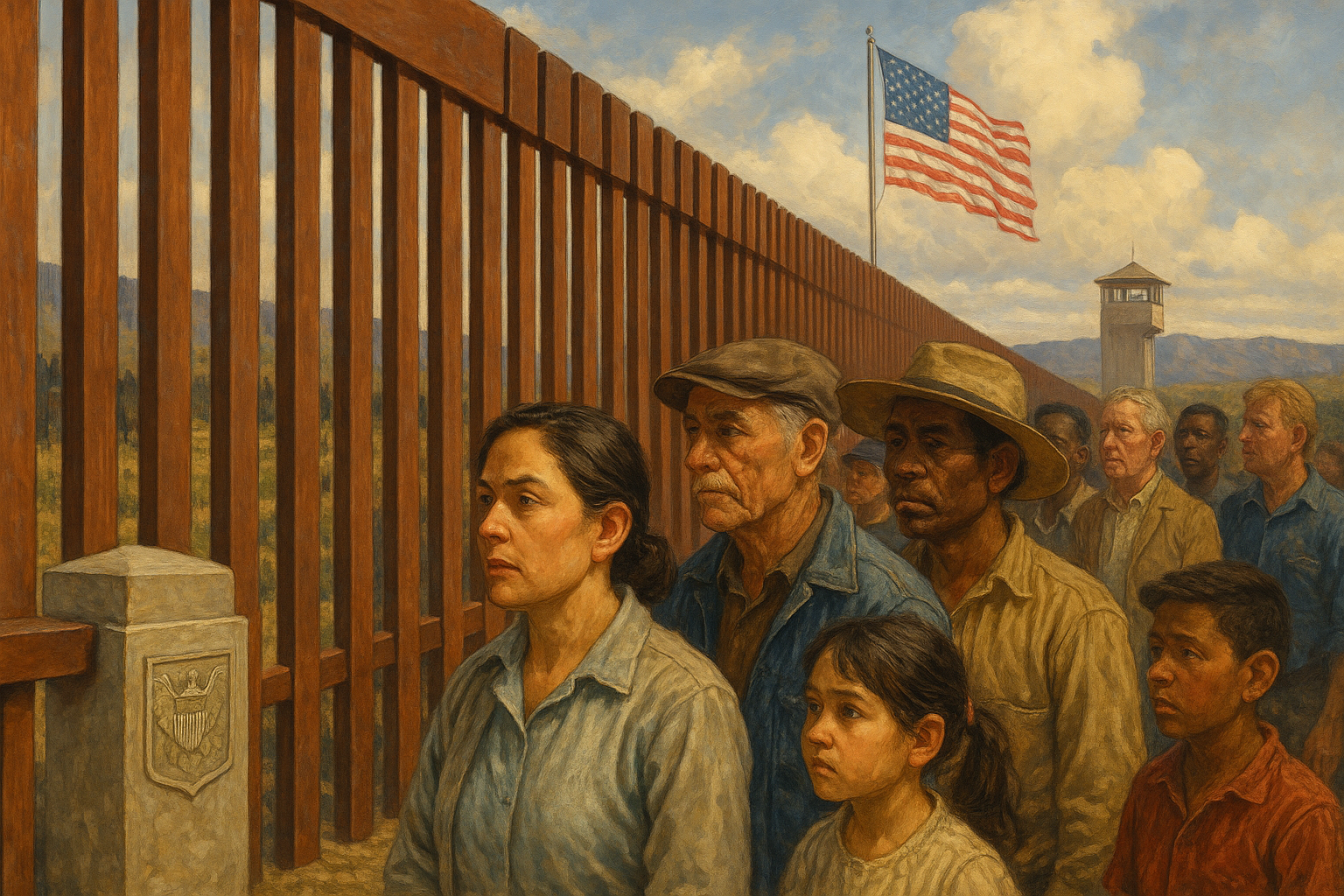
Immigration and border policy is one of the most persistent, polarizing, and consequential issues in contemporary American politics.
It sits at the intersection of national security, economic opportunity, humanitarian concern, rule of law, and national identity.
For many voters, it drives electoral choices, affects local public services, and stokes powerful cultural emotions.
Yet despite its prominence, the conversation often lacks clarity about what is at stake, why it matters, and how policy choices translate into real-world outcomes.
At its core, immigration and border policy is about one central question: Who gets to come into and stay in the United States, under what conditions, and with what responsibilities and rights?
That question ripples across economics, demographics, civic institutions, and the rule of law. For American citizens — regardless of party affiliation — the implications are tangible and significant.
National Relevance: Security, Economics, Rule of Law
The U.S.–Mexico border stretches roughly 2,000 miles.
For decades, it has been both a gateway of opportunity and a challenge of governance.
In recent years, the number of people attempting to cross that border — both with and without legal authorization — has surged dramatically, driven by violence, economic stagnation, and political instability in other countries.
As a result, issues once confined to a handful of border states now influence the daily lives, public budgets, and safety calculations of communities nationwide.
From the standpoint of national security, unauthorized border crossings raise questions about who enters the country, under what circumstances, and with what screening.
Federal border enforcement agencies, principally the Department of Homeland Security (DHS) and U.S. Customs and Border Protection (CBP), are charged with preventing the entry of individuals who pose threats, including those tied to criminal networks or extremist movements.
When crossings increase beyond the capacity to process them orderly, backlogs and uncertainty grow — affecting everything from data systems to local enforcement resources.
Economically, immigration intersects with both labor markets and public finances.
Immigrants — documented and undocumented — contribute to the workforce in agriculture, construction, hospitality, and services. They pay taxes, consume goods and services, and in many cases start small businesses that employ others.
At the same time, critics of current policy argue that unauthorized immigration can strain local school systems, healthcare facilities, and social services, particularly in jurisdictions that lack proportional federal support.
Assessing these trade-offs is complex because the economic impact depends on skill levels, legal status, and integration into the formal economy.
From the perspective of the rule of law, how the nation manages its borders reflects broader commitments to the Constitution and the separation of powers.
The U.S. is a nation of laws: laws crafted by Congress, interpreted by the courts, and enforced by the executive branch. When executive agencies exercise broad prosecutorial discretion — especially in ways that appear inconsistent — citizens on all sides of the debate ask whether laws are being applied fairly and transparently.
Immigration in the Public Mind: Polling and Public Sentiment
Polling data consistently shows that immigration is a top-tier issue for American voters — one that leans closely behind the economy, health care, and national security.
Gallup polling over the past several years has repeatedly placed immigration among the top three issues that voters care about when deciding how to vote in national elections.
While precise numbers shift with current events, a consistent theme emerges: Americans want secure borders coupled with a legal, orderly system of immigration.
When asked specifically about illegal immigration, majorities in polls often express support for stronger border enforcement.
For example, a survey by the Pew Research Center found that a substantial share of Americans favor beefed-up border security even if it means tougher enforcement measures.
At the same time, a large portion of respondents support providing a path to legal status for long-term residents who meet certain requirements.
This reflects a nuanced public view that rejects extremes on both sides — neither open borders nor indefinite detention — and instead seeks a system that is enforceable, humane, and economically rational.
Legal and Institutional Backdrop
Understanding immigration policy means appreciating the legal framework in which it operates.
U.S. immigration law rests primarily on statutes enacted by Congress — including the Immigration and Nationality Act of 1952 and its subsequent amendments — which define the categories of lawful entry, grounds for exclusion and deportation, and procedures for asylum and refugee status.
The executive branch, through agencies such as DHS, implements these laws and sets enforcement priorities. Meanwhile, federal courts regularly interpret immigration statutes and constitutional protections, shaping how policies play out in practice.
In recent decades, the system has struggled under its own complexity.
Backlogs in immigration courts have ballooned, resulting in wait times that can stretch for years. Administrative processes for visas, asylum claims, and removal proceedings often suffer from resource constraints. This institutional congestion contributes to activist litigation, executive directives, and, ultimately, public frustration — all of which feed political polarization.
Why Every Citizen Should Care
Even citizens who live far from the border feel the effects of immigration policy.
Federal budget debates often hinge on border spending and immigration enforcement priorities. Local law enforcement agencies grapple with conflicting state and federal directives on cooperation with immigration authorities. Employers confront labor shortages in key sectors and weigh the compliance costs of verifying worker eligibility. Cultural dynamics shift as new language communities and immigrant populations settle throughout the heartland.
More broadly, immigration and border policy touches questions that every citizen must consider: What does it mean to be a sovereign nation? How do we balance compassion for the suffering with the practical demands of enforcement? How do we maintain public confidence in institutions when people perceive laws as unevenly applied? These questions strike at the heart of constitutional self-government and civic cohesion.
The Stakes Ahead
As demographic trends suggest continued movement of people across borders — driven by globalization, economic disparity, and geopolitical instability — immigration will remain a central concern for American voters. Whether through legislative action, executive orders, court decisions, or grassroots political engagement, the policies this nation adopts will shape its communities, workforce, international reputation, and national character.
In the sections that follow, we will dissect how the two major political parties — Republican and Democrat — articulate their visions on this issue, translate them into policy, and respond to both public expectations and internal disagreements. This analysis will provide readers with a grounded understanding — not just of party rhetoric, but of the substantive choices facing the nation.
Articles in the Critical Issues series require more time to read than most content on this site. They are intentionally written as thorough, in-depth examinations of their subjects.
Immigration and Border Policy from a Republican Perspective
From the Republican perspective, immigration and border policy begins with a foundational premise: a nation that cannot control its borders cannot meaningfully govern itself.
This conviction informs nearly every Republican policy proposal, rhetorical emphasis, and legislative effort related to immigration. Republicans generally argue that compassion, economic opportunity, and lawful immigration are not possible — or at least not sustainable — without first establishing border security and consistent enforcement of existing law.
Core Principles in the 2024 Republican Party Platform
The 2024 Republican Party platform frames immigration primarily as a matter of sovereignty, public safety, and rule of law.
The platform emphasizes that immigration must be legal, orderly, and controlled, and it explicitly rejects policies that incentivize unlawful entry or weaken enforcement mechanisms (Republican Party Platform, 2024).
Key principles articulated in the platform include:
• Securing the southern border through physical barriers with effective, enhanced technology, and increased personnel
• Ending “catch and release” practices that allow migrants to remain in the country while awaiting hearings
• Restoring enforcement of existing immigration laws rather than relying on executive discretion
• Opposing sanctuary jurisdictions that obstruct cooperation with federal immigration authorities
• Prioritizing merit-based legal immigration that serves the national interest
The platform repeatedly frames the issue as one of fairness: fairness to legal immigrants who follow the rules, fairness to citizens who bear the costs of disorder, and fairness to communities overwhelmed by sudden population inflows.
Federal-Level Republican Actions and Legislation
At the federal level, Republican lawmakers have consistently supported legislation aimed at tightening border enforcement and reducing incentives for illegal entry. Prominent examples include repeated efforts to fund border wall construction, expand detention capacity, and limit the use of parole authority by the executive branch.
During Republican-controlled periods in Congress, lawmakers advanced bills such as the Secure the Border Act, which sought to mandate detention of individuals crossing illegally, restrict asylum claims to ports of entry, and compel the Department of Homeland Security to resume enforcement practices curtailed under Democratic administrations. Although such bills often stalled in the Senate or faced presidential veto threats, they reflected the party’s policy priorities.
Republicans have also been vocal critics of executive actions that, in their view, effectively rewrite immigration law without congressional approval. GOP members of Congress have argued that broad parole programs, mass releases into the interior, and non-enforcement directives undermine the constitutional separation of powers by substituting executive preference for statutory law.
Statements from Republican lawmakers frequently emphasize that Congress writes the law, not administrative agencies, and that selective enforcement erodes public trust. This argument has been a central theme in hearings, press conferences, and floor debates.
Border-State Leadership and State-Level Initiatives
Republican governors and attorneys general — particularly in border states — have played an increasingly prominent role in shaping immigration enforcement through state action. Texas, under Republican leadership, has been the most visible example.
Texas officials have implemented state-funded border security initiatives involving additional law enforcement personnel, physical barriers on state-controlled land, and aggressive cooperation with federal authorities where permitted. Republican leaders in Texas have argued that when the federal government fails to enforce immigration law, states have both the right and responsibility to act to protect their citizens.
Other Republican-led states have adopted policies restricting state benefits for illegal immigrants, banning sanctuary policies, or requiring local law enforcement to cooperate with federal immigration authorities. These efforts are typically framed as restoring uniform application of the law rather than targeting immigrants themselves.
At the city and county level, Republican officials often contrast their policies with those of sanctuary jurisdictions, arguing that refusal to cooperate with federal enforcement creates safe havens for criminal activity and places additional burdens on local taxpayers.
Public Safety Emphasis
A major rhetorical and policy emphasis among Republicans is the connection between uncontrolled immigration and public safety. While Republicans generally acknowledge that most immigrants are not violent criminals, they argue that any system that loses track of entrants creates unacceptable risk.
Republican lawmakers frequently cite cases where individuals with prior criminal histories were released into the country due to enforcement lapses and later committed serious crimes. These cases are used to argue that border enforcement is not merely an abstract policy debate but a matter with life-and-death consequences for American citizens.
This emphasis on public safety resonates strongly with Republican voters and is often used to critique Democratic policies as naïve or ideologically driven rather than grounded in real-world consequences.
Economic Framing: Labor and Wages
Republicans also approach immigration through an economic lens, particularly concerning labor markets and wages. While generally supportive of legal immigration that fills genuine labor shortages, many Republicans argue that mass illegal immigration suppresses wages for lower-income American workers and places downward pressure on job opportunities for the most vulnerable citizens.
The Republican position often stresses the importance of employer accountability, including enforcement of laws that prohibit hiring unauthorized workers. The argument is that meaningful reform must address both supply and demand: securing the border while discouraging illegal employment practices that attract unlawful migration in the first place.
Internal Disagreements Within the Republican Party
Although the Republican Party is largely unified around border security, there are meaningful internal disagreements regarding the scope and tone of reform. Some Republicans, particularly those representing agricultural or business-heavy districts, have supported expanded guest-worker programs or temporary legal status arrangements to address labor shortages.
Others within the party prioritize enforcement almost exclusively and oppose any measures that could be interpreted as “amnesty,” even if paired with enforcement reforms. These disagreements tend to center on sequencing — whether enforcement must be completed before any legalization measures are considered — rather than on whether enforcement itself is necessary.
Despite these differences, the Republican Party’s overall posture remains markedly more enforcement-focused than that of Democrats, with border security treated as a prerequisite rather than a negotiable component of immigration policy.
Republican Self-Understanding on Immigration
Republicans typically reject the accusation that their policies are anti-immigrant. Instead, they frame their approach as pro–legal immigration and pro–citizenship integrity. The party argues that a broken system harms everyone: citizens, legal immigrants, and migrants alike.
From this perspective, restoring enforcement is not viewed as cruelty but as moral clarity — a necessary step toward a functioning system that is honest about limits, lawful procedures, and national responsibility.
Immigration and Border Policy from a Democrat Perspective
The Democratic Party approaches immigration and border policy from a markedly different starting point than Republicans. Where Republicans begin with sovereignty and enforcement, Democrats generally begin with humanitarian concern, group equity, and skepticism toward enforcement mechanisms they believe disproportionately harm marginalized populations. This difference is not merely tactical; it reflects distinct moral intuitions and, increasingly, distinct worldviews.
The 2024 Democratic Party Platform on Immigration
The 2024 Democratic Party platform presents immigration primarily as a matter of human dignity, civil rights, and inclusivity. The platform emphasizes America’s historical identity as a “nation of immigrants” and frames modern immigration debates in continuity with civil rights struggles of the past (Democratic Party Platform, 2024).
Key themes include:
• Expanding access to asylum and refugee protections
• Providing pathways to legal status or citizenship for undocumented immigrants
• Ending large-scale detention and restrictive enforcement practices
• Limiting deportations, especially for long-term residents
• Opposing physical border barriers and deterrence-based strategies
The platform places heavy emphasis on the moral obligation to welcome migrants fleeing hardship and portrays restrictive enforcement as incompatible with American values. Border enforcement is discussed, but often in vague terms — emphasizing “smart,” “humane,” or “values-based” security without specifying clear enforcement thresholds or consequences for illegal entry.
Federal Democratic Actions and Legislative Priorities
At the federal level, Democratic lawmakers have supported legislation that expands legal protections for migrants while narrowing enforcement tools. Proposals such as broad legalization programs, expanded asylum eligibility, and limits on Immigration and Customs Enforcement (ICE) cooperation are recurring features of Democratic legislative efforts.
Democrats have also supported executive actions that prioritize prosecutorial discretion — effectively allowing the executive branch to choose which immigration laws to enforce and which to deprioritize. These policies are frequently defended as necessary triage in an “overburdened system,” but critics argue they amount to de facto non-enforcement.
Statements by Democratic leaders often downplay the deterrent effect of enforcement, suggesting that migration flows are driven primarily by external conditions rather than U.S. policy signals. This framing tends to absolve domestic policy decisions of responsibility for increased crossings.
State and City-Level Democratic Governance
At the state and municipal level, Democratic governance reveals the most concrete application of the party’s immigration worldview. Many Democrat-led cities and states have adopted sanctuary policies, limiting cooperation with federal immigration authorities. These policies are justified as necessary to maintain trust between immigrant communities and local law enforcement.
However, sanctuary jurisdictions often experience practical tensions when migration volumes increase rapidly. Cities that publicly embrace welcoming rhetoric have, in some cases, declared states of emergency when faced with large numbers of arrivals requiring housing, healthcare, and education.
This has exposed a recurring pattern: symbolic moral commitment without proportional institutional preparation. The tension between rhetoric and capacity has led some Democratic leaders to quietly request federal intervention even while opposing enforcement measures publicly.
Defining “Progressive,” “Woke,” and “Neo-Marxist” Influences
Before applying these terms, they must be defined operationally.
In contemporary political usage, Progressivism emphasizes group-based equity over individual equality, views institutions as structurally oppressive, and seeks to use state power to correct perceived systemic injustices.
“Woke” ideology is a cultural expression of Progressivism, characterized by heightened sensitivity to power dynamics, moralization of identity categories, and the belief that disagreement often signals moral failure rather than honest difference.
Neo-Marxism, as applied here, does not mean classical economic Marxism. Rather, it refers to the adaptation of Marxist concepts — oppressor versus oppressed, power struggle, moral legitimacy derived from victim status — into cultural, legal, and social analysis.
How These Worldviews Shape Democratic Immigration Policy
Within this framework, immigration is interpreted less as a legal process and more as a moral narrative. Migrants are framed primarily as oppressed victims, while border enforcement institutions are cast as instruments of systemic injustice. National borders themselves are sometimes treated as morally suspect — arbitrary constructs that protect privilege rather than legitimate sovereignty.
This worldview produces predictable policy outcomes:
• Enforcement is viewed with suspicion or hostility
• Deterrence is morally reframed as cruelty
• Citizenship distinctions are softened or treated as morally secondary
• National interest is subordinated to transnational moral claims
As a result, Democratic policy often resists clear enforcement boundaries, preferring flexibility and discretion even when outcomes strain institutions.
Rhetoric Versus Reality: Do Democratic Positions Match Their Actions?
A critical question is whether Democratic rhetoric aligns with observed outcomes.
Official messaging emphasizes compassion, order, and humane management. Yet policy actions frequently generate disorderly and chaotic conditions, including overwhelmed border facilities, overloaded city services, and prolonged legal limbo for migrants themselves.
Critics argue that the party’s language often masks reality through euphemism. Terms like “undocumented,” “newcomers,” or “asylum seekers” are used broadly, obscuring distinctions between legal categories.
Enforcement failures are described as humanitarian crises rather than policy failures, shifting blame away from decision-makers.
This rhetorical strategy has the effect — intentional or not — of insulating ideology from accountability.
Authoritarian Tendencies and Public Transparency
Another concern raised by critics is whether Democratic immigration policy reflects a more authoritarian posture than is commonly recognized. While Democrats frequently invoke democracy and inclusion, the use of executive power to bypass Congress, limit public input, and suppress dissenting viewpoints raises questions.
When citizens express concern about border control, they are sometimes dismissed as misinformed, xenophobic, or morally deficient. This pattern suggests an elite-driven moral framework that assumes superior insight and discourages open debate.
Whether this reflects intentional deception, ideological certainty, or institutional inertia is debated. What is clear is that the underlying worldview is rarely explained to the public, even though it decisively shapes outcomes.
Criticisms, Counterarguments, and Public Scrutiny
Immigration and border policy generates intense disagreement not only between Republicans and Democrats, but also between each party and large segments of the general public. Importantly, many of the criticisms exchanged are not fringe talking points but arise from thoughtful observers who share basic civic concerns yet differ in priorities. Examining these criticisms — and the responses offered — helps clarify what is truly at stake.
Criticisms of the Republican Position
One common criticism raised by Democrats and left-leaning independents is that Republican immigration policy is overly punitive and insufficiently compassionate.
Critics argue that heavy emphasis on enforcement, detention, and deportation fails to account for the human suffering that drives migration in the first place. They contend that border walls, expanded detention, and rapid removals reduce complex human stories to security problems.
Another frequent criticism is that Republicans overstate the link between immigration and crime. While acknowledging that border security is necessary, critics argue that most migrants are not violent criminals and that sensational cases distort public perception. From this viewpoint, Republicans are accused of using fear to mobilize voters rather than pursuing balanced reform.
A third criticism focuses on economic inconsistency. Critics note that many Republican constituencies — particularly agriculture, construction, and service industries — rely heavily on immigrant labor. They argue that Republicans benefit from this labor while opposing reforms that would legalize or stabilize the workforce, resulting in a system that is neither humane nor efficient.
Republican Counter-Responses
Republicans typically respond by rejecting the premise that enforcement and compassion are mutually exclusive. They argue that lawlessness itself is inhumane, both to citizens and to migrants who are lured into dangerous journeys by false promises. From this perspective, lax enforcement enriches smugglers, traffickers, and cartels while exposing migrants to exploitation and death.
Regarding crime, Republicans emphasize that risk management matters even when most individuals are nonviolent. The issue is not that immigrants are inherently dangerous, but that a system incapable of vetting entrants creates unacceptable vulnerabilities. Republicans argue that a sovereign nation has the moral right — and duty — to know who enters its territory.
On economics, Republicans counter that the solution is not tolerance of illegality but reform of legal immigration channels that meet labor needs without undermining wages or the rule of law. They argue that employer accountability and legal worker programs must accompany enforcement, not replace it.
Criticisms of the Democratic Position
Critics of the Democratic approach — including Republicans, independents, and some moderate Democrats — often argue that Democratic immigration policy is naïve about incentives. They contend that messaging and policies signaling low enforcement predictably increase migration flows, overwhelming institutions and harming both migrants and host communities.
Another criticism is that Democrats rely heavily on euphemistic language that obscures reality. Terms such as “undocumented,” “newcomers,” or “asylum seekers” are used broadly, critics argue, to avoid acknowledging illegal entry or policy failure. This linguistic softening is seen as a way to reduce public resistance rather than to inform citizens honestly.
A third concern centers on local impact. While Democratic leaders often frame immigration as a national moral obligation, the costs are frequently borne by specific cities, school districts, hospitals, and taxpayers. Critics argue that Democratic leaders underestimate these downstream effects or dismiss them as morally irrelevant.
Democratic Counter-Responses
Democrats typically respond by arguing that migration is driven primarily by global conditions, not U.S. policy choices. Violence, climate instability, and economic collapse in other countries, they argue, would push migrants northward regardless of enforcement posture. From this view, punitive enforcement fails to address root causes.
On language, Democrats argue that terminology matters because it shapes public empathy and prevents dehumanization. They maintain that focusing on legal status alone misses the moral reality of human need and historical patterns of exclusion.
Regarding local strain, Democratic leaders often emphasize the need for federal coordination and funding, arguing that failures arise from inadequate national support rather than flawed philosophy. They frame these challenges as growing pains in a more inclusive system rather than evidence of systemic failure.
The View from the General Public
The general public often occupies an uneasy middle ground. Polling suggests that many Americans simultaneously want secure borders and humane treatment. They express frustration with chaos and disorder while also resisting rhetoric that appears callous or demeaning.
This creates a credibility challenge for both parties. Republicans risk appearing indifferent to suffering if they emphasize enforcement without articulating a moral framework. Democrats risk appearing detached from reality if they emphasize compassion without addressing enforcement failures.
For many citizens, the core question is not ideological purity but functional governance: Does the policy work? Does it reduce disorder? Does it respect law while acknowledging human dignity?
This tension sets the stage for evaluating alternative approaches — and ultimately, for considering how Christians should think biblically about the issue.
Other Political Parties and the Limits of Their Immigration Frameworks
While Republicans and Democrats dominate immigration debates, other political parties also articulate distinct approaches. These alternatives can sound appealing precisely because they avoid the frustrations associated with the two major parties. However, when examined carefully — especially through a biblical lens — their shortcomings become clear.
The Libertarian Party on Immigration
The Libertarian Party typically approaches immigration from a framework of maximal individual liberty and minimal state authority. In its most consistent form, Libertarian immigration policy favors dramatically reduced border controls, expanded freedom of movement, and limited government involvement in determining who may enter or remain in the country.
Libertarian arguments often rest on several assumptions:
• Individuals possess a natural right to migrate freely across borders
• National borders are administrative conveniences rather than moral boundaries
• Labor markets, not governments, should determine migration flows
• State enforcement of borders represents coercive overreach
Some Libertarians explicitly support near–open borders, arguing that economic freedom and private property rights are sufficient to regulate migration. Others adopt a slightly more restrained position, allowing for minimal screening but opposing most enforcement measures as violations of liberty.
Why This View Appeals to Some Voters
The Libertarian position can appear morally attractive because it emphasizes personal freedom, skepticism of government power, and economic efficiency. In contrast to what many perceive as authoritarian impulses within both major parties, Libertarianism presents itself as principled and consistent.
It also resonates with those who are frustrated by bureaucratic inefficiency and politicized enforcement. By reducing the role of the state, Libertarians promise fewer abuses of power and fewer politicized decisions.
Where Libertarian Immigration Policy Falls Short
Despite its surface appeal, the Libertarian approach struggles when confronted with reality, responsibility, and biblical teaching.
First, Libertarianism treats the nation primarily as a marketplace rather than a moral community. Scripture, however, consistently treats political communities as accountable entities with defined responsibilities.
A people are not merely individuals sharing space; they are a covenantal society with obligations to maintain order and justice.
Second, the Libertarian model assumes that private property and voluntary association can replace national enforcement. In practice, this ignores the fact that public goods — infrastructure, courts, defense, welfare systems — are maintained collectively. Large-scale migration inevitably impacts these shared systems, requiring governance rather than mere market adjustment.
Third, the Libertarian framework lacks a meaningful doctrine of authority. Scripture affirms that civil authority is ordained by God to restrain evil and promote order. A political philosophy that minimizes authority to the point of ineffectiveness fails to meet this biblical expectation.
Other Minor Parties
Other minor parties generally mirror or exaggerate one of the two dominant frameworks. Progressive third parties tend to push Democratic positions further left, advocating expansive migration rights with minimal enforcement. Nationalist fringe parties tend to push Republican themes toward ethnic or racial exclusion, which is incompatible with biblical teaching on human dignity.
These alternatives typically collapse under biblical scrutiny because they either absolutize compassion without order or absolutize identity without justice.
The Biblical Standard Applied to Non-Major Parties
From a biblical perspective, any immigration policy must balance justice, order, and compassion. Systems that deny national authority fail the test of order. Systems that deny human dignity fail the test of justice. Libertarianism, in particular, errs by denying the legitimacy of national boundaries and civil authority altogether.
As a result, while Libertarian critiques may occasionally highlight real excesses or inefficiencies, their solutions do not provide a morally or practically adequate framework for governing a nation.
A Biblical Perspective on Immigration, Borders, and the Protection of Moral Order
A biblical evaluation of immigration and border policy must begin with first principles rather than party loyalty.
Scripture does not speak in modern policy language, but it does speak clearly about nations, authority, law, order, and moral responsibility.
When these principles are assembled carefully, they yield a coherent framework for thinking about borders — not merely as lines on a map, but as boundaries that protect a moral and civil inheritance.
Nations, Borders, and God’s Design
The Bible affirms the existence of nations as part of God’s providential ordering of the world.
Humanity is not presented as a single, borderless mass, but as peoples organized into distinct nations with real boundaries and real responsibilities.
Scripture teaches that God determines the boundaries of nations and their allotted places in history, not arbitrarily, but for the good ordering of human society (Acts 17:26).
Borders, therefore, are not immoral constructs. They are instruments of stewardship. A nation’s border defines the scope of its laws, its institutions, and its shared moral expectations.
To deny the legitimacy of borders is not an act of compassion; it is a rejection of God’s design for ordered human life.
Borders as Guardians of a Moral Inheritance
A nation is more than territory. It is a repository of ideas, customs, laws, and moral assumptions.
The United States, imperfect though it is, was shaped by a Christian moral framework that emphasized human dignity, the rule of law, ordered liberty, and accountability under God.
Borders mark the space where those ideas are meant to be preserved, debated, and transmitted to future generations.
In this sense, borders are not merely about keeping people out; they are about protecting a moral ecosystem.
Just as a family sets boundaries to protect its children, and a church guards doctrine to protect the flock, a nation has a duty to protect the ideas that sustain its civil life.
When a nation loses confidence in the legitimacy of its borders, it often loses confidence in its own moral inheritance as well.
The Danger of Unassimilated Enclaves
Scripture repeatedly emphasizes the importance of assimilation to just law for those who dwell within a nation.
The sojourner in Israel was to be treated with dignity, but not permitted to undermine Israel’s law or moral order. There was one law for the native and the sojourner alike (Exodus 12:49).
Modern Western societies, however, have increasingly tolerated the formation of ideological enclaves — areas where foreign moral systems are allowed to persist unchallenged in the name of multicultural tolerance. This is not biblical hospitality; it is civil negligence.
The consequences of this failure are visible.
In Great Britain, the systematic abuse of young girls by Pakistani grooming gangs was enabled not only by criminal depravity, but by institutional fear of confronting cultural practices incompatible with British law. Authorities hesitated to act, fearing accusations of bigotry, and in doing so abandoned their duty to protect the vulnerable.
Similarly, in parts of Europe and even in the United States, there have been documented instances of de facto Sharia enforcement within insular communities — not through formal legislation, but through social coercion, informal courts, and intimidation.
While defenders often minimize these cases, their existence highlights a serious problem: when a nation refuses to insist on the supremacy of its own law, it invites moral fragmentation.
Why Ideas Matter More Than Numbers
The immigration debate is often framed in terms of numbers — how many people cross the border, how many visas are issued, how many asylum claims are pending.
But from a biblical perspective, ideas are more consequential than numbers.
A small number of people committed to destructive ideas can do more harm than a large number committed to lawful assimilation. This is why Scripture treats false teaching as more dangerous than simple ignorance. Bad ideas, left unchecked, replicate themselves.
Borders, properly enforced, serve as filters not only for security risks but for civil compatibility. This does not require ethnic exclusion or religious tests. It requires confidence that the nation’s laws, constitutional order, and moral norms are non-negotiable.
Compassion Without Surrender
Biblical compassion never requires surrendering moral authority. Scripture commands care for the stranger, the poor, and the oppressed, but it never commands a nation to dissolve its laws or tolerate injustice in the name of mercy.
A government that fails to enforce its borders fails in its God-given role.
Civil authority exists to reward good and restrain evil (Romans 13:1–4). When enforcement collapses, the vulnerable suffer first — including immigrants themselves.
Which Party Aligns More Closely with a Biblical Framework?
Measured against these principles, the Republican position — while imperfect — aligns more closely with a biblical worldview than the Democratic alternative.
Republican emphasis on borders, enforcement, assimilation, and the supremacy of law reflects biblical concerns for order, justice, and stewardship.
Democratic emphasis on border fluidity, enforcement skepticism, and moral relativism regarding national identity undermines those same concerns.
This does not require endorsing every Republican policy or personality. It does require recognizing that a Christian must weigh ideas, not intentions, and outcomes, not rhetoric.
Weighing Immigration Against Other Moral Issues
Immigration is important, but it is not the highest moral issue. Scripture demands that Christians assign appropriate weight to moral concerns. Issues involving the direct taking of innocent human life — such as abortion — carry greater moral gravity than disputes over taxation or regulatory policy.
Immigration policy should be evaluated within that hierarchy. A candidate’s position on borders matters, but it should be weighed alongside their stance on life, family, religious liberty, and the rule of law.
In the final section, we will draw these threads together and reflect on the Christian’s duty to seek the welfare of the nation — including the proper use of the ballot in a constitutional republic.
Seeking the Welfare of the Nation
Christians are not called to withdraw from public life, nor are they permitted to treat political questions as morally neutral.
Scripture consistently teaches that God’s people have a responsibility to seek the good of the communities in which they live. This duty applies even when those communities are imperfect, divided, or in decline. In a constitutional republic, voting is one of the primary means by which citizens may fulfill that obligation.
Immigration and border policy is not a peripheral issue. It shapes the safety of communities, the credibility of law, the sustainability of institutions, and the moral confidence of a nation. When borders collapse, it is not merely a bureaucratic failure; it is a failure of stewardship. Disorder spreads, accountability weakens, and the most vulnerable — citizens and immigrants alike — bear the cost.
Christians should resist the false framing that treats concern for borders as morally suspect. Scripture does not equate compassion with permissiveness, nor does it bless the abdication of authority. Biblical love is ordered love. It seeks justice, protects the innocent, restrains evil, and promotes peace within defined moral boundaries.
A nation that loses confidence in its right to govern itself will eventually lose the ability to protect anyone within it. History offers sobering examples of societies that prioritized sentiment over structure and paid dearly for the mistake. The Christian, informed by Scripture, should not be surprised by this outcome. God has designed human societies to function within limits, under law, and with accountability.
When evaluating political candidates, believers must therefore look beyond slogans and emotional appeals.
They must ask whether a candidate’s policies strengthen or weaken the rule of law, whether they protect or erode the moral inheritance passed down to future generations, and whether they align with the biblical vision of justice tempered by mercy.
No political party perfectly reflects the kingdom of God. Yet choices must still be made. On immigration and border policy, the Republican emphasis on sovereignty, enforcement, and assimilation aligns more closely with biblical principles than the Democratic emphasis on border fluidity, enforcement skepticism, and moral relativism regarding national authority. That alignment does not excuse failures, excesses, or uncharitable rhetoric. It does, however, provide a clearer framework for ordered liberty.
Christians must also remember that voting is not the only responsibility. Prayer for leaders, support for lawful reform, charity toward those in need, and courageous truth-telling all remain essential. But voting is a real act of stewardship, and refusing to exercise it wisely is itself a moral choice.
The prophet Jeremiah instructed God’s people to seek the welfare of the city where they dwelled, knowing that their own welfare was bound up with it (Jeremiah 29:7). That counsel remains relevant today. In seeking the good of the nation, Christians honor God, serve their neighbors, and bear witness to a moral order that transcends politics while still engaging it faithfully.
S.D.G.,
Robert Sparkman
rob@christiannewsjunkie.com
RELATED CONTENT
Party platforms
If you want to read the party platforms yourself, here are the links:
Republican Party 2024 Platform
Concerning the Related Content section, I encourage everyone to evaluate the content carefully.
If I have listed the content, I think it is worthwhile viewing to educate yourself on the topic, but it may contain coarse language or some opinions I don’t agree with.
I use words that reflect the “woke” culture and their re-definitions sometimes. It is hard to communicate effectively without using their twisted vocabulary. Rest assured that I do not believe gender ideology or “Progressivism”. Words and phrases like “trans man”, “trans women” , “transgender”, “transition” or similar words and phrases are nonsensical and reflect a distorted, imaginary worldview where men can become women and vice-versa. The word “Progressive” itself is a propagandistic word that implies the Progressives are the positive force in society, whereas in reality their cultic belief system is very corrosive to mankind.
Feel free to offer your comments below. Respectful comments without expletives and personal attacks will be posted and I will respond to them.
Comments are closed after sixty days due to spamming issues from internet bots. You can always send me an email at rob@christiannewsjunkie.com if you want to comment on something afterwards, though.
I will continue to add videos and other items to the Related Content section as opportunities present themselves.