
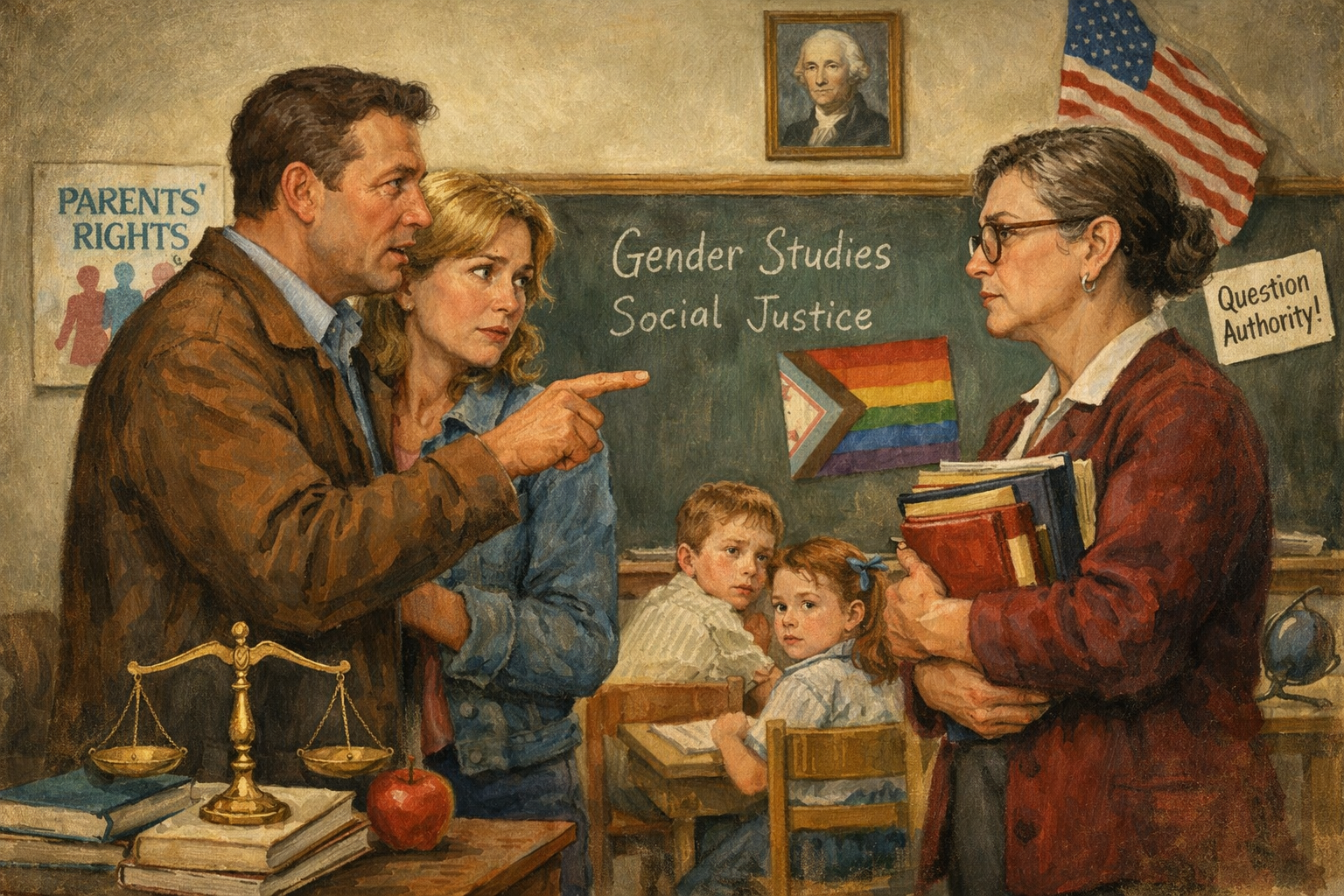
Public education is not a narrow policy dispute. It sits at the crossroads of culture, economics, parental authority, national cohesion, and the future moral imagination of the country. Few institutions touch more Americans more directly or more persistently than the public school system. Over fifty million children attend public K–12 schools each year, and nearly ninety percent of American children receive at least part of their education in government-run classrooms. That alone makes public education a voting issue of the first order.
But numbers alone do not explain why public education has become one of the most bitterly contested political battlegrounds in modern America. What has changed is not simply how schools are funded or administered, but what schools are understood to be for. Education has increasingly shifted from the transmission of knowledge and civic formation toward ideological formation. This shift has profound consequences for families, communities, and the stability of a constitutional republic.
At stake is a fundamental question: Who shapes the moral, intellectual, and social formation of children—the family or the state?
Why American Voters Should Care
Polling consistently shows that education ranks among the top issues for American voters, particularly parents. In recent election cycles, education concerns have surged dramatically, driven by several converging developments: prolonged school closures during COVID, the discovery of ideologically driven curricula, disputes over parental notification policies, and declining academic performance despite rising per-pupil spending.
National Assessment of Educational Progress (NAEP) scores reveal sobering realities. Reading and math proficiency have declined to levels not seen in decades, with particularly sharp drops among lower-income and minority students. At the same time, education spending per student has steadily increased when adjusted for inflation. Americans are paying more for worse outcomes.
This mismatch between investment and results naturally raises questions. Voters are asking whether public education has lost focus, whether bureaucratic interests have displaced student outcomes, and whether ideological commitments are crowding out core academic competencies like literacy, numeracy, history, and science.
Economic Impact on Families and Communities
Public education has a direct economic impact on nearly every American household, whether or not they have children in the system. Local property taxes, state budgets, and federal education spending all flow into school systems that often show little fiscal discipline. Teachers’ pensions, administrative overhead, and union-negotiated benefits consume a growing share of education budgets, leaving fewer resources for classrooms.
For working- and middle-class families, this creates a double burden. Parents pay taxes to support public schools while increasingly feeling compelled to spend additional money on tutoring, private schooling, or homeschooling resources to compensate for deficiencies or ideological conflicts. School choice restrictions exacerbate this problem by trapping families—especially poorer families—in failing systems.
At a national level, workforce readiness is also affected. Employers routinely report that graduates lack basic skills once assumed to be standard: reading comprehension, arithmetic competence, punctuality, and basic civics knowledge. When public education fails at scale, the cost is borne by the entire economy in the form of lower productivity and higher remediation costs.
Public Safety and Social Cohesion
Education is not merely academic; it is formative. Schools shape how students understand authority, citizenship, history, and social norms. When education systems undermine parental authority or promote radical social theories that frame society as fundamentally oppressive, trust erodes—both within families and across communities.
Disciplinary policies rooted in ideological theories rather than behavioral accountability have contributed to rising disorder in some school systems. Incidents of violence, chronic absenteeism, and classroom disruption are not abstract problems. They directly affect teachers’ ability to teach and students’ ability to learn. In some districts, parents report schools that resemble holding facilities more than places of instruction.
Historically, American public education aimed to form informed citizens capable of self-government. From the McGuffey Readers to civics instruction emphasizing constitutional principles, schools once reinforced shared moral and civic assumptions—even while allowing for religious liberty. Today, that consensus has fractured. Competing worldviews now vie for dominance in the classroom, often without parental knowledge or consent.
Institutional Power and Ideological Drift
One cannot understand modern public education without recognizing the institutional power structures that shape it. Two teachers’ unions—the National Education Association (NEA) and the American Federation of Teachers (AFT)—exercise enormous influence over curriculum standards, teacher training programs, school board policies, and national education discourse. These organizations are not politically neutral. They are deeply embedded within the Democratic Party’s policy apparatus and are among its largest financial and organizational supporters.
As public trust declines, voters are increasingly aware that education policy debates are not simply about pedagogy but about power: who decides what children are taught, what values are emphasized, and what dissent is tolerated. Transparency battles over curriculum access and parental rights legislation reflect this growing unease.
Why This Issue Has Become Politically Explosive
Public education now sits at the center of broader debates over Progressive ideology, parental authority, federalism, and the limits of state power. What once seemed like technical policy questions have become moral and philosophical disputes about human nature, truth, and the role of government.
This explains why school board meetings have become contentious, why education has reshaped voting patterns in suburban districts, and why education reform has moved from think tanks into kitchen-table conversations. Voters intuitively understand that whoever controls education controls the future cultural trajectory of the nation.
In short, public education matters because it shapes citizens before they ever cast a ballot, join the workforce, or raise families of their own. It affects economic vitality, social order, and the preservation—or erosion—of inherited moral norms. Any serious evaluation of American political divisions must take education seriously.
Articles in the Critical Issues series require more time to read than most content on this site. They are intentionally written as thorough, in-depth examinations of their subjects.
The Republican Perspective on K–12 Public Education
The Republican approach to K–12 public education is best understood as a reaction to institutional drift. Over the past several decades, Republicans have increasingly come to view public education not as a neutral civic enterprise but as a captured institution—dominated by bureaucracies, unions, and ideological commitments that conflict with parental authority, local control, and academic rigor.
At its core, the Republican position emphasizes parents as the primary stakeholders in a child’s education, not the state.
This conviction shapes Republican policy preferences across school choice, curriculum transparency, union power, discipline, and federal involvement.
Foundational Principles
Republicans generally approach K–12 education with four guiding convictions:
First, education exists to transmit knowledge and skills, not to impose contested ideological frameworks like wokeness and gender ideology. Reading, writing, mathematics, history, science, and civics are viewed as the proper core of public education.
Second, parents—not government institutions—hold primary authority over children. Schools exist to assist families, not replace them.
Third, local control is preferable to federal control. Education decisions should be made as close to families as possible, where accountability is direct and cultural conditions are understood.
Fourth, competition improves outcomes. Monopolistic systems stagnate; pluralistic systems improve through accountability and choice.
These convictions are reflected in both the 2024 Republican Party platform and in legislation promoted by Republican lawmakers at the federal and state levels.
The 2024 Republican Party Platform on K–12 Education
The 2024 Republican Party platform frames education primarily through the lens of parental rights, academic excellence, and opposition to ideological indoctrination.
While the platform does not use academic jargon, its priorities are unmistakable.
Key platform commitments include:
- Affirming parents’ rights to direct their children’s education
- Supporting school choice, including charter schools, education savings accounts (ESAs), vouchers, and tax credits
- Opposing racial and gender-based ideological instruction, including Critical Race Theory and gender ideology, in K–12 classrooms
- Reducing federal overreach in education policy
- Protecting religious liberty for students, families, and educators
- Promoting curriculum transparency and parental access to instructional materials
(Republican Party Platform, Education and Families sections)
The platform reflects a belief that educational decline is not accidental but systemic—and that reform requires structural change rather than marginal funding increases.
School Choice as a Central Pillar
School choice is perhaps the defining feature of the modern Republican education agenda.
Republicans argue that when families are given meaningful alternatives to failing schools, outcomes improve—especially for low-income and minority students.
Republican lawmakers have championed a range of school choice mechanisms:
- Education Savings Accounts (ESAs)
- Charter school expansion
- Voucher programs
- Tax-credit scholarships
At the state level, Republican-led legislatures in Florida, Arizona, Texas, Iowa, Arkansas, and others have passed expansive school choice laws. These policies allow public education funding to follow students rather than institutions, weakening the monopoly power of traditional public school systems.
Republicans argue that opposition to school choice reveals an uncomfortable truth: that institutional stakeholders often prioritize system preservation over student outcomes.
Parental Rights and Curriculum Transparency
Republicans have increasingly focused on parental notification and curriculum transparency laws, particularly in response to concealed instruction related to gender identity, sexuality, and political ideology.
Republican lawmakers contend that schools have no legitimate authority to hide information from parents, especially regarding a child’s mental health, social identity, or moral instruction.
Legislation in states like Florida, Tennessee, and Virginia has required:
- Parental access to curriculum materials
- Disclosure of instructional content
- Parental notification regarding counseling and gender-related interventions
Critics often characterize these laws as censorship. Republicans respond that transparency is not censorship—it is accountability.
Opposition to Ideological Indoctrination
Republicans have been explicit in opposing what they view as ideological indoctrination in K–12 education.
This includes opposition to:
- Critical Race Theory-derived curricula
- Gender ideology instruction
- Politicized social-emotional learning frameworks
- Activist pedagogy that frames students as oppressors or victims based on group identity
Republican lawmakers argue that these frameworks undermine social cohesion, distort history, and impose contested moral claims on children without parental consent.
Legislation restricting such instruction has been passed or proposed in numerous Republican-controlled states. These efforts are often framed not as bans on discussion, but as limits on mandatory ideological instruction funded by taxpayers.
Teachers’ Unions and Institutional Power
Republicans are openly critical of teachers’ unions, particularly the National Education Association (NEA) and the American Federation of Teachers (AFT).
Republicans argue that these unions function less as professional associations and more as political actors aligned with the Democratic Party.
Republican critiques focus on several areas:
- Union opposition to school choice
- Union resistance to reopening schools during COVID
- Union influence over curriculum standards
- Union protection of ineffective educators through rigid labor contracts
Alignment of teacher unions and the Democrat Party is impossible to contest. Teacher unions donate massively to Democrat candidates and leftist organizations, with virtually no donations to Republican or conservative organizations.
From the Republican perspective, union power contributes to administrative bloat, shields poor performance, and prioritizes adult interests over student needs.
Federalism and the Role of Washington
Republicans generally oppose expanding federal control over K–12 education.
They argue that federal programs often come with ideological conditions attached and weaken local accountability.
Republican lawmakers have supported:
- Reducing the scope of the Department of Education
- Returning education authority to states and local districts
- Limiting federal mandates tied to funding
Federalism is a fundamental concept of American governance. The federal government should control certain aspects of American civil life such as national defense and interstate interests. However, other aspects belong to the state level where local taxpayers can hold the elected officials accountable.
The Republican position is not that public education should be dismantled, but that it should be re-centered around families, communities, and academic excellence, rather than ideological experimentation.
Internal Republican Disagreements
While Republicans are broadly aligned on education reform, disagreements do exist.
Some Republicans emphasize incremental reform within traditional public schools, while others advocate aggressive school choice expansion that could significantly shrink the public school system as currently structured.
There is also debate over how far restrictions on ideological instruction should go, with some cautioning against overly broad language that could invite legal challenges or unintended consequences.
Despite these differences, the Republican coalition is united in its belief that the current K–12 system is failing too many children—and that maintaining the status quo is unacceptable.
The Democrat Perspective on K–12 Public Education
The Democrat approach to K–12 public education is rooted in a fundamentally different understanding of the school’s role in society.
Where Republicans emphasize parental authority, decentralization, and competition, Democrats generally view public education as a primary instrument for achieving social outcomes defined at the national level.
Schools, in this framework, are not merely places where academic skills are transmitted, but institutions tasked with shaping social values, correcting perceived inequities, and advancing a broader vision of social justice.
This difference is not merely one of policy preference; it reflects competing philosophies about authority, the nature of inequality, and the proper role of government in forming the next generation.
The 2024 Democrat Party Platform on K–12 Education
The 2024 Democrat Party platform presents K–12 public education as a civil rights issue and frames federal involvement as necessary to ensure equity, inclusion, and uniform standards across states.
Key themes in the platform include:
- Strong federal oversight and funding of public schools
- Opposition to most forms of school choice, particularly vouchers and ESAs
- Explicit support for teachers’ unions
- Emphasis on “equity,” “inclusion,” and “anti-discrimination” frameworks
- Expansion of social services within schools
- Resistance to parental rights legislation perceived as limiting school discretion
(Democrat Party Platform, Education and Civil Rights sections)
The platform consistently treats public education as a public good best administered by centralized systems, professional educators, and national standards rather than by parents exercising individualized choice.
Teachers’ Unions as Political Partners
No discussion of the Democrat position on K–12 education is complete without addressing the central role of teachers’ unions. The National Education Association (NEA) and the American Federation of Teachers (AFT) are not peripheral allies of the Democrat Party; they are core institutional partners.
Both unions are among the largest donors to Democrat candidates and causes. Their leadership maintains close relationships with Democrat lawmakers, the White House, and federal agencies shaping education policy.
Rebecca Pringle (NEA) and Randi Weingarten (AFT) have consistently framed education policy debates in ideological terms, openly aligning their organizations with Progressive priorities. These unions advocate not only for wages and benefits but for specific curricular frameworks, including:
- Critical pedagogy
- Racial “equity” initiatives
- Gender identity instruction
- Opposition to parental oversight
- Resistance to school choice and homeschooling
Union leaders have argued that schools should act as instruments of social transformation rather than neutral providers of academic instruction.
Their stance is classic Neo-Marxist (woke).
The title of Randi Weingarten’s recent book tells the reader all he needs to know: Why Fascists FearTeachers: Public Education and the Future of Democracy.
Who is she calling a Fascist? Virtually anyone, including parents, conservative teachers and politicians who resist the woke revolution.
Progressives consider themselves the elite and view conservatives as uneducated fascists. Similar language was employed by Barack Obama and Hillary Clinton.
Opposition to School Choice and Homeschooling
Democrats overwhelmingly oppose school choice initiatives, particularly those that allow public funds to follow students to private, religious, or home-based educational settings.
The rationale offered is typically that school choice “drains resources” from public schools and undermines equity.
However, critics note that Democrat opposition aligns closely with union interests, which benefit from captive student populations and centralized funding streams.
Homeschooling is often treated with suspicion by Democrat lawmakers and allied advocacy groups. Regulatory efforts, curriculum mandates, and oversight proposals have frequently targeted homeschool families under the banner of child welfare or educational equity.
The underlying assumption appears to be that the state has a superior claim to shaping children’s education than parents, especially when parental beliefs diverge from Progressive norms.
Ideological Content and Curriculum
Democrat-led education policy increasingly embraces ideological frameworks that interpret society through lenses of power, identity, and systemic oppression. These frameworks influence K–12 curricula in history, social studies, literature, and even mathematics instruction.
Examples include:
- Teaching history primarily through narratives of oppression
- Framing civic institutions as fundamentally unjust
- Encouraging students to adopt activist identities
- Normalizing gender fluidity and rejecting biological distinctions
Democrat leaders typically defend these approaches as necessary for inclusion and social awareness. Critics argue that they amount to ideological indoctrination and impose contested moral claims on children without parental consent.
COVID-Era School Policies
The COVID-19 pandemic exposed sharp contrasts between Democrat and Republican approaches to K–12 education.
Democrat leaders, often in close coordination with teachers’ unions, supported prolonged school closures, remote learning mandates, and delayed reopenings—even after evidence emerged that children faced minimal health risk and that learning loss was severe.
Republicans argue that these policies reflected union priorities rather than student welfare.
Democrat leaders largely defended their decisions as precautionary and science-driven, though internal communications later revealed significant union influence on federal guidance.
The educational damage from this period—particularly for low-income students—has intensified scrutiny of Democrat education governance.
Support from Democrat Leadership Figures
Prominent Democrat figures have openly supported teachers’ unions and their objectives. Hillary Clinton has repeatedly praised the role of unions in shaping education policy and has opposed most forms of school choice. Jill Biden, herself a longtime educator and union ally, has been a visible advocate for union priorities during the Biden administration.
These relationships reinforce Republican claims that Democrat education policy is shaped less by parental concerns than by institutional alliances and ideological commitments.
Internal Democrat Tensions
While the Democrat Party is largely unified on education policy, some internal tensions do exist.
A small faction of moderate Democrats—often representing minority or working-class districts—has expressed limited openness to charter schools or choice-based reforms. However, these voices are typically marginalized by union leadership and Progressive advocacy groups.
The dominant faction within the party remains firmly aligned with centralized control, union influence, and ideological education frameworks.
Summary of the Democrat Position
In summary, the Democrat approach to K–12 public education emphasizes:
- Centralized authority
- Institutional expertise over parental judgment
- Union partnership
- Ideological frameworks tied to equity and identity
- Resistance to decentralization and competition
Supporters view this approach as necessary to promote fairness and social cohesion. Critics argue that it prioritizes ideology and institutional power over academic outcomes, parental rights, and educational pluralism.
The Libertarian Perspective on K–12 Public Education
The Libertarian position on K–12 public education differs substantially from both Republican and Democrat approaches, though in practice it overlaps more frequently with Republicans than with Democrats. Libertarians approach education primarily through the lens of individual liberty, voluntary association, and skepticism toward state power. As a result, they tend to view government-run education itself—not merely its current ideological direction—as inherently problematic.
That said, because Libertarians are not a dominant political force in American governance, their position is presented here tangentially, to provide contrast rather than a competing governing framework.
Core Libertarian Principles Applied to Education
Libertarians begin with a foundational presupposition: the state should have minimal involvement in the upbringing and education of children. Education, in their view, is best handled by families, churches, voluntary associations, and private institutions operating in a free market.
Key Libertarian convictions include:
- Education is not a proper function of centralized government
- Parental authority is paramount and should be unrestricted
- Tax-funded monopolies distort incentives and suppress innovation
- Competition produces better educational outcomes than regulation
Libertarians do not typically argue that government education can be “fixed” through reform. Instead, they argue that government involvement inevitably leads to coercion, inefficiency, and ideological capture.
The Libertarian Party Platform on K–12 Education
The most recent Libertarian Party platform advocates for a dramatic reduction—if not elimination—of government involvement in education.
Platform themes include:
- Ending compulsory government schooling
- Eliminating federal and state departments of education
- Replacing public funding with market-based alternatives
- Allowing parents complete discretion over educational choices
(Libertarian Party Platform, Education section)
The platform frames education as a private good rather than a public one, emphasizing voluntary exchange over collective provision.
Alignment and Divergence with Republicans
Libertarians frequently align with Republicans on specific policy initiatives, particularly:
- School choice
- Opposition to ideological indoctrination
- Resistance to teachers’ union power
- Support for homeschooling
However, the philosophical grounding differs. Republicans generally seek to reform public education while preserving it as a civic institution. Libertarians, by contrast, often regard public education as irredeemable due to its coercive funding structure and centralized authority.
This difference becomes especially clear when Republicans argue for improved public schools alongside choice options, while Libertarians argue that public schools themselves should be phased out.
Divergence from Democrats
Libertarians sharply diverge from Democrats on nearly every education issue.
They reject:
- Federal oversight of education
- Equity-based redistribution frameworks
- Union-driven labor structures
- Ideological curriculum mandates
Where Democrats view public education as a tool for social transformation, Libertarians see it as a mechanism of social control.
Practical Limitations of the Libertarian Position
Critics—including many conservatives—note that the Libertarian approach often underestimates practical realities.
Public education currently serves tens of millions of children, many from unstable homes. Abrupt withdrawal of government involvement could leave vulnerable populations without access to education.
Republicans tend to argue that while choice and decentralization are essential, a baseline public education system remains necessary for social stability and civic continuity.
Why Libertarians Remain a Secondary Consideration
While Libertarian ideas influence education debates—particularly around school choice and parental rights—their platform does not currently translate into governing coalitions capable of implementing comprehensive education reform at scale.
As a result, the primary conflict shaping American K–12 education remains between the Republican and Democrat visions, not between Libertarians and the two major parties.
Progressive Principles and Their Influence on K–12 Public Education
To understand the modern Democrat approach to K–12 education, one must understand the influence of Progressivism (wokeness, critical theory/intersectionality, Cultural Marxism, political correctness, identity politics, Neo-Marxism) on contemporary educational philosophy.
These terms are not identical, but they share enough conceptual overlap to describe a coherent ideological trajectory that now dominates much of public education policy, curriculum design, and teacher training.
Progressivism in education is not merely about pedagogical techniques. It is about redefining the purpose of education itself—from transmitting accumulated knowledge and moral norms to reshaping society by re-forming the student’s worldview to the Progressive (woke) worldview.
The Core Assumptions of Progressive Educational Thought
Progressive ideology begins with a set of presuppositions about human nature, society, and power.
First, society is assumed to be structured primarily by systems of oppression rather than by individual moral agency. Social outcomes are interpreted less as the result of personal choices and more as products of historical injustice embedded in institutions.
Second, truth is treated as socially constructed, especially in matters of history, ethics, and identity. Competing narratives are evaluated not by correspondence to reality, but by whether they advance equity outcomes. Absolute truth is rejected.
Third, authority is viewed with suspicion unless it serves Progressive ends. Traditional authorities—parents, churches, Scripture, local communities, and inherited moral norms—are treated as obstacles to liberation rather than as legitimate formative influences.
Fourth, education is explicitly activist. Students are encouraged not merely to understand society, but to challenge, disrupt, and transform it.
These assumptions form the philosophical soil from which Progressive educational policies grow.
Critical Pedagogy and the Classroom
A central mechanism by which Progressive ideology enters K–12 education is critical pedagogy.
This approach teaches students to interpret knowledge through the lens of power relationships. Lessons are designed to help students “critique” social structures, often before they have mastered basic facts or historical context.
In practice, critical pedagogy shifts the classroom from a place of instruction to a place of ideological formation. Teachers are encouraged to function as facilitators of social awareness rather than transmitters of objective knowledge.
This approach directly conflicts with the traditional understanding of education held by many parents, who expect schools to teach children how to think, not what political conclusions to reach.
Identity, Equity, and Group-Based Moral Frameworks
Progressive education replaces individual moral responsibility with group-based identity frameworks.
Students are increasingly categorized by race, gender identity, sexual orientation, and perceived power status.
Moral narratives are assigned accordingly:
- Some groups are framed primarily as oppressors (white, male, heterosexual, non-cisgender, able-bodied Christians are the quintessential oppressors)
- Others are framed primarily as victims (a handicapped black lesbian may be considered the quintessential oppressed person)
- Guilt and virtue are often treated as inherited traits, with guilt assigned to oppressors and virtue assigned to the oppressed
Persons are assigned to oppressor or oppressed status depending on how many oppressor or oppressed labels they accrue. The handicapped, black, lesbian transgender may be the ultimate oppressed person who is assigned more virtue than the white, male, heterosexual, non-cisgender, able-bodied male, who is assigned to the maximal oppressor category.
This framework stands in tension with classical liberal ideals and biblical anthropology alike, both of which emphasize moral agency, equal dignity, and individual accountability.
In K–12 settings, this manifests through curriculum materials, diversity training, and classroom discussions that encourage students to see themselves primarily through identity categories rather than shared citizenship.
Gender Ideology and the Rejection of Biological Reality
Another defining feature of Progressive influence in K–12 education is the embrace of gender ideology, which separates gender identity from biological sex and treats subjective self-identification as authoritative.
Schools influenced by this ideology may:
- Teach that gender is fluid and socially constructed
- Encourage children to question their biological sex
- Withhold information from parents regarding a child’s identity claims
- Treat parental disagreement as harmful or abusive
From a Progressive perspective, resistance to these practices is framed as discrimination. From a parental and conservative perspective, these practices represent a profound overreach of institutional authority into the most sensitive areas of child development.
The Diminishing Role of Parents
Progressive educational ideology implicitly—and sometimes explicitly—redefines the role of parents.
Parents are no longer seen as primary moral educators but as stakeholders whose authority is conditional upon alignment with institutional norms.
Parental objections to curriculum content are often dismissed as ignorance, bigotry, or fear. Transparency is reframed as interference. Choice is reframed as segregation.
This shift reflects a deeper assumption: that the state, guided by Progressive expertise, is better equipped to shape children’s values than families are.
Why Progressivism Thrives in Education Institutions
Public education is uniquely susceptible to Progressive capture for several reasons.
Teacher training programs are heavily centralized and ideologically homogeneous.
Administrative layers insulate decision-makers from parental accountability.
Union structures reward ideological conformity. Federal funding incentives encourage compliance with national frameworks.
Over time, dissenting voices are filtered out, leaving an institutional culture that treats Progressive assumptions as settled fact rather than contested ideology.
Consequences for Educational Outcomes
The practical results of this ideological shift are increasingly visible.
Academic performance has declined. Discipline has weakened. Civics education has deteriorated. Trust between parents and schools has eroded.
Rather than unifying students around shared knowledge and national identity, schools increasingly fracture students into competing grievance categories.
Supporters argue that this is the necessary discomfort of moral progress. Critics argue that it represents institutionalized confusion, imposed on children least equipped to navigate it.
Do Democrat Actions Match Their Platform?
“In politics, what you DO is what you believe. Everything else is cottage cheese.”
— Senator Joseph N. Kennedy
This blunt observation provides a useful lens for evaluating Democrat leadership on K–12 public education.
Party platforms articulate ideals; governance reveals priorities.
The relevant question is not whether Democrat leaders say they support parents, transparency, and student welfare, but whether their actions consistently reflect those claims when power is exercised.
When examined closely, a significant gap emerges between stated commitments and observable behavior—particularly under Progressive administrations and during the Biden presidency.
Platform Rhetoric Versus Operational Reality
The Democrat Party platform emphasizes equity, inclusion, student well-being, and democratic participation. On paper, these goals sound unobjectionable.
In practice, however, implementation often prioritizes institutional authority and ideological enforcement over parental involvement and academic outcomes.
Democrat leaders frequently affirm parental engagement rhetorically while opposing policies that would give parents meaningful leverage—such as curriculum disclosure laws, opt-out provisions, and school choice mechanisms.
The result is a system where parental input is encouraged only when it aligns with institutional preferences.
The Biden Administration and Federal Leverage
Under the Biden administration, federal agencies increasingly used guidance, funding conditions, and regulatory pressure to shape K–12 education policy nationwide.
Examples include:
- Department of Education guidance expanding Title IX interpretations to include gender identity
- Federal encouragement of “equity” audits and disciplinary reform frameworks
- Coordination with teachers’ unions on reopening policies during COVID
- Public condemnation of parental rights activism as disruptive or extremist
While framed as administrative clarification or civil rights enforcement, these actions effectively centralized education policy and marginalized dissenting parental perspectives.
Teachers’ Unions as De Facto Policymakers
Union influence under Democrat leadership is not subtle.
During the COVID pandemic, internal communications revealed that union language was incorporated directly into federal guidance documents.
School reopening timelines aligned closely with union demands rather than emerging scientific consensus or student welfare data.
This pattern reinforced the perception that Democrat education governance operates in partnership with unions rather than independently of them. When union priorities conflict with parental concerns—as they often do—union priorities prevail.
Resistance to Transparency and Parental Notification
One of the clearest areas where Democrat actions diverge from democratic rhetoric is in opposition to curriculum transparency and parental notification laws.
Democrat leaders and Progressive school boards have:
- Opposed requirements to disclose instructional materials
- Resisted parental notification regarding gender identity interventions
- Characterized concerned parents as threats to democracy
- Used bureaucratic procedures to limit public participation
These actions contradict claims of inclusivity and stakeholder engagement. Transparency is treated as a threat when it exposes ideological content.
Double Standards in Accountability
Democrat leadership frequently applies accountability standards selectively. Schools are encouraged to lower academic standards to achieve equity metrics, yet parents are held to strict behavioral expectations when they object.
Similarly, ideological instruction is defended as “age-appropriate” and “evidence-based,” while parental moral instruction is treated as potentially harmful or regressive.
This asymmetry reveals an underlying assumption: institutional expertise outranks parental judgment, especially when Progressive values are at stake.
Progressive States and Cities as Case Studies
States and cities governed by Progressive Democrats provide concrete examples of how platform ideals translate into policy.
In states such as California, New York, Oregon, Washington, Illinois, and Massachusetts, education policy has increasingly emphasized identity frameworks, restorative discipline, and social services integration—often at the expense of academic rigor and parental trust.
Cities like San Francisco, Portland, Seattle, Chicago, Minneapolis, Boston, and Washington, D.C. have experienced declining enrollment, falling test scores, and escalating family flight to alternative schooling options.
Rather than prompting reassessment, these outcomes are often attributed to insufficient funding or parental resistance rather than policy design.
Authoritarian Tendencies Beneath the Rhetoric
While Democrats often frame their education agenda as compassionate and inclusive, enforcement mechanisms sometimes reflect soft authoritarianism—and in some cases, hard coercion.
Parents who dissent may face administrative stonewalling, social stigma, or legal pressure. Educators who resist ideological mandates risk professional consequences. School boards invoke procedural authority to suppress dissent rather than engage it.
These patterns suggest that Progressive education governance tolerates pluralism only within tightly controlled ideological boundaries.
Summary of the Disconnect
When Democrat leadership controls education policy, actions consistently reveal:
- Centralization of authority
- Institutional alignment with unions
- Resistance to parental oversight
- Enforcement of ideological conformity
- Marginalization of dissent
This does not mean all Democrat officials act with malicious intent. Many sincerely believe they are serving children’s best interests. However, sincerity does not negate consequences—and consequences reveal belief.
How Each Party Critiques the Other—and How They Respond
Public education debates are often reduced to slogans, caricatures, and bad-faith arguments.
Yet beneath the noise are serious critiques raised by honest interlocutors on both sides.
Understanding these criticisms—and the counter-responses offered—helps voters distinguish principled disagreement from rhetorical misdirection.
This section examines the strongest criticisms each party raises against the other regarding K–12 public education, followed by the most common responses.
Common Criticisms Raised Against the Republican Position
Critics of the Republican approach to K–12 education frequently raise the following objections:
Republicans are accused of attempting to “defund” public education through school choice initiatives. Opponents argue that allowing funds to follow students weakens already under-resourced public schools and exacerbates inequality.
Republicans are also accused of promoting censorship by restricting certain curricular content. From this perspective, limits on instruction related to race, gender, or sexuality are framed as book bans or ideological suppression.
Another common criticism is that Republican parental rights legislation undermines professional educators. Teachers and administrators argue that excessive parental oversight politicizes classrooms and interferes with pedagogical expertise.
Finally, Republicans are often accused of using education as a cultural wedge issue—appealing to fear rather than evidence and inflaming moral panic for political gain.
Republican Responses to These Criticisms
Republicans counter that school choice does not defund education but redirects funding toward students rather than institutions. They argue that families fleeing public schools is evidence of systemic failure, not sabotage. Competition, they maintain, incentivizes improvement.
Regarding censorship, Republicans distinguish between banning discussion and restricting mandatory ideological instruction. They argue that age-inappropriate or contested moral frameworks have no rightful place in taxpayer-funded classrooms without parental consent.
On professional authority, Republicans respond that teachers are not sovereign actors but public servants accountable to families and communities. Expertise does not confer moral authority over children.
As for cultural panic, Republicans argue that parental concern is not manufactured but discovered—often when parents finally gain visibility into classroom content previously hidden from them.
Common Criticisms Raised Against the Democrat Position
Critics of the Democrat approach raise a different set of concerns.
Democrats are accused of subordinating academic achievement to ideological objectives. Critics argue that equity-driven reforms have coincided with declining test scores, weakened discipline, and diluted standards.
Another frequent criticism is that Democrats place institutional loyalty above parental trust, shielding unions and bureaucracies from accountability while marginalizing family input.
Democrats are also criticized for promoting ideological conformity—particularly around race and gender—while labeling dissent as bigotry or extremism.
Finally, critics argue that Democrat education policy reflects an implicit belief that the state is better positioned than families to shape children’s moral development.
Democrat Responses to These Criticisms
Democrats respond that academic metrics alone fail to capture student well-being and that equity-focused reforms address long-standing injustices ignored by traditional models.
They argue that union protections are necessary to prevent politicized purges of educators and to ensure stable learning environments.
Regarding ideological instruction, Democrats contend that teaching about diversity and inclusion reflects social reality and prepares students for a pluralistic society.
On parental authority, Democrats maintain that public education must balance parental input with professional standards and civil rights protections—particularly when parental beliefs conflict with institutional definitions of harm.
Where the Debate Often Breaks Down
The debate frequently collapses because the two sides operate from incompatible assumptions.
Republicans assume that parents are the primary moral authorities over children. Democrats often assume that institutions must intervene to correct parental deficiencies.
Republicans treat ideological neutrality as achievable and desirable. Democrats often view neutrality as impossible and therefore illegitimate.
Republicans see declining trust as evidence of institutional failure. Democrats often interpret distrust as misinformation or resistance to progress.
Until these underlying assumptions are acknowledged, education debates will continue to generate heat rather than clarity.
Credible Suspicions About Party Strategies and Motives
When political disputes persist despite mounting evidence of failure or success, voters naturally begin to question motives, not just stated intentions.
This is especially true in K–12 public education, where outcomes affect children directly and where institutional behavior often appears resistant to reform.
This section does not allege conspiracy. It examines credible suspicions—reasonable inferences drawn from incentives, patterns of behavior, and public statements made by party leaders and allied institutions.
Republican Suspicions Regarding Democrat Strategy
Republicans widely suspect that Democrat leadership views K–12 public education as a long-term ideological investment rather than a neutral public service.
Schools shape worldview before political allegiance is consciously formed. From this perspective, controlling curriculum, teacher training, and institutional norms is strategically advantageous.
Specific suspicions include:
- That Progressive-aligned education systems cultivate political attitudes favorable to Democrat policy priorities
- That resistance to school choice is driven less by concern for equity and more by preserving institutional and electoral power
- That teachers’ unions function as political mobilization networks as much as labor organizations
- That federal involvement is used to standardize ideological frameworks nationwide
Republicans point to consistent opposition to parental transparency and decentralization as evidence that control—not collaboration—is the dominant priority.
Democrat Suspicions Regarding Republican Strategy
Democrats, in turn, harbor suspicions about Republican motives.
They frequently argue that Republicans aim to weaken public education in order to privatize it, redirecting public funds to religious or ideological institutions that operate outside civil rights frameworks.
Democrats also suspect that parental rights rhetoric is selectively deployed to mask opposition to social change—particularly regarding race, gender, and sexuality—and that education reform efforts are vehicles for restoring traditional hierarchies.
Finally, Democrats often view Republican skepticism toward unions and federal oversight as part of a broader hostility toward organized labor and centralized governance rather than education-specific concerns.
The Role of Political Incentives
Both parties operate within incentive structures that shape behavior.
For Democrats, teachers’ unions provide campaign funding, grassroots mobilization, and ideological reinforcement. Maintaining union dominance aligns with electoral success.
For Republicans, education reform energizes suburban voters, faith-based communities, and working-class parents who feel alienated by Progressive schooling. Championing parental rights has proven politically effective.
These incentives do not invalidate arguments—but they do explain why positions harden even in the face of counterevidence.
The Question of Children as Political Assets
Perhaps the most unsettling suspicion on both sides concerns whether children are being treated as means rather than ends.
Republicans fear that students are being used to advance ideological goals unrelated to academic competence or civic unity.
Democrats fear that children are being caught in cultural conflicts driven by adult anxieties rather than educational needs.
The tragedy is that both suspicions can be simultaneously true in different contexts—yet the institutional structure of K–12 education often prevents course correction once ideological commitments harden.
Why These Suspicions Matter
Suspicion thrives where trust has eroded. When parents feel excluded, institutions feel threatened, and transparency is resisted, even well-intentioned policies invite doubt.
Healthy systems invite scrutiny. Unhealthy systems demand compliance.
Understanding strategic incentives does not require assuming bad faith. It requires acknowledging that political actors respond predictably to power, money, and institutional survival.
High-Trust and Low-Trust Societies — How Declining Trust Shapes K–12 Education
Debates over K–12 public education cannot be separated from a broader cultural reality:
America is becoming a low-trust society. Institutions that once operated on shared assumptions about truth, authority, and moral formation now function amid suspicion, fragmentation, and competing worldviews.
Education has not merely reflected this decline in trust—it has accelerated it.
Understanding the education conflict requires understanding the difference between high-trust and low-trust social arrangements.
What Is a High-Trust Society?
A high-trust society is one in which institutions are presumed to act in good faith unless proven otherwise.
Parents assume schools will teach basic knowledge honestly.
Schools assume parents share broadly similar moral expectations.
Disagreements exist, but they are resolved within a framework of mutual respect.
Historically, American K–12 education operated in this mode. Local school boards were accountable to parents. Teachers were seen as extensions of the community. Curriculum disputes were rare because foundational values—literacy, civic virtue, moral restraint—were widely shared.
The Transition to a Low-Trust Model
That consensus has fractured.
As schools increasingly adopt ideological frameworks that many parents reject, trust erodes.
Parents begin to scrutinize curriculum. Schools respond defensively. Transparency is resisted. Bureaucratic language replaces plain speech.
This is the defining feature of a low-trust society: systems are no longer trusted to act neutrally, so stakeholders seek control rather than cooperation.
In K–12 education, this manifests in several ways:
- Parents demand access to instructional materials
- School administrators limit disclosure
- Policy debates escalate into moral conflict
- Legal intervention replaces informal resolution
Once trust collapses, even reasonable reforms are interpreted through adversarial lenses.
Republican Interpretation of the Trust Breakdown
Republicans largely interpret declining trust as evidence of institutional betrayal.
Parents trusted schools with their children and later discovered instruction and counseling occurring without consent or disclosure.
From this perspective, transparency laws, parental notification policies, and school choice initiatives are defensive responses—mechanisms to restore accountability in a system that no longer self-regulates.
Republicans argue that trust cannot be rebuilt without structural reform. Appeals to professionalism ring hollow when institutions appear ideologically captured.
Democrat Interpretation of the Trust Breakdown
Democrats often interpret declining trust differently.
They attribute parental suspicion to misinformation, politicization, or resistance to social progress.
From this viewpoint, parental activism is sometimes framed as destabilizing, threatening, or even extremist.
Institutions respond by consolidating authority to preserve operational stability and protect marginalized groups.
The result is a feedback loop: the more institutions centralize control, the more parents distrust them.
Education as a Trust-Dependent Institution
K–12 education is uniquely trust-dependent.
Parents are legally compelled to send children to school. Children are cognitively vulnerable. The moral content of instruction cannot be easily compartmentalized.
When trust exists, this arrangement works. When trust collapses, coercion replaces cooperation.
In low-trust environments, families seek exit rather than reform. Enrollment declines. Homeschooling rises. Charter schools expand. Public systems respond by tightening control rather than rebuilding trust.
Consequences of Low Trust in Education
The practical effects of declining trust are severe:
- Constant policy battles replace educational focus
- Teachers face suspicion rather than support
- Parents view schools as adversaries
- Students become pawns in adult conflict
Low-trust systems are brittle. They rely on enforcement rather than legitimacy. Over time, they lose moral authority—even when well-intentioned individuals remain within them.
Why Trust Cannot Be Legislated
Trust cannot be mandated by policy statements or diversity training. It is earned through consistent behavior aligned with shared expectations.
Until public education institutions demonstrate respect for parental authority, ideological restraint, and academic seriousness, trust will continue to erode—regardless of funding levels or rhetorical assurances.
Media Distortion and the Public Narrative Around K–12 Education
No modern political issue escapes media framing, but K–12 public education has been particularly affected by selective reporting, loaded language, and narrative construction.
For many Americans, their understanding of education debates is shaped less by firsthand experience and more by how journalists, editors, and commentators choose to describe events.
The result is not merely disagreement, but distortion—where one side’s motives are pathologized while the other’s assumptions are normalized.
How Media Frames the Republican Position
When Republicans raise concerns about curriculum content, parental notification, or ideological instruction, mainstream media outlets frequently frame these efforts as:
- “Book bans” rather than curriculum boundaries
- “Censorship” rather than parental consent
- “Attacks on teachers” rather than institutional accountability
- “Culture war politics” rather than governance disputes
This framing subtly shifts the moral burden. Republicans are portrayed as aggressors disrupting a neutral system, rather than as parents and lawmakers responding to substantive changes in educational practice.
Coverage often relies on emotionally charged anecdotes rather than policy analysis. Parents are described as angry mobs. School board disputes are framed as threats to democracy. Rarely are the underlying materials or policies at issue presented in full.
How Media Frames the Democrat Position
By contrast, Democrat education policies are typically framed as pragmatic, compassionate, and expert-driven.
Union leaders are described as advocates for children. Equity initiatives are treated as morally self-evident. Federal interventions are framed as civil rights protections rather than expansions of centralized authority.
When problems arise—declining test scores, enrollment collapse, disciplinary breakdown—the causes are often externalized: underfunding, pandemic disruption, or societal inequities. Policy design itself is rarely scrutinized with equal intensity.
The Language of Moral Asymmetry
Media coverage frequently employs moral asymmetry.
Progressive intentions are assumed to be benevolent. Conservative objections are assumed to be reactionary.
Terms like “inclusive,” “affirming,” and “evidence-based” are applied uncritically to Democrat-aligned policies.
Terms like “controversial,” “divisive,” and “far-right” are applied reflexively to Republican proposals—even when those proposals involve transparency or parental access.
This asymmetry discourages good-faith debate. Once one side is cast as morally suspect, its arguments need not be engaged seriously.
Selective Omission and Downplaying
Equally important is what is not covered.
Media outlets often minimize:
- Union influence on policy
- Internal documents revealing ideological priorities
- Parent lawsuits and whistleblower accounts
- Academic performance declines following reform
When such information is reported, it is often buried, contextualized away, or framed as partisan dispute rather than institutional failure.
Case Examples of Distortion
Several patterns recur across outlets:
School board conflicts are covered as disruptions rather than as responses to policy changes. Parental protests are framed as intimidation. Legislative efforts to require transparency are reported without quoting the actual bill language.
Meanwhile, Progressive activism within schools—student walkouts, ideological training sessions, curriculum shifts—is treated as organic or educational rather than political.
The cumulative effect is a public narrative in which one side’s exercise of power is invisible, while the other’s resistance is hyper-visible.
Why This Matters to Voters
Media distortion shapes electoral outcomes by shaping perceived legitimacy. If voters are told repeatedly that concerns are imaginary or hateful, they may doubt their own experiences—or disengage entirely.
A functioning democracy requires accurate information, not narrative enforcement. When journalism becomes advocacy, citizens lose the ability to evaluate policy on its merits.
For education policy in particular, distortion delays reform by insulating institutions from accountability.
Reclaiming Discernment
Voters concerned about K–12 education increasingly bypass traditional media, relying instead on direct sources: school board meetings, curriculum documents, and firsthand testimony from educators and parents.
This shift reflects not cynicism, but adaptation. When trust in mediating institutions erodes, citizens seek unfiltered information.
A Biblical Perspective on K–12 Public Education
A biblical Christian approach to K–12 public education begins from fundamentally different premises than those driving modern Progressive ideology.
Scripture does not treat education as morally neutral, nor does it assign the primary responsibility for child formation to the state. Instead, it presents education as an extension of covenantal responsibility, moral stewardship, and generational faithfulness.
This perspective does not require Christians to withdraw from public education entirely, but it does require clear-eyed discernment about authority, purpose, and allegiance.
The God-Given Role of Parents
Scripture consistently assigns primary responsibility for the instruction and moral formation of children to parents—not to the state, and not to institutional experts.
The pattern is explicit in passages such as Deuteronomy 6:6–7 (ESV), where parents are commanded to teach God’s words diligently to their children “when you sit in your house, and when you walk by the way.”
Proverbs assumes parental authority as normative.
Ephesians 6:4 places responsibility on fathers to bring children up in the discipline and instruction of the Lord.
From a biblical standpoint, schools—whether public or private—operate derivatively, not autonomously. They may assist parents, but they may not displace them.
Any education system that treats parents as obstacles rather than partners stands in tension with biblical teaching.
The Purpose of Education in Scripture
Biblical education is ordered toward wisdom, truth, and moral formation—not merely economic productivity or social engineering.
“The fear of the Lord is the beginning of knowledge” (Proverbs 1:7, ESV) establishes that knowledge divorced from reverence for God is incomplete. Scripture does not separate intellectual formation from moral accountability.
This does not mean public schools must function as churches. It does mean that education which systematically undermines moral reality, biological truth, or parental authority conflicts with the biblical understanding of truth and order.
Authority, Sphere Limits, and Civil Government
Scripture affirms civil government as ordained by God for limited purposes—primarily the administration of justice and the preservation of social order (Romans 13:1–7).
Education, however, is not presented as a core function of the civil magistrate.
Historically, Christians have recognized distinct spheres of authority: family, church, and state. When the state expands beyond its legitimate sphere and assumes formative authority over children’s moral identity, it exceeds biblical limits.
This is why biblical Christians are deeply concerned when K–12 institutions claim authority to shape children’s beliefs about sexuality, identity, or morality independent of parental consent.
Human Nature and the Myth of Neutrality
Scripture teaches that human beings are fallen and that institutions created by fallen humans are not morally neutral (Genesis 3; Romans 3:23).
Claims of educational neutrality must therefore be evaluated skeptically.
When Progressive frameworks present themselves as merely “inclusive” or “scientific,” biblical Christians recognize that every educational system catechizes—it teaches a vision of reality, whether acknowledged or not.
The question is not whether values will be taught, but whose values and under what authority.
Alignment with Political Parties
When evaluated through a biblical lens, none of the major political parties perfectly aligns with Christian doctrine.
However, the Republican Party currently provides substantially greater space for biblical convictions to coexist with public policy engagement.
Republican positions on parental authority, religious liberty, school choice, and limits on ideological instruction more closely reflect biblical priorities than the Democrat or Libertarian alternatives.
Democrat education policy increasingly conflicts with biblical anthropology, sexual ethics, and the doctrine of parental stewardship. Libertarian minimalism, while appealing in its defense of liberty, often lacks a robust account of moral formation and communal responsibility.
Thus, while biblical Christians should maintain critical distance from all political movements, alignment with Republican education policy is generally the most consistent option available in the present political landscape.
Conscience and Prudence
Biblical Christians must navigate education policy with both conviction and humility.
Romans 14 reminds believers that matters of conscience require charity and restraint. Not all faithful Christians will make identical schooling choices.
However, prudence does not mean passivity. When public education institutions undermine parental authority or moral truth, Scripture supports lawful resistance, advocacy, and reform.
Faithfulness requires engagement—not retreat—and discernment grounded in Scripture rather than partisan loyalty.
Encouraging the Christian Voter to Act Wisely
Christian participation in the political process—particularly on issues as formative as K–12 public education—should be guided neither by partisan reflex nor by withdrawal in the face of cultural hostility.
Scripture calls believers to exercise wisdom, moral clarity, and proportional judgment when engaging public life.
Voting is not an act of spiritual perfection. It is an act of stewardship.
Voting as Moral Stewardship, Not Moral Endorsement
A common objection raised among Christians is the concern that voting for a particular party implies full moral endorsement of that party’s platform or character.
Scripture does not require such an understanding of civic participation.
In a fallen world, all political options are imperfect. Voting is best understood as choosing between available alternatives, not as affirming an ideal.
The biblical model emphasizes prudence—seeking outcomes that restrain evil, protect the vulnerable, and preserve conditions conducive to righteousness.
Public education directly shapes children’s moral imagination, intellectual formation, and understanding of authority. For this reason alone, it should rank high among voting considerations for Christian parents and grandparents.
Weighing Issues According to Moral Gravity
Not all political issues carry equal moral weight. Scripture distinguishes between matters of life and death, justice and injustice, and prudential disagreement.
A mature Christian voter recognizes that issues such as abortion, parental authority, religious liberty, and moral formation carry greater ethical significance than secondary concerns like tax policy or regulatory disputes.
K–12 education intersects directly with these weightier matters.
Policies that undermine parental stewardship, deny biological reality, or catechize children into false moral frameworks cannot be treated as peripheral.
Jesus’ teaching on faithfulness in stewardship (Luke 16:10, ESV) reminds believers that responsibility increases with influence. Voting is one of the means by which Christians exercise that responsibility.
Why Christians Tend to Align with Republicans on Education
While the Republican Party does not represent a Christian confession, it has consistently allowed biblical Christians to participate openly within its ranks.
Republican education policy—particularly on parental rights, school choice, religious liberty, and limits on ideological instruction—aligns more closely with biblical principles than the alternatives.
By contrast, the Democrat Party increasingly treats traditional Christian convictions as obstacles to progress, particularly in the realm of education. Policies that marginalize parental authority or redefine moral reality place Christians in a posture of constant defense rather than constructive engagement.
Libertarians, while valuing freedom, often lack a coherent account of moral responsibility and generational formation—both central biblical concerns.
For these reasons, biblical Christians seeking to act faithfully in the public square will, as a rule, find Republican candidates more compatible with their convictions on K–12 education.
Voting With Clear Eyes and Clean Conscience
Christians should vote neither naively nor cynically. Scripture calls believers to discern fruit rather than rhetoric (Matthew 7:16, ESV). Campaign promises matter less than demonstrated policy outcomes.
At the same time, Christians must resist the temptation to absolutize politics. Voting is important, but it is not salvific. No election will usher in the kingdom of God.
Faithfulness consists in acting responsibly within one’s calling, while placing ultimate trust in God’s sovereignty rather than political outcomes.
Encouragement Toward Faithful Engagement
Christian voters should be encouraged—not shamed—into thoughtful participation. Silence in the face of injustice is not neutrality; it is abdication. Where public education policy threatens truth, parental authority, or the well-being of children, Christians have both the right and responsibility to speak and act.
Voting is one of several lawful means by which believers may seek the good of their neighbors and the integrity of their communities.
The Christian’s Duty to Seek the Welfare of the Nation
Scripture does not permit Christians to retreat into private piety while ignoring the public consequences of moral decay. While the church’s mission is not political, Christians are nonetheless called to seek the good of the communities and nations in which God has placed them. This obligation includes—but is not limited to—responsible engagement with K–12 public education policy.
Seeking the Welfare of the City
The biblical principle is stated plainly in Jeremiah 29:7 (ESV): “Seek the welfare of the city where I have sent you into exile, and pray to the LORD on its behalf, for in its welfare you will find your welfare.”
This command was given to God’s people living under pagan rule, not in a Christian nation. It assumes cultural tension and moral disagreement. Yet God still calls His people to pursue the good of the society around them—not by coercion, but by faithfulness, wisdom, and lawful engagement.
Education policy directly affects the welfare of the city. A society that miseducates its children undermines its own future. Christians who care about justice, stability, and neighbor-love cannot be indifferent to what is taught in schools funded by their communities and entrusted with their children.
Responsible Voting as One Means of Obedience
Voting is not the only means by which Christians seek the welfare of the nation, but it is a legitimate and often effective one. Casting a ballot is a way of signaling which vision of education, authority, and moral formation one believes best serves the common good.
Responsible voting involves more than party loyalty. It requires discernment, issue prioritization, and moral courage. Christians should evaluate candidates based on their demonstrated positions and actions—particularly on issues that shape children and families.
At the same time, Scripture recognizes that faithful Christians may reach different conclusions about participation in voting. Romans 14 affirms that matters of conscience must not be coerced. Some believers, for reasons of conviction, abstain from voting. This position falls within the bounds of Christian liberty and should be respected.
Other Faithful Means of Civic Engagement
Voting alone is insufficient to address systemic problems in K–12 education. Christians seeking the welfare of their nation should consider multiple forms of lawful engagement, including:
- Attending school board meetings
- Speaking during public comment periods
- Communicating respectfully with educators and administrators
- Supporting curriculum transparency efforts
- Serving on local boards or committees
- Encouraging alternative education models when necessary
Prayer is not a substitute for action—but action without prayer is presumption. Scripture repeatedly calls believers to pray for those in authority (1 Timothy 2:1–2, ESV), including school administrators, teachers, and policymakers.
Maintaining Christian Witness in a Hostile Climate
Engagement must be marked by truth and charity. Christians are commanded to speak the truth in love (Ephesians 4:15, ESV), even when disagreement is sharp. The goal is not domination, but faithfulness.
In an era of declining trust and ideological rigidity, Christian conduct matters. Respectful firmness, moral clarity without cruelty, and perseverance without bitterness distinguish faithful engagement from mere political activism.
Hope Beyond Policy Outcomes
Finally, Christians must remember that their hope does not rest in educational reform or electoral success. God remains sovereign over nations, institutions, and history. Cultural decline does not thwart His purposes.
Yet sovereignty does not excuse passivity. God ordinarily works through ordinary means—including the obedience of His people in their callings.
Seeking the welfare of the nation through education reform is one such calling.
Key Takeaways and Concluding Remarks
After examining K–12 public education through political, cultural, and biblical lenses, several conclusions emerge with clarity. While reasonable people may disagree on tactics, the directional differences between the parties are not ambiguous.
The education debate is no longer about marginal reform; it is about competing visions of authority, truth, and formation.
This section condenses the major arguments of the article and offers concluding reflections for thoughtful readers.
Summary of the Republican Position
The Republican approach to K–12 public education prioritizes:
- Parental authority as primary
- Academic rigor and core knowledge
- Transparency and accountability
- Decentralization and local control
- School choice as a corrective mechanism
- Resistance to ideological indoctrination
Republicans largely view public education as a service institution that must be accountable to families and communities. Where schools fail to honor that role, Republicans advocate structural reform rather than rhetorical reassurance.
While internal disagreements exist, the dominant Republican position seeks to restore education to its instructional mission and limit the expansion of ideological governance within schools.
Summary of the Democrat Position
The Democrat approach to K–12 public education emphasizes:
• Centralized standards and federal oversight
• Institutional authority over parental discretion
• Partnership with teachers’ unions
• Equity-driven frameworks rooted in identity categories
• Broad discretion for schools to shape social values
Democrats largely view public education as a vehicle for social transformation. In this model, parental authority is conditional, dissent is often pathologized, and transparency is subordinated to institutional stability.
Although framed as compassionate and inclusive, this approach has coincided with declining academic performance, eroding trust, and growing conflict between families and schools.
Summary of the Libertarian Position
The Libertarian position rejects centralized public education altogether, favoring:
- Minimal or nonexistent state involvement
- Complete parental discretion
- Market-based alternatives
While Libertarian critiques of coercion and monopoly power are often insightful, the absence of a robust account of communal responsibility and moral formation limits their applicability to large-scale governance.
As such, Libertarians influence the debate philosophically but do not meaningfully shape K–12 policy outcomes.
Summary of the Biblical Christian Perspective
A biblical worldview affirms:
- Parents as God-appointed stewards of children
- Education as moral and formative, not neutral
- Limited government authority
- Objective truth rooted in God’s created order
- Accountability to God for generational faithfulness
When evaluated against these principles, Republican education policy aligns more closely with biblical priorities than Democrat or Libertarian alternatives—without being immune to critique.
Christians are not called to political perfection, but to faithful stewardship under constraint.
Concluding Observations
K–12 public education has become a defining fault line in American life because it touches the deepest questions a society must answer: Who shapes children? What is truth? Who holds authority?
Attempts to depoliticize these questions ring hollow. Education is inherently moral. The only question is which moral framework will govern it.
The evidence suggests that Progressive dominance in public education has weakened academic outcomes, fractured trust, and displaced parents from their rightful role. Reform is not optional. It is necessary.
For voters seeking clarity rather than slogans, the contrasts are real, consequential, and enduring.
S.D.G.,
Robert Sparkman
rob@christiannewsjunkie.com
RELATED CONTENT
Party platforms
If you want to read the party platforms yourself, here are the links:
Republican Party 2024 Platform
Concerning the Related Content section, I encourage everyone to evaluate the content carefully.
If I have listed the content, I think it is worthwhile viewing to educate yourself on the topic, but it may contain coarse language or some opinions I don’t agree with.
I use words that reflect the “woke” culture and their re-definitions sometimes. It is hard to communicate effectively without using their twisted vocabulary. Rest assured that I do not believe gender ideology or “Progressivism”. Words and phrases like “trans man”, “trans women” , “transgender”, “transition” or similar words and phrases are nonsensical and reflect a distorted, imaginary worldview where men can become women and vice-versa. The word “Progressive” itself is a propagandistic word that implies the Progressives are the positive force in society, whereas in reality their cultic belief system is very corrosive to mankind.
Feel free to offer your comments below. Respectful comments without expletives and personal attacks will be posted and I will respond to them.
Comments are closed after sixty days due to spamming issues from internet bots. You can always send me an email at rob@christiannewsjunkie.com if you want to comment on something afterwards, though.
I will continue to add videos and other items to the Related Content section as opportunities present themselves.