
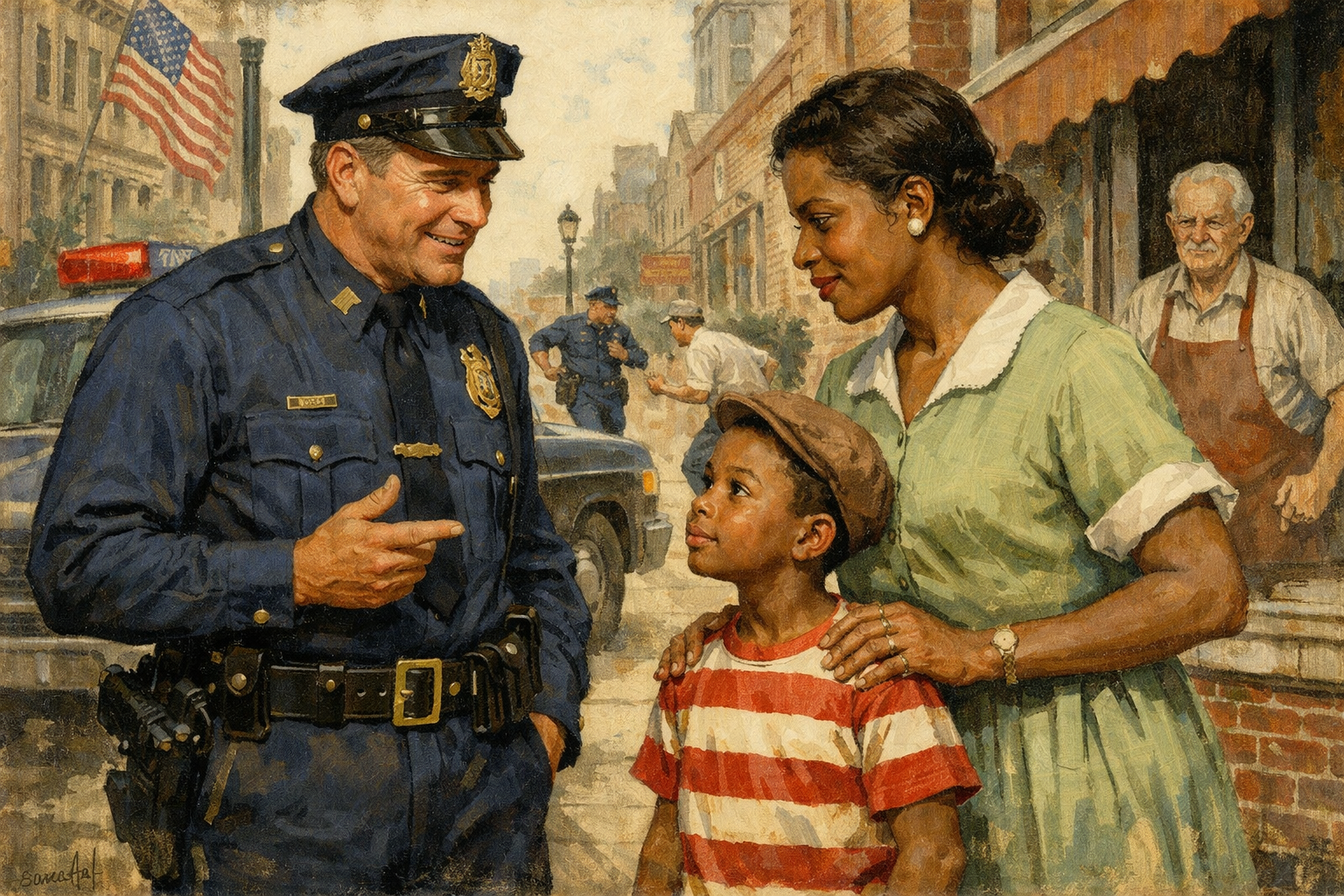
Policing is one of those public issues that touches ordinary Americans far more directly than abstract debates in Washington. Unlike foreign policy or monetary theory, policing is experienced at street level—when a family calls 911, when a business owner locks up at night, when parents decide whether their children can safely walk home from school. For that reason alone, how a nation understands law enforcement, crime, and justice is not a marginal concern. It is foundational to civic life.
In recent years, the issue of policing has been swept into a broader national argument about race, power, and institutional legitimacy. Claims of widespread or “systemic” racism within law enforcement have moved from academic theory into party platforms, corporate boardrooms, school curricula, and federal policy discussions. These claims now function not merely as criticisms of individual misconduct but as indictments of policing as an institution. That shift has enormous implications for public safety, social trust, and governance.
For voters, this debate is not theoretical. It shapes how laws are enforced, how police departments are funded or defunded, how crimes are prosecuted, and whether communities cooperate with or withdraw from law enforcement altogether.
Public Safety and Everyday Consequences
At the most basic level, policing exists to restrain violent behavior and protect innocent life. When that function is weakened, the consequences are measurable and immediate. FBI crime data and Bureau of Justice Statistics reports show that spikes in violent crime disproportionately harm the poor, the elderly, and minority communities—precisely the populations most dependent on effective policing.
Following the 2020 riots and the surge of “defund the police” rhetoric, many major American cities experienced sharp increases in homicide, aggravated assault, and carjacking. Cities such as Chicago, New York, Los Angeles, Minneapolis, and Portland all recorded dramatic rises in violent crime over the subsequent years. These were not abstract statistical shifts; they translated into more victims, unsolved crimes, and neighborhoods effectively abandoned by law enforcement due to staffing shortages or political pressure.
This reality exposes a key tension voters must evaluate: rhetoric about policing may sound compassionate or reform-minded, but policy outcomes determine whether citizens live in safer or more dangerous environments.
Economic Costs of Policing Policies
Policing debates also carry significant economic consequences. Crime imposes direct and indirect costs on society. Businesses leave high-crime areas, shrinking the local tax base. Insurance premiums rise. Property values fall. Emergency medical and judicial systems absorb the downstream effects of violence. Law-abiding residents—often those with the least financial flexibility—are left with fewer opportunities and fewer services.
Conversely, effective policing correlates with economic stability. Cities that maintain order attract investment, sustain employment, and preserve functional public spaces. When police departments are publicly delegitimized or politically constrained, recruitment and retention collapse. Training standards erode. Response times lengthen. All of these outcomes translate into higher costs borne by taxpayers.
From an economic standpoint alone, voters have a rational interest in policies that maintain professional, adequately funded law enforcement while addressing genuine misconduct without dismantling the institution itself.
The Role of Trust in Law Enforcement
Trust is the invisible infrastructure of policing. Police officers cannot function effectively without community cooperation—witnesses willing to speak, victims willing to report crimes, juries willing to convict based on evidence. When law enforcement is portrayed as inherently racist or morally suspect, trust deteriorates. Citizens withdraw. Crime becomes harder to solve. Vigilantism and disorder fill the vacuum.
This erosion of trust is not evenly distributed. Surveys consistently show that minority communities express strong support for police presence when crime rises in their neighborhoods. The disconnect often lies between activist elites and the lived experiences of working-class Americans, including minority families who want both fair treatment and strong protection.
Voters must therefore ask whether political narratives about policing restore trust or corrode it—and who benefits from the resulting disorder.
Claims of Racism and Their Political Weight
The accusation that American policing is systemically racist is among the most serious charges that can be leveled against a civic institution. If true, it would justify radical restructuring. If false or exaggerated, it risks delegitimizing a necessary public function and fueling social division.
This claim has become a central dividing line between the political parties. One side treats disparities in outcomes as proof of racial bias embedded within the system. The other insists that disparities must be analyzed carefully, with attention to crime rates, situational context, and individual behavior rather than assumed racism.
For voters, the stakes are high. Accepting one framework over the other determines whether reform focuses on training and accountability—or whether it escalates toward abolitionist or punitive ideological solutions that undermine public safety.
Why This Issue Has Become Politically Defining
Policing now serves as a proxy for deeper worldview conflicts: views of human nature, responsibility, authority, and justice. It intersects with debates over federalism, constitutional limits, and the proper role of government power. It also reveals how each party understands moral accountability—whether wrongdoing is primarily individual or primarily systemic.
Because of this, policing is no longer merely a law enforcement issue. It is a test case for how America governs itself, how it balances order and liberty, and how it adjudicates claims of injustice.
For the American voter, disengagement is not a neutral position. Policies adopted today shape the safety, stability, and moral character of communities for decades to come.
Articles in the Critical Issues series require more time to read than most content on this site. They are intentionally written as thorough, in-depth examinations of their subjects.
The Republican Position on Policing and Claims of Racism
The Republican approach to policing is rooted in a straightforward conviction: law enforcement is a legitimate, necessary, and morally justified institution whose primary purpose is the protection of life, liberty, and property. While Republicans acknowledge that individual officers—like individuals in any profession—can act wrongly and should be held accountable, they reject the claim that American policing is inherently or systemically racist.
This distinction between individual misconduct and institutional guilt is foundational to the Republican position and sharply differentiates it from the modern Democrat approach.
Core Principles Underlying the Republican View
At its core, the Republican position rests on several assumptions about human nature and governance:
First, Republicans generally hold a constrained view of human nature. People are capable of good and evil, and therefore societies require enforcement mechanisms to restrain wrongdoing. Law enforcement is not an optional feature of a civilized society; it is a prerequisite for one.
Second, Republicans emphasize personal responsibility. Crime is primarily the result of individual choices, not abstract systems. While social conditions can influence behavior, they do not eliminate moral agency.
Third, Republicans affirm equal application of the law. The law should be blind to race, class, and political status. Outcomes may differ across populations, but unequal outcomes do not automatically prove unequal treatment.
These principles explain why Republicans are skeptical of claims that statistical disparities alone demonstrate racism within policing.
The 2024 Republican Party Platform on Policing
The 2024 Republican Party platform explicitly affirms support for law enforcement, public safety, and the rule of law. While platform language evolves from cycle to cycle, Republicans consistently emphasize:
- Support for adequately funded police departments
- Opposition to “defund the police” policies
- Backing for law enforcement officers who act lawfully in the line of duty
- Accountability for criminal behavior by officers without presuming collective guilt
The platform frames public safety as a civil right, particularly for law-abiding citizens living in high-crime neighborhoods. It treats policing not as a tool of oppression but as a safeguard for vulnerable communities.
Where the platform discusses criminal justice reform, it tends to focus on procedural fairness, training improvements, and due process—not ideological restructuring based on racial theories.
Republican Lawmakers and Legislative Positions
Republican members of Congress have repeatedly resisted legislation that assumes systemic racism as a premise. Instead, they favor measures that:
- Increase penalties for violent crime
- Support police recruitment, retention, and training
- Protect officers from politically motivated prosecution when acting within policy
- Strengthen cooperation between federal, state, and local law enforcement
Republicans opposed sweeping federal oversight bills that would impose national standards rooted in ideological assumptions about race and power. They argue that policing is best handled locally, where communities can tailor policies to actual conditions rather than political narratives.
At the same time, Republicans have supported targeted reforms—such as body cameras, clearer use-of-force policies, and independent investigations—when those reforms are evidence-based and do not undermine officer morale or public safety.
Republican State and Local Leadership in Practice
Republican governors and mayors often provide the clearest illustration of how these principles translate into policy.
In Republican-led states, law enforcement budgets have generally been preserved or expanded, even during periods of national unrest. These leaders emphasize rapid response, visible patrols, and deterrence-based policing. When riots or mass unrest occurred in 2020 and afterward, Republican executives were more likely to deploy National Guard units, enforce curfews, and prioritize restoration of order.
This approach contrasts sharply with cities that embraced activist-driven reforms, where police pullbacks often coincided with spikes in violent crime.
Republicans point to these outcomes as empirical evidence that strong policing saves lives, particularly in minority neighborhoods where crime rates are highest.
Republican Rejection of the “Systemic Racism” Narrative
A defining feature of the Republican position is rejection of the claim that policing outcomes are best explained by racial animus. Republicans argue that:
- Crime rates vary by location, not race
- Police deployment follows crime patterns, not skin color
- Most use-of-force incidents are rare and context-dependent
- High-risk encounters increase with violent criminal activity, not racial identity
From this perspective, labeling policing as racist misidentifies the problem and leads to destructive policy solutions. Republicans contend that such narratives discourage proactive policing, lower recruitment standards, and create adversarial relationships between officers and the communities they serve.
They also warn that portraying police as oppressors erodes respect for lawful authority more broadly, weakening social order itself.
Internal Republican Disagreements
While Republicans are broadly unified on opposing defunding and systemic racism claims, there are internal differences worth noting.
Some libertarian-leaning Republicans express concern about excessive force, surveillance, or militarization of police. Their critique is rooted not in racial ideology but in suspicion of government power. Others emphasize strong enforcement above all else, prioritizing order even at the risk of occasional overreach.
Despite these differences, the party remains united on two key points:
- Policing is essential and legitimate.
- Claims of widespread racial bias are unproven and politically dangerous.
These internal debates occur within a shared commitment to public safety and the rule of law, not a rejection of policing itself.
The Democrat Position on Policing and Claims of Racism
The modern Democrat position on policing represents a significant departure from the party’s stance of even two decades ago. While Democrats historically emphasized law enforcement as a necessary public good—particularly during the 1990s crime wave—the contemporary party increasingly frames policing through the lens of racial disparity, power imbalance, and systemic injustice.
Today, policing is often treated not merely as an institution capable of error, but as one whose structure and culture are presumed to produce racially unjust outcomes, regardless of individual intent.
Core Assumptions Underlying the Democrat View
The Democrat approach rests on a set of assumptions that differ sharply from the Republican framework:
First, Democrats tend to emphasize systemic explanations over individual behavior. Disparities in arrest rates, use-of-force incidents, or incarceration outcomes are interpreted as evidence of structural bias rather than differences in crime exposure, neighborhood conditions, or situational risk.
Second, Democrats often adopt an outcomes-based definition of justice. If different racial groups experience different results, the system itself is assumed to be unjust unless those differences are eliminated.
Third, Democrats place strong emphasis on historical grievance. Present-day policing is frequently interpreted as an extension of past injustices—slavery, segregation, and discriminatory laws—creating a moral continuity that casts modern officers as inheritors of historical guilt.
These assumptions explain why claims of systemic racism have become central to Democrat rhetoric, even in the absence of clear evidence of widespread racial animus among individual officers.
The 2024 Democrat Party Platform on Policing
The 2024 Democrat Party platform frames policing within a broader narrative of racial justice and equity. While the platform typically affirms that police play a role in public safety, this affirmation is heavily qualified by language emphasizing reform, oversight, and accountability.
Key themes include:
- Recognition of “systemic racism” in the criminal justice system
- Calls for federal standards governing policing practices
- Support for expanded civilian oversight and DOJ intervention
- Emphasis on reducing police encounters through alternative response models
The platform avoids overt endorsement of “defund the police” language, reflecting political caution after voter backlash. However, it continues to endorse policies that effectively reallocate responsibilities away from traditional law enforcement, such as mental health crisis teams and social service responses.
The tension between rhetorical support for police and policy prescriptions that diminish their authority is a defining feature of the Democrat position.
Democrat Lawmakers and Legislative Initiatives
Democrat members of Congress have introduced and supported legislation premised on the belief that policing suffers from entrenched racial bias. These initiatives typically include:
- National use-of-force standards
- Expanded DOJ consent decrees over local departments
- Restrictions on qualified immunity
- Data collection mandates emphasizing racial metrics
Supporters argue these measures are necessary to curb abuse. Critics counter that they expose officers to legal risk, encourage hesitation in life-threatening situations, and prioritize ideological compliance over practical policing.
Statements by prominent Democrat lawmakers often reinforce the systemic framing. Phrases such as “policing as we know it must be reimagined” or “public safety without police” reflect a conceptual shift: law enforcement is no longer seen as the primary guarantor of safety but as one component among many—sometimes a problematic one.
Democrat State and City Leadership in Practice
The practical effects of Democrat policing philosophy are most visible at the state and municipal level.
In many Democrat-controlled cities, officials responded to activist pressure by reducing police budgets, downsizing departments, or discouraging proactive enforcement. Prosecutors in these jurisdictions often declined to pursue entire categories of offenses, arguing that enforcement itself perpetuated injustice.
The results were widely reported increases in violent crime, slower response times, and reduced clearance rates. In several cities, residents—particularly minority residents—publicly pleaded for greater police presence after experiencing the consequences of pullback policies.
Yet Democrat leaders frequently attributed these outcomes to external factors such as poverty, gun availability, or the pandemic, rather than acknowledging policy misjudgments related to policing.
Internal Divisions Within the Democrat Party
The Democrat coalition is not monolithic on policing.
Moderate Democrats, especially those representing swing districts or crime-affected constituencies, often express discomfort with radical rhetoric. They emphasize reform without abolition and stress the need for police presence.
Progressive Democrats, by contrast, openly embrace narratives that portray policing as fundamentally oppressive. Some advocate outright abolition, replacing police functions with social workers, community mediators, or restorative justice programs.
This divide creates strategic ambiguity. Party leaders often attempt to reassure voters that they support law enforcement while simultaneously appeasing activist factions that demand structural dismantling.
The result is a pattern of carefully worded platform language paired with policies that reflect the priorities of the party’s progressive wing.
Claims of Racism as a Political Tool
A defining feature of the Democrat approach is the moral weight attached to accusations of racism. Once policing is labeled racist at a systemic level, dissent becomes morally suspect rather than merely political.
This dynamic discourages empirical debate. Critics of the narrative are often dismissed as indifferent to injustice or hostile to minority communities, even when they rely on data-driven arguments.
Republicans argue that this framing transforms policing into a political battlefield rather than a public service, incentivizing symbolic gestures over effective crime control.
The Libertarian Position on Policing
The Libertarian position on policing occupies a distinct philosophical lane that partially overlaps with both Republicans and Democrats while fully aligning with neither. Libertarians are not a dominant political force in American governance, but their views are influential in shaping certain arguments—particularly those concerning civil liberties, state power, and the limits of enforcement authority.
For the purposes of this article, the Libertarian position is presented tangentially, as you directed, to help readers understand how its assumptions differ from the two major parties.
Core Libertarian Assumptions About Policing
Libertarianism begins with a deep skepticism toward government power. This skepticism applies to all state institutions, including law enforcement. Unlike Democrats, however, Libertarians do not frame their critique primarily in terms of race. Unlike Republicans, they are less inclined to emphasize order and deterrence as overriding goods.
Three principles shape the Libertarian view:
First, individual liberty is paramount. Any use of state force—even for legitimate ends—is presumed dangerous and must be strictly limited.
Second, the state is seen as prone to abuse, regardless of which party controls it. Police misconduct is interpreted as a symptom of concentrated power rather than racial animus or moral failure unique to officers.
Third, Libertarians emphasize negative rights—freedom from coercion—over positive guarantees like safety or security.
These assumptions lead Libertarians to critique policing from a structural but non-racial perspective.
The Libertarian Party Platform on Policing
The most recent Libertarian Party platform emphasizes restraint, decentralization, and accountability. It typically includes positions such as:
- Opposition to qualified immunity
- Strong protections for due process and civil liberties
- Resistance to surveillance, militarization, and asset forfeiture
- Support for local control rather than federal oversight
Libertarians argue that many policing problems arise because officers are asked to enforce too many laws—particularly victimless crimes related to drugs, licensing, or regulatory compliance.
In this respect, Libertarians sometimes align with Democrats on reducing the scope of policing, though for fundamentally different reasons.
Where Libertarians Align With Republicans
Libertarians often agree with Republicans that:
- Policing is not inherently racist
- Crime cannot be explained solely by systemic oppression
- Order is preferable to chaos
They also tend to reject ideological narratives that portray officers as moral villains or tools of racial domination. Libertarians are typically uncomfortable with collectivist guilt and resist identity-based explanations for social outcomes.
Where Libertarians Align With Democrats
At the same time, Libertarians overlap with Democrats in areas such as:
- Opposition to broad police discretion
- Support for ending qualified immunity
- Concern about excessive force and no-knock raids
- Skepticism toward federal drug enforcement
However, these overlaps are tactical rather than philosophical. Democrats tend to frame these concerns in terms of racial equity and social justice, while Libertarians frame them in terms of individual liberty and state overreach.
Key Differences From Both Parties
The crucial distinction is that Libertarians do not prioritize public safety in the same way Republicans do, nor do they prioritize equity outcomes as Democrats do.
Republicans are willing to accept expanded enforcement authority to preserve order.
Democrats are willing to accept expanded federal power to enforce ideological standards.
Libertarians resist both, even if doing so increases disorder.
This creates a persistent criticism of the Libertarian position: it often underestimates the real-world consequences of reduced enforcement in high-crime environments. Communities experiencing violence rarely view minimal policing as liberation.
Why Libertarians Are Not Central to This Debate
While Libertarian ideas influence public discourse, they rarely translate into governing coalitions capable of implementing policy at scale. Their reluctance to prioritize public safety as a positive good limits their appeal to voters concerned with immediate crime conditions.
For this reason, the Libertarian position is best understood as a theoretical counterpoint, not a practical alternative currently shaping national policing policy.
Progressive Principles and Their Influence on the Democrat Position on Policing
To understand the modern Democrat approach to policing, one must understand the influence of Progressivism (wokeness, Cultural Marxism, political correctness, Neo-Marxism). These terms are not identical, but they point in the same general direction: a worldview that interprets society primarily through power relationships, group identity, and systemic oppression.
This framework did not originate in American policing. It was imported from academic theory and later translated into political activism. Once adopted by the Democrat Party, it reshaped how crime, law enforcement, and justice are conceptualized.
The Progressive Lens: Power Before Behavior
Progressive ideology begins with a fundamental presupposition: society is structured by unequal power relationships, and those inequalities determine outcomes more than individual choices.
Under this lens:
- Police are viewed as agents of state power
- The state is assumed to preserve the interests of dominant groups
- Disparities are presumed to result from oppression, not behavior
This framework treats law enforcement not as a neutral enforcer of rules, but as an instrument of social control—especially over marginalized groups.
Once this assumption is adopted, empirical data becomes secondary. Crime statistics are often dismissed as “contextless” or “biased,” while anecdotal narratives are elevated as representative truths.
Redefining Racism: From Intent to Outcome
One of the most consequential Progressive moves is the redefinition of racism itself.
Traditionally, racism referred to intentional discrimination based on race. Under Progressive thought, racism is redefined as any system that produces unequal outcomes, regardless of intent.
This shift matters enormously for policing. If unequal outcomes are sufficient proof of racism, then policing becomes racist by definition, because crime rates and police interactions are not evenly distributed across populations.
This redefinition removes the need to demonstrate bias, prejudice, or malice on the part of officers. The system is guilty regardless of evidence.
Moral Inversion and Institutional Distrust
Progressive ideology also introduces a form of moral inversion:
- Authority is presumed suspect
- Enforcement is equated with harm
- Constraint is treated as oppression
Under this view, criminals are often framed as victims of circumstance, while police are framed as perpetrators of injustice. Responsibility shifts away from individual wrongdoing and toward abstract systems.
This inversion has predictable effects. Officers become hesitant. Departments struggle to recruit. Proactive policing declines. The very people most vulnerable to crime are left exposed.
How Progressivism Reshaped Democrat Messaging
Once these ideas entered mainstream Democrat discourse, party rhetoric changed noticeably.
Phrases such as “reimagining public safety,” “dismantling oppressive systems,” and “community-based alternatives” reflect a deeper conviction that policing as traditionally practiced is morally compromised.
Even when Democrats insist they “support the police,” that support is typically conditional upon acceptance of Progressive assumptions. Law enforcement is tolerated only insofar as it submits to ideological oversight.
This explains why Democrat leaders often condemn police action reflexively, before investigations are complete, while remaining silent or equivocal about criminal behavior that fits favored narratives.
Why This Framework Persists Despite Evidence
One of the most striking features of Progressive influence is its resistance to falsification.
When crime rises after police pullbacks, the blame is assigned to racism, poverty, or “structural violence.”
When crime falls under stronger enforcement, the explanation is reframed as temporary, coercive, or morally suspect.
Because the framework begins with moral certainty rather than empirical inquiry, outcomes are interpreted to fit the theory rather than challenge it.
This is why debates over policing often feel disconnected from lived experience. The argument is no longer about what works, but about what narratives must be preserved.
The Cost of Ideological Capture
The Progressive transformation of policing has real-world consequences:
- Law enforcement legitimacy erodes
- Public trust fractures along ideological lines
- Crime control becomes politicized
- Ordinary citizens pay the price
Republicans argue that this ideology represents not reform but institutional sabotage, driven by abstract theory rather than practical wisdom.
From this perspective, the Democrat Party’s struggle with policing is not accidental. It is the predictable result of adopting a worldview that treats authority as inherently suspect and order as morally inferior to grievance.
Do Democrat Actions Match Their Official Platform on Policing?
This section must be approached with clarity rather than sentiment, because it tests credibility. Political platforms describe intentions; actions reveal beliefs.
As Senator Joseph P. Kennedy famously observed, “In politics, what you DO is what you believe. Everything else is cottage cheese.” That principle is especially relevant when evaluating Democrat leadership on policing and claims of racism.
The central question is not what Democrats say about public safety, but whether their conduct—legislative, executive, rhetorical, and administrative—matches their stated commitments.
Rhetoric Versus Reality
Official Democrat platform language typically claims to support both public safety and reform. The platform reassures voters that Democrats value law enforcement while also promising to address “systemic inequities.”
In practice, however, Democrat leadership has repeatedly applied different standards to law enforcement than to other institutions, and different standards to favored political groups than to ordinary citizens.
When police act, Democrats frequently assume malice or bias.
When criminals act, Democrats often assume social causation or victimhood.
This asymmetry is not incidental. It reflects Progressive presuppositions discussed earlier, not neutral governance.
The Biden Administration as a Case Study
Under the Biden administration, federal behavior toward policing exposed a sharp divergence between stated moderation and actual priorities.
The Department of Justice aggressively expanded civil rights investigations and consent decrees targeting local police departments, particularly in jurisdictions already struggling with crime. These interventions often imposed costly mandates, reduced officer discretion, and subjected departments to long-term federal oversight.
At the same time, federal officials routinely amplified claims of systemic racism following high-profile incidents—often before investigations were complete. This pattern reinforced public suspicion toward law enforcement while offering little support to officers attempting to manage rising crime.
Despite claims of supporting police funding, federal grants were frequently tied to ideological conditions emphasizing racial equity frameworks rather than measurable crime reduction.
Progressive State and City Governments in Practice
The most revealing evidence comes from Progressive state and municipal governments, where Democrats faced little political resistance.
In states such as California, New York, Illinois, Oregon, Washington, Massachusetts, and Minnesota, lawmakers enacted policies that reduced penalties for crimes, restricted police tactics, and empowered prosecutors who declined enforcement altogether.
Major cities—Portland, Seattle, Los Angeles, San Francisco, Chicago, New York City, Minneapolis, Oakland, and Washington, D.C.—implemented policies that discouraged proactive policing, eliminated specialized units, or signaled that enforcement itself was suspect.
The consequences were consistent:
- Violent crime increased
- Police staffing collapsed
- Response times lengthened
- Clearance rates declined
When residents protested deteriorating safety, Democrat leaders often blamed external factors or doubled down on ideological explanations rather than reversing course.
Unequal Application of Standards
Another revealing inconsistency lies in how Democrats apply moral judgment.
Police are routinely judged by worst-case scenarios. Entire departments are condemned based on isolated incidents. Meanwhile, Progressive-aligned protests that turned violent were often described as “mostly peaceful,” and enforcement was deliberately restrained.
This selective enforcement undermines the claim that Democrats seek equal justice. Instead, justice appears contingent upon political alignment.
When law enforcement enforces laws against favored groups, it is condemned. When it refrains from enforcement in disfavored neighborhoods, the resulting disorder is rationalized.
Authoritarian Tendencies Beneath the Rhetoric
Ironically, while Democrats accuse policing of authoritarianism, their own governance often exhibits soft authoritarianism.
Federal agencies impose ideological compliance through funding mechanisms. Local governments restrict police discretion while expanding bureaucratic oversight. Speech critical of Progressive narratives is labeled harmful or dangerous.
In some jurisdictions, officers who resist ideological training or question policy shifts face discipline—not for misconduct, but for dissent.
This reveals a deeper contradiction: Democrat leadership resists authority it cannot control, while expanding authority it can.
Conclusion of the Evidence
Measured against their own platform language, Democrat leadership fails the consistency test.
They claim to support policing but systematically weaken it.
They claim to value fairness but apply moral judgment selectively.
They claim to oppose authoritarianism while enforcing ideological conformity.
The gap between word and deed is not accidental. It reflects the dominance of Progressive ideology over practical governance.
Examining Republican and Democrat Positions from the Perspective of the Opposition
A serious analysis requires more than partisan assertion. It requires listening to honest criticisms raised by thoughtful opponents and testing whether those criticisms withstand scrutiny. This section examines how Republicans and Democrats are criticized by their opponents on policing and claims of racism—and how each side typically responds.
The goal here is not caricature, but clarity.
Common Criticisms of the Republican Position
Opponents of the Republican approach—primarily Democrats and Progressives—raise several recurring objections.
One frequent criticism is that Republicans “ignore lived experience” by relying too heavily on statistics. Critics argue that crime data fails to capture the fear, humiliation, or historical trauma experienced by minority communities during police encounters.
Another common charge is that Republicans “defend bad policing” by prioritizing officer morale and institutional support over accountability. This critique claims Republicans excuse misconduct in the name of order.
A third accusation is that Republicans are “indifferent to racial disparities,” treating unequal outcomes as morally irrelevant rather than as red flags requiring intervention.
Republican Responses to These Criticisms
Republicans respond first by rejecting the idea that emotion or narrative should override evidence. They argue that public policy must be grounded in measurable reality, not subjective perception. While lived experience matters, it cannot substitute for empirical analysis when lives are at stake.
Second, Republicans distinguish sharply between defending policing as an institution and excusing individual wrongdoing. They support accountability through existing legal mechanisms but oppose collective punishment or ideological presumption of guilt.
Third, Republicans contend that disparities alone cannot establish injustice. They insist that disparities must be explained, not merely asserted, and that explanations must include behavior, crime exposure, and situational risk.
From the Republican perspective, critics confuse compassion with permissiveness—and moral concern with policy competence.
Common Criticisms of the Democrat Position
Republicans and moderates raise several critiques of the Democrat approach.
The most prominent is that Democrats prioritize ideology over public safety. Critics argue that policies inspired by racial theories have predictably increased crime while failing to improve trust or fairness.
Another criticism is that Democrats weaponize accusations of racism to silence debate. Labeling disagreement as moral failure discourages honest discussion and prevents course correction.
A third critique is that Democrats apply inconsistent standards, condemning law enforcement aggressively while minimizing or excusing criminal behavior that fits favored narratives.
Democrat Responses to These Criticisms
Democrats typically respond by reframing outcomes as transitional pains. Crime spikes are described as temporary disruptions caused by broader social forces rather than policing policy.
They also argue that resistance to their reforms proves the depth of systemic bias, reinforcing rather than challenging their assumptions.
When accused of inconsistency, Democrats often appeal to historical injustice, suggesting that extraordinary corrective measures are justified—even if they appear unequal—because of past wrongs.
To critics, this response appears circular: evidence against the theory becomes evidence for it.
Where Honest Interlocutors Agree
Despite sharp disagreement, there are areas where thoughtful voices on both sides converge.
Most agree that policing requires professionalism, training, and clear standards.
Most agree that misconduct should be punished fairly and transparently.
Most agree that trust between police and communities matters.
The disagreement lies not in these goals, but in diagnosis and prescription.
Republicans diagnose the problem as ideological demoralization and under-enforcement.
Democrats diagnose the problem as systemic bias requiring structural overhaul.
These diagnoses lead to radically different policies—and radically different outcomes.
Why These Debates Matter for Voters
For voters, the relevance of these critiques is practical, not academic.
If Republicans are correct, Democrat policies risk sustained disorder and institutional collapse.
If Democrats are correct, Republican policies risk perpetuating injustice under the guise of order.
The task of the voter is to evaluate which explanation best accounts for real-world results.
In recent years, crime trends, public safety outcomes, and community feedback have increasingly favored the Republican diagnosis.
Credible Suspicions About Party Strategies and Motives on Policing
Political parties do not operate in a vacuum. Their public positions often serve broader strategic aims—electoral, ideological, and institutional. While motives cannot be proven with mathematical certainty, credible suspicions arise when rhetoric, incentives, and outcomes align consistently over time.
This section examines reasonable inferences about what each party stands to gain—or risks losing—based on how it frames policing and claims of racism.
Credible Suspicions Regarding the Democrat Party
A growing number of observers suspect that the Democrat Party’s posture on policing serves objectives beyond crime reduction or fairness.
One credible suspicion is electoral coalition maintenance. Progressive activists, academic institutions, nonprofit organizations, and racial grievance groups exert outsized influence within the Democrat coalition. These groups benefit—financially and politically—from a narrative of systemic injustice that requires constant reform, oversight, and funding. Policing, as a visible symbol of authority, becomes an ideal target.
Another suspicion concerns centralization of power. By framing local police departments as morally compromised, Democrats justify expanded federal oversight through the Department of Justice, consent decrees, and national standards. This shifts authority away from locally accountable institutions toward centralized bureaucracies aligned with Progressive ideology.
There is also a reasonable concern that persistent accusations of racism function as a disciplinary tool. Officials, officers, and citizens who dissent risk reputational damage or professional consequences. This discourages opposition and enforces ideological conformity without overt coercion.
Finally, critics suspect a form of managed instability. Rising crime and disorder can be rhetorically leveraged to argue for more social programs, more regulation, and more state intervention—solutions that expand government reach while deflecting responsibility for policy failure.
Democrats deny these motives, insisting their intentions are reformist and compassionate. Yet when outcomes repeatedly contradict promises and policies remain unchanged, skepticism becomes rational.
Credible Suspicions Regarding the Republican Party
Republicans are not immune from suspicion, though the nature of the concerns differs.
Some critics argue Republicans benefit politically from fear-based messaging, emphasizing crime to mobilize voters even when conditions improve. Others claim Republicans may underemphasize legitimate cases of misconduct to avoid alienating law enforcement constituencies.
There is also suspicion that Republicans occasionally resist reform not out of principle, but out of reflexive opposition to Democrat initiatives—fearing that any concession validates Progressive narratives.
However, these suspicions are tempered by observable behavior. Republican-led jurisdictions tend to implement policies consistent with their stated goals: increased enforcement, support for officers, and measurable crime reduction. This alignment between rhetoric and outcome strengthens Republican credibility, even when critics disagree with their priorities.
Comparing Incentives and Outcomes
A useful test of motive is incentive alignment.
Democrat incentives reward expanding narratives of injustice, centralizing oversight, and maintaining activist support—even at the cost of rising crime.
Republican incentives reward visible order, declining crime rates, and institutional stability—even at the risk of being accused of insensitivity.
When incentives align with outcomes, suspicion becomes reasonable. When outcomes contradict stated goals yet policies persist, motive deserves scrutiny.
Why Motives Matter for Voters
Voters are not obligated to accept stated intentions at face value. Democratic governance depends on judging patterns of behavior, not speeches.
If a party claims to want safer communities but implements policies that repeatedly produce disorder, voters must ask why those policies continue.
If another party claims to support justice but insists that justice requires effective enforcement, voters must weigh whether that approach aligns with their lived experience.
Motive analysis is not cynicism. It is prudence.
High-Trust and Low-Trust Societies and the Impact on Policing
Policing cannot be understood in isolation from the broader social environment in which it operates. One of the most useful frameworks for understanding the current American crisis in law enforcement is the distinction between high-trust and low-trust societies.
This distinction helps explain why similar policing policies produce different outcomes in different places—and why ideological attacks on law enforcement are so destabilizing in a society already experiencing declining trust.
What Is a High-Trust Society?
A high-trust society is one in which most citizens assume good faith from institutions and from one another. Laws are generally obeyed. Authority is viewed as legitimate. Enforcement is relatively light because compliance is largely voluntary.
In such societies:
- Police are seen as guardians, not adversaries
- Most encounters are routine and non-confrontational
- Enforcement is predictable and consistent
- Social norms do much of the work that laws otherwise must do
Historically, the United States functioned closer to a high-trust society. Communities cooperated with police. Witnesses came forward. Juries respected evidence. Officers could intervene early without immediate suspicion of malice.
What Is a Low-Trust Society?
Low-trust societies operate very differently. Institutions are assumed corrupt. Authority is viewed as hostile. Citizens comply only when forced—or not at all.
In these environments:
- Policing becomes reactive rather than preventive
- Enforcement requires more force and resources
- Communities withhold cooperation
- Crime becomes harder to solve and easier to commit
Low-trust conditions create a vicious cycle. As trust erodes, enforcement becomes more difficult. As enforcement weakens, disorder increases. As disorder increases, trust collapses further.
How Progressive Policing Narratives Accelerate Trust Collapse
Claims that policing is systemically racist accelerate the transition from high trust to low trust.
When citizens are taught that law enforcement is inherently oppressive, cooperation becomes morally suspect. Reporting crime is reframed as betrayal. Compliance becomes submission. Authority becomes illegitimate.
This is not a neutral cultural shift. It is an intentional reframing that carries predictable consequences.
Republicans argue that Progressive narratives function as trust-destroying mechanisms, regardless of intent. Once trust collapses, no amount of reform can substitute for legitimacy.
Why Republicans and Democrats Interpret Trust Differently
Republicans tend to see trust as a precondition for effective governance. Without trust, order cannot be maintained, markets cannot function, and civil society fractures.
Democrats influenced by Progressive thought often treat distrust as virtuous. Skepticism toward authority is celebrated, even when it undermines public safety. Distrust is interpreted as moral awareness rather than social risk.
This difference explains why Democrats often downplay the importance of legitimacy and emphasize confrontation, exposure, and disruption as tools of reform.
Policing in a Low-Trust Environment
Once a society crosses into low-trust conditions, policing becomes more dangerous and more controversial.
Officers hesitate, fearing accusation. Criminals exploit restraint. Innocent citizens retreat from public spaces. Enforcement becomes uneven, selective, and politicized.
Ironically, this environment produces the very disparities Progressives claim to oppose. When proactive policing disappears, crime concentrates in vulnerable neighborhoods. Victims are abandoned. Outcomes worsen.
Why This Framework Matters for Voters
Voters must ask a simple question: Which party’s approach restores trust, and which one consumes it?
Policies that weaken enforcement while delegitimizing authority do not produce justice. They produce disorder.
A society cannot survive indefinitely without shared assumptions of legitimacy. Once trust is gone, coercion fills the void—and no ideology escapes that reality.
Media Distortion and Misrepresentation of Policing Debates
No discussion of policing and claims of racism can be complete without addressing the role of modern media. For many Americans, media coverage is the primary lens through which they encounter policing incidents. When that lens is distorted, public understanding—and public policy—inevitably follow.
Over the past decade, major media institutions have increasingly abandoned descriptive journalism in favor of narrative enforcement, particularly on issues involving race and law enforcement.
The Pattern of Selective Coverage
One of the most consistent distortions is selective amplification.
Incidents involving police use of force—especially when the suspect is a minority—receive wall-to-wall coverage, often before basic facts are established. Video clips are looped endlessly, stripped of context, and framed to evoke moral outrage.
By contrast, incidents that complicate the preferred narrative—such as justified uses of force, crimes against officers, or minority victims pleading for more policing—receive limited attention or are ignored altogether.
This asymmetry creates a false impression that police misconduct is ubiquitous and representative, rather than rare and context-dependent.
Premature Moral Judgment
Another recurring distortion is preemptive moral verdicts.
Media outlets frequently frame incidents in accusatory terms before investigations conclude. Headlines imply racism or misconduct as fact, even when later evidence contradicts the initial framing. Corrections, when issued, receive minimal visibility.
This practice damages public trust in both policing and journalism. It also pressures political leaders to respond performatively rather than prudently.
Republicans argue that this media behavior incentivizes disorder by portraying enforcement itself as suspect, regardless of legality.
Language Manipulation and Framing
Media outlets also employ subtle but powerful language choices.
Terms like “unarmed” are used without clarifying threat level or situational dynamics. Criminal histories are omitted. Resistance is downplayed. Officer actions are described with emotionally loaded verbs, while suspect actions are softened.
Conversely, riots are reframed as “protests,” looting becomes “property damage,” and enforcement responses are labeled “crackdowns.”
These linguistic choices are not accidental. They reflect ideological commitments that shape audience perception.
Distortion of Party Positions
Media coverage frequently misrepresents Republican and Democrat positions alike—but not equally.
Republican calls for law and order are often portrayed as authoritarian or racially motivated, while Democrat calls for reform are framed as compassionate, even when policies produce harmful outcomes.
When Republicans cite crime statistics, they are accused of dog-whistling. When Democrats cite disparities without context, they are described as addressing injustice.
This double standard discourages honest debate and rewards ideological conformity.
The Consequences of Media Activism
The cumulative effect of these distortions is profound:
- Public fear increases while understanding decreases
- Officers disengage or leave the profession
- Policy becomes reactive and symbolic
- Trust in institutions collapses
Media institutions insist they are holding power accountable. In reality, they often act as participants in the political struggle, not neutral observers.
Why Media Literacy Matters for Voters
Voters must learn to distinguish reporting from advocacy.
When coverage consistently omits context, assigns guilt prematurely, and frames one side as morally suspect by default, skepticism is not cynicism—it is wisdom.
Policing policy shaped by distorted media narratives will always fail, because it responds to fiction rather than reality.
A Biblical Perspective on Policing, Justice, and Authority
A biblical evaluation of policing begins at a different point than modern political ideologies. Scripture does not treat authority, justice, or enforcement as social constructs to be endlessly reimagined. It treats them as necessary features of a fallen world, instituted by God to restrain evil and preserve order.
This perspective cuts across partisan rhetoric and exposes where each political philosophy aligns—or conflicts—with biblical teaching.
Authority as a God-Ordained Institution
The Bible is unambiguous that civil authority is not a human invention alone. Romans 13 teaches that governing authorities are established by God and exist to reward good and punish evil. This does not sanctify every action of every official, but it does establish the legitimacy of enforcement itself.
Policing, as an extension of civil authority, fits squarely within this framework. The officer who restrains violence, apprehends criminals, and protects the innocent is performing a morally legitimate function—even when imperfectly.
This immediately challenges Progressive claims that law enforcement is inherently oppressive. Scripture assumes the necessity of coercive authority in a sinful world. The absence of enforcement is not liberation; it is chaos.
Justice Requires Both Mercy and Restraint
Biblical justice is not defined by equal outcomes but by righteous judgment. Scripture consistently affirms impartiality—judging without regard to wealth, status, or identity—while also recognizing differences in behavior and guilt.
Exodus, Deuteronomy, Proverbs, and the New Testament all emphasize that wrongdoing carries consequences. Compassion toward the poor never excuses violence against the innocent. Mercy does not eliminate accountability.
This biblical balance aligns more closely with the Republican emphasis on law, order, and responsibility than with Democrat frameworks that prioritize outcome parity over moral agency.
The Biblical View of Human Nature
Scripture rejects the notion that people are primarily victims of systems. It teaches that sin originates in the human heart and expresses itself through individual choices. While social structures can encourage or restrain evil, they do not absolve moral responsibility.
This understanding undermines the Progressive tendency to attribute crime primarily to oppression or disparity. It also cautions Republicans against assuming enforcement alone can fix deeper moral decay.
Policing restrains evil; it does not regenerate hearts. That distinction matters.
The Role of the State Versus the Role of the Church
The Bible assigns different responsibilities to different institutions.
The state bears the sword to punish wrongdoing.
The church proclaims the gospel, calls sinners to repentance, and administers discipline within the covenant community.
Families cultivate moral formation.
When these roles are confused, dysfunction follows. Progressive ideology often demands that the state perform pastoral functions—healing trauma, redistributing moral responsibility, redefining justice. This is not the biblical model.
At the same time, Christians should resist the temptation to treat policing as a substitute for discipleship or cultural renewal.
Alignment of Party Positions with the Biblical Worldview
When viewed through a biblical lens, the alignment becomes clearer.
The Republican position, though imperfect and sometimes inconsistent, affirms:
- The legitimacy of authority
- The necessity of enforcement
- The reality of moral agency
- The importance of public order
The Democrat position, especially as shaped by Progressive ideology, increasingly rejects:
- Objective standards of justice
- Individual moral responsibility
- The legitimacy of coercive authority
- Biblical anthropology
Libertarianism, while valuing liberty, often underestimates the biblical role of the state in restraining evil.
For these reasons, biblical Christians will generally align with the Republican position on policing, even while recognizing that no party fully embodies Christian ethics.
Worldview Differences That Drive the Divide
At root, this is a worldview conflict.
Biblical Christianity sees justice as rooted in God’s character.
Progressivism sees justice as constructed through power realignment.
Republicanism retains remnants of a Christian moral framework, even in secular form.
Libertarianism prioritizes freedom but lacks a robust doctrine of authority.
Understanding these differences helps Christians navigate political engagement without confusion or false neutrality.
Encouraging the Reader to Vote Based on Biblical Alignment
For the Christian, voting is not a matter of personal expression or partisan loyalty. It is an exercise of stewardship. When Christians participate in the political process, they do so as moral agents accountable to God for how they use the influence entrusted to them.
This does not mean Scripture provides a checklist for modern policy questions. It does mean that worldview alignment matters, and some positions are more compatible with biblical teaching than others.
Voting as Moral Discernment, Not Moral Perfection
Christians are often tempted to disengage from politics because no candidate or party perfectly reflects biblical ethics. While the concern is understandable, it misunderstands the nature of political choice.
Voting is comparative, not absolute. The question is not whether a party is righteous, but whether its policies better align with biblical principles than the alternatives.
On the issue of policing, the contrast is stark.
One party treats law enforcement as a necessary, God-ordained institution that must be preserved and strengthened.
Another increasingly treats it as morally suspect, structurally unjust, and in need of ideological reengineering.
A Christian cannot pretend these approaches are morally equivalent.
Weighing Issues According to Biblical Priority
Scripture teaches that not all moral issues carry equal weight. Jesus rebuked religious leaders for neglecting “the weightier matters of the law” (Matthew 23:23). Wisdom requires moral ordering.
For example, abortion—the taking of innocent human life—demands greater moral urgency than tax rates or regulatory policy. Similarly, public safety and the restraint of violence carry greater weight than abstract theories of social equity.
A mature Christian voter evaluates candidates holistically, but not equally. Policing matters because it directly affects the protection of life, which Scripture treats as sacred.
Why Biblical Christians Generally Align With Republicans
On policing, the Republican Party remains far more open to biblical participation and influence than the Democrat Party.
Republicans allow Christians to affirm:
- Objective moral standards
- Legitimate authority
- Individual responsibility
- The necessity of law and order
Democrats increasingly require assent to Progressive moral frameworks that contradict biblical teaching on justice, authority, and human nature.
This does not mean every Republican candidate is virtuous, nor that every Democrat voter is hostile to Christianity. It does mean that institutional alignment matters, and one party is structurally more compatible with biblical convictions.
Guarding Against Political Idolatry
At the same time, Christians must resist turning political engagement into a substitute for discipleship or evangelism.
No election will redeem a nation. No policy will regenerate hearts. Policing can restrain evil, but it cannot produce righteousness.
Christians vote not because politics saves, but because obedience matters—even in limited, imperfect arenas.
Encouragement to Act With Clarity and Courage
The pressure to remain silent or neutral on controversial issues is intense. Christians are often told that public moral reasoning is inappropriate or divisive.
Scripture teaches otherwise. God’s people are called to speak truth, pursue justice, and seek the welfare of their communities.
Voting for candidates who respect law enforcement and reject destructive ideologies is one concrete way Christians can act faithfully in the public square.
The Christian’s Duty to Seek the Welfare of the Nation
Scripture does not permit Christians to retreat into private spirituality while ignoring the condition of the society in which they live. While the kingdom of God is not of this world, Christians are nonetheless commanded to live faithfully within it.
The Bible presents civic responsibility not as political activism, but as an extension of neighbor love.
Seeking the Welfare of the City
In Jeremiah 29:7, God commands His people to “seek the welfare of the city where I have sent you into exile, and pray to the LORD on its behalf.” This instruction was given to a people living under pagan rule, not a friendly or godly regime.
The principle is clear: God’s people are to care about the moral and practical health of their nation, even when its leaders are flawed.
Policing directly affects that welfare. A society unable or unwilling to restrain violence cannot flourish. Families suffer, commerce falters, and fear replaces trust. Seeking the good of the nation therefore includes supporting policies that preserve order and protect life.
Responsible Voting as One Means—Not the Only Means
Voting is one legitimate means by which Christians can seek the welfare of their nation. It allows citizens to influence who holds authority and how that authority is exercised.
However, voting is not the only means, nor is it the most important. Christians also serve their nation by:
- Praying for rulers and authorities (1 Timothy 2:1–2)
- Teaching truth within their families and churches
- Practicing charity and mercy locally
- Modeling obedience to law and respect for authority
Voting must never replace these responsibilities, but it can complement them.
Christian Liberty and the Question of Voting
Scripture also recognizes matters of conscience.
Some Christians believe participation in voting violates their conscience. Romans 14 affirms that believers may differ on such matters without condemnation, provided they act in faith and not out of fear or coercion.
A Christian who abstains from voting out of sincere conviction is not disobedient. Nor should such believers be shamed or pressured.
At the same time, those who do vote should do so thoughtfully, prayerfully, and with moral clarity.
Obedience Without Naivety
Seeking the welfare of the nation does not mean trusting political leaders uncritically. Scripture warns repeatedly against placing hope in princes.
Christians engage politically without illusion. They recognize corruption, ambition, and misuse of power as perennial realities. This realism makes biblical political engagement sober rather than utopian.
Supporting law enforcement, for example, does not mean excusing wrongdoing. It means affirming the institution while insisting on justice.
A Balanced Civic Faithfulness
The Christian approach avoids two errors:
Withdrawal, which abandons the public square to destructive ideologies.
Idolatry, which treats politics as salvific.
Between these extremes lies faithful engagement—grounded in truth, guided by Scripture, and oriented toward the common good.
Key Takeaways and Concluding Remarks
After examining policing and claims of racism from historical, political, ideological, and biblical perspectives, several conclusions emerge with clarity. While reasonable people may disagree on tactics or emphasis, the core dividing lines are not subtle. They are rooted in fundamentally different understandings of justice, authority, and human nature.
Republican Position: Order, Legitimacy, and Moral Agency
The Republican position affirms that:
- Policing is a necessary and legitimate institution in a fallen world
- Law enforcement protects the most vulnerable citizens
- Disparities do not automatically prove discrimination
- Individual moral responsibility matters
- Public safety is a civil right
Republicans generally resist ideological narratives that portray police as inherently racist and oppose reforms that weaken enforcement or demoralize officers. Their approach prioritizes deterrence, order, and the rule of law, while allowing for accountability through existing legal mechanisms.
This position aligns more closely with biblical teaching on authority and justice, even when imperfectly applied.
Democrat Position: Systemic Suspicion and Ideological Reform
The modern Democrat position increasingly holds that:
- Policing is structurally compromised by systemic racism
- Unequal outcomes are evidence of injustice
- Authority should be constrained through oversight and reengineering
- Enforcement itself often causes harm
While Democrats insist they support public safety, their policies frequently undermine it in practice. Progressive ideology has reshaped the party’s approach, producing inconsistent standards, ideological enforcement, and measurable declines in public safety in many jurisdictions.
The result is a widening gap between rhetoric and outcome.
Libertarian Position: Liberty Over Order
Libertarians emphasize:
- Skepticism of state power
- Individual liberty over collective security
- Reduction of policing scope
While their concerns about overreach are not without merit, their framework underestimates the biblical role of civil authority and the real-world consequences of diminished enforcement. As such, libertarianism remains a peripheral influence rather than a governing solution.
The Biblical Perspective: Justice Rooted in God’s Order
Scripture affirms:
- The legitimacy of civil authority (Romans 13)
- The necessity of restraint against evil
- Impartial justice based on truth, not outcomes
- Moral responsibility at the individual level
From this perspective, policing is not optional, nor is it inherently unjust. While reform and accountability are appropriate, dismantling or delegitimizing law enforcement contradicts biblical wisdom.
Biblical Christians will therefore find themselves aligned primarily with the Republican position, not because the party is righteous, but because it remains more compatible with biblical anthropology, justice, and authority.
Final Reflections for the Reader
The debate over policing is not merely about tactics. It is about whether America will remain a society governed by law or drift into one governed by grievance and ideology.
When trust collapses, enforcement weakens.
When enforcement weakens, disorder rises.
When disorder rises, the innocent suffer first.
A society that cannot defend order cannot preserve liberty.
For voters—especially Christian voters—clarity on this issue is not optional. It is an obligation of stewardship.
S.D.G.,
Robert Sparkman
rob@christiannewsjunkie.com
RELATED CONTENT
Party platforms
If you want to read the party platforms yourself, here are the links:
Republican Party 2024 Platform
Concerning the Related Content section, I encourage everyone to evaluate the content carefully.
If I have listed the content, I think it is worthwhile viewing to educate yourself on the topic, but it may contain coarse language or some opinions I don’t agree with.
I use words that reflect the “woke” culture and their re-definitions sometimes. It is hard to communicate effectively without using their twisted vocabulary. Rest assured that I do not believe gender ideology or “Progressivism”. Words and phrases like “trans man”, “trans women” , “transgender”, “transition” or similar words and phrases are nonsensical and reflect a distorted, imaginary worldview where men can become women and vice-versa. The word “Progressive” itself is a propagandistic word that implies the Progressives are the positive force in society, whereas in reality their cultic belief system is very corrosive to mankind.
Feel free to offer your comments below. Respectful comments without expletives and personal attacks will be posted and I will respond to them.
Comments are closed after sixty days due to spamming issues from internet bots. You can always send me an email at rob@christiannewsjunkie.com if you want to comment on something afterwards, though.
I will continue to add videos and other items to the Related Content section as opportunities present themselves.