
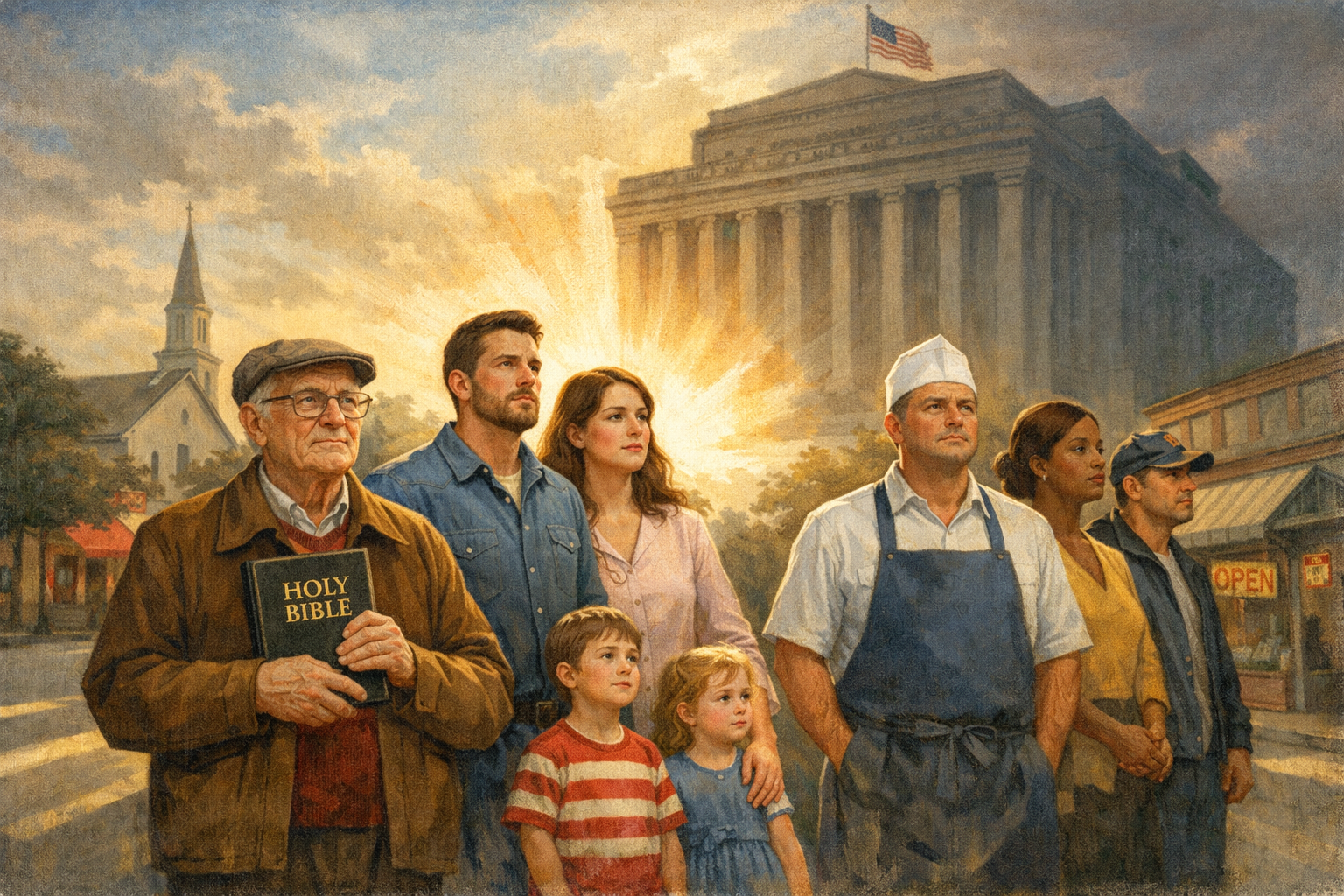
Religious liberty is not a side issue in American life.
It is one of the load-bearing pillars of the constitutional order, and when it weakens, the entire structure of a free society begins to creak.
The Founders did not treat religious freedom as a hobby right or a private eccentricity. They treated it as a pre-political right—something that exists before government and therefore something government must respect rather than grant.
At its most basic level, religious liberty means the freedom to live consistently with one’s deepest convictions about God, truth, and moral obligation—without fear of punishment, exclusion, or coercion by the state. That includes freedom of belief, freedom of worship, freedom of speech, freedom of association, and freedom to order one’s family, business, and conscience accordingly. When religious liberty is secure, pluralism flourishes peacefully. When it is undermined, the state begins to decide which beliefs are acceptable and which must be suppressed.
For American voters, this issue matters because it affects everyday life far more than many realize.
Religious liberty determines whether parents retain authority over their children’s moral formation, whether churches may preach unpopular doctrines without legal retaliation, whether business owners may operate according to conscience, whether counselors may speak honestly to those seeking help, and whether peaceful protest is protected equally under the law.
Why Americans Should Care Now
In recent years, religious liberty has moved from a theoretical concern to a lived controversy.
The Biden administration years (2021–2024) marked a sharp escalation in conflicts between the federal government and religious Americans—particularly Christians with traditional views on life, marriage, and sexuality. The selective enforcement of the federal FACE Act against pro-life Christians, including elderly individuals and parents with minor children, was not hypothetical. It was documented, prosecuted, and defended by the Department of Justice.
By contrast, since returning to office in 2025, President Donald Trump has issued pardons and commutations for many individuals imprisoned or charged under these FACE prosecutions, arguing that the law had been weaponized to punish peaceful religious expression while ignoring violent attacks on churches and pregnancy resource centers. Whether one supports Trump politically or not, the contrast between these two administrations underscores why religious liberty is not an abstract concern—it rises or falls based on who governs and how power is exercised.
Polling consistently shows that Americans remain concerned about threats to free speech, parental rights, and religious freedom, even when they disagree about specific applications. Surveys from Pew Research and Gallup over the last decade reveal a growing perception—especially among religious Americans—that expressing traditional Christian beliefs now carries social and legal risk. This perception is not paranoia; it reflects observable patterns in litigation, employment disputes, school policies, and federal enforcement priorities.
Economic Consequences of Religious Liberty Conflicts
Religious liberty also has economic implications. Small business owners—particularly bakers, florists, photographers, and venue operators—have faced years of litigation, fines, and forced closures for declining to participate in events that violate their religious convictions. These cases are often framed misleadingly as “discrimination,” but at their core they involve compelled speech and coerced participation.
The economic burden is not limited to the defendants. Prolonged lawsuits drain public resources, clog courts, and chill entrepreneurship. When the state signals that religious conviction is a liability rather than a protected right, risk-averse individuals choose silence, exit certain professions, or withdraw from public engagement altogether. Over time, this erodes civic trust and weakens the diversity of civil society institutions that historically reduced dependence on government.
Churches, religious schools, and faith-based charities also face uncertainty. Regulatory pressure related to accreditation, licensing, zoning, and employment standards increasingly tests whether religious organizations may operate according to their stated beliefs. When the rules change unpredictably, institutions that serve millions—often at lower cost and with better outcomes than government programs—are destabilized.
Public Safety and Social Stability
Religious liberty contributes directly to public safety and social stability. Historically, churches and faith-based organizations have played a critical role in education, poverty relief, addiction recovery, family stability, and moral formation. When religious institutions are marginalized or driven from public life, the vacuum is not filled by neutral alternatives. It is filled by state bureaucracies and ideological programs that often lack accountability and moral consensus.
The selective enforcement of laws undermines respect for the rule of law itself. When peaceful pro-life protesters are aggressively prosecuted while violent attacks on churches go unresolved, citizens reasonably conclude that justice is being applied unevenly. That perception fuels cynicism, resentment, and disengagement—conditions hostile to a stable republic.
History offers repeated warnings. Societies that allow the state to redefine conscience eventually discover that no belief is safe once political power becomes the ultimate moral authority. America’s early commitment to religious liberty was not naïve optimism; it was hard-earned wisdom drawn from Europe’s religious wars and state-controlled churches.
Religious Liberty as a Voting Issue
For voters, religious liberty functions as a diagnostic issue. It reveals how a party understands power, human nature, and the limits of government. A political movement that respects religious liberty generally recognizes that the state is not God and that citizens possess duties higher than political obedience. A movement that treats religious conviction as a problem to be managed or eliminated reveals an unconstrained vision of authority—one that assumes moral superiority and demands compliance.
This is why religious liberty cannot be compartmentalized as merely a “culture war” concern. It touches education, healthcare, business, family life, free speech, and the criminal justice system. It determines whether pluralism is genuine or merely tolerated until dissent becomes inconvenient.
In the sections that follow, this article will examine how the Republican Party, the Democrat Party, Libertarians, and Progressive ideology approach religious liberty; whether rhetoric matches reality; how media framing distorts public understanding; and how biblical Christians should evaluate these issues when voting and engaging civic life.
This is not a call for panic, nor is it an exercise in nostalgia. It is a sober assessment of where the nation stands—and where it may be headed—when one of its first freedoms is treated as optional.
Articles in the Critical Issues series require more time to read than most content on this site. They are intentionally written as thorough, in-depth examinations of their subjects.
The Republican Perspective on Religious Liberty
From the modern Republican perspective, religious liberty is not merely one civil liberty among many, but a foundational freedom that safeguards all others. Republicans generally argue that if the state can coerce conscience—especially religious conscience—it can eventually coerce speech, association, and even thought. This view places religious liberty near the top of the party’s hierarchy of rights, particularly in contrast to newer claims of rights rooted in personal identity or subjective self-definition.
Core Republican Principles on Religious Liberty
The 2024 Republican Party platform explicitly affirms the First Amendment’s Free Exercise Clause and rejects government actions that penalize individuals or institutions for acting in accordance with their religious beliefs (2024 GOP Platform, sections on Constitutional Rights, Religious Freedom, and Parental Rights). The platform frames religious liberty as both an individual and institutional right—meaning churches, schools, charities, and businesses are entitled to operate according to their faith commitments without government retaliation.
Republicans consistently emphasize three related principles:
- Free exercise over compelled compliance – The state may not force citizens to affirm, celebrate, or materially support beliefs that violate their conscience.
- Viewpoint neutrality – Laws must be enforced evenly, not selectively against disfavored religious or moral positions.
- Parental authority – Parents, not the state, bear primary responsibility for the moral and religious upbringing of children.
These principles are frequently invoked in debates over abortion protests, same-sex wedding services, counseling practices, and public education.
The FACE Act and Selective Enforcement
A central Republican critique of the Biden administration involved the enforcement of the federal Freedom of Access to Clinic Entrances (FACE) Act. While the law was originally passed in 1994 to address violent obstruction of abortion facilities, Republicans argue that it was repurposed between 2021 and 2024 to target peaceful pro-life Christians—many of whom were elderly, nonviolent, and engaged in prayer or quiet protest.
Republican lawmakers repeatedly noted that during the same period, dozens of churches and pregnancy resource centers were vandalized or firebombed following the Dobbs decision, with few arrests and minimal federal response. This disparity became a talking point in congressional hearings and DOJ oversight efforts, where Republican members questioned whether enforcement priorities reflected ideological bias rather than neutral application of the law.
The case of Mark Houck became emblematic. Houck, a Catholic father of seven, was arrested in a highly publicized early-morning FBI raid at his home over a minor physical altercation outside an abortion clinic—despite local authorities declining prosecution and despite the incident involving no clinic access obstruction. Republican lawmakers cited the raid as evidence of intimidation tactics inconsistent with proportional justice, especially when directed at religious families.
Following his return to office in 2025, President Trump issued pardons and sentence commutations for several individuals convicted under these FACE prosecutions. Republicans defended these actions as corrective measures aimed at restoring equal justice and signaling that peaceful religious expression should not be criminalized.
Another striking FACE Act prosecution during the Biden administration involved Eva Edl, an elderly pro-life activist and survivor of a Nazi concentration camp.
Her case became emblematic of the federal government’s aggressive posture toward peaceful Christian protesters—and of the moral blindness that can accompany ideologically driven enforcement.
Eva Edl was born in Yugoslavia in 1933 and survived imprisonment in a Nazi concentration camp as a child during World War II. She later immigrated to the United States, where she became a committed Christian and long-time advocate for the unborn. By the time of her prosecution, Edl was in her late 80s, physically frail, and suffering from serious health problems.
Edl participated in a peaceful pro-life protest outside a Michigan abortion facility as part of a group that included several other older Christians. The protest involved prayer, singing hymns, and verbal appeals intended to persuade women not to undergo abortions.
There was no allegation of violence, vandalism, or physical harm to any person.
Federal prosecutors nevertheless charged Edl and several others under the Freedom of Access to Clinic Entrances (FACE) Act, alleging that their presence obstructed access to the facility. The case was brought by the U.S. Department of Justice during the Biden administration, reflecting a broader pattern of selective enforcement against pro-life Christians during that period.
Edl was convicted and faced sentencing in federal court before Judge Colleen Kollar-Kotelly, a Clinton appointee. During sentencing, Edl’s attorneys and supporters appealed to the court for mercy, citing her advanced age, deteriorating health, and extraordinary life history—including her survival of Nazi imprisonment.
The request was not for exoneration, but for leniency: alternatives to incarceration such as home confinement or time served.
Judge Kollar-Kotelly explicitly rejected those appeals. In denying mercy, the judge made clear that Edl’s age, health condition, and personal history would not mitigate the sentence. The court emphasized that deterrence and uniform application of the law outweighed considerations of compassion, even in the case of a sickly, elderly woman.
Edl was ultimately sentenced to jail time, becoming one of the oldest individuals imprisoned under the FACE Act.
The image of an elderly Holocaust survivor—once imprisoned by an authoritarian regime—being jailed by the United States government for peaceful prayer outside an abortion clinic shocked many Americans. To critics, the case illustrated how far the federal government had drifted from proportional justice and equal application of the law.
The Edl case stood in stark contrast to the federal government’s minimal response to firebombings and vandalism of churches and pregnancy resource centers following the Dobbs decision. That contrast reinforced the perception that FACE Act enforcement during the Biden years was not neutral, but ideological.
After Donald Trump returned to office in 2025, cases like Edl’s were repeatedly cited by supporters of his decision to pardon or commute sentences for individuals convicted under what he described as a weaponized enforcement regime.
The Eva Edl case is not merely about abortion politics. It raises deeper questions about:
- Proportionality in sentencing
- Selective enforcement of federal law
- The erosion of mercy in the justice system
- Whether religious conviction is being treated as an aggravating factor rather than a protected right
For many Americans, the jailing of a frail, elderly concentration-camp survivor for peaceful prayer marked a moral line crossed—one that clarified how religious liberty can be quietly suffocated without ever being formally abolished.
Religious Liberty in Business and the Marketplace
Republicans also strongly defend the rights of religious business owners, particularly in cases involving same-sex weddings and expressive services. From the GOP perspective, forcing a baker, florist, or photographer to create custom expressive content for an event they believe is morally wrong constitutes compelled speech, not mere regulation of commerce.
Republican officials often point to Supreme Court decisions affirming that the government cannot compel speech or punish individuals for holding traditional beliefs about marriage. They argue that anti-discrimination laws were never intended to function as ideological loyalty oaths, and that using them as such undermines pluralism.
State-level Republican leaders have responded by passing Religious Freedom Restoration Acts (RFRAs) or strengthening conscience protections for small businesses, healthcare workers, and adoption agencies. These measures are framed not as licenses to discriminate, but as safeguards against government overreach.
Counseling, Healthcare, and Conscience Protections
Another area of concern for Republicans is the increasing pressure on Christian counselors, therapists, and medical professionals to affirm behaviors or identities that conflict with their beliefs. Republican lawmakers argue that banning non-affirming counseling—particularly when sought voluntarily—violates both free speech and free exercise protections.
At the federal level, Republicans have opposed attempts to condition funding, licensing, or accreditation on ideological compliance related to gender identity. At the state level, Republican-led legislatures have passed laws protecting medical professionals from being forced to perform procedures or provide referrals that violate their conscience.
These positions reflect a broader Republican concern: once the state claims authority to define moral truth in matters of sexuality and identity, dissenting religious views are reclassified as harm rather than disagreement.
Education and Parental Rights
Republicans increasingly link religious liberty with parental rights in education. They argue that public schools have moved beyond neutral instruction into active moral formation—particularly regarding gender ideology—often without parental knowledge or consent.
Republican governors and legislators have responded with policies requiring parental notification, curriculum transparency, and opt-out provisions. These measures are defended as extensions of religious liberty, recognizing that parents have a constitutional right to direct their children’s moral and religious upbringing.
Internal disagreements do exist within the Republican Party, particularly between libertarian-leaning Republicans who prioritize minimal government involvement and social conservatives who support proactive legal protections. However, both factions generally agree that the state must not punish religious belief or compel ideological conformity.
Summary of the Republican Position
In sum, the Republican position on religious liberty emphasizes:
- Strong protection for free exercise, even when beliefs are unpopular.
- Opposition to selective or ideologically driven law enforcement.
- Robust conscience protections in business, healthcare, counseling, and education.
- Recognition of religious institutions as essential contributors to civil society.
- Resistance to government efforts to redefine moral norms through coercion.
For Republicans, religious liberty is not nostalgia for a bygone era. It is a practical necessity for maintaining a free, diverse, and stable society where citizens are governed by law—not by the shifting moral preferences of those in power.
The Democrat Perspective on Religious Liberty
The modern Democrat Party affirms religious liberty in principle, but increasingly redefines it in practice. While official rhetoric continues to reference the First Amendment and freedom of worship, the party’s governing approach has narrowed religious liberty to the private sphere—belief and internal worship—while treating public expression of religious conviction as subordinate to other policy priorities, particularly those related to sexual identity, abortion access, and anti-discrimination frameworks.
This shift is not always stated plainly, but it becomes evident when examining platform language, legislative priorities, enforcement patterns, and public statements by Democrat leaders.
How Democrats Frame Religious Liberty
The 2024 Democrat Party platform references religious freedom primarily in the context of protecting individuals from discrimination and ensuring access to healthcare, reproductive services, and public accommodations. Religious liberty is framed less as a fundamental right with broad protections and more as a personal preference that must not “harm” others or interfere with newly defined civil rights (2024 Democrat Platform, sections on Civil Rights, LGBTQ+ Equality, Reproductive Freedom, and Healthcare).
In practical terms, this means religious liberty is often treated as:
- A private belief, not a public guiding principle
- Secondary to anti-discrimination claims, especially those tied to sexual orientation and gender identity
- Acceptable only when it aligns with Progressive policy outcomes
Democrat leaders frequently insist they support religious liberty “for everyone,” but then qualify that support with language asserting that religious beliefs cannot be used to “deny services,” “cause harm,” or “impose beliefs”—terms that are left deliberately vague and expansive.
Abortion, the FACE Act, and Enforcement Priorities
Nowhere is the Democrat approach clearer than in abortion policy. The party’s platform explicitly elevates abortion access as a fundamental right and treats opposition as a threat to women’s autonomy and public safety. Within this framework, pro-life religious protest is often viewed not as protected speech, but as obstruction or intimidation.
During the Biden administration (2021–2024), the Department of Justice pursued FACE Act prosecutions almost exclusively against pro-life Christians, many of whom were peaceful demonstrators engaged in prayer, counseling, or sidewalk advocacy. Some defendants were elderly; others were parents of young children. Democrats defended these prosecutions as necessary to protect clinic access, even as violent attacks on churches and pregnancy centers went largely unaddressed at the federal level.
Democrat lawmakers routinely dismissed concerns about selective enforcement, framing objections as misinformation or partisan exaggeration. The moral seriousness of imprisoning nonviolent religious protesters was rarely acknowledged, and calls for proportionality were treated as hostility to women’s rights.
This pattern reflects a deeper assumption: when religious conviction conflicts with abortion policy, religious liberty yields.
Same-Sex Marriage, Business Owners, and Compelled Speech
On issues involving same-sex marriage and expressive services, Democrats overwhelmingly side with enforcement of anti-discrimination laws—even when doing so compels speech or participation. The dominant Democrat view is that once a business opens its doors to the public, religious conscience becomes irrelevant.
Democrat officials often reject the distinction between refusing service to a person and refusing participation in an event. This rhetorical move allows them to portray religious objectors as bigots rather than conscientious dissenters. As a result, Christian bakers, florists, and photographers are framed not as citizens exercising constitutional rights, but as obstacles to social progress.
The party’s leadership has shown little interest in crafting exemptions or conscience protections, arguing instead that equality demands uniform compliance. In effect, religious liberty is reinterpreted as a freedom that must never inconvenience Progressive social goals.
Counseling, Gender Ideology, and State Authority
Democrats also support restrictions on counseling practices that do not affirm Progressive views of sexuality and gender. Laws banning so-called “conversion therapy” are often written broadly enough to prohibit any counseling that questions or discourages gender transition—even when such counseling is sought voluntarily and grounded in religious conviction.
From the Democrat perspective, affirming identity claims is framed as a public health necessity, while dissenting religious views are characterized as harmful. This reframing places the state in the role of moral arbiter, empowered to determine which beliefs are acceptable and which must be silenced.
Similarly, Democrat leaders generally oppose conscience protections for medical professionals who decline to participate in procedures related to abortion or gender transition. The argument is consistent: access must be guaranteed, and individual objections must yield.
Education and the State’s Role in Moral Formation
Democrats strongly support expansive state involvement in education, including the integration of gender ideology into public school curricula. Resistance from religious parents is often dismissed as fear-driven or intolerant.
The prevailing Democrat view holds that schools must affirm students’ identities—even over parental objection—and that withholding information from parents may be justified to protect children from “unsupportive” households. In this framework, parental authority rooted in religious belief is increasingly treated as suspect.
Democrat governors, school boards, and education departments have defended policies that restrict parental notification and limit opt-out provisions, arguing that children possess autonomous rights that override family and religious structures.
Internal Democrat Disagreements
There are internal tensions within the Democrat Party, particularly between older liberals who once championed robust free speech and younger Progressive activists who prioritize identity-based protections. Some Democrats express discomfort with aggressive enforcement tactics or censorship, but these voices are increasingly marginalized.
The dominant faction within the party views religious liberty through a utilitarian lens: it is protected insofar as it does not conflict with Progressive moral priorities. When it does conflict, it is reclassified as discrimination, harm, or extremism.
Summary of the Democrat Position
In practice, the Democrat approach to religious liberty reflects the following assumptions:
- Religious belief is acceptable privately but dangerous publicly.
- The state must resolve moral disputes in favor of Progressive definitions of harm and equality.
- Conscience protections are subordinate to identity-based rights.
- Parental authority yields to state-defined child welfare.
- Enforcement disparities are justified by moral urgency.
This vision does not abolish religious liberty outright. Instead, it narrows it steadily—until it exists largely on paper, while real-world application is constrained by ideological boundaries set by those in power.
The Libertarian Perspective on Religious Liberty
The Libertarian approach to religious liberty is shaped less by theological conviction and more by a philosophical commitment to individual autonomy and minimal government interference. While Libertarians are not a dominant force in American electoral politics, their views often influence debates within both major parties—especially on issues involving free speech, conscience, and state power.
Because this article focuses primarily on the Republican and Democrat positions, the Libertarian perspective is presented here only tangentially, as a point of contrast rather than a governing alternative.
Core Libertarian Commitments
The Libertarian Party’s most recent national platform strongly affirms freedom of religion, freedom of speech, and freedom of association, grounding these rights in self-ownership and voluntary consent rather than divine authority or natural law. From the Libertarian perspective, religious liberty exists because individuals own themselves and therefore cannot be compelled to believe, speak, or act against their will.
Libertarians generally argue that:
- The state has no legitimate role in regulating belief or expression.
- Government should neither privilege nor penalize religious viewpoints.
- Disputes over morality should be resolved through voluntary association and market choices, not legislation.
This results in a broad rhetorical defense of religious liberty that often overlaps with Republican arguments—especially when opposing censorship, compelled speech, or intrusive enforcement.
Areas of Alignment with Republicans
On several high-profile issues, Libertarians align more closely with Republicans than Democrats. Libertarians tend to oppose:
- Selective enforcement of laws such as the FACE Act.
- Government mandates compelling expressive participation.
- Licensing regimes that punish dissenting counselors or medical professionals.
- State intrusion into parental decision-making.
Libertarians are often vocal critics of bureaucratic overreach, warning that once government claims authority to define acceptable beliefs, liberty for all is endangered.
Points of Divergence from Republicans
Despite this overlap, Libertarians diverge sharply from Republicans in their underlying justifications and long-term implications.
First, Libertarians typically reject the idea that religious liberty is rooted in objective moral order or divine authority. This makes their defense of religious freedom contingent rather than principled. If personal autonomy is the highest good, then religious liberty survives only so long as it does not conflict with another individual’s claimed autonomy.
Second, Libertarians often oppose religious exemptions when they believe such exemptions interfere with market neutrality. For example, some Libertarians argue that businesses refusing services for religious reasons should simply accept market consequences—without legal protections or exemptions.
Third, Libertarians are divided on abortion and family policy. While some defend unborn life on non-aggression grounds, others prioritize bodily autonomy, creating inconsistency in their application of liberty principles.
Education, Family, and the State
Libertarians generally oppose government-run education altogether, advocating for private schooling, homeschooling, or voucher systems. In this sense, they may appear supportive of parental rights. However, this support is grounded in opposition to state involvement rather than affirmation of parental moral authority.
Libertarians are less likely to engage questions of moral formation or cultural transmission, treating these as personal matters rather than social responsibilities. This limits their ability to address the broader cultural consequences of eroding religious liberty.
Strengths and Limitations of the Libertarian Position
The Libertarian perspective contributes valuable warnings about state power, regulatory creep, and enforcement abuse. Their skepticism toward centralized authority aligns with historical concerns about tyranny and conscience coercion.
However, their framework lacks a durable foundation for defending religious liberty when cultural or political pressures shift. Without an appeal to transcendent moral limits on government, liberty becomes negotiable—subject to reinterpretation as social priorities evolve.
Summary of the Libertarian Perspective
In brief, Libertarians:
- Offer a strong procedural defense of religious liberty.
- Often align with Republicans against Progressive coercion.
- Lack a theological or moral grounding that secures liberty long-term.
- Remain a minor political force with limited policy influence.
Their contribution to the religious liberty debate is real but secondary. The central contest in American politics remains between a vision that recognizes limits on state power grounded in moral reality, and one that treats liberty as conditional upon ideological conformity.
Progressive Principles and Their Influence on Religious Liberty
To understand the modern Democrat position on religious liberty, it is necessary to examine the influence of Progressivism (wokeness, Cultural Marxism, political correctness, identity politics, critical theory/intersectionality, Neo-Marxism). These terms are not identical, but they point to a shared set of assumptions that increasingly shape policy, rhetoric, and enforcement priorities on the left. This section is not offered as caricature, but as an attempt to identify the governing ideas that explain why religious liberty is treated the way it is today.
The Progressive Moral Framework
Progressivism begins with a fundamentally different understanding of moral authority. Rather than viewing moral truth as grounded in God, nature, or enduring tradition, Progressive thought treats morality as socially constructed and historically contingent. What matters most is not whether an action conforms to transcendent truth, but whether it advances equity, inclusion, and the redistribution of power among social groups.
In this framework, religion—particularly orthodox Christianity—is not merely another worldview competing in the public square. It is often seen as a carrier of historical oppression. Traditional Christian teachings on sexuality, marriage, gender, and the sanctity of life are interpreted through the lens of power rather than truth. As a result, religious conviction is recast as a threat rather than a protected good.
This explains why Progressives often insist they support “freedom of worship” while simultaneously restricting religious conduct in public life. Worship is tolerated as a private ritual; obedience to religious conscience in public action is treated as suspect.
Reframing Harm and Redefining Rights
A central Progressive move is the redefinition of harm. Under this paradigm, emotional distress, offense, or disagreement with someone’s identity claims can qualify as harm. Once harm is defined this broadly, religious liberty becomes easily overridden.
For example, a Christian counselor declining to affirm a client’s chosen identity is not seen as exercising conscience, but as inflicting psychological damage. A baker declining to create a wedding cake is not viewed as refusing participation in an event, but as denying a person’s dignity. A parent objecting to gender ideology in schools is framed not as protecting a child, but as endangering them.
By redefining harm in subjective terms, Progressive ideology creates a moral justification for coercion. The state is then positioned as protector, authorized to intervene against religious dissent for the sake of vulnerable groups.
Power, Identity, and Moral Hierarchies
Progressive ideology also reorders moral authority according to group identity. Individuals are evaluated less as moral agents and more as members of protected or non-protected classes. Religious believers—especially Christians—are typically placed in the latter category.
This hierarchy explains enforcement asymmetry. When religious believers protest abortion clinics, their actions are scrutinized aggressively. When activists vandalize churches or threaten pregnancy centers, those actions are often contextualized, minimized, or ignored. Power analysis replaces equal justice.
Within this worldview, neutrality is rejected as a myth. The state must take sides, and it must side with those deemed historically marginalized. Religious liberty, when it conflicts with identity-based claims, is therefore expendable.
The State as Moral Educator
Progressivism also elevates the role of the state as moral educator. Schools, licensing boards, healthcare systems, and regulatory agencies are viewed as instruments for reshaping social norms. This is especially evident in education policy.
Public schools are no longer treated as venues for academic instruction alone, but as spaces for identity affirmation and ideological formation. When religious parents resist this shift, they are portrayed as obstacles to progress rather than partners in education. The idea that parents possess prior authority over children is replaced with the claim that the state must intervene to ensure correct moral outcomes.
This is why Progressive administrations often defend policies that conceal information from parents, restrict opt-outs, or discipline teachers who dissent. Religious liberty, in this context, is a problem to be managed—not a right to be honored.
Why Religious Liberty Collides with Progressive Assumptions
At bottom, religious liberty poses a challenge to Progressive governance because it asserts a higher authority than the state. It claims that there are limits to what government may demand and boundaries it must not cross. For an ideology committed to continuous moral revision and centralized enforcement, such limits are intolerable.
The conflict, therefore, is not accidental. It is structural. As long as Progressivism treats moral disagreement as harm and views the state as the ultimate moral arbiter, religious liberty will remain under pressure.
This does not require malice on the part of every Progressive policymaker. Many genuinely believe they are advancing compassion and justice. But intentions do not negate consequences. A system that cannot tolerate principled dissent will eventually punish it.
Summary of Progressive Influence
Progressive principles have reshaped the Democrat approach to religious liberty by:
- Narrowing religious freedom to private belief.
- Redefining harm to justify coercion.
- Elevating identity claims over conscience.
- Treating the state as the primary moral authority.
- Viewing religious dissent as a social threat.
Understanding these assumptions helps explain why Democrat rhetoric about religious liberty often diverges so sharply from enforcement reality.
Do Democrat Actions Match Their Platform on Religious Liberty?
“In politics, what you DO is what you believe. Everything else is cottage cheese.”
—Senator Joseph N. Kennedy
This blunt observation provides a useful lens for evaluating religious liberty under Democrat leadership. Party platforms, speeches, and press releases may affirm freedom of religion in abstract terms, but governing actions reveal what is truly prioritized when values collide. When examined honestly, a consistent gap emerges between Democrat rhetoric about religious liberty and the policies enacted, enforced, and defended—particularly during the Biden administration (2021–2024) and in Progressive-controlled states and cities.
This section examines whether Democrat leadership applies its stated principles consistently, or whether religious liberty is treated as conditional and expendable.
Rhetoric vs. Enforcement
Democrat leaders routinely claim that religious liberty is “settled law” and “fully protected.” Yet the most consequential religious liberty disputes of the last decade have not arisen from private disagreements, but from state action.
Under the Biden administration, federal enforcement priorities made clear that religious liberty was subordinate to abortion access and sexual-identity policy. The Department of Justice aggressively pursued FACE Act prosecutions against pro-life Christians—many of whom were peaceful, elderly, or parents—while showing little urgency in prosecuting violent attacks against churches and pregnancy resource centers after the Dobbs decision.
If religious liberty were truly a core Democrat value, enforcement would have been even-handed. It was not. The disparity itself is evidence of belief.
Equality for Some, Exemptions for None
Democrats often argue that religious exemptions create “special rights.” Yet in practice, the party aggressively supports exemptions for favored groups while denying them to religious believers.
For example, Democrat-led administrations routinely carve out exceptions in labor law, housing policy, and healthcare regulations to accommodate identity-based claims. At the same time, they reject conscience protections for religious business owners, counselors, medical professionals, and parents.
This reveals a double standard. Equality is invoked selectively—applied rigidly to religious dissenters and flexibly to Progressive constituencies. Such inconsistency undermines claims of neutrality.
The Biden Administration as a Case Study
The Biden administration provides the clearest case study of how Progressive ideology shapes outcomes regardless of platform language.
Key patterns included:
- Aggressive prosecution of peaceful religious protesters under FACE
- Hostility toward conscience protections in healthcare and counseling
- Support for federal policies that conditioned funding and accreditation on ideological compliance
- Dismissal of parental objections to gender ideology in education
- Public rhetoric framing religious objections as dangerous or discriminatory
These actions were not accidental. They reflected a coherent worldview in which religious conviction is tolerated only when it aligns with Progressive goals.
Progressive States and Cities
The same pattern appears at the state and municipal level in Progressive strongholds such as California, New York, Massachusetts, Illinois, Oregon, Washington, and Colorado.
Examples include:
- Licensing boards disciplining professionals for expressing religious beliefs
- Education departments limiting parental notification and opt-outs
- State mandates pressuring religious schools and charities
- Local governments using zoning and regulatory power against churches
In cities like Portland, Seattle, Berkeley, Boston, Chicago, Los Angeles, and Washington, D.C., religious institutions often face bureaucratic scrutiny far exceeding that applied to secular organizations.
The common denominator is not public safety or neutrality, but ideological alignment.
Language as Camouflage
Democrat leaders rarely say they oppose religious liberty outright. Instead, they employ euphemistic language—“balancing rights,” “preventing harm,” “ensuring inclusion”—to obscure coercive outcomes.
This language masks an authoritarian impulse: the belief that the state may override conscience for the sake of moral progress. The result is not open persecution, but regulated conformity.
When words and actions diverge, actions win.
Is There an Authoritarian Drift?
While Democrats often accuse their opponents of authoritarianism, their own governance reveals elements of soft—and at times hard—leftist authoritarianism. This is characterized by:
- Centralized moral authority
- Bureaucratic enforcement rather than democratic persuasion
- Punishment of dissent framed as protection
- Suppression of speech labeled as harm
The Biden administration did not abolish religious liberty. It redefined it downward, enforced it selectively, and punished those who refused to comply.
Summary Judgment
Measured by actions rather than statements, Democrat leadership has:
- Narrowed religious liberty to private belief
- Applied laws unevenly based on ideology
- Punished conscience-based dissent
- Elevated Progressive morality over constitutional restraint
This is not a failure of implementation. It is the predictable result of Progressive assumptions applied to power.
Evaluating the Parties from the Perspective of the Opposition
A serious analysis of religious liberty requires stepping outside partisan comfort zones and examining how each party is viewed by thoughtful critics—including those who disagree in good faith. This section briefly introduces the concept of constrained versus unconstrained visions of human nature and governance, as articulated by Thomas Sowell, and uses it as a framework for understanding how Republicans, Democrats, Progressives, Libertarians, and biblical Christians differ in their approach to religious liberty.
The goal here is not to concede ground unnecessarily, but to demonstrate intellectual honesty, identify real weaknesses, and show why some criticisms fail upon closer inspection.
Constrained vs. Unconstrained Visions
Thomas Sowell describes two competing visions of human nature:
- The constrained vision assumes human nature is flawed, moral knowledge is limited, and social order requires restraint, tradition, and humility about power.
- The unconstrained vision assumes human nature is malleable, moral insight can be perfected, and enlightened elites can design better social outcomes through policy.
Religious liberty sits at the fault line between these visions.
Biblical Christianity and, to a large extent, the Republican worldview operate within a constrained vision. Progressive ideology and much of the modern Democrat Party operate within an unconstrained vision. Libertarians occupy an unusual middle space—skeptical of power, but often detached from moral anthropology.
How Republicans Are Criticized—and How They Respond
Common Criticisms:
Opponents argue that Republicans use religious liberty as a pretext for discrimination, particularly against LGBT individuals. Critics claim Republicans want to impose religious morality through law, blur church–state separation, and privilege Christianity over other beliefs.
Counter-Responses:
Republicans respond that protecting religious liberty does not impose belief; it prevents coercion. Refusing to compel speech or participation is not the same as denying someone’s humanity. Republicans argue that true pluralism requires space for moral disagreement, not enforced conformity.
Tone-Deaf Moments:
Some Republican leaders have spoken carelessly, framing religious liberty in tribal or dismissive terms that alienate non-religious citizens. These statements weaken the case by making conscience protections sound like favoritism rather than constitutional principle.
How Democrats Are Criticized—and How They Respond
Common Criticisms:
Critics argue Democrats pay lip service to religious liberty while hollowing it out through enforcement and regulation. They are accused of redefining disagreement as harm, privileging identity claims, and empowering bureaucracies to police belief.
Counter-Responses:
Democrats insist they are protecting vulnerable groups and ensuring equal access to services. They argue religious liberty should not function as a shield for harm or exclusion, and that the state must intervene when private beliefs produce public consequences.
Tone-Deaf Moments:
Democrat leaders have often dismissed religious objections as ignorance or bigotry, reinforcing the perception that religious citizens are viewed as obstacles rather than participants in civic life. Such rhetoric undermines trust and invites backlash.
How Progressives Are Viewed
Progressives are frequently criticized for moral absolutism disguised as compassion. Their unconstrained vision assumes that once the “right” policy is identified, dissent becomes irrational or malicious.
From the opposition perspective, Progressivism exhibits:
- Intolerance toward dissent
- Confidence in centralized moral authority
- Willingness to use state power to enforce virtue
Progressives respond that urgency demands action and that neutrality preserves injustice. Critics counter that enforced virtue corrodes liberty.
How Libertarians Are Viewed
Common Criticisms:
Libertarians are criticized for offering procedural freedom without moral substance. By reducing liberty to individual choice, they struggle to explain why religious liberty deserves special protection when it conflicts with other claims of autonomy.
Counter-Responses:
Libertarians argue that limiting state power protects everyone, including religious believers. They warn that once government arbitrates moral truth, liberty collapses.
Blind Spots:
Their reluctance to engage moral anthropology leaves them ill-equipped to address cultural decay or the long-term erosion of institutions that sustain liberty.
The Biblical Christian Perspective
Biblical Christians criticize both parties—but not equally.
They critique Republicans for inconsistency, political expediency, and occasional moral shallowness. Yet they recognize that Republicans generally operate within a constrained vision that acknowledges limits on state power and allows religious participation.
They critique Democrats for adopting an unconstrained vision that treats the state as moral arbiter and religious conviction as a threat to be neutralized.
From the biblical Christian perspective, religious liberty exists because God, not the state, is sovereign. Any government that forgets this will eventually overreach.
Summary Assessment
From the opposition’s perspective:
- Republicans are strongest where they defend limits on power, weakest where rhetoric lacks discipline.
- Democrats are strongest where they appeal to compassion, weakest where they enforce conformity.
- Progressives are morally confident but institutionally dangerous.
- Libertarians are liberty-minded but morally thin.
- Biblical Christianity aligns most naturally with a constrained vision that restrains power and protects conscience.
Suspected Strategies and Motives Behind Party Positions on Religious Liberty
When political behavior is consistent across time, institutions, and jurisdictions, it is reasonable—not conspiratorial—to ask what strategies and motives may be at work. This section does not assume secret meetings or hidden cabals. It examines observable patterns, leadership statements, and policy outcomes to assess whether each party’s approach to religious liberty reflects deeper strategic goals.
Healthy skepticism is part of citizenship. Naiveté is not a virtue.
Republican Motives and Strategic Incentives
Credible Suspicion:
Republicans emphasize religious liberty partly because religious voters—especially evangelical Christians and orthodox Catholics—form a reliable segment of their electoral coalition.
Supporting Observations:
- Republican leaders routinely highlight religious liberty in campaign rhetoric.
- Conscience protections often appear alongside other social conservative priorities.
- Religious liberty is sometimes emphasized more during election cycles than during periods of unified Republican governance.
Countervailing Evidence:
This suspicion does not invalidate the position. A political party can both believe something and benefit from believing it. Moreover, Republicans have consistently appointed judges, advanced legislation, and resisted regulations that materially protect religious liberty—often at political cost.
Tone-Deaf Moments:
Some Republican officials speak as though religious liberty belongs exclusively to Christians, rather than as a universal right. This weakens public credibility and invites misrepresentation.
Bottom Line:
Republican support for religious liberty is strategically beneficial—but it is also substantively real. The party’s actions generally align with its stated principles, even when inconvenient.
Democrat Motives and Strategic Incentives
Credible Suspicion:
Democrats increasingly view religious liberty as an obstacle to long-term Progressive cultural transformation.
Supporting Observations:
- Religious institutions resist Progressive positions on abortion, sexuality, gender, and family.
- These institutions remain among the few organized bodies capable of mobilizing opposition outside state control.
- Progressive activists regularly frame religious belief as harmful, regressive, or dangerous.
From this perspective, narrowing religious liberty is not incidental—it is instrumental.
Leadership Statements:
Democrat leaders frequently suggest that religious objections are pretexts for discrimination or ignorance. This rhetoric signals an underlying belief that dissent must be managed, not accommodated.
Strategic Outcome:
By redefining religious liberty as private worship only, Democrats neutralize religious influence without openly repealing constitutional protections.
Progressive Strategy: Cultural Capture Before Legal Change
Progressives rarely attempt to abolish rights directly. Instead, they pursue cultural capture—reshaping institutions, language, and norms until dissent appears abnormal or immoral.
In religious liberty disputes, this strategy includes:
- Redefining harm and discrimination
- Expanding regulatory authority
- Using professional licensing as leverage
- Framing coercion as compassion
Once cultural assumptions shift, legal changes follow with minimal resistance.
Libertarian Motives and Blind Spots
Libertarians are motivated primarily by opposition to state power. Their suspicion of government aligns them against Progressive coercion.
However, their reluctance to defend moral foundations creates vulnerability. When liberty conflicts with competing autonomy claims, Libertarians often lack a principled reason to defend religious conscience beyond preference.
Is There Strategic Authoritarianism?
The evidence suggests not a single authoritarian blueprint, but an ideological drift toward centralized moral authority within Progressive governance.
Indicators include:
- Unelected bureaucratic enforcement
- Delegitimization of dissent
- Moral certainty paired with procedural shortcuts
- Punishment framed as protection
This is how authoritarianism often arrives—not with tanks, but with policies.
Summary of Strategic Motives
- Republicans defend religious liberty as both principle and coalition necessity.
- Democrats increasingly view religious liberty as a structural impediment.
- Progressives pursue cultural transformation before legal confrontation.
- Libertarians resist power but lack moral anchoring.
- Biblical Christians recognize that unchecked power always seeks to silence rivals.
High-Trust, Low-Trust Societies and the Erosion of Religious Liberty
Religious liberty does not exist in a vacuum. It depends heavily on the level of trust within a society—trust between citizens, trust between the people and institutions, and trust that laws will be applied fairly rather than weaponized. As American society has shifted from a relatively high-trust culture to an increasingly low-trust one, religious liberty has become more fragile, more contested, and more politicized.
This shift helps explain why conflicts that once could be resolved informally now escalate into litigation, federal enforcement actions, and public shaming campaigns.
What Is a High-Trust Society?
A high-trust society assumes that most people act in good faith, that institutions operate with restraint, and that disagreements can be managed without coercion. In such societies:
- Laws are enforced evenly.
- Conscience is presumed sincere unless proven otherwise.
- Power is exercised cautiously because abuse is feared.
- Civil society institutions—churches, families, charities—are trusted partners, not rivals.
For much of American history, religious liberty flourished because Christians, Jews, and others were presumed to be acting honestly, even when they disagreed with prevailing norms.
The Shift to Low-Trust Assumptions
A low-trust society assumes hidden motives, bad faith, and structural oppression. Under these conditions:
- Disagreement is treated as threat.
- Conscience claims are assumed to be pretextual.
- Enforcement becomes aggressive and centralized.
- Bureaucracies expand to manage perceived risk.
Progressive governance increasingly operates on low-trust assumptions toward religious citizens. Religious objections are not taken at face value; they are interpreted as camouflage for discrimination or control. This suspicion justifies intrusive oversight and coercive enforcement.
How Republicans and Democrats Interpret Trust Differently
Republicans tend to operate from a higher-trust posture toward religious institutions. They assume churches, parents, and faith-based organizations are generally beneficial and self-regulating. This does not mean Republicans believe abuse never occurs, but they believe existing legal tools are sufficient to address it without sweeping intervention.
Democrats increasingly adopt a low-trust posture. Religious institutions are viewed as potential sources of harm—especially regarding sexuality, gender, and authority. This leads to preemptive regulation rather than case-by-case judgment.
The disagreement is not merely political; it reflects different assumptions about human nature and social order.
Religious Liberty in a Low-Trust Environment
In a low-trust society, religious liberty is reframed from a right to be protected into a risk to be managed. This produces several consequences:
- Selective enforcement: Laws are applied aggressively against disfavored groups.
- Credential policing: Licensing and accreditation are used to enforce ideological compliance.
- Parental displacement: The state assumes parents cannot be trusted with moral formation.
- Speech restriction: Dissenting beliefs are labeled harmful misinformation.
Once trust erodes, neutrality collapses. Power fills the gap.
Why Suspicion Cuts Both Ways
Republicans suspect that Democrats use regulation and enforcement to marginalize religious influence. Democrats deny intentionality, but the pattern itself fuels distrust.
Democrats, in turn, suspect religious liberty claims are designed to roll back civil rights gains. Whether or not this is true in every case, the assumption drives policy.
Low trust becomes self-reinforcing. Each side interprets the other’s actions as confirmation of bad faith.
The Cost of Low Trust
Low-trust governance produces instability. Citizens disengage. Institutions retreat. Compliance replaces cooperation.
For religious liberty, the cost is especially high. When conscience is treated as suspect, people either conform outwardly or withdraw from public life. Neither outcome benefits a free society.
High-trust pluralism allows disagreement without domination. Low-trust governance demands alignment.
Summary
- Religious liberty thrives in high-trust societies.
- Progressive governance increasingly operates on low-trust assumptions toward religious belief.
- Selective enforcement accelerates distrust.
- Once trust collapses, liberty follows.
Media Distortion and the Religious Liberty Debate
The national media plays a decisive role in shaping how Americans understand religious liberty. For many citizens, their exposure to these issues comes not from court documents or legislation, but from headlines, framing choices, and selectively quoted sources. Over the past decade, major media outlets have increasingly portrayed religious liberty disputes through an ideological lens that distorts both the facts on the ground and the motivations of those involved.
This distortion does not always take the form of outright falsehood. More often, it appears through omission, framing, and loaded language.
Framing Religious Liberty as “Discrimination”
One of the most common media distortions is the routine framing of religious liberty claims as discrimination claims. When a Christian baker, florist, or photographer declines to participate in a same-sex wedding, media coverage typically emphasizes the emotional impact on the requesting couple while minimizing—or ignoring—the constitutional issues of compelled speech and conscience.
By collapsing refusal of participation into refusal of service to a person, the media removes moral nuance and primes the audience to view religious believers as hostile rather than conscientious. This framing is rarely applied in reverse. Progressive activists who boycott or refuse service for ideological reasons are often described as principled or courageous.
The result is a moral asymmetry: conscience on the left is valorized; conscience on the right is pathologized.
Selective Silence on Enforcement Disparities
Media coverage of FACE Act prosecutions during the Biden administration illustrates another pattern: selective silence. High-profile arrests of peaceful pro-life Christians were often framed as necessary law enforcement actions, with little attention given to defendants’ age, nonviolent conduct, or family circumstances.
By contrast, widespread vandalism and arson attacks against churches and pregnancy resource centers after the Dobbs decision received comparatively muted coverage. When reported at all, these incidents were often treated as isolated acts rather than evidence of systemic hostility.
This imbalance reinforces the impression that religious liberty concerns are exaggerated or manufactured—despite a growing body of documented cases.
Language That Signals Moral Judgment
Media outlets frequently employ language that implicitly assigns moral blame. Terms such as “far-right,” “Christian nationalist,” “extremist,” or “anti-LGBTQ” are applied broadly, often without precise definition. These labels serve as shortcuts, allowing journalists to bypass substantive engagement with constitutional arguments.
Once labeled, religious liberty advocates are no longer treated as participants in a legitimate debate, but as threats to be managed. This framing discourages empathy and legitimizes coercive responses.
Platforming One Side, Marginalizing the Other
Another distortion involves source selection. Progressive legal scholars, advocacy groups, and activists are routinely quoted as neutral experts, while religious liberty advocates are framed as interested parties. This creates the illusion of consensus where none exists.
In many cases, journalists fail to interview defendants or their legal representatives, relying instead on activist organizations to interpret events. This practice narrows the range of acceptable opinion and reinforces ideological blind spots.
The Feedback Loop Between Media and Policy
Media framing does not merely reflect policy debates—it influences them. When religious liberty claims are consistently portrayed as dangerous or illegitimate, policymakers face little public pressure to defend conscience protections. Bureaucratic enforcement becomes easier when dissent has already been delegitimized.
This feedback loop helps explain why enforcement disparities persist. Media narratives shape public perception, which in turn shapes political incentives.
Consequences for Public Trust
As Americans increasingly recognize media bias, trust erodes further. Religious citizens come to view the press as adversarial rather than informative. This deepens polarization and drives audiences toward alternative media ecosystems.
Ironically, the media’s attempt to manage narratives often produces the opposite effect: greater skepticism, fragmentation, and disengagement.
Summary
- Media framing frequently collapses religious liberty into discrimination.
- Enforcement disparities are underreported or minimized.
- Loaded language substitutes for substantive analysis.
- Selective sourcing creates false consensus.
- Media narratives reinforce coercive policy outcomes.
A free society requires a press willing to represent disagreements honestly. When journalism becomes advocacy, religious liberty suffers alongside public trust.
A Biblical Perspective on Religious Liberty
A biblical understanding of religious liberty begins with a simple but profound truth: God alone is Lord of the conscience. Civil government is real, necessary, and ordained, but it is not ultimate. When the state attempts to occupy the place of God—defining moral truth, compelling belief, or punishing obedience to conscience—it exceeds its God-given authority.
Biblical Christianity does not arrive at religious liberty through Enlightenment individualism or political convenience. It arrives there through theology.
God’s Authority and the Limits of the State
Scripture consistently affirms that all earthly authority is delegated authority. Romans 13 teaches that civil rulers are instituted by God for a defined purpose: to punish evil and praise good. That purpose is real, but it is limited. The state is not authorized to remake human nature, redefine moral truth, or demand ultimate allegiance.
When Peter and the apostles were commanded by civil authorities to cease preaching, their response was neither anarchic nor deferential: “We must obey God rather than men” (Acts 5:29, ESV). This statement establishes a hierarchy of authority. Obedience to the state is required—until the state commands what God forbids or forbids what God commands.
Religious liberty flows from this hierarchy. It is not rebellion; it is fidelity.
Conscience as a Moral Reality
Biblical Christianity treats conscience as morally significant, though not infallible. Conscience must be shaped by God’s Word, not autonomous feeling. Yet once informed, conscience cannot be coerced without moral damage.
Romans 14 teaches that believers must not be compelled to violate conscience, even on disputed matters. While the chapter addresses intra-church disputes, the principle applies broadly: coercion in matters of moral conviction produces sin, not righteousness.
This is why compelled speech, forced participation, and coerced affirmation are incompatible with biblical ethics. The state may regulate outward conduct for public order, but it may not demand inward assent or expressive endorsement of moral falsehood.
Religious Liberty Is Not Moral Relativism
A biblical defense of religious liberty does not rest on the claim that all beliefs are equally true. Christianity makes exclusive truth claims. Yet Scripture never authorizes the state to enforce conversion or punish unbelief.
Jesus distinguished clearly between the kingdoms of this world and the kingdom of God. The gospel advances by proclamation and persuasion, not coercion. When the church relies on state power to enforce belief, it betrays its mission. When the state attempts to suppress belief, it oversteps its mandate.
Religious liberty protects both truths simultaneously: the exclusivity of Christian doctrine and the freedom of conscience for all.
Why Biblical Christians Align Most Closely with Republicans
From a biblical perspective, no political party fully embodies Christian ethics. However, alignment is a matter of proximity, not perfection.
Biblical Christians align most closely with the Republican Party on religious liberty for several reasons:
- Republicans affirm limits on state authority.
- Republicans defend conscience protections in law.
- Republicans allow biblical Christians to participate openly without demanding ideological compromise.
- Republicans resist redefining moral truth through bureaucratic enforcement.
By contrast, the Democrat Party increasingly treats biblical convictions as incompatible with public participation. Progressive ideology demands affirmation, not mere tolerance. That demand places biblical Christians outside acceptable civic boundaries.
Libertarians share concerns about state power but lack a theological grounding for conscience. Their framework cannot explain why obedience to God should ever override civil command.
Where Biblical Christianity Diverges from Republicanism
Alignment does not equal identity. Biblical Christians must also critique Republican shortcomings:
- Instrumental use of religion for political gain
- Moral inconsistency and lack of discipline
- Overconfidence in political solutions
The Christian’s hope is not in elections, courts, or parties, but in Christ. Political engagement is stewardship, not salvation.
Summary of the Biblical Position
From a biblical standpoint:
- God alone is Lord of the conscience.
- The state has real but limited authority.
- Coercion in matters of belief is illegitimate.
- Religious liberty protects obedience to God without enforcing belief.
- Political alignment is pragmatic, not ultimate.
Religious liberty is not a concession granted by government. It is a recognition of reality: no earthly power is competent to rule the human soul.
Encouraging Faithful Voting and Moral Discernment
For biblical Christians, voting is not merely a civic habit or partisan ritual. It is an exercise of moral stewardship. While Scripture does not prescribe a particular party or political system, it does require believers to act wisely, justly, and with clear-eyed discernment when participating in public life.
Religious liberty belongs squarely in that moral calculus.
Voting as Stewardship, Not Salvation
Christians must resist the temptation to treat politics as a substitute for faith or elections as a means of redemption. Scripture is clear that salvation does not come through princes or policies. At the same time, Scripture does not permit withdrawal from moral responsibility.
Voting is one way—though not the only way—that Christians may seek the good of their neighbor and the welfare of their nation. When exercised thoughtfully, it reflects love of neighbor by restraining evil and protecting the conditions necessary for human flourishing.
The question is not whether a candidate is flawless, but whether their policies and governing philosophy align more closely with biblical truth and moral reality.
Weighing Issues with Proper Moral Gravity
Not all political issues carry the same moral weight. A mature Christian does not evaluate candidates by tallying talking points as if each were morally equivalent.
Issues involving the direct taking of innocent life, coercion of conscience, and corruption of moral authority carry far greater significance than disputes over tax rates, zoning policy, or regulatory preferences.
Religious liberty belongs in this higher category because it determines whether Christians—and others—may live faithfully without state punishment. When conscience is no longer protected, obedience to God becomes costly in ways that Scripture warns believers to anticipate but does not require them to invite unnecessarily.
Why Biblical Christians Generally Vote Republican
Given the current political landscape, biblical Christians will, as a rule, find themselves voting for Republican candidates—not because the party is righteous, but because it remains open to biblical conviction.
The Republican Party allows Christians to speak openly, dissent respectfully, and participate without affirming beliefs they reject. It supports conscience protections, limits on state power, and parental authority. These positions create space for Christian faithfulness in public life.
By contrast, the Democrat Party increasingly conditions participation on ideological conformity, particularly on matters of life, sexuality, and identity. When a party treats biblical belief as harmful, it disqualifies itself as a viable option for faithful Christians.
Libertarian candidates may appeal to some Christians concerned primarily with government overreach, but their moral minimalism and internal divisions limit their usefulness as a governing alternative.
Voting with Humility and Resolve
Christians must vote without illusion and without despair.
Without illusion, because no party or candidate will fully reflect the kingdom of God. Without despair, because political outcomes do not determine Christ’s reign or the church’s mission.
Scripture calls believers to act justly, love mercy, and walk humbly with God. In a democratic republic, voting is one means of pursuing justice and mercy by restraining policies that punish righteousness and reward coercion.
Summary
Faithful voting involves:
- Recognizing voting as moral stewardship
- Weighing issues according to biblical gravity
- Supporting candidates who protect conscience and limit power
- Rejecting ideological conformity as the price of participation
- Acting with humility, not triumphalism
Christians vote not to save the world, but to seek its good—knowing that ultimate justice and freedom come only from God.
The Christian’s Duty to Seek the Welfare of the Nation
Scripture does not permit Christians to retreat into private piety while ignoring the moral direction of the society in which they live. Even when God’s people dwell in nations that do not share their faith, they are commanded to seek the good of the place where God has put them.
Jeremiah’s instruction to the exiles in Babylon remains instructive: “Seek the welfare of the city where I have sent you into exile, and pray to the LORD on its behalf, for in its welfare you will find your welfare” (Jeremiah 29:7, ESV). This command assumes engagement without compromise—faithfulness without assimilation.
Seeking the Nation’s Welfare: What It Is—and Is Not
Seeking the welfare of the nation does not mean baptizing its sins or confusing national success with spiritual blessing. Nor does it mean assuming the state can usher in righteousness by law.
Rather, it means working to preserve conditions in which truth may be spoken freely, families may function, churches may operate without fear, and conscience may remain intact. Religious liberty is essential to that task.
Christians seek the nation’s welfare when they resist the expansion of state power into realms God has reserved for families, churches, and individuals.
Responsible Voting as One Means of Obedience
Voting is one legitimate means—though not the only means—by which Christians may seek the good of their nation. Casting a ballot is a way of exercising stewardship over influence that would otherwise be wielded by others.
Responsible voting involves:
- Learning how policies affect conscience and moral order
- Refusing to normalize injustice through apathy
- Supporting candidates who restrain coercion and protect liberty
Voting does not require optimism. It requires faithfulness.
Other Faithful Means of Seeking the Nation’s Good
Scripture also recognizes that political participation takes many forms beyond voting. Christians seek the welfare of their nation through:
- Prayer for rulers (1 Timothy 2:1–2), regardless of party
- Faithful church membership, strengthening moral formation
- Raising children in truth, resisting state overreach
- Peaceful advocacy and persuasion, not coercion
- Personal obedience to God, even when costly
Political engagement detached from spiritual formation quickly becomes idolatrous. Conversely, spiritual formation detached from moral courage becomes escapist.
Christian Liberty and the Question of Voting
It must be acknowledged that some Christians, after careful reflection, conclude that voting violates their conscience. Scripture allows for this diversity of conviction.
Romans 14 teaches that believers must not be compelled to act against conscience in matters not explicitly commanded by God. For such Christians, abstention from voting—when motivated by sincere conviction rather than apathy—falls within the bounds of Christian liberty.
These believers are not disobedient. They are accountable to God, not to political expectations.
However, abstention does not absolve Christians of responsibility to pray, speak truthfully, or live faithfully in public life.
Unity Without Uniformity
The church must resist the temptation to fracture over political strategy. Unity in Christ does not require uniformity in civic tactics.
Christians may disagree over prudential judgments while remaining united in core commitments: the lordship of Christ, the authority of Scripture, the sanctity of life, and the inviolability of conscience.
Religious liberty protects that unity by allowing believers to live out their convictions without state interference.
Summary
Seeking the welfare of the nation involves:
- Obedience to God’s command to engage, not retreat
- Responsible use of civic influence, including voting
- Recognition of legitimate differences of conscience
- Commitment to prayer, truth, and faithful presence
Christians do not seek power for its own sake. They seek peace, order, and freedom to live obediently before God.
Key Takeaways and Concluding Remarks
After surveying religious liberty from historical, political, philosophical, and biblical perspectives, several conclusions emerge with clarity. These are not partisan slogans, but observations grounded in patterns of belief, governance, and consequence.
Religious liberty remains one of the most reliable indicators of whether a society still recognizes limits on state power. When conscience is protected, pluralism survives. When conscience is coerced, pluralism becomes performance.
Condensed Positions by Perspective
Republican Position
The Republican Party generally treats religious liberty as a foundational civil right rooted in the Constitution and natural law. While imperfect and sometimes inconsistent, Republicans tend to resist compelled speech, selective enforcement, and ideological conformity. They support conscience protections in education, healthcare, business, and worship, and they allow biblical Christians to participate openly within the party.
Democrat Position
The Democrat Party affirms religious liberty rhetorically but increasingly restricts it in practice. Under Progressive influence, religious liberty is narrowed to private belief and subordinated to identity-based claims. Enforcement under Democrat leadership—particularly during the Biden administration—demonstrated selective prosecution, bureaucratic coercion, and hostility toward conscience-based dissent.
Libertarian Position
Libertarians offer a procedural defense of religious liberty rooted in opposition to state power. While often aligned with Republicans on enforcement issues, their framework lacks a moral foundation capable of sustaining liberty when autonomy claims collide. Their political influence remains limited.
Biblical Christian Position
Biblical Christianity affirms religious liberty because God alone is Lord of the conscience. The state has authority, but not ultimacy. While no party fully embodies Christian ethics, biblical Christians align most closely with Republicans because that party still recognizes limits on government power and permits faithful participation without ideological submission.
Overarching Conclusions
Several themes recur throughout this analysis:
- Religious liberty erodes not through open repeal, but through narrowing definitions and selective enforcement.
- Progressive ideology reframes disagreement as harm, justifying coercion.
- Low-trust governance accelerates the loss of freedom.
- Media framing often obscures constitutional realities.
- Biblical Christianity offers the most coherent foundation for conscience protections.
The contrast between the Biden administration’s aggressive FACE Act prosecutions (2021–2024) and President Trump’s actions since returning to office in 2025—pardoning and correcting those excesses—illustrates how quickly liberty can expand or contract depending on who governs and what they believe.
Final Reflection
Religious liberty is not merely about Christians. It is about whether any citizen may live truthfully without fear of punishment for holding unpopular convictions. Once the state acquires the power to compel belief or silence dissent, no worldview remains safe for long.
History teaches that governments rarely stop where they begin.
The preservation of religious liberty requires vigilance, moral clarity, and courage—especially when cultural winds shift. It requires citizens willing to distinguish tolerance from coercion, compassion from control, and justice from ideology.
Above all, it requires remembering that liberty is not self-sustaining. It must be defended by people who understand why it matters.
S.D.G.,
Robert Sparkman
rob@christiannewsjunkie.com
RELATED CONTENT
Concerning the Related Content section, I encourage everyone to evaluate the content carefully.
If I have listed the content, I think it is worthwhile viewing to educate yourself on the topic, but it may contain coarse language or some opinions I don’t agree with.
I use words that reflect the “woke” culture and their re-definitions sometimes. It is hard to communicate effectively without using their twisted vocabulary. Rest assured that I do not believe gender ideology or “Progressivism”. Words and phrases like “trans man”, “trans women” , “transgender”, “transition” or similar words and phrases are nonsensical and reflect a distorted, imaginary worldview where men can become women and vice-versa. The word “Progressive” itself is a propagandistic word that implies the Progressives are the positive force in society, whereas in reality their cultic belief system is very corrosive to mankind.
Feel free to offer your comments below. Respectful comments without expletives and personal attacks will be posted and I will respond to them.
Comments are closed after sixty days due to spamming issues from internet bots. You can always send me an email at rob@christiannewsjunkie.com if you want to comment on something afterwards, though.
I will continue to add videos and other items to the Related Content section as opportunities present themselves.