
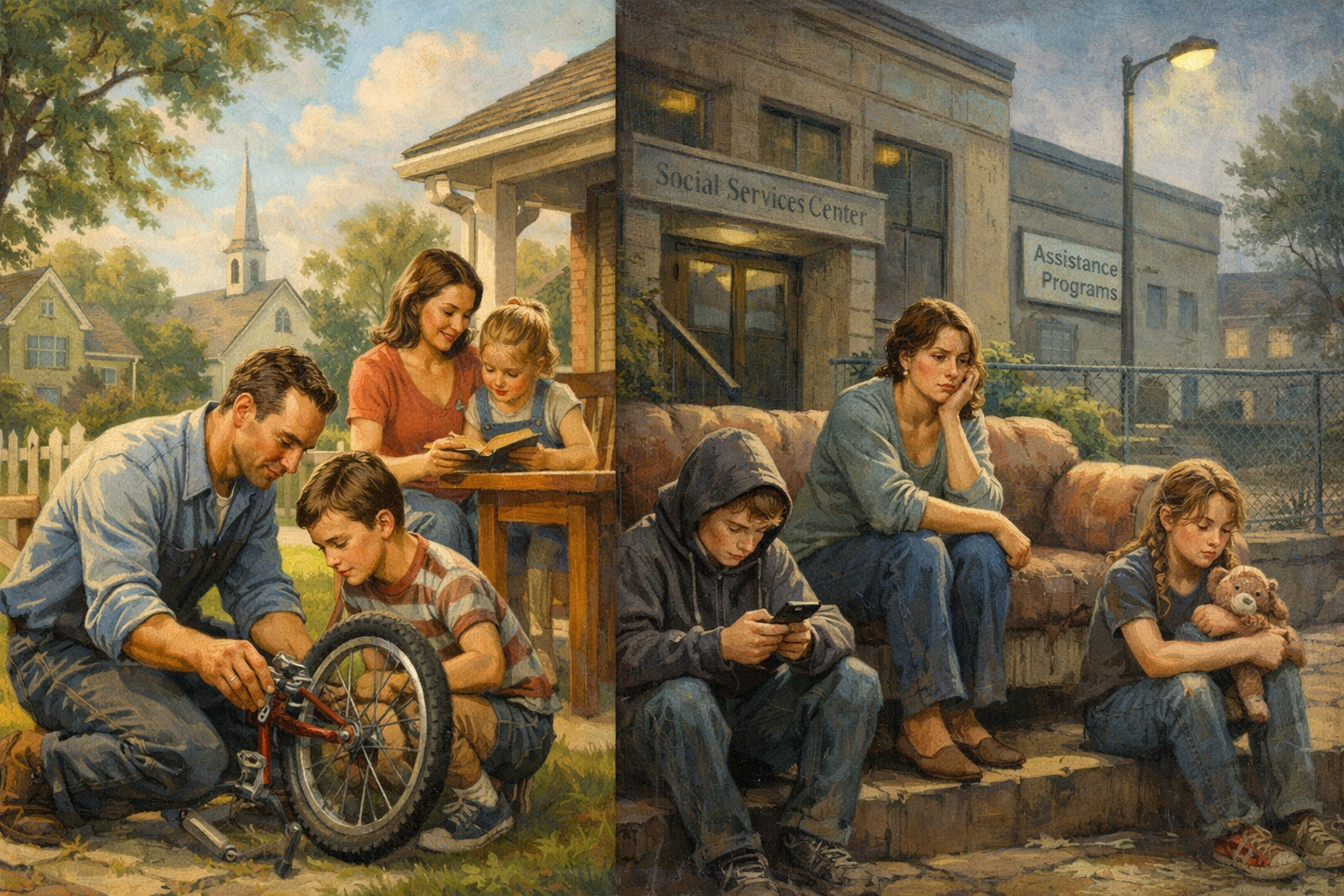
The family is not a niche issue, a private lifestyle preference, or a sentimental talking point reserved for holidays and greeting cards.
It is the most basic social institution in any civilization and the primary mechanism by which moral norms, economic stability, and social trust are transmitted from one generation to the next.
When families are strong, societies tend to be stable, productive, and orderly. When families fracture, downstream effects show up everywhere: crime, poverty, educational failure, mental health crises, and the expansion of government power to fill the void.
This is why the family has become such a fiercely contested political issue.
Republicans, Democrats, Progressives, Libertarians, and biblical Christians are not merely debating policy details.
They are operating from fundamentally different assumptions about human nature, authority, responsibility, and the role of the state. Those assumptions inevitably shape legislation, court rulings, public education, welfare systems, and cultural norms.
For American voters, the family question is unavoidable. It affects taxes, school curricula, crime rates, workforce participation, housing demand, welfare spending, and even national cohesion.
One does not need to be married, have children, or even value traditional culture to be affected by family breakdown. Everyone pays the bill when families fail—financially, socially, and morally.
This article examines the issue of the family through three primary lenses: Republican, Democrat (Progressive), and biblical.
It also evaluates the Libertarian position as a secondary perspective.
The goal is not to feign neutrality, but to offer clarity. Voters cannot make informed decisions if party platforms use similar language while meaning radically different things by it.
What Do We Mean by “Family”?
At first glance, “family” seems like an uncomplicated word.
In practice, it is one of the most ideologically loaded terms in modern politics.
The Republican understanding of the family views it as a natural institution.
It is pre-political, meaning it exists prior to the state and independent of government recognition.
It is biological, grounded in the reality of male and female, and oriented toward marriage and the bearing and raising of children.
It is durable, meant to persist over time, and it functions as the primary unit of social formation, economic cooperation, and moral instruction.
From this perspective, the state does not create the family. Rather, the state recognizes and protects it because strong families produce the kinds of citizens necessary for a free society.
When Republicans speak about “supporting families,” they generally mean policies that reduce burdens on marriage, incentivize parental responsibility, protect parental rights, and limit state intrusion into child-rearing.
The Democrat understanding of the family is markedly different.
In modern Democrat and Progressive thought, the family is a malleable social construct.
It is self-defined, fluid, and mediated by the state. Biological ties are downplayed in favor of emotional or chosen relationships. Marriage is redefined away from its procreative and gendered foundation, and parenting is increasingly viewed as a shared responsibility between individuals and public institutions.
Under this view, the state plays an active role in reshaping family norms to promote equity, inclusion, and autonomy.
When Democrats speak of “family values,” they often mean access to government services, recognition of diverse household arrangements, and state intervention to correct perceived inequalities within or between families.
This definitional divide matters enormously. The Democrat platform may appear to “support families” on paper, but it is supporting a fundamentally different concept of what a family is.
Voters who assume shared definitions often misread policy implications.
Why This Issue Is Measurable and Relevant
The importance of the family is not merely theoretical. It is empirically observable across multiple domains.
Economically, intact families—particularly married, two-parent households—are far less likely to live in poverty.
They rely less on welfare programs, generate higher household incomes, and provide greater economic mobility for children. When family breakdown increases, government spending expands to compensate through housing assistance, food programs, healthcare subsidies, and remedial education.
Public safety is also directly tied to family structure.
Communities with high rates of fatherlessness consistently experience higher crime rates, increased incarceration, and greater gang activity.
Law enforcement professionals have long recognized that the absence of stable families produces predictable patterns of antisocial behavior. This is not a moral judgment; it is a sociological reality confirmed across decades of data.
Education outcomes track the same pattern. Children raised in stable families perform better academically, have lower dropout rates, and are less likely to require special education or behavioral intervention.
When families weaken, schools are pressured to assume roles they were never designed to fill—moral formation, discipline, and even basic emotional regulation.
Historically, American society understood these connections intuitively. For much of the nation’s history, public policy assumed the family as the default social unit.
Only in the latter half of the twentieth century, particularly following the Sexual Revolution and the rise of Progressive governance, did the state begin to treat family structure as optional or irrelevant.
Today, the consequences of that shift are no longer abstract. They are visible in strained public budgets, unsafe neighborhoods, declining birth rates, and a growing dependence on centralized authority.
Economic and Social Spillover Effects
Family breakdown creates cascading effects similar to those seen in other policy areas.
Just as poorly managed immigration affects housing supply, wages, and public safety, family policy shapes economic and social outcomes far beyond the household.
When marriage is penalized by welfare programs, individuals are incentivized to remain unmarried or separate households to retain benefits.
This increases housing demand, fragments communities, and entrenches long-term dependency. Children raised in such systems are statistically more likely to repeat the cycle, perpetuating generational instability.
Healthcare systems are also affected. Family fragmentation correlates strongly with higher rates of mental illness, substance abuse, and chronic stress-related conditions. These burdens are then absorbed by public healthcare programs and insurance markets, raising costs for everyone.
From a civic standpoint, the family has historically been the primary incubator of virtue, responsibility, and self-governance. As that role diminishes, the state inevitably expands. This is not accidental. When families weaken, citizens become more reliant on bureaucratic systems, and political power concentrates upward.
For voters concerned about economic sustainability, public safety, and the preservation of liberty, the family is not a side issue. It is foundational.
Articles in the Critical Issues series require more time to read than most content on this site. They are intentionally written as thorough, in-depth examinations of their subjects.
The Republican Perspective on the Family
The modern Republican position on the family begins with a simple but far-reaching premise: the family is a natural institution that the state did not create and therefore cannot legitimately redefine.
From this starting point flow policy preferences that emphasize marriage, parental authority, biological reality, and limited government intrusion into family life.
While Republicans are not monolithic—and internal tensions do exist—the party’s center of gravity on family issues remains far closer to the biblical understanding than any other major political coalition in the United States.
The Family in the 2024 Republican Party Platform
The 2024 platform of the Republican Party consistently frames the family as the foundational unit of society.
While platform language often uses broad terms like “parents,” “children,” and “households,” the underlying assumptions are clear: children thrive best when raised by their married biological mother and father, and public policy should not undermine that structure.
Key themes appearing throughout the platform include:
- Protection of parental rights in education, healthcare, and moral instruction
- Opposition to government policies that weaken marriage or incentivize family fragmentation
- Affirmation of biological sex as male and female, with corresponding implications for parenting and education
- Support for faith-based and community institutions that strengthen families rather than replace them
Importantly, when the platform speaks of “supporting families,” it does not default to expanding federal programs.
Instead, it emphasizes removing penalties to marriage, allowing families to keep more of what they earn, and protecting parents from ideological capture by bureaucracies—particularly in public schools.
This is a crucial distinction. The Republican platform treats the family as something to be protected from the state, whereas Democrat platforms increasingly treat the family as something to be managed by the state.
Republican Legislative Priorities and Actions
At the federal level, Republican lawmakers have repeatedly focused on legislation that reinforces parental authority and resists ideological intrusion into family life.
Examples include:
- Parental Rights in Education initiatives, affirming that parents—not schools or federal agencies—are the primary decision-makers regarding a child’s upbringing, medical care, and moral instruction.
- Legislative opposition to federal mandates compelling schools to affirm gender ideology or conceal information about a child’s gender identity from parents.
- Tax policies that recognize the economic reality of families, including child tax credits structured to reward work and marriage rather than dependency.
Republican members of the U.S. House and Senate have also been vocal critics of welfare structures that unintentionally penalize marriage.
While Republicans generally support a social safety net, they argue it should function as a temporary aid rather than a long-term substitute for family stability.
At the state level, Republican governors and legislatures have gone further. States such as Florida, Texas, and Tennessee have enacted laws limiting sexually explicit material in schools, prohibiting irreversible medical interventions on minors, and reinforcing the legal rights of parents over school boards and administrative agencies.
These actions are not merely reactive. They reflect a coherent worldview in which children are not autonomous consumers of identity, but dependents entrusted to parents, who in turn bear moral responsibility before God and society.
Republican Leaders and Public Advocacy
Prominent Republican leaders have framed the family issue in explicitly civilizational terms. Governors, senators, and representatives frequently link family stability to public safety, economic opportunity, and national cohesion.
Statements from Republican officials consistently emphasize themes such as:
- Fatherhood and responsibility as antidotes to crime and social decay
- The dangers of replacing parental formation with ideological schooling
- The moral hazard of treating children as lifestyle accessories rather than persons with inherent dignity
At the municipal and state level, Republican leaders often clash with Democrat-run cities over education policy, child welfare standards, and religious liberty protections for faith-based adoption agencies. These conflicts reveal how divergent assumptions about the family lead to radically different governance outcomes, even when leaders claim to be pursuing “the best interests of children.”
Internal Republican Disagreements
While the Republican Party is broadly aligned on the importance of the family, internal disagreements do exist.
One fault line runs between social conservatives and more libertarian-leaning Republicans.
The latter may support limited government in principle but hesitate to legislate moral norms related to marriage, sexuality, or child-rearing.
This tension often surfaces in debates over same-sex marriage, IVF regulation, and the scope of parental rights versus individual autonomy.
Another division concerns tactics rather than goals. Some Republicans prioritize incremental reform—limiting the most damaging policies—while others argue for more explicit moral clarity and structural reform. These disagreements can give the impression of inconsistency, but they do not negate the party’s fundamental orientation toward the family as a pre-political institution.
Crucially, even where Republicans disagree, the debate occurs within a shared moral grammar that assumes the family matters and is worth preserving. That alone sets the party apart from its opposition.
The Democrat Perspective on the Family
The modern Democrat position on the family cannot be understood merely by reading isolated passages from party platforms or campaign literature.
While the language often sounds supportive—emphasizing “care,” “equity,” and “inclusion”—the underlying worldview represents a decisive break from the traditional understanding of the family as a natural, pre-political institution.
Instead, the Democrat Party increasingly treats the family as a flexible social arrangement subject to redefinition, regulation, and supplementation by the state.
This shift did not happen overnight.
It reflects decades of ideological development shaped by Progressivism, the Sexual Revolution, radical feminism, and, more recently, gender ideology.
The result is a vision of family life that prioritizes individual autonomy and state oversight over biological reality, moral continuity, and parental authority.
The Family in the 2024 Democrat Party Platform
The 2024 platform of the Democratic Party avoids defining the family in biological or marital terms.
Instead, it consistently uses expansive and ambiguous language such as “families of all kinds,” “caregivers,” and “households.”
On the surface, this appears compassionate and inclusive. In practice, it signals a deliberate refusal to privilege marriage, biological parenthood, or durable family structures.
When the platform discusses “family support,” it overwhelmingly refers to government programs: subsidized childcare, expanded welfare benefits, universal pre-K, paid family leave administered through federal mechanisms, and healthcare interventions that increasingly bypass parental consent.
The family is not treated as the primary agent of care, formation, and responsibility, but as one stakeholder among many—often subordinate to state-defined priorities.
Most notably absent is any acknowledgment that children have a natural right to their mother and father, or that marriage between a man and a woman provides a unique and irreplaceable context for child development.
This omission is not accidental. It reflects a philosophical commitment to moral neutrality on family form, even while aggressively promoting certain forms as socially equivalent through law and policy.
Democrat Legislative Priorities and Policy Outcomes
Democrat-led legislation over the past several decades reveals how these abstract commitments translate into concrete policy.
Welfare programs supported and expanded by Democrats have frequently created disincentives to marriage.
Benefits are often reduced or eliminated when two-parent households form, effectively penalizing marital stability among lower-income families.
While framed as poverty alleviation, these structures unintentionally—but predictably—encourage family fragmentation and long-term dependency.
Democrats have also championed the legal normalization of same-sex marriage and adoption, presenting these policies as civil rights achievements.
From a biblical and child-centered perspective, however, these moves institutionalize a false equivalence between fundamentally different family structures.
Children placed in such arrangements are deprived—by design—of either a mother or a father, and society is instructed to treat this deprivation as morally irrelevant or even virtuous.
The party has further supported the commodification of children through surrogacy and IVF regimes that separate procreation from marital commitment and biological continuity.
These practices increasingly treat children as products of adult desire rather than gifts entrusted to parents with corresponding duties and limits.
Education, Gender Ideology, and Parental Displacement
Perhaps the clearest expression of the Democrat view of the family emerges in public education policy.
Democrat-run school systems have increasingly asserted authority over a child’s identity formation, particularly regarding sexuality and gender.
Policies that allow schools to socially transition children without parental knowledge or consent represent a direct challenge to parental authority.
The underlying assumption is that the state—or its appointed professionals—may act as a moral arbiter superior to parents.
This approach reached new levels during the Biden administration (2021–2024), when federal agencies promoted guidance encouraging schools to affirm transgender identities, integrate gender ideology into curricula, and reinterpret civil rights law to include contested claims about sex and identity.
Parents who objected were often portrayed as threats to their own children or as obstacles to progress.
The practical effect is a slow but steady displacement of the family’s formative role.
The more the state assumes responsibility for moral, sexual, and psychological formation, the less authority parents retain. This is not an unintended consequence; it is the logical outcome of a worldview that treats the family as optional and malleable.
Internal Democrat Tensions—and Their Limits
It is true that not all Democrats are equally radical on family issues.
Some older or culturally moderate Democrats express discomfort with gender ideology, the erosion of parental rights, or the excesses of the Sexual Revolution. These concerns occasionally surface in polling or local elections.
However, such dissent rarely translates into durable policy resistance. The dominant coalition within the Democrat Party is now aligned with Progressive activism, institutional enforcement, and cultural transformation.
Those who resist are often sidelined, pressured, or rebranded as out of step with the party’s moral trajectory.
As a result, whatever internal disagreements exist do not meaningfully alter the party’s direction. The Democrat vision of the family is no longer rooted in preservation, but in reconstruction.
Why the Progressive Worldview Must Be Examined
Understanding the Democrat position on the family requires more than cataloging policies.
It demands an examination of the Progressive worldview that animates those policies.
Terms like “equity,” “liberation,” and “inclusion” function as moral signposts, but they draw their meaning from deeper philosophical commitments—many of which are incompatible with biblical anthropology and historical Christian teaching.
For this reason, the Progressive (often called “woke”) worldview warrants focused attention. It is not merely a political style or rhetorical posture. It is a comprehensive vision of human nature, power, and social order that fundamentally reinterprets the family’s role in society.
That worldview will be examined directly in the next section.
The Progressive (Woke) Worldview and Its Impact on the Family
To understand why the Democrat Party now governs as it does on family issues, one must grapple with the worldview it has absorbed.
The word “Progressive” is often treated as a benign synonym for compassion or reform. In reality, Progressivism represents a coherent—though internally fractured—philosophical project that radically reinterprets human nature, authority, and social institutions.
The family sits squarely in its crosshairs.
This section explains the conceptual architecture behind that project and shows how it predictably manifests in policy.
From “Progressive” to Woke—A Brief Map of Ideas
“Progressive,” “woke,” “politically correct,” “identity politics,” “critical theory,” “intersectionality,” “Cultural Marxism,” and “Neo-Marxism” are not identical terms, but they overlap significantly. They describe different layers of the same intellectual ecosystem.
At the core lies a Marxist-inspired framework that interprets society primarily through power relationships between groups—oppressors and oppressed.
Classical Marxism focused on economic class. Neo-Marxist variants expand the analysis to race, sex, gender, sexuality, and other identity categories.
The goal is not merely reform but transformation: dismantling existing institutions deemed to perpetuate unequal power.
In this framework, tradition is presumed guilty until proven innocent.
Institutions that predate the modern state—church, family, local community—are viewed with suspicion because they transmit norms independent of centralized authority. The family, in particular, is seen as a site where “oppressive” hierarchies are reproduced: male over female, parent over child, heterosexual over homosexual, biological reality over self-definition.
“Wokeness” is the moral posture that accompanies this analysis.
To be “woke” is to claim awareness of hidden systems of oppression and to justify aggressive intervention to correct them. Moral authority no longer flows from transcendent truth or inherited wisdom, but from perceived victim status and ideological alignment.
How Neo-Marxist Assumptions Reframe the Family
Within Progressive thought, the family is not primarily a natural bond but a social construct that can and should be redesigned to achieve equity. Several assumptions follow.
First, parental authority is treated as morally suspect.
Parents are seen as potential vectors of bigotry, superstition, or “harmful norms.”
This justifies state intervention in education, healthcare, and even speech within the home when parental beliefs conflict with Progressive orthodoxy.
Second, biological reality is subordinated to subjective identity.
Motherhood and fatherhood are reframed as interchangeable roles. Sex differences are treated as arbitrary or oppressive. This makes it possible to argue that children do not need a mother and a father—only affirming caregivers sanctioned by the state.
Third, dependency is normalized. Rather than strengthening families so they can function independently, Progressive policy often expands bureaucratic oversight and social programs that replace family functions. The stated goal is compassion; the practical effect is increased state authority and diminished family autonomy.
Fourth, children are reimagined as rights-bearing individuals detached from parental stewardship.
This provides moral cover for policies that allow institutions to override parents in matters of sexuality, gender identity, and medical intervention.
None of this is accidental. These outcomes flow directly from the underlying presuppositions.
Policy Manifestations in Democrat Governance
When these ideas migrate from the academy to the administrative state, the results are concrete and measurable.
Education policy becomes a primary battleground. Curriculum shifts away from shared civic norms and toward identity-based moral instruction. Parents who object are characterized as threats to inclusion or even domestic extremism.
Transparency is resisted because ideological formation requires insulation from dissent.
Healthcare policy follows a similar logic. Gender-affirming frameworks prioritize subjective self-identification over biological sex, even for minors.
Parental consent is treated as optional or obstructive. Medical professionals who dissent face professional sanctions.
Welfare and labor policies likewise reflect Progressive assumptions.
By minimizing the importance of marriage and maximizing individual entitlement, policy design unintentionally entrenches fatherlessness and weakens intergenerational bonds—while expanding administrative oversight.
In each case, the family’s role shrinks as the state’s role grows.
Why the Family Must Be Weakened
From a Progressive perspective, strong families are a problem.
They transmit values, loyalties, and moral frameworks that compete with ideological conformity. They foster independence from bureaucratic systems. They ground identity in biology, history, and obligation rather than self-creation.
For Marxist-adjacent movements, this is unacceptable. If social transformation is the goal, the family must be de-emphasized, redefined, or replaced. Loyalty must shift from kinship and faith to state and ideology. The family becomes one lifestyle option among many—until it quietly loses its privileged status altogether.
This helps explain why Progressive rhetoric often sounds therapeutic while producing coercive outcomes. The language is soft; the logic is hard.
Why This Matters for Voters
Voters who assume that family policy disagreements are merely cultural squabbles miss the deeper stakes.
The issue is not tone or tolerance, but authority. Who forms the next generation? Who decides what children are taught about reality, morality, and identity? Who bears responsibility when things go wrong—parents or the state?
Progressivism answers these questions decisively, even if it avoids saying so plainly.
Its vision requires a diminished family and an empowered administrative regime. Once this is understood, the consistency of Democrat policy across education, healthcare, and social welfare becomes clear.
The Libertarian Position on the Family
The Libertarian position on the family occupies an unusual and often unstable middle ground in American political thought.
Libertarians are not a major governing force in the United States, but their ideas exert disproportionate influence—especially within media, academia, and certain Republican factions.
For that reason, their view of the family deserves careful examination, even if only tangentially.
At first glance, Libertarianism appears to offer a principled defense of individual freedom and limited government. On family issues, however, this framework reveals significant weaknesses, particularly when it attempts to remain morally “neutral” while still making normative claims about human flourishing.
The Libertarian Party Platform and Core Assumptions
The most recent platform of the Libertarian Party emphasizes individual autonomy, voluntary association, and minimal state interference.
Applied to the family, this generally means the government should neither privilege nor discourage any particular family structure.
The Libertarian platform tends to frame family-related questions in terms of consent between adults rather than obligations to children or society.
Marriage is treated primarily as a private contract. Parenting is viewed as a personal choice rather than a socially formative role. The state’s involvement is to be minimized across the board—whether that involvement takes the form of welfare programs or moral regulation.
On paper, this sounds consistent and principled. In practice, it raises difficult questions that Libertarianism struggles to answer.
Where Libertarians Align with Republicans
Libertarians often align with Republicans in opposing expansive welfare systems, intrusive bureaucracy, and federal overreach into private life.
On these points, they correctly observe that government programs can weaken personal responsibility and crowd out voluntary institutions—including families and churches.
Libertarians also tend to resist compelled speech, ideological education mandates, and excessive regulation of religious institutions. In these areas, they function as useful allies in restraining Progressive excesses.
However, this alignment is largely procedural rather than substantive.
Libertarians oppose state intervention because it violates individual liberty, not because it undermines the family as a moral institution.
Where Libertarianism Breaks Down
The central weakness of the Libertarian view is its claim to moral neutrality.
By refusing to make substantive judgments about the nature of the family, Libertarianism implicitly borrows moral capital from other worldviews—usually Christianity or cultural conservatism—without acknowledging the source.
For example, Libertarians often speak of “stable families,” “responsible parenting,” or “the well-being of children.”
Yet their philosophical framework provides no robust basis for privileging biological parenthood, marriage, or sexual restraint. If all consensual arrangements are morally equivalent, there is no principled reason to defend the family as anything more than one lifestyle choice among many.
This becomes particularly problematic when children are involved. Children cannot consent to the structures into which they are born. Any serious account of family life must therefore include duties, limits, and moral claims that transcend individual preference.
Libertarianism, with its emphasis on autonomy, struggles to articulate these claims without importing assumptions it officially rejects.
Alignment with Democrats on Key Outcomes
Despite Libertarian rhetoric about freedom, the practical outcomes of Libertarian family policy often converge with Democrat and Progressive results. By declining to privilege marriage or biological parenthood, Libertarianism leaves the family vulnerable to redefinition by the state or cultural elites.
In the absence of a shared moral framework, power flows to those who control institutions. This means that Progressive ideologies—far from being restrained—often fill the vacuum left by Libertarian neutrality. What begins as a rejection of government interference ends as acquiescence to administrative rule.
This is why Libertarianism frequently functions as a transitional ideology. It weakens traditional norms without providing a durable replacement, clearing the ground for more coercive systems to take root.
Why the Libertarian View Is Presented Only Tangentially
The Libertarian Party does not govern at scale in the United States, and its platform does not meaningfully shape federal or state family policy. For that reason, its position is presented here for contrast rather than equivalence.
Nevertheless, its influence on conservative discourse makes it worth addressing. Voters who care about the family should understand that procedural freedom alone is insufficient to sustain institutions that require moral commitment, sacrifice, and intergenerational responsibility.
What the Parties Actually Do in Power
“In politics, what you DO is what you believe. Everything else is cottage cheese.”
— Joseph N. Kennedy
Party platforms matter, but governing reveals priorities far more clearly.
This section examines whether Republican-run and Democrat-run administrations—at the federal, state, and city levels—have acted in ways consistent with their stated commitments regarding the family, as the ordinary American understands that term.
Republican-Run Administrations in Practice
Across Republican-controlled jurisdictions, there is a visible—though imperfect—pattern of policies aimed at preserving parental authority, biological reality, and family autonomy.
At the federal level, Republican administrations have generally resisted efforts to federalize family life.
During the first Trump administration (2017–2020), federal agencies rolled back guidance that pressured schools to adopt gender ideology frameworks.
Religious liberty protections were strengthened for faith-based adoption agencies, allowing them to operate according to their convictions without losing government contracts.
While not every policy explicitly strengthened the family, the administration’s posture was defensive rather than transformative—seeking to prevent federal intrusion rather than impose a new moral order.
At the state level, Republican governors and legislatures have been far more proactive.
Laws affirming parental rights in education, restricting irreversible medical procedures on minors, and limiting sexually explicit material in public schools reflect a consistent effort to restore the family’s formative role.
These measures are often framed as transparency and consent protections rather than moral crusades, but their practical effect is the same: reinforcing parental authority.
At the local level, Republican-led cities and counties tend to resist the use of public institutions to advance ideological views of sexuality and gender.
Where Republican governance prevails, schools are more likely to defer to parents, and family life is treated as something to be supported indirectly—through public safety, economic opportunity, and stable norms—rather than reengineered.
Republican governance is not flawless. Some Republican administrations have failed to address marriage penalties embedded in welfare systems, and others have avoided family issues to sidestep controversy.
Still, when measured against their platform commitments, Republican actions generally align with a vision of the family as pre-political and deserving of protection from the state.
Democrat-Run Administrations in Practice
Democrat-run administrations present a far sharper contrast between rhetoric and outcome.
At the federal level, the Biden administration (2021–2024) aggressively advanced policies that weakened parental authority and redefined family norms.
Federal guidance reinterpreted civil rights law to incorporate gender identity, pressuring schools to affirm contested claims about sex and identity. Parents who objected found themselves marginalized or portrayed as hostile to their own children’s well-being.
Federal agencies also supported healthcare frameworks that prioritized self-identification over biological sex, including in pediatric contexts. The cumulative effect was a significant expansion of federal influence into domains historically governed by families.
At the state level, Democrat-run states consistently expanded the state’s role as surrogate parent.
Laws shielding schools from parental oversight, mandating ideological curricula, and restricting parental access to information about their own children became increasingly common. Welfare expansion often proceeded without addressing structural incentives that discourage marriage, further entrenching family fragmentation.
At the city level, Progressive governance produced some of the most extreme outcomes. Municipal policies treated dissent from Progressive family norms as discrimination, restricted faith-based adoption agencies, and normalized the idea that children are primarily wards of the state rather than members of families.
The pattern is unmistakable. Democrat administrations consistently act as though the family is subordinate to state-defined values. This is not an accident or a series of one-off excesses. It is the logical expression of the worldview described in earlier sections.
Platform Consistency and the Common Man’s Understanding
To the average American, “supporting families” means helping parents raise their children, not replacing them.
It means protecting children, not experimenting on them. It means rewarding responsibility, not penalizing it.
Measured by this standard, Republican governance—however incomplete—generally moves in the direction voters expect. Democrat governance, by contrast, routinely contradicts ordinary expectations while insisting it is acting in the family’s best interest.
This gap between language and action explains much of the public’s growing distrust. When voters observe that policies labeled “family-friendly” systematically weaken families in practice, skepticism is not only rational—it is inevitable.
Mutual Criticisms and Competing Visions of Human Nature
Political conflict over the family is not merely a dispute about outcomes; it is a clash between fundamentally different visions of human nature and social order.
Each party levels sharp criticisms against the other, and each responds from within its own moral framework. Understanding these exchanges clarifies why compromise on family issues is increasingly rare.
Republican Criticisms of the Democrat Approach
Republicans argue that Democrat policies systematically undermine the family while claiming to support it. The central criticism is that Democrats replace parents with the state and moral formation with ideology.
Republicans point to welfare structures that discourage marriage, educational policies that conceal information from parents, and healthcare frameworks that treat children as autonomous decision-makers detached from family authority.
From the Republican perspective, these policies erode responsibility, weaken social trust, and produce predictable social harm—crime, dependency, and intergenerational instability.
Democrat response: Democrats typically counter that these policies protect vulnerable individuals, promote inclusion, and correct historical injustices. They argue that parental authority must sometimes be constrained to prevent harm and that state intervention is necessary when families fail or when traditional norms exclude marginalized groups.
Republican counter-response: Republicans respond that this framing confuses rare cases of abuse with normal parental authority.
They argue that expanding state power on the basis of exceptional cases leads to routine intrusion.
Moreover, they contend that redefining harm to include moral disagreement weaponizes compassion against the family itself.
Democrat Criticisms of the Republican Approach
Democrats accuse Republicans of imposing religious beliefs through public policy and of romanticizing a “traditional” family structure that they claim never universally existed.
They frame Republican policies as discriminatory toward non-traditional households and harmful to individual freedom.
Democrats also argue that Republican resistance to gender ideology and sexual liberation endangers mental health and denies people their authentic identities.
Republican response: Republicans counter that recognizing biological reality and protecting children is not religious imposition but basic governance. They argue that all law encodes moral judgments, and that pretending otherwise simply masks which morality is being enforced.
Democrat counter-response: Democrats reply that moral neutrality is possible and that personal autonomy should be the guiding principle.
Republicans answer that autonomy without obligation dissolves the very conditions that make freedom possible.
Constrained and Unconstrained Visions
These disagreements map closely onto what Thomas Sowell describes as the constrained and unconstrained visions of human nature.
The constrained vision—shared broadly by Republicans and biblical Christians—assumes that human nature is fixed, flawed, and limited.
Institutions like the family exist to channel behavior, transmit norms, and mitigate those flaws over time. Change should be cautious, incremental, and grounded in experience.
The unconstrained vision—embraced by Progressives and many Democrats—assumes human nature is malleable and improvable through reason and policy.
Institutions are obstacles to be redesigned, not inheritances to be stewarded. Authority flows from expertise and intention rather than tradition.
Libertarianism straddles these visions uneasily. It often assumes constrained human behavior in economic matters but unconstrained autonomy in moral ones, producing internal tension.
Biblical Christianity aligns decisively with the constrained vision. Scripture presents humanity as created, fallen, and in need of moral formation—precisely the role the family has historically fulfilled.
Why These Critiques Rarely Resolve
Because these criticisms arise from incompatible visions, debate rarely produces consensus.
Each side hears the other as either authoritarian or irresponsible. Without agreement on what the family is and what human beings are, policy disputes become proxy wars over ultimate authority.
This explains why family issues increasingly bypass democratic deliberation and are settled through courts, administrative agencies, and cultural coercion. When visions collide, power fills the gap.
Credible Suspicions and Strategic Concerns
Political actors are rarely motivated by a single principle.
Coalitions pursue power, protect constituencies, and advance long-term strategies—often while presenting their actions in the most favorable moral light.
On the issue of the family, both Republicans and Democrats harbor suspicions about the motives and end goals of their opposition. Not all such suspicions are provable, but many are reasonable given observable patterns of behavior, policy sequencing, and leadership statements.
This section examines those concerns with sobriety rather than sensationalism.
Republican Suspicions of the Democrat Strategy
Republicans widely suspect that Democrat family policy is less about protecting children and more about reshaping society by weakening mediating institutions between the individual and the state.
One concern centers on state dependency. When marriage is discouraged through welfare structures and parental authority is undermined through education and healthcare policy, families become more reliant on government systems. Republicans argue this produces a more governable population—less anchored to tradition, faith, and kinship, and more dependent on administrative expertise and political favor.
Another suspicion involves cultural enforcement through institutions. Republicans observe that policies advancing gender ideology and sexual liberation are rarely optional in practice. Schools, employers, and medical systems are compelled to comply, while dissenters face sanctions. This suggests not pluralism, but enforced orthodoxy—one that crowds out traditional family norms.
There is also concern about demographic and political incentives. Progressive policies tend to appeal strongly to urban, secular, and single-voter blocs. By redefining family structures and marginalizing religious and traditional households, Democrats may be consolidating a long-term electoral advantage. This is not typically stated openly, but voting patterns and messaging priorities reinforce the suspicion.
Republicans further note that children raised in fragmented families are statistically more likely to require state intervention. This creates a self-reinforcing cycle: weakened families justify expanded government, which further weakens families.
Democrat Suspicions of the Republican Strategy
Democrats, for their part, suspect Republicans of using the family as a vehicle for enforcing religious morality and maintaining social hierarchies. They argue that appeals to tradition mask resistance to social change and protect entrenched power structures.
Some Democrats believe Republican emphasis on parental rights is a pretext for shielding abuse or discrimination. Others claim that traditional family advocacy marginalizes non-traditional households and creates social stigma.
There is also suspicion that Republicans selectively defend family autonomy while ignoring economic pressures that strain families—such as housing costs, healthcare expenses, and labor market instability. Democrats argue that without robust public support systems, appeals to family responsibility amount to moralizing without material assistance.
Republicans counter that these critiques misunderstand both intent and effect. They argue that moral formation and economic stability are not competing goods, and that no amount of public spending can replace the formative power of intact families.
Why These Suspicions Persist
These suspicions persist because patterns repeat. Policies accumulate. Outcomes align with ideology.
Republicans see Democrat governance consistently expanding the state’s role in child formation while marginalizing parents. Democrats see Republicans resisting cultural change while invoking tradition as a shield. Each side finds confirmation in real-world evidence.
Importantly, the concerns outlined here do not require belief in conspiracy theories. They arise naturally when ideologies are applied consistently over time. Strategy does not require secrecy when incentives are visible.
For the politically attentive voter, the question is not whether every suspicion is correct, but whether the trajectory of policy aligns with human flourishing and social stability.
High-Trust and Low-Trust Societies and the Family
One of the most useful lenses for understanding the modern family crisis is the distinction between high-trust and low-trust societies. This framework helps explain why family breakdown is not merely a private tragedy, but a civilizational problem with political consequences.
What Is a High-Trust Society?
A high-trust society is one in which most people assume—rightly or wrongly—that others will generally act in predictable, lawful, and responsible ways. Social cooperation is easier. Contracts are simpler. Enforcement costs are lower. Institutions can remain limited because informal norms do much of the work.
Historically, the United States functioned as a high-trust society. That trust did not emerge spontaneously. It was cultivated through shared moral assumptions, religious formation, and—most importantly—the family.
The family taught self-restraint before the state had to impose it. It taught duty before rights. It formed citizens capable of liberty.
Marriage, particularly, served as a trust-generating institution. It bound men to women, parents to children, and adults to future generations. When families were intact, the broader society could afford to be freer.
Family Breakdown and the Collapse of Trust
As the family weakens, trust erodes. This is not speculative; it is observable.
Fatherlessness correlates strongly with higher crime rates, lower educational attainment, and increased reliance on public assistance. Communities marked by family instability require heavier policing, more regulation, and greater bureaucratic oversight. The assumption of responsibility gives way to the expectation of supervision.
In low-trust environments, people behave defensively. Businesses raise prices to cover risk. Governments expand rules to manage disorder. Citizens retreat into factions. Social cooperation becomes fragile and transactional.
This dynamic creates a vicious cycle. Family breakdown produces low trust, which justifies state expansion, which further displaces family authority, producing even lower trust.
Progressive Policy and the Acceleration of Low Trust
Progressive governance often assumes low trust from the outset.
Parents are not trusted to raise children without ideological oversight. Citizens are not trusted to organize family life without bureaucratic guidance. Moral norms are not trusted to endure without enforcement.
Policies that bypass parents, normalize dependency, and redefine family obligations accelerate the transition from high trust to low trust. Once that shift occurs, it is extremely difficult to reverse. Rebuilding trust requires restoring the very institutions that were weakened.
Republicans tend to recognize this intuitively, even when they lack the language to articulate it fully. Democrats, influenced by Progressive theory, often treat low trust as justification for further intervention rather than as evidence of institutional failure.
Why This Matters Politically
A low-trust society cannot sustain limited government. It demands constant supervision, redistribution, and management. In such a society, freedom becomes dangerous because the social preconditions for freedom no longer exist.
For voters, this means family policy is inseparable from questions of liberty. The erosion of the family does not merely change household arrangements; it changes the character of the nation.
Media Distortion and the Shifting Overton Window
No modern political issue is shaped in isolation from the media environment, and the family is no exception.
Over the past several decades, mainstream media institutions have played a decisive role in reframing how Americans think—and do not think—about marriage, parenting, sexuality, and authority.
This influence has not been neutral. It has consistently favored the Progressive understanding of the family while portraying dissenting views as suspect, outdated, or dangerous.
Patterns of Distortion
Mainstream media outlets routinely distort Republican and biblical positions on the family through selective framing rather than outright falsehood.
The most common technique is redefining moral disagreement as animus.
For example, opposition to gender ideology in schools is frequently framed as “anti-trans” rather than as a defense of parental authority and biological reality.
Advocacy for the two-parent family is portrayed as hostility toward single parents rather than as recognition of statistical and historical realities. Resistance to sexually explicit curricula is cast as censorship rather than child protection.
In each case, the media collapses intent into effect. If a policy might make someone feel excluded, it is assumed to be motivated by malice. This framing forecloses serious debate and trains audiences to interpret family-centered arguments as threats rather than concerns.
Euphemism and Language Shifts
Language is one of the most powerful tools of persuasion, and media outlets have been remarkably effective at laundering radical ideas through soft terminology.
Words like “reproductive health,” “gender-affirming care,” “family-building,” and “inclusive education” obscure the moral and biological realities under discussion. Surrogacy becomes an act of compassion rather than a commercial transaction involving children. IVF is framed solely as hope for adults rather than as a process that routinely discards embryos. Sexual liberation is described as authenticity, while restraint is labeled repression.
Over time, repeated exposure to euphemism shifts public perception. Once language changes, policy resistance becomes more difficult because objections sound harsh or unintelligible within the new vocabulary.
Moving the Overton Window
The Overton window describes the range of ideas considered acceptable for public discussion. On family issues, mainstream media has been instrumental in pushing that window steadily leftward.
Positions that were once treated as radical—such as denying biological sex or removing parents from key decisions—are now presented as settled science or basic decency. Conversely, views that dominated American life for centuries are now treated as extremist or fringe.
This shift did not occur because the evidence changed, but because repetition normalized new assumptions. Media institutions did not merely report cultural change; they manufactured it by choosing which voices to amplify and which to marginalize.
Consequences for Democratic Deliberation
When media distortion becomes systemic, democratic deliberation suffers. Voters are deprived of clear descriptions of what policies actually do. Moral tradeoffs are hidden behind therapeutic language. Critics are caricatured rather than engaged.
This environment benefits Progressive governance, which relies on administrative enforcement rather than popular consent. If voters fully understood the implications of many family policies, public resistance would be far stronger.
The Biblical Perspective on the Family
Any serious evaluation of the family must eventually confront a foundational question: Is the family a human invention or a divine institution?
Scripture answers this unambiguously. The family is not a social experiment, a flexible contract, or a state-defined arrangement. It is a creation ordinance—established by God, prior to government, and ordered toward human flourishing and His glory.
This section outlines what Scripture affirms about the family and why the biblical vision aligns far more closely with the Republican position than with Democrat, Progressive, or Libertarian alternatives.
The Family as a Creation Ordinance
The Bible locates the origin of the family in creation itself.
Before the fall, before the law, before the state, God instituted marriage between one man and one woman and oriented it toward fruitfulness and stewardship (Genesis 1:27–28; 2:18–25, ESV).
Marriage is covenantal, not contractual. It binds husband and wife in a lifelong union that creates the natural context for bearing and raising children. Parenthood is not incidental to marriage but flows from it. Children are described not as accessories or entitlements, but as blessings entrusted by God (Psalm 127:3–5, ESV).
This understanding undercuts modern attempts to redefine the family. If the family is created by God, then neither cultural preference nor political power can legitimately remake it.
Theologians such as R. C. Sproul and John MacArthur have consistently emphasized that creation ordinances establish moral boundaries that transcend time and culture. To reject them is not progress, but rebellion.
Ordered Loves and Authority Structures
Scripture presents the family as an ordered institution, not a hierarchy of domination but a structure of responsibility.
Husbands are called to sacrificial leadership, wives to complementary partnership, and children to honor and obedience (Ephesians 5:22–6:4, ESV).
This ordering reflects what Augustine described as ordo amoris—rightly ordered loves. Love for God orders love for spouse, which orders love for children, which orders love for neighbor. When this order is inverted, disorder follows.
Modern Progressivism rejects ordered loves as oppressive. Scripture presents them as life-giving. Authority within the family is not about power, but about stewardship. Parents answer to God for the formation of their children. The state does not.
Pastors like Voddie Baucham and Thomas Ascol have been especially clear that family breakdown is not merely a sociological concern but a theological one. When fathers abdicate and parents are displaced, the consequences ripple outward into church and state alike.
Children, Sexuality, and Moral Formation
Biblically, children are morally formative beings, not autonomous selves. They are to be instructed, disciplined, and nurtured within the covenantal household (Deuteronomy 6:6–7; Proverbs 22:6, ESV).
Sexuality is not a personal identity to be discovered but a gift to be governed within marriage.
This stands in stark contrast to contemporary claims that children can self-identify apart from their bodies or their parents. Scripture recognizes that immaturity requires guidance, not affirmation of confusion.
Scholars such as Gregory Beale have emphasized that biblical anthropology is covenantal and corporate. Identity is received, not invented. The family is the primary context in which that identity is formed.
Engagement with Conservative Catholic Voices
While significant doctrinal differences exist, conservative Roman Catholic thinkers such as Michael Knowles, J. D. Vance, and Matt Walsh have offered valuable cultural analysis on the family.
They correctly identify the Sexual Revolution as corrosive, fatherlessness as catastrophic, and state intrusion as destructive.
Their contributions reinforce a broader Judeo-Christian moral consensus: children need mothers and fathers, marriage matters, and societies that deny these truths eventually collapse under the weight of their own contradictions.
Alignment with Political Parties
When viewed through a biblical lens, the alignment becomes clear.
The Democrat and Progressive positions contradict Scripture at nearly every foundational point: the nature of marriage, the authority of parents, the meaning of sex, and the purpose of the family.
Libertarianism, while resisting state overreach, lacks the moral substance to defend the family beyond personal preference.
The Republican Party, though imperfect and not identical to the biblical worldview, welcomes Christians to bring their convictions into public life. It affirms the family as a pre-political institution and resists ideological efforts to dismantle it.
For this reason, biblical Christians will, as a rule, find themselves far more aligned with Republicans on family issues than with any alternative.
Worldview explains policy. Where Scripture governs assumptions, the family is protected. Where autonomy or power governs assumptions, the family is redefined or displaced.
A common objection raised by Progressives is the existence of real cases of child abuse within families. This objection must be taken seriously—but it does not justify transferring ultimate authority over children to the state.
Abuse represents a violation of the family’s God-given mandate, not evidence that the family itself is illegitimate.
In a just society, parental authority is presumed and protected, while state authority is limited, derivative, and corrective.
The state rightly intervenes to restrain and punish proven abuse through due process and evidentiary standards, but it does so as an emergency measure, not as a replacement parent.
When exceptional cases are used to justify routine state supervision of families, the result is not child protection but state parenthood—an arrangement that historically expands power, lowers evidentiary thresholds, and ultimately exposes children to ideological and bureaucratic harm rather than genuine care.
The Case Against the Democrat Party from a Biblical and Human Flourishing Perspective
Having examined the competing worldviews and policy outcomes, the case against the Democrat Party on the issue of the family can now be stated directly.
This case is not rooted in partisan animus, but in observable effects and biblical principles that bear directly on human flourishing.
Whatever the stated intentions, Democrat and Progressive governance has consistently produced outcomes that weaken marriage, marginalize parental authority, commodify children, and expand state control at the expense of the family.
This section evaluates those outcomes in principle and in practice.
Why Democrat Governance Conflicts with Biblical Principles
From a biblical standpoint, several conflicts are unavoidable.
First, Scripture affirms that children are entrusted to parents, not to the state.
Democrat policies routinely invert this relationship by treating parents as provisional caretakers subject to professional override.
Whether through education mandates, healthcare guidance, or child welfare standards, parental authority is increasingly conditional on ideological compliance.
Second, Scripture affirms marriage as the normative context for sexual relations and childrearing.
Democrat policy treats marriage as optional, interchangeable, or even suspect. By normalizing fatherlessness, redefining marriage, and subsidizing non-marital childbearing, these policies actively undermine the structure Scripture presents as foundational.
Third, Scripture forbids the commodification of human life. Democrat support for commercial surrogacy, unregulated IVF, and reproductive technologies severs procreation from covenantal responsibility and reduces children to outcomes of adult desire. This violates the biblical view of children as gifts rather than products.
Fourth, Scripture recognizes the reality of sin and human limitation. Progressive governance operates as if social engineering can overcome fallen human nature.
The result is not liberation, but coercion—because idealized visions must be enforced when they fail to materialize organically.
From a human flourishing perspective, these conflicts are not abstract. They produce measurable harm: family instability, emotional trauma for children, social fragmentation, and the erosion of trust.
Case Studies from the Biden Administration (2021–2024)
The Biden administration provides a concentrated illustration of these principles in action.
Parental displacement in education. Federal guidance encouraged schools to treat gender identity as authoritative over biological sex and, in some cases, to withhold information from parents. This reframed parents as potential adversaries rather than primary caregivers.
Medicalization of identity confusion. Federal agencies promoted “gender-affirming care” frameworks that prioritized self-identification over developmental caution. Even where procedures were nominally left to states, federal rhetoric and funding signals pushed institutions in a uniform direction.
Redefinition of civil rights. By reinterpreting Title IX and related statutes to include gender identity, the administration effectively redefined sex-based protections without legislative consent. This move had direct consequences for family life, sports, education, and parental authority.
Marginalization of faith-based family institutions. Adoption and foster care agencies operating on biblical convictions faced regulatory pressure, limiting their ability to serve children unless they conformed to Progressive sexual ethics.
Each of these actions reflects a consistent assumption: the family is subordinate to ideological and administrative priorities.
Case Studies from Progressive States and Cities
The same pattern appears—often more starkly—at the state and municipal level.
In states such as California, Massachusetts, New York, Oregon, and Washington, laws have expanded state authority over children’s medical and educational decisions while narrowing parental recourse.
Some jurisdictions have positioned themselves as sanctuaries for minors seeking gender-related interventions, even when parents object.
Cities including Seattle, Portland, San Francisco, Chicago, Boston, and Washington, D.C. have implemented education policies that treat Progressive sexual ethics as settled truth. Parental dissent is tolerated only insofar as it does not impede institutional goals.
In these environments, family life is reshaped by regulation rather than supported by governance. The cumulative effect is predictable: declining birth rates, rising mental health crises among youth, and increased reliance on state systems to address problems families once mitigated.
Signposting matters here. These outcomes are not isolated mistakes. They are consistent across jurisdictions that share the same worldview.
Why Intentions Do Not Negate Consequences
Democrats frequently respond that their intentions are compassionate—that they seek to protect vulnerable children and support diverse families. Scripture, however, evaluates actions by fruit, not slogans (Matthew 7:16–20, ESV).
Policies that weaken marriage weaken children. Policies that sideline parents harm those they claim to protect. Policies that redefine reality require coercion to sustain.
Good intentions cannot redeem bad anthropology.
Voting with a Biblical Worldview and Moral Prioritization
Christians are not called to political naïveté.
Scripture never commands believers to withdraw from public responsibility, nor does it endorse the illusion of moral neutrality in civic life.
While the kingdom of God is not advanced through elections, the conditions under which families, churches, and communities live are profoundly shaped by those who govern. For that reason, voting is a morally serious act, even though it is not the sum total of Christian faithfulness.
This section encourages readers to think carefully—and biblically—about how family policy should shape their political decisions.
Aligning Votes with Biblical Convictions
A biblical worldview begins with the recognition that God has revealed objective truth about human nature, marriage, sexuality, and authority.
These truths are not suspended at the ballot box. Christians are therefore obligated to evaluate candidates and parties based on how closely their stated positions and governing records align with those truths.
Scripture consistently affirms that rulers are accountable for rewarding good and restraining evil (Romans 13:1–4, ESV). While no political party fully embodies biblical ethics, the Christian voter must ask which available option most closely approximates justice, protects the innocent, and preserves the institutions God has ordained.
On the issue of the family, this alignment is not ambiguous.
The Democrat Party has formally and institutionally rejected the biblical understanding of marriage, parental authority, and sexual morality. The Libertarian Party offers procedural freedom but lacks the moral substance necessary to sustain family life.
The Republican Party, while imperfect and sometimes inconsistent, remains the only major political coalition that welcomes biblical Christians and affirms the family as a pre-political institution.
This choice does not require uncritical loyalty. It requires moral clarity.
Weighing Issues with Appropriate Gravity
A mature Christian does not treat all political issues as morally equivalent. Scripture itself establishes a hierarchy of moral concern.
Issues involving the direct destruction of human life, the corruption of children, and the dismantling of God-ordained institutions carry greater moral weight than disputes over tax rates, regulatory minutiae, or infrastructure funding.
For this reason, a candidate’s position on abortion, family integrity, and parental authority must weigh more heavily than secondary economic disagreements.
This does not trivialize economic policy. Families require material stability. But economics serves human flourishing; it does not define it. A society that preserves wealth while sacrificing its children and families is not healthy—it is hollow.
Christians should therefore resist the temptation to reduce voting decisions to narrow self-interest. Voting is not about maximizing personal comfort. It is about stewarding influence in a fallen world.
Voting as Prudence, Not Perfection
Scripture does not require Christians to find perfect candidates. It calls them to act with wisdom and prudence in imperfect circumstances.
The Republican Party’s openness to Christian participation matters. It allows believers to advocate, influence, and sometimes restrain excesses within the party. By contrast, Progressive governance increasingly treats biblical convictions as disqualifying rather than contributory.
This reality should factor into voting decisions. A party that excludes Christian moral reasoning from public life cannot be corrected from within. One that permits and even invites it can.
Accountability and Humility
Finally, Christians should vote with humility. Political engagement does not confer righteousness, nor does abstention imply disobedience. Believers may disagree in good faith about tactics, candidates, and timing.
What Scripture does require is integrity—acting in accordance with conscience informed by God’s Word. Voting should be accompanied by prayer, repentance, and a recognition that ultimate hope does not rest in earthly rulers.
The Christian’s Duty to Seek the Welfare of the Nation
Biblical Christianity does not permit indifference toward the society in which believers live.
While the church is not a political institution and the gospel is not a policy platform, Scripture consistently teaches that God’s people have obligations toward the earthly communities they inhabit.
Those obligations include prayer, moral witness, lawful participation, and the pursuit of the common good—especially where the welfare of families and children is at stake.
Biblical Foundations for Civic Responsibility
The prophet Jeremiah instructed the exiles in Babylon to “seek the welfare of the city where I have sent you” and to pray for it, “for in its welfare you will find your welfare” (Jeremiah 29:7, ESV).
This command was given not to rulers, but to ordinary believers living under a government that did not share their faith or values.
Similarly, the New Testament affirms that governing authorities are ordained by God to maintain order and restrain evil (Romans 13:1–7, ESV).
While this passage is often abused to demand unquestioning obedience, its purpose is descriptive, not absolute. It establishes that civil order matters and that Christians are not anarchists. It does not require believers to endorse injustice or moral error.
Seeking the welfare of the nation therefore includes advocating for laws and policies that protect the vulnerable, reward responsibility, and preserve the institutions God has established—chief among them the family.
Responsible Voting as One Means—Not the Only Means
Voting is one legitimate and important means by which Christians may seek the welfare of their nation.
It allows believers to register moral preference, resist destructive policies, and support leaders who acknowledge limits on state power.
However, voting is not the only means, nor is it sufficient by itself.
Christians also serve the common good through:
- Raising children in the nurture and admonition of the Lord
- Strengthening marriages and extended families
- Supporting churches, schools, and charities that reinforce moral formation
- Speaking truthfully and charitably in public discourse
- Resisting cultural lies through faithful witness, even at personal cost
Political engagement detached from these responsibilities becomes hollow. Conversely, cultural engagement without political awareness leaves families exposed to hostile governance.
Christian Liberty and the Conscience of the Believer
Scripture also recognizes that faithful Christians may reach different conclusions about political participation. Romans 14 establishes that matters not explicitly commanded or forbidden by God fall within the realm of Christian liberty.
Some believers conclude that voting violates their conscience, particularly when all available options fall short of biblical standards. Others believe abstention cedes ground to injustice. Scripture does not anathematize either position when held sincerely and practiced faithfully.
What Scripture does forbid is apathy masquerading as piety.
Christians who choose not to vote remain obligated to pray for leaders, support the family within their sphere of influence, and bear witness to truth in their communities.
Prayer for Leaders and the Nation
Prayer is not a retreat from responsibility; it is an act of obedience.
Paul instructs believers to pray for kings and all in authority “that we may lead a peaceful and quiet life, godly and dignified in every way” (1 Timothy 2:1–2, ESV).
Praying for leaders does not require approval of their policies. It requires recognition that God governs even flawed rulers and that national welfare affects the church’s ability to live faithfully.
A nation hostile to the family will eventually become hostile to the church. Seeking the welfare of the nation is therefore not a distraction from Christian discipleship—it is one of its public expressions.
Conclusion
At this point, the core argument of the article is complete.
What follows is a concise synthesis of the positions examined and a set of closing observations intended to help the reader step back and assess the issue of the family with clarity rather than fatigue.
Comparative Summary of Positions on the Family
Republican Position
- Views the family as a natural, pre-political institution grounded in biological reality.
- Affirms marriage as foundational to child-rearing and social stability.
- Emphasizes parental rights, especially in education and healthcare.
- Generally resists federal intrusion into family life and moral formation.
- In practice, imperfect and sometimes inconsistent, but broadly aligned with preserving the family rather than redefining it.
Democrat / Progressive Position
- Treats the family as a malleable social construct subject to redefinition.
- De-centers marriage and biological parenthood in favor of self-defined arrangements.
- Expands state authority over children through education, healthcare, and welfare systems.
- Normalizes fatherlessness, commodifies children through surrogacy and IVF, and reframes parental authority as conditional.
- Governed by a Progressive worldview that prioritizes autonomy, equity, and administrative control over tradition and moral continuity.
Libertarian Position
- Emphasizes individual autonomy and minimal state interference.
- Claims neutrality on family structure while implicitly borrowing moral assumptions from Christianity and conservatism.
- Lacks a substantive moral framework to defend marriage, parental authority, or child-centered obligations.
- In practice, often converges with Progressive outcomes by weakening norms without restraining state or cultural power.
Biblical Position
- Affirms the family as a creation ordinance instituted by God.
- Grounds marriage in covenant, not contract, and orients it toward children.
- Recognizes ordered loves and authority structures as necessary for human flourishing.
- Assigns primary responsibility for children to parents, not the state.
- Views family breakdown as both a moral and societal crisis with cascading consequences.
Closing Observations
The struggle over the family is not a peripheral cultural debate. It is a contest over who forms the next generation and by what authority.
Political parties are not merely offering policy options; they are advancing rival anthropologies—competing visions of what human beings are, what children need, and what society owes its members.
The evidence is overwhelming that societies do not remain neutral on the family. When the family is weakened, something else fills the vacuum. In modern America, that “something else” is the administrative state, guided by Progressive ideology and enforced through institutions insulated from democratic accountability.
The Republican Party is not the church, and it is not immune from criticism.
But it remains the only major political vehicle through which biblical Christians can plausibly defend the family in the public square. That fact alone carries moral weight.
The family is fragile because it requires virtue, sacrifice, and restraint—qualities no bureaucracy can manufacture. It survives only when defended deliberately.
S.D.G.,
Robert Sparkman
rob@christiannewsjunkie.com
RELATED CONTENT
Concerning the Related Content section, I encourage everyone to evaluate the content carefully.
If I have listed the content, I think it is worthwhile viewing to educate yourself on the topic, but it may contain coarse language or some opinions I don’t agree with.
I use words that reflect the “woke” culture and their re-definitions sometimes. It is hard to communicate effectively without using their twisted vocabulary. Rest assured that I do not believe gender ideology or “Progressivism”. Words and phrases like “trans man”, “trans women” , “transgender”, “transition” or similar words and phrases are nonsensical and reflect a distorted, imaginary worldview where men can become women and vice-versa. The word “Progressive” itself is a propagandistic word that implies the Progressives are the positive force in society, whereas in reality their cultic belief system is very corrosive to mankind.
Feel free to offer your comments below. Respectful comments without expletives and personal attacks will be posted and I will respond to them.
Comments are closed after sixty days due to spamming issues from internet bots. You can always send me an email at rob@christiannewsjunkie.com if you want to comment on something afterwards, though.
I will continue to add videos and other items to the Related Content section as opportunities present themselves.