
The Ukraine–Russia war did not suddenly appear in February 2022, even though that date marks Russia’s full-scale invasion.
The conflict is the culmination of decades of unresolved geopolitical tensions following the collapse of the Soviet Union in 1991. When the USSR dissolved, Ukraine emerged as an independent nation but inherited a complicated legacy: deep cultural ties to Russia, economic dependency, disputed borders, and—critically—nuclear weapons.
At independence, Ukraine possessed the world’s third-largest nuclear arsenal, left behind by the Soviet military.
In 1994, Ukraine agreed to surrender those weapons under the Budapest Memorandum, receiving security assurances from Russia, the United States, and the United Kingdom in return.
The signatories pledged to respect Ukraine’s sovereignty and territorial integrity.
Whether these assurances constituted a binding defense obligation remains a central dispute in today’s political debate and will be examined later in this article.
Throughout the 1990s and early 2000s, Ukraine oscillated between pro-Western and pro-Russian leadership.
This internal divide came to a head during the Orange Revolution (2004) and later the Maidan Revolution (2013–2014), when mass protests erupted after a pro-Russian president abandoned an association agreement with the European Union.
The Maidan protests ultimately led to his removal.
Russia responded decisively.
In 2014, it annexed Crimea—a move condemned internationally—and supported separatist forces in eastern Ukraine’s Donbas region.
Fighting continued at a low simmer for years, punctuated by ceasefires that never fully held.
By 2021, Russia had massed troops along Ukraine’s borders. In February 2022, Russian forces launched a full invasion, framing it as a defensive and historical necessity. Ukraine, backed by Western military aid, resisted.
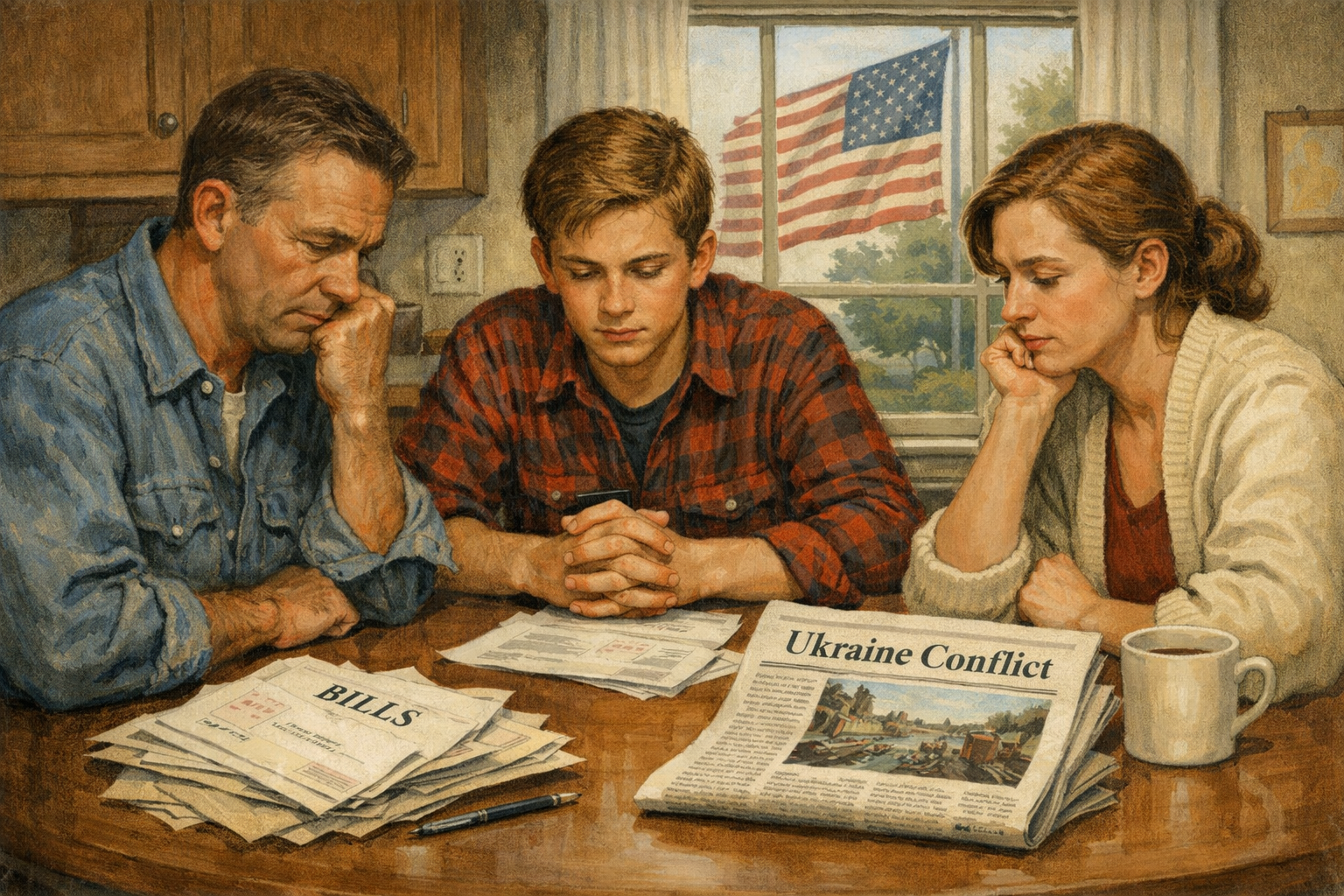
This is the war American voters are now being asked to fund, defend rhetorically, and morally interpret.
Why American Citizens Should Care
For many Americans, Ukraine feels distant—another foreign war in another part of the world.
That instinct is understandable. However, foreign conflicts involving major powers rarely stay contained.
The Ukraine–Russia war intersects directly with American interests in at least four critical ways: economic stability, national security, public trust in institutions, and precedent-setting global order.
First, the war has had measurable economic consequences for American households.
Energy prices spiked sharply following the invasion, especially in Europe, but global oil and natural gas markets are interconnected.
Policies that restrict domestic energy production while relying on unstable foreign suppliers amplify this vulnerability.
Food prices were also affected, as Ukraine is a major exporter of wheat, corn, and sunflower oil.
Disruptions in global supply chains translate into higher grocery bills in Indiana, Ohio, and Texas just as surely as in Berlin or Paris.
Second, the war raises fundamental questions about American military commitments.
Since 2022, the United States has sent tens of billions of dollars in military aid to Ukraine. This has occurred alongside recruitment shortfalls, aging equipment, and unresolved readiness concerns within the U.S. armed forces.
Voters reasonably ask whether America is strengthening its own defenses or stretching itself thin.
Third, public safety and geopolitical escalation are real concerns.
Russia is a nuclear-armed power. While direct NATO–Russia conflict has been avoided, miscalculation remains possible. Americans lived through the Cold War with a clear understanding that proxy wars carry risks of wider escalation. The Ukraine war has revived those anxieties for a new generation.
Fourth, and perhaps most important, the conflict forces Americans to confront questions of credibility and trust. If international agreements like the Budapest Memorandum are effectively meaningless, what incentive does any nation have to disarm? Conversely, if the United States is perceived as obligated to defend every signatory to every security assurance, voters must ask who decides where the line is drawn—and at what cost.
Metrics of Relevance to American Life
Polling consistently shows that Americans are divided on continued funding for Ukraine, with skepticism increasing over time, particularly among Republicans and independents.
Support is often strongest when framed as resisting Russian aggression, but declines when costs and timelines are emphasized.
Economically, Congress has authorized well over $100 billion in Ukraine-related assistance when military aid, humanitarian relief, and indirect support are combined. This spending competes with domestic priorities at a time of high inflation, rising national debt, and strained entitlement programs.
Institutionally, the war has reshaped NATO, expanded military cooperation, and hardened divisions between political parties at home. It has also become a proxy issue for broader debates about globalization, nationalism, and America’s role as a world policeman.
Historically, Americans have seen how overseas entanglements—Korea, Vietnam, Iraq, Afghanistan—begin with limited objectives and expand over time. Skepticism is not isolationism; it is a learned response to past experience.
The Nuclear Question and Deterrence
One of the most uncomfortable but unavoidable questions raised by the Ukraine war is whether Ukraine made a catastrophic mistake by relinquishing its nuclear weapons.
Nuclear arsenals have limited lifespans and require technical maintenance, but nations such as Pakistan and North Korea have managed to sustain deterrence under far worse conditions.
The implication is sobering: Ukraine disarmed in exchange for promises, not protection.
That reality is now being studied closely by regimes around the world. American voters should care because deterrence failures rarely stay foreign. They shape future wars, arms races, and security dilemmas that eventually involve U.S. forces and U.S. taxpayers.
Why This Issue Divides the Parties
The Ukraine–Russia conflict sits at the crossroads of competing American instincts: moral responsibility versus national interest, deterrence versus restraint, global leadership versus domestic renewal. Republicans and Democrats approach these tensions differently, often speaking past one another.
Some frame the war as a clear moral test: democracy versus authoritarianism. Others view it as a tragic but peripheral conflict that risks draining American strength while ignoring more direct threats, including China.
These disagreements are not merely tactical. They reflect deeper differences in worldview, trust in institutions, and interpretations of America’s proper role in the world—differences that voters must understand if they are to make informed decisions at the ballot box.
Articles in the Critical Issues series require more time to read than most content on this site. They are intentionally written as thorough, in-depth examinations of their subjects.
The Republican Perspective on the Ukraine–Russia Conflict
The Republican approach to the Ukraine–Russia conflict is best understood as fractured but principled.
Unlike the Democrat Party, which has largely moved in lockstep behind the Biden administration’s strategy, Republicans exhibit a visible internal debate. That debate is not accidental or chaotic; it reflects long-standing tensions within conservative foreign-policy thinking between interventionism, realism, and restraint.
What unites Republicans, however, is skepticism—skepticism about open-ended commitments, unchecked executive power, and the assumption that American taxpayers must indefinitely underwrite foreign wars without clearly defined national interests.
The 2024 Republican Party Platform and Ukraine
The 2024 Republican Party platform does not present Ukraine as an existential American obligation.
Instead, it frames foreign policy through the lens of America First realism, emphasizing border security, military readiness, and national sovereignty.
While the platform affirms opposition to Russian aggression and supports NATO allies, it avoids language that commits the United States to unlimited military or financial support for Ukraine.
Where Ukraine is addressed, the emphasis is placed on:
- Avoiding blank-check foreign aid
- Demanding accountability and transparency for U.S. funds
- Preventing escalation into direct U.S.–Russia conflict
- Prioritizing American defense readiness
This is a marked departure from the post-Cold War Republican consensus of the early 2000s. The platform reflects lessons learned from Iraq and Afghanistan: wars justified morally can still end disastrously if they lack strategic clarity.
Core Republican Arguments
Most Republicans begin from a shared premise: Russia’s invasion was wrong. There is little sympathy within the party for Vladimir Putin’s actions. The disagreement lies in what follows from that moral judgment.
Republicans generally raise four core concerns.
First, they question whether the Ukraine war constitutes a vital national interest of the United States. While Ukraine’s sovereignty matters, Republicans ask whether its defense rises to the level that justifies massive, ongoing U.S. expenditures while America’s own borders remain porous and its military recruitment numbers decline.
Second, Republicans object to the absence of a defined endgame. What constitutes victory? Is the goal the restoration of Ukraine’s pre-2014 borders? Regime change in Moscow? Permanent containment? Without answers, Republicans argue that America risks funding a war with no clear conclusion.
Third, Republicans emphasize oversight and accountability. Members of Congress have repeatedly raised concerns about corruption within Ukraine and the difficulty of tracking advanced weapons systems once they enter an active war zone. This concern is not theoretical; it reflects hard-won experience from previous conflicts.
Fourth, Republicans worry about escalation. Russia is not Iraq or Afghanistan. It is a nuclear-armed power with a history of brinkmanship. Republicans are particularly sensitive to rhetoric that blurs the line between supporting Ukraine and committing U.S. forces directly.
Congressional Republicans: Support with Conditions
Republican lawmakers in Congress broadly fall into two camps.
One camp supports aid to Ukraine but insists on conditions. Senators and Representatives in this group argue that limited assistance can weaken Russia without deploying American troops, but only if Congress retains control over funding levels and objectives. They favor measured support, allied burden-sharing, and strict auditing requirements.
Another camp is openly skeptical of continued aid. These lawmakers argue that the war has become a proxy conflict with no clear benefit to American citizens, especially when domestic crises—crime, inflation, border security—remain unresolved. They often point out that European nations, which face far greater direct risk from Russia, should bear the primary burden.
Importantly, neither camp supports Russian expansionism. The dispute is about means and priorities, not moral alignment with Moscow.
State and Local Republican Leadership
Republican governors and state officials have largely echoed congressional concerns.
While some states have supported humanitarian aid or accepted Ukrainian refugees, Republican leaders have resisted symbolic gestures that imply permanent commitment or moral absolutism.
At the state level, Republicans consistently emphasize:
- Fiscal responsibility
- Domestic infrastructure and public safety
- Energy independence
Many Republican governors argue that American energy production—rather than foreign military entanglements—offers a more sustainable way to weaken adversarial regimes by reducing global dependence on hostile exporters.
The Nuclear Question Revisited
Republicans are more willing than Democrats to confront the uncomfortable implications of Ukraine’s nuclear disarmament. Many conservatives argue that the Budapest Memorandum demonstrates a harsh truth: security assurances are not security guarantees.
This leads to a broader Republican concern about deterrence. If giving up nuclear weapons results in invasion rather than protection, Republicans warn that future adversaries will draw dangerous conclusions. This skepticism feeds resistance to moralistic foreign policy divorced from hard power realities.
Internal Republican Tensions
The Republican divide over Ukraine reflects a deeper philosophical shift within conservatism.
Traditional hawks emphasize deterrence, alliances, and global stability through strength. The newer populist wing emphasizes national sovereignty, domestic renewal, and strategic restraint. Both camps distrust utopian foreign policy but disagree on how active the United States should be abroad.
What unites them is a rejection of automatic interventionism and a demand that foreign policy serve clearly articulated American interests.
Summary of the Republican Position
In summary, Republicans generally:
- Condemn Russia’s invasion
- Support Ukraine’s right to self-defense
- Reject unlimited or open-ended U.S. involvement
- Demand accountability, clarity, and defined objectives
- Prioritize American national interest over ideological crusades
This position is often mischaracterized as isolationist. In reality, it reflects a sober reassessment shaped by decades of costly foreign entanglements and a desire to avoid repeating them.
The Democrat Perspective on the Ukraine–Russia Conflict
Democrats have approached the Ukraine–Russia war as a central test of American global leadership.
In their telling, the conflict is not merely a regional border dispute; it is an argument about whether the post–World War II order (and the credibility of U.S.-led alliances) still means anything when challenged by an authoritarian power.
That framing explains why Democrat leaders—more than Republicans—tend to speak in moral, civilizational language: democracy versus autocracy, rules versus conquest, freedom versus dictatorship. You can see that worldview explicitly in the Democratic platform’s “Strengthening American Leadership Worldwide” chapter, which casts the era as an “inflection point” between democracy and autocracy.
What Democrats Say They’re Doing (Their Own Words)
The clearest statement of the Democrat posture is in their 2024 platform’s Europe section, where they describe three “core objectives” in Ukraine:
- help Ukraine defend sovereignty,
- maintain unity in transatlantic alliances,
- prevent escalation into direct conflict with Russia.
They argue the U.S. has succeeded on all three, emphasizing military aid, diplomatic/economic support, sanctions, and coalition-building (“approximately 50 nations”). They also claim the effort supports U.S. jobs through defense industrial production and helps protect Ukraine’s civilians and energy infrastructure, while restoring agricultural exports to support global food security.
And Democrats connect Ukraine to a broader NATO revival—highlighting Finland and Sweden joining NATO and increased allied defense spending.
That’s the Democrat “story of the case”: America leads, allies unify, Russia is constrained, democracy is defended, and escalation is avoided.
The Biden Administration’s Pattern: Aid Packages and Public Messaging
In practice, the Biden administration repeatedly used major aid announcements to signal resolve and continuity. For example, late 2024 statements and releases publicly announced multi-billion-dollar security assistance packages as part of ongoing support for Ukraine’s defense.
On the legislative side, Democrats largely backed large supplemental appropriations for Ukraine. One notable measure in 2024 was H.R. 815 (Public Law 118-50), which provided FY2024 supplemental appropriations including assistance to Ukraine (alongside other priorities).
If you want it in plain English: Democrats have preferred large, centrally coordinated federal action, with the executive branch strongly shaping the strategy and Congress funding it.
The Democrat Coalition: Establishment, Institutions, and “Credibility”
Democrat rhetoric often returns to “credibility”—the idea that if the U.S. does not hold a line in Ukraine, adversaries will be emboldened elsewhere. This tends to mesh with:
- strong institutional trust (State Department, NATO, intelligence community),
- multilateralism (coalitions, sanctions regimes, partner coordination),
- and a preference for moral framing (democracy/autocracy).
It’s also why Democrats frequently highlight that they are not sending U.S. troops to fight Russia directly; avoiding escalation is part of their stated objectives.
The Money Question and Oversight: The Most Predictable Flashpoint
Even many Americans who sympathize with Ukraine still ask: How much, for how long, and with what accountability?
A U.S. government oversight portal summarizing appropriations reports that Congress appropriated $174.2 billion through five Ukraine supplemental acts enacted FY2022–FY2024 (with additional allocations from other sources).
Democrats generally defend this as necessary and strategic, particularly compared to the costs of a wider European war or a strengthened Russia. Republicans—and a growing number of independents—often see it as too large, too open-ended, and too poorly policed.
You can see the partisan split in public opinion: Pew Research (July 2024) found wide differences—Democrats were far more likely to say the U.S. is responsible for helping Ukraine defend itself, while Republicans were far more likely to say the U.S. is providing too much aid.
Where Critics Hit Democrats Hardest (and Why the Critique Lands)
From a conservative viewpoint—especially a “limited government + national interest first” outlook—Democrats are vulnerable on a few predictable points:
1) “Blank check” optics.
Even if Democrats argue there are controls, the perception of endless funding without a clear end stated fuels backlash.
2) Mission creep risk.
Democrats insist they are avoiding escalation, yet their own moral framing can paint the war as existential—making compromise politically harder later.
3) Domestic neglect argument.
When Americans are worried about inflation, border security, fentanyl, and rising debt, Democrats are exposed to the charge that they will spend extravagantly overseas while demanding sacrifices at home.
4) Institutional trust gap.
Democrats lean heavily on institutional expertise. After years of “trust the experts” controversies in other domains, many voters no longer grant that credibility automatically.
None of these critiques require sympathy for Russia. They’re arguments about governance, prudence, and priorities.
The Democrat Bottom Line
In summary, Democrats generally:
- frame Ukraine as a major test of global order and U.S. leadership,
- prioritize alliance unity and sanctions,
- support substantial military and economic aid,
- emphasize avoiding direct U.S.–Russia war while materially backing Ukraine,
- and treat victory/containment as strategically necessary to deter future aggression.
The Libertarian Position on the Ukraine–Russia Conflict
The Libertarian position on the Ukraine–Russia war is best described as principled non-interventionism.
Libertarians are not a major governing force in American politics, but their arguments are influential—especially among younger voters, some independents, and a subset of Republicans who are weary of foreign entanglements.
This section is included for completeness and contrast, not because Libertarians shape U.S. foreign policy in any decisive way.
The Libertarian Party Platform and Foreign Policy
The Libertarian Party’s most recent platform is unambiguous on foreign conflicts. It rejects what it calls “foreign interventionism” and opposes U.S. involvement in wars that are not directly defensive.
Applied to Ukraine, Libertarians argue that:
- The United States should not fund or fight foreign wars.
- NATO expansion provoked predictable Russian reactions.
- Military alliances entangle the U.S. in conflicts unrelated to core national defense.
- War spending diverts resources from domestic liberty and prosperity.
Unlike Republicans and Democrats, Libertarians do not frame Ukraine primarily in moral or civilizational terms. Their concern is structural: government power grows during war, civil liberties shrink, and the costs are socialized across taxpayers who had no say in the decision.
Libertarian Moral Reasoning (and Its Limits)
Libertarians typically condemn Russia’s invasion as immoral while simultaneously denying that the United States has any obligation to intervene. Their moral reasoning emphasizes:
- National self-determination
- Opposition to aggression
- Individual liberty over collective geopolitical goals
However, Libertarians draw a sharp line between moral judgment and political obligation. A wrong committed abroad does not automatically justify U.S. military or financial involvement.
This is where Libertarians diverge sharply from Democrats and, to a lesser extent, Republicans.
The Nuclear and Deterrence Question: A Libertarian Blind Spot
One of the weakest aspects of the Libertarian approach is its handling of deterrence.
By minimizing the role of power balances, Libertarians often underplay the consequences of failed deterrence.
The Ukraine case illustrates the problem. If nuclear disarmament followed by invasion becomes the lesson of history, future regimes may pursue nuclear weapons more aggressively. Libertarian theory offers little guidance on how to prevent this dynamic beyond exhortations to non-aggression.
In practice, power vacuums are rarely neutral.
Why Libertarians Remain Marginal on This Issue
Libertarians raise legitimate concerns about war powers, spending, and civil liberties. However, their unwillingness to engage questions of global power politics leaves them ill-equipped to address conflicts involving nuclear-armed states.
As a result, their influence on Ukraine policy has been indirect—shaping skepticism rather than policy.
Summary of the Libertarian Position
In brief, Libertarians:
- Oppose U.S. military and financial involvement in Ukraine
- Reject NATO expansion and alliance commitments
- Emphasize domestic liberty over international order
- Align tactically with Republican skeptics but diverge philosophically
- Offer limited tools for addressing deterrence and escalation risks
This position appeals to voters deeply distrustful of federal power, but it does not provide a governing framework for managing a world where hostile powers actively test boundaries.
Progressivism and How It Shapes the Democrat Approach to the Ukraine–Russia Conflict
To understand the modern Democrat position on the Ukraine–Russia war, it is not enough to read the party platform or listen to official statements.
One must also understand the Progressive worldview—often described, imperfectly but recognizably, as Progressivism (wokeness, Cultural Marxism, political correctness, Neo-Marxism)—that increasingly frames how Democrats interpret international events.
This worldview does not operate primarily at the level of military tactics. It operates at the level of presuppositions: assumptions about power, morality, history, and human nature.
Those assumptions strongly influence how Democrats interpret Russia, Ukraine, America, and the meaning of “justice” on the global stage.
Progressivism’s Moral Framework
At its core, Progressivism divides the world into oppressors and oppressed. This lens, originally developed in domestic social theory, has been exported into foreign policy thinking.
Under this framework:
- Powerful nations are presumed suspect.
- Historical “hegemons” are presumed guilty.
- Moral legitimacy flows from perceived victimhood.
In the Ukraine conflict, this framework produces an apparently straightforward narrative: Russia is the oppressor; Ukraine is the oppressed.
That much aligns with observable facts. The problem is not the initial moral recognition—it is the selective and asymmetrical application of the framework.
Progressive thinking tends to stop asking hard questions once an “oppressed” label has been assigned.
Complexity is flattened. Tradeoffs are moralized. Any call for restraint or negotiation risks being framed as complicity with evil.
How Progressivism Interprets Power
Traditional realism treats power as morally neutral but dangerous.
Progressive ideology treats power as morally tainted by default.
This leads to two tensions in Democrat policy.
First, Progressives distrust American power in theory while relying on it in practice.
They often describe the United States as historically exploitative, colonial, or unjust—yet demand that it act as the enforcer of global morality.
Second, Progressive rhetoric frequently ignores secondary and tertiary consequences. Sanctions, military aid, and escalation are treated as moral gestures rather than complex instruments with unpredictable outcomes.
This helps explain why Democrat leaders are often rhetorically maximalist (“stand with Ukraine as long as it takes”) while strategically vague about endpoints.
The Institutional Reflex
Progressivism places heavy trust in transnational institutions—the United Nations, NATO, international courts, NGOs, and global governance frameworks.
These institutions are viewed as morally superior to national governments, particularly democratic nation-states rooted in tradition or religion.
As a result, Democrat leaders often frame Ukraine policy in terms of:
- defending “the rules-based international order,”
- upholding global norms,
- preserving institutional credibility.
The assumption is that institutional consensus equals moral legitimacy. Dissent is treated as backward, selfish, or parochial rather than prudential.
For voters skeptical of bureaucratic authority—especially after recent domestic controversies—this institutional reflex feels detached from reality.
Language as Moral Shield
Progressive rhetoric is highly sensitive to language. Words are used not merely to describe reality but to shape permissible thought.
In the Ukraine debate:
- Calls for negotiation are often framed as “appeasement.”
- Cost concerns are framed as “abandoning democracy.”
- Skepticism is framed as “Russian talking points.”
This pattern discourages honest debate. It functions as a moral shield, protecting policy from scrutiny by equating disagreement with immorality.
For many Americans, this rhetorical posture feels familiar. It mirrors domestic debates where dissent is pathologized rather than answered.
The Selectivity Problem
One of the most damaging effects of Progressive foreign policy thinking is selective outrage.
Not all invasions provoke the same response. Not all wars receive equal attention. Not all victims are treated equally.
This selectivity erodes credibility. Voters notice when moral clarity appears only where it aligns with ideological or institutional priorities.
Republicans often seize on this inconsistency, arguing that Democrat outrage is performative rather than principled.
Whether or not one agrees with that charge, it resonates because the pattern is visible.
Progressivism and the Suppression of Prudence
Prudence—careful judgment under uncertainty—has historically been a conservative virtue. Progressive ideology often treats prudence as moral weakness.
In the Ukraine context, this produces:
- resistance to discussing off-ramps,
- discomfort with acknowledging limits,
- suspicion toward realism and restraint.
Yet wars end either by negotiation or exhaustion. Moral absolutism can delay both.
Why This Matters Politically
Progressive assumptions shape not only policy but how disagreement is handled. Voters who raise legitimate concerns about costs, escalation, or domestic priorities are often dismissed rather than persuaded.
This has contributed to declining trust in Democrat leadership on foreign policy—even among voters who oppose Russian aggression.
Summary of Progressive Influence
Progressivism:
- frames the conflict in moral binaries,
- emphasizes institutional legitimacy over national interest,
- moralizes dissent and minimizes tradeoffs,
- relies on American power while distrusting it philosophically,
- and discourages prudential debate.
This worldview deeply informs Democrat leadership’s posture on Ukraine, even when it is not explicitly acknowledged.
Do Democrat Actions Match Their Platform? Rhetoric Versus Reality Under Democrat Leadership
“In politics, what you DO is what you believe. Everything else is cottage cheese.”
—Senator Joseph P. Kennedy
This quotation is an appropriate entry point for examining the gap—if any—between Democrat rhetoric on Ukraine and the actions taken by Democrat leadership, particularly under the Biden administration.
Party platforms are aspirational documents. Governing records are evidentiary. When the two diverge, voters are entitled to draw conclusions.
What the Democrat Platform Claims
As noted earlier, the Democrat platform emphasizes three core commitments regarding Ukraine:
- Supporting Ukraine’s sovereignty and territorial integrity
- Maintaining alliance unity and international legitimacy
- Avoiding direct military confrontation between the U.S. and Russia
On paper, this sounds measured. It presents the image of disciplined leadership: firm but restrained, moral but cautious.
The question is whether actions, language, and enforcement mechanisms actually reflect this balance.
The Reality of Executive-Centered Decision-Making
In practice, Ukraine policy under the Biden administration was highly centralized in the executive branch. Major aid packages were announced by the White House first, with Congress reacting after the fact under political pressure to “stand with Ukraine.”
This pattern raised concerns even among lawmakers nominally supportive of Ukraine. The repeated use of emergency funding mechanisms and supplemental bills limited ordinary budget scrutiny. Oversight provisions existed, but enforcement was inconsistent and often opaque to the public.
From a constitutional perspective, this approach reflected a broader Democrat tendency: expand executive discretion during perceived crises, then normalize that expansion.
Rhetorical Escalation Versus Strategic Restraint
Democrat leaders frequently insisted they avoided escalation. At the same time, their rhetoric was often maximalist.
Phrases such as:
- “as long as it takes,”
- “Ukraine must win,”
- “Russia must not be allowed to succeed,”
sound decisive but were strategically ambiguous. They raised expectations without defining victory conditions or acceptable compromise.
This matters because rhetoric shapes policy momentum. When leaders speak in absolute moral terms, it becomes politically difficult to pursue negotiated outcomes later—even if circumstances demand it.
Accountability and the Corruption Question
Democrats acknowledged that corruption exists in Ukraine, but they tended to treat it as a secondary concern, subordinate to the overriding moral imperative of resistance.
This stood in tension with their domestic posture, where Democrats routinely insisted on:
- exhaustive compliance standards,
- equity audits,
- financial transparency,
- and zero tolerance for misuse of funds.
The inconsistency is obvious to voters. If Democrats demand strict accountability from American citizens, small businesses, churches, and parents—but apply looser standards to foreign aid recipients—credibility suffers.
This is not an argument against helping Ukraine. It is an argument against double standards.
Standards Applied to Others Versus Themselves
Democrat leaders are quick to accuse critics of Ukraine policy of:
- spreading misinformation,
- undermining democracy,
- or parroting foreign propaganda.
Yet those same leaders resist meaningful debate about:
- opportunity costs,
- long-term escalation risks,
- or domestic tradeoffs.
This asymmetry reinforces the perception that Democrat leadership believes intentions excuse outcomes. If the cause is declared righteous, scrutiny becomes suspect.
That is a dangerous posture in a constitutional republic.
Progressive States and Cities as Case Studies
The governance style seen in Ukraine policy mirrors patterns visible in Progressive-led states and cities such as California, New York, Illinois, Oregon, Washington State, and cities like Los Angeles, Portland, Seattle, Chicago, and Washington, D.C.
In these jurisdictions, leaders often:
- announce sweeping moral objectives,
- downplay costs and unintended consequences,
- stigmatize dissent,
- and rely on administrative discretion rather than democratic consensus.
Ukraine policy reflects the same governing instinct—scaled up to the international level.
Authoritarian Drift: Soft, Not Hard
It would be inaccurate to claim Democrats have embraced overt authoritarianism. The pattern is subtler.
What emerges is soft authoritarianism:
- narrowing acceptable opinion,
- using moral language to silence debate,
- centralizing decision-making,
- and dismissing critics as illegitimate.
This approach does not require jackboots. It requires institutions, media alignment, and moral certainty.
Does Democrat Leadership Betray Its Platform?
The Democrat platform promises restraint, accountability, and coalition-based leadership. In practice:
- restraint is rhetorical but not operational,
- accountability is promised but inconsistently enforced,
- coalition leadership often masks executive unilateralism.
The result is a growing gap between what Democrats say and what they do.
Summary Judgment
Measured against their own standards, Democrat leadership:
- governs Ukraine policy through executive dominance,
- escalates rhetorically while avoiding clarity,
- applies inconsistent accountability standards,
- marginalizes dissent,
- and relies on moral framing to shield policy from scrutiny.
For voters who value transparency, constitutional process, and prudence, this gap is not trivial. It is decisive.
How Each Party Criticizes the Other—and Which Criticisms Actually Land
By this point, the reader can see that the Ukraine–Russia conflict has become more than a foreign policy dispute.
It is a proxy battle over trust, competence, priorities, and worldview.
In this section, we step back and examine how Republicans and Democrats criticize one another—and which criticisms withstand serious scrutiny.
This matters because voters are not choosing between abstract theories. They are choosing between governing coalitions, each with a record, instincts, and blind spots.
Democrat Criticisms of Republicans
Democrats tend to level four main accusations against Republicans regarding Ukraine.
First, that Republicans are “soft on Russia.”
Democrats often suggest that skepticism toward Ukraine aid amounts to sympathy for Vladimir Putin. This charge is rhetorically effective but intellectually weak. Republicans overwhelmingly condemn Russia’s invasion. Their disagreement is about American involvement, not Russian innocence.
This criticism lands emotionally but fails logically.
Second, that Republicans are abandoning democracy.
Democrats frame Ukraine as a frontline defense of democracy itself. Republicans who question funding or escalation are accused of undermining democratic values.
The flaw here is overreach. Not every conflict involving a non-democratic regime is existential to American democracy. When everything becomes a “defining battle,” voters become numb.
Third, that Republicans lack moral clarity.
This argument assumes that moral clarity requires maximal involvement. Republicans counter that moral clarity without prudence is reckless. History supports their caution.
Fourth, that Republican skepticism emboldens adversaries.
Democrats argue that hesitation signals weakness to Russia, China, and Iran. Republicans respond that fiscal discipline, energy independence, and military readiness signal strength more credibly than slogans.
This critique partially lands only if one assumes unlimited resources and public trust—assumptions that no longer hold.
Republican Criticisms of Democrats
Republicans aim their criticisms at governance rather than morality.
First, the “blank check” charge.
Republicans argue Democrats have authorized massive spending without a clear end state or transparent oversight. This criticism resonates strongly with voters, especially amid inflation and rising debt.
This critique lands.
Second, mission creep and escalation risk.
Republicans warn that Democrat rhetoric creates pressure to escalate even when strategy is unclear. Historical analogies to Vietnam and Afghanistan reinforce this concern.
This critique lands.
Third, misplaced priorities.
Republicans argue that Democrats are more willing to secure Ukraine’s border than America’s. Whether one agrees or not, the contrast is politically potent.
This critique lands.
Fourth, institutional arrogance.
Republicans accuse Democrats of assuming voters must simply “trust the experts.” After recent domestic failures, that posture has lost persuasive power.
This critique lands decisively.
Tone-Deaf Statements That Undermine Credibility
Both parties have made statements that damaged their credibility.
On the Democrat side, repeated use of phrases like “as long as it takes” without clarification has alienated voters who want limits and accountability. Similarly, dismissing skeptics as “misinformed” or “Putin-aligned” has hardened opposition rather than persuading it.
On the Republican side, a small number of figures have spoken too casually about abandoning Ukraine altogether, reinforcing Democrat caricatures. These statements, though not representative, provide ammunition to critics.
Tone matters. Voters notice when leaders appear detached from cost, consequence, or nuance.
Where Honest Interlocutors Agree
Despite partisan conflict, there is notable overlap among serious observers:
- Russia’s invasion was unjustified.
- Ukraine has the right to self-defense.
- Nuclear escalation must be avoided.
- Open-ended war is undesirable.
- American public trust is fragile.
The disagreement is not about whether the situation is tragic, but about how much responsibility the United States bears and how long that responsibility lasts.
Counter-Responses That Actually Work
Republicans strengthen their case when they:
- clearly distinguish restraint from isolationism,
- articulate concrete national interests,
- and affirm humanitarian concern without moral grandstanding.
Democrats strengthen their case when they:
- define measurable objectives,
- acknowledge tradeoffs honestly,
- and stop treating skepticism as immorality.
The party that regains trust will be the one that treats voters as adults rather than moral children.
Summary of the Clash
Democrat criticisms of Republicans rely heavily on moral framing and fear of weakness. Republican criticisms of Democrats rely on governance, accountability, and prudence.
At this stage of American political life, governance arguments tend to carry more weight.
Credible Suspicions About Party Strategies and Motives
At this stage, reasonable Americans—without indulging conspiracy theories—can still ask sober questions about incentives, political benefit, and strategic positioning.
Politics does not occur in a vacuum. Parties pursue policies not only because they believe them to be right, but also because those policies align with institutional interests, donor bases, ideological commitments, and electoral strategies.
This section does not allege hidden cabals or secret plots. It examines credible suspicions—the kind that arise naturally when patterns of behavior repeat.
Suspicions Regarding Democrat Strategy
Several suspicions arise from Democrat leadership’s approach to Ukraine.
First, foreign policy as moral branding.
Ukraine allows Democrats to present themselves as defenders of democracy on the world stage at a time when they face skepticism about governance at home. Moral clarity abroad can function as a substitute for competence domestically.
This does not make the policy insincere—but it does create an incentive to maintain a morally charged narrative even when conditions change.
Second, institutional alignment and bureaucratic momentum.
Democrats are closely aligned with the national security bureaucracy, international NGOs, and global governance institutions. These entities benefit from sustained engagement, funding, and relevance. Long conflicts justify expanded budgets, new offices, and permanent programs.
Bureaucracies, once mobilized, rarely argue for their own contraction.
Third, political insulation through complexity.
Foreign policy—especially overseas war—is complex. Complexity shields decision-makers from direct accountability. Voters may feel morally compelled to support “the cause” even when they do not understand the mechanics.
This dynamic favors the party more comfortable governing through administrative expertise rather than popular consent.
Fourth, deflection from domestic fractures.
A unifying foreign enemy can temporarily mute internal party divisions. Ukraine policy has allowed Democrats to rally factions that otherwise disagree sharply on domestic issues such as crime, education, and energy.
This incentive should not be ignored.
Suspicions Regarding Republican Strategy
Republicans are not immune to strategic calculation.
First, populist signaling.
Skepticism toward Ukraine plays well with voters who are frustrated by inflation, immigration failures, and perceived elite indifference. Some Republicans may emphasize restraint less out of strategic analysis and more out of political resonance.
This does not invalidate their arguments—but it does color their presentation.
Second, coalition management.
The Republican Party is balancing traditional defense hawks with a newer populist base. Expressing skepticism toward foreign wars helps maintain unity without requiring full withdrawal from NATO or global engagement.
This can lead to cautious or ambiguous messaging.
Third, reaction to Democrat overreach.
Some Republican positions are shaped more by opposition than by first principles. When Democrats frame Ukraine as an existential moral crusade, Republicans instinctively push back—even where limited agreement might exist.
Political reflex sometimes replaces strategic coherence.
What Both Parties Avoid Saying
Both parties tend to avoid openly discussing certain realities.
- That wars often end in negotiation, not total victory.
- That public tolerance for foreign conflict is finite.
- That economic pain at home changes moral calculus.
- That deterrence failures send dangerous signals globally.
Silence on these points preserves political flexibility—but at the cost of honesty.
Tone-Deaf Statements as Clues
Tone-deaf statements often reveal underlying motives more clearly than formal policy documents.
When Democrat leaders speak as though cost concerns are morally suspect, it suggests a priority on narrative preservation over democratic consent.
When Republican figures speak dismissively about Ukraine’s survival, it suggests an overcorrection driven by domestic anger rather than strategic clarity.
Voters notice both.
The Role of Donors and Defense Interests
While simplistic “military-industrial complex” accusations are often overused, it would be naïve to ignore the role of defense contractors, lobbying, and regional economic interests.
Democrats are more comfortable defending industrial policy tied to defense spending. Republicans are more divided—supportive of military strength but wary of entanglements that enrich contractors without clear strategic gain.
Neither party is immune to these pressures.
Summary of Strategic Motives
In sum:
- Democrats benefit from moral framing, institutional alignment, and executive control.
- Republicans benefit from populist skepticism, domestic focus, and opposition to elite consensus.
- Both parties sometimes subordinate long-term strategy to short-term political advantage.
Recognizing these incentives does not require cynicism. It requires maturity.
High-Trust and Low-Trust Societies—and Why Trust Shapes the Ukraine Debate
The debate over Ukraine cannot be separated from a deeper problem facing the United States: the erosion of trust.
Trust is the invisible infrastructure of any society. When trust is high, citizens tolerate sacrifice, accept uncertainty, and defer to authority in limited circumstances. When trust is low, even sound policies face resistance.
The Ukraine–Russia conflict has unfolded during a period of historically low institutional trust in America. That fact alone explains much of the political friction surrounding it.
What Is a High-Trust Society?
A high-trust society is one in which citizens broadly believe that:
- leaders act in good faith,
- institutions are competent and honest,
- rules are applied consistently,
- and sacrifices are shared fairly.
Post–World War II America was largely high-trust. Citizens accepted rationing, military drafts, and international commitments because leadership credibility was high and outcomes were visible.
America’s Shift Toward Low Trust
Over recent decades, repeated failures have eroded that confidence:
- prolonged wars with unclear outcomes,
- financial crises caused by elite mismanagement,
- inconsistent enforcement of laws,
- politicization of institutions,
- and repeated “expert” failures without accountability.
This erosion did not begin with Ukraine—but it defines how Ukraine is perceived.
How Low Trust Changes the Ukraine Conversation
In a low-trust environment, citizens do not ask only:
“Is this morally right?”
They ask:
“Who benefits?”
“What are they not telling us?”
“Why should I believe this time is different?”
Democrats often assume trust that no longer exists. Republicans often channel suspicion that sometimes overshoots.
The result is polarization.
Republican Suspicion in a Low-Trust Context
Republicans tend to interpret Democrat Ukraine policy through a lens of institutional distrust. They suspect:
- executive overreach,
- manipulation of moral language,
- selective enforcement of standards,
- and concealed long-term commitments.
Whether these suspicions are fully justified is less important than the fact that they are rational within a low-trust environment.
Democrat Denial of the Trust Problem
Democrats often misread skepticism as ignorance or malice. This is a strategic mistake.
When leaders respond to doubt with scolding rather than explanation, trust erodes further. Appeals to authority fail when authority itself is in question.
This dynamic has been visible across multiple policy domains—not just foreign affairs.
Trust and Sacrifice
Foreign wars require sacrifice—financial, emotional, and sometimes military. Sacrifice cannot be compelled indefinitely in a low-trust society.
This explains why:
- support for Ukraine declines as costs rise,
- demands for clarity increase,
- and tolerance for ambiguity decreases.
Trust is not a luxury; it is a prerequisite.
The Immigration Parallel (Without Confusion)
Just as Republicans suspect Democrats of strategic motives regarding immigration policy, they apply similar skepticism to Ukraine policy—not because the issues are identical, but because the pattern of governance feels familiar.
In both cases, voters perceive:
- moral justification paired with administrative opacity,
- dismissal of dissent,
- and downstream consequences borne by ordinary citizens.
Patterns matter.
Summary of the Trust Problem
The Ukraine debate is not only about Russia or Ukraine. It is about whether Americans still believe their leaders tell them the truth.
Until trust is rebuilt, even defensible policies will face resistance.
Media Distortion and the Ukraine–Russia Conflict
Any serious examination of the Ukraine–Russia war must account for the role of the American media. Media institutions do not merely report events; they frame them. In a low-trust society, that framing can either clarify reality or deepen suspicion. On Ukraine, the dominant media posture has too often done the latter.
This section is not an argument that journalists are secretly coordinated or uniformly malicious. It is an argument that systemic bias, narrative incentives, and ideological alignment have produced consistent distortions—particularly to the disadvantage of Republican and conservative perspectives.
The Dominant Media Narrative
Mainstream media coverage has largely adopted the Democrat framing of the conflict:
- Ukraine as the frontline of democracy,
- U.S. leadership as morally necessary,
- skepticism as suspect or irresponsible,
- and escalation concerns as overblown.
This narrative is repeated with remarkable uniformity across major networks, national newspapers, and cable news outlets. Dissenting voices are not absent, but they are marginalized, framed defensively, or associated with fringe elements.
Uniformity should always prompt scrutiny.
How Republican Positions Are Distorted
Republican skepticism is frequently presented as one of three things:
- Isolationism
- Putin sympathy
- Ignorance of history
None of these accurately describes the mainstream Republican position. Republicans are not arguing that America should withdraw from the world. They are arguing for limits, accountability, and prioritization.
By collapsing prudential concerns into moral failure, media coverage discourages substantive debate.
The “Talking Points” Smear
One of the most corrosive media habits has been the insinuation that Republican critiques echo “Russian talking points.” This rhetorical move does not rebut arguments; it delegitimizes speakers.
The effect is chilling. Elected officials become hesitant to raise legitimate questions for fear of reputational damage. Voters interpret the smear as evidence that something is being hidden.
In a free society, disagreement is not disloyalty.
Democrat Blind Spots Soft-Pedaled
While Republican skepticism is scrutinized aggressively, Democrat failures receive softer treatment.
Examples include:
- limited follow-up on oversight mechanisms,
- minimal investigation into aid accountability,
- little pressure to define victory conditions,
- acceptance of vague language from executive officials.
The press often treats Democrat assurances as sufficient, even when similar claims would be interrogated harshly if made by Republicans.
This asymmetry is visible and corrosive.
Moral Language as a Media Shortcut
Media outlets frequently rely on moral language—“defending democracy,” “standing up to tyranny”—as a substitute for detailed analysis.
Moral clarity sells. Complexity does not.
But wars are complex. When moral framing replaces strategic explanation, citizens are encouraged to feel rather than think. That may mobilize short-term support, but it undermines long-term legitimacy.
The Consequence: Distrust Compounds
When media coverage aligns too closely with one party’s narrative, it accelerates distrust. Skeptical voters do not become persuaded; they become alienated.
This dynamic reinforces polarization:
- Democrats trust the media and dismiss critics.
- Republicans distrust the media and discount even accurate reporting.
The casualty is shared reality.
Summary of Media Distortion
The media has:
- exaggerated Republican extremism,
- minimized Democrat accountability gaps,
- relied heavily on moral framing,
- and discouraged open debate.
In doing so, it has contributed to the very distrust that now complicates Ukraine policy.
A Biblical Perspective on the Ukraine–Russia Conflict
A biblical approach to international conflict does not begin with party platforms, polling data, or media narratives.
It begins with God’s revealed truth about human nature, authority, justice, and the limits of earthly power.
Scripture neither endorses utopian globalism nor isolationist indifference. It calls for moral clarity joined to prudence.
This section does not argue that Scripture gives a detailed foreign policy blueprint.
It does argue that Scripture provides moral guardrails within which Christians must think.
The Reality of Human Sin and the Limits of Power
The Bible is unsentimental about human nature.
Nations are composed of fallen people. Rulers are not neutral arbiters of justice; they are moral actors accountable to God.
Scripture repeatedly warns against trusting princes or assuming righteousness flows automatically from authority (Psalm 146:3). This applies equally to Moscow, Kyiv, Washington, and Brussels.
This realism aligns more closely with the conservative instinct than with Progressive optimism about institutions.
Just War Principles: Moral Clarity Without Naivety
Christian theology has long recognized the concept of just war, which includes:
- legitimate authority,
- just cause (such as defense against aggression),
- proportionality,
- and reasonable chance of success.
Ukraine clearly meets the standard of just defense. Russia does not.
However, just war theory also warns against open-ended violence divorced from achievable ends. Moral outrage does not suspend prudential judgment.
Christians may affirm Ukraine’s right to defend itself while still questioning whether unlimited American involvement is wise or just.
The State’s Role and Its Boundaries
Romans 13 teaches that governing authorities exist to restrain evil and preserve order.
However, that mandate is limited and local.
Scripture does not assign the U.S. government responsibility for enforcing justice everywhere on earth.
Nations have particular obligations to their own people. A government that neglects its citizens while pursuing moral projects abroad violates its stewardship.
This principle undercuts the Democrat tendency to universalize American responsibility.
Peace as a Moral Good—Not a Moral Surrender
The Bible commends peace (Romans 12:18), but not at the expense of truth or justice. Peace achieved by rewarding aggression is not peace at all. At the same time, perpetual war is not righteousness.
Christians should resist simplistic binaries:
- “Fight forever or betray justice”
- “Negotiate and surrender”
Wars end through complex processes. Seeking peace is not appeasement; it is obedience to biblical wisdom.
Alignments With Political Parties
When measured against biblical principles, biblical Christians tend to align more closely with the Republican position on this issue—not because Republicans are consistently righteous, but because their framework better accounts for:
- human sin,
- limits of power,
- national stewardship,
- and prudential restraint.
Democrats tend to moralize power without adequately acknowledging its dangers. Libertarians tend to minimize the reality of evil and coercion.
Republicans, at their best, occupy a middle ground—recognizing evil while resisting hubris.
Worldview Differences That Matter
The biblical worldview:
- sees history as fallen but purposeful,
- treats power as dangerous but sometimes necessary,
- values justice tempered by wisdom,
- and recognizes accountability before God.
Progressive ideology trusts institutions too much. Libertarian ideology distrusts authority too much. The biblical worldview navigates between these extremes.
Summary of the Biblical Perspective
From a biblical standpoint:
- Russia’s invasion is unjust.
- Ukraine’s self-defense is legitimate.
- American involvement must be limited, accountable, and prudent.
- Moral clarity must not eclipse wisdom.
- Peace should be pursued without rewarding evil.
This framework explains why biblical Christians generally find the Republican posture more compatible with Scripture.
Encouraging the Christian Voter—How to Weigh the Ukraine–Russia Conflict at the Ballot Box
For the Christian voter, the Ukraine–Russia conflict must be evaluated within a broader moral hierarchy.
Scripture does not permit single-issue absolutism in foreign policy, nor does it allow disengagement from moral reasoning in the public square.
Voting is a matter of stewardship, not sentiment.
This section is not a call to emotional reaction, but to disciplined moral judgment.
Voting as Moral Stewardship
Christians are called to exercise judgment informed by truth, wisdom, and humility. When believers vote, they are not endorsing a person’s entire character or platform in every detail; they are choosing among fallen options while seeking the greatest good and least harm.
Scripture affirms that rulers are accountable for how they wield authority (Proverbs 29:2). While the Bible does not command Christians to vote, when voting is available, it becomes one of the means by which believers may seek the welfare of their nation.
Weighing Foreign Policy Among Competing Moral Claims
The Ukraine war is serious—but it is not the only moral issue confronting voters. Mature Christian reasoning requires weighting issues appropriately, not flattening them into a single emotional scale.
For example:
- The protection of innocent life (abortion) carries greater moral weight than taxation or foreign aid levels.
- National security and border integrity directly affect the government’s God-given duty to protect its people.
- Foreign conflicts must be evaluated alongside domestic justice, economic stability, and religious liberty.
A party that is right on Ukraine but hostile to foundational biblical values elsewhere presents a grave dilemma.
Why Biblical Christians Tend to Vote Republican
While no party perfectly reflects biblical ethics, the Republican Party remains significantly more open to candidates and voters who hold a biblical worldview. On Ukraine specifically, Republicans are more likely to:
- insist on limits and accountability,
- resist moral absolutism detached from prudence,
- and prioritize national stewardship.
More broadly, Republicans defend positions aligned with biblical teaching on life, family, and the role of the state.
This does not mean every Republican position is correct. It does mean that, as a rule, Christians seeking coherence between faith and public policy will find fewer conflicts within the Republican coalition.
Scripture and Political Discernment
Christians are warned against being swept away by rhetoric that sounds righteous but lacks wisdom. Scripture exhorts believers to test claims, weigh consequences, and avoid deception (1 Thessalonians 5:21).
A candidate’s tone, accountability, and respect for limits matter. Foreign policy conducted through moral intimidation rather than honest persuasion should raise concern.
Avoiding False Guilt and False Neutrality
Some Christians are pressured to support policies out of fear of appearing unloving or indifferent to suffering. Scripture rejects this manipulation. Compassion does not require imprudence.
At the same time, Christians should avoid retreating into apathy. Neutrality in the face of moral questions is itself a moral choice.
Summary Guidance for the Christian Voter
In evaluating Ukraine:
- affirm justice without embracing recklessness,
- demand accountability without denying compassion,
- and refuse moral blackmail that treats disagreement as sin.
Vote for candidates whose worldview most closely aligns with biblical truth across the full range of issues—not merely the loudest one.
The Christian’s Duty to Seek the Welfare of the Nation
Christian responsibility does not begin or end at the ballot box. Voting is important, but it is only one expression of a broader biblical mandate: to seek the good of the community in which God has placed us. Scripture presents civic engagement as a means, not an idol.
This section broadens the lens beyond elections and places political participation within a larger framework of Christian obedience.
Seeking the Welfare of the City
The prophet Jeremiah instructed God’s people in exile to “seek the welfare of the city where I have sent you” (Jeremiah 29:7). That command did not depend on the righteousness of the rulers or the moral purity of the surrounding culture. It assumed engagement under imperfect conditions.
For Christians in modern democracies, this includes:
- informed participation in civic life,
- prayerful discernment,
- and responsible use of lawful means to influence public affairs.
Foreign policy decisions, including those involving Ukraine, affect national stability, economic conditions, and the lives of citizens. Christians may not ignore them simply because they are complex or distant.
Voting as One Tool Among Many
Voting is significant, but it is not sufficient by itself. Christians also serve their nation by:
- praying for leaders (1 Timothy 2:1–2),
- speaking truth in public discourse,
- supporting relief efforts where appropriate,
- raising morally informed families,
- and maintaining faithful churches that form consciences.
These activities shape culture more deeply than any single election.
Christian Liberty and Conscience
Scripture recognizes that faithful believers may arrive at different conclusions on matters not explicitly commanded or forbidden. Romans 14 affirms liberty of conscience where Scripture does not bind.
Some Christians may conclude that participation in voting violates their conscience. That position, while uncommon, is not unbiblical. It should be respected, not mocked or coerced.
Others may vote reluctantly, viewing it as a tragic necessity rather than a moral triumph. That posture reflects realism, not apathy.
Unity Without Uniformity
Christians must resist the temptation to equate political disagreement with spiritual rebellion. The church is not a political party, and its unity is not grounded in foreign policy consensus.
At the same time, unity does not require silence. Faithful believers may speak clearly and firmly about justice, prudence, and stewardship without questioning one another’s salvation.
A Warning Against Political Messianism
Scripture warns against placing ultimate hope in human rulers (Psalm 146:3). No election, alliance, or foreign policy strategy will usher in the kingdom of God.
Christians should participate fully in public life while remembering that Christ’s reign is not dependent on geopolitical outcomes.
Summary of the Christian’s Civic Duty
The Christian seeks the welfare of the nation by:
- engaging wisely,
- voting responsibly when conscience permits,
- praying faithfully,
- and refusing despair or triumphalism.
Ukraine matters. America matters more. Christ matters most.
Key Takeaways and Concluding Summary
After examining the Ukraine–Russia conflict from historical, political, moral, and biblical angles, several conclusions become clear. The issue is complex, emotionally charged, and frequently oversimplified. Voters are often pressured to choose between caricatures rather than carefully reasoned positions.
This section distills the core takeaways.
Republican Position — Condensed
Republicans generally:
- Condemn Russia’s invasion as unjust.
- Affirm Ukraine’s right to self-defense.
- Reject open-ended financial or military commitments.
- Demand accountability, oversight, and clear objectives.
- Emphasize American national interest, deterrence, and domestic priorities.
- Warn against escalation with a nuclear-armed adversary.
This approach reflects a restrained realism shaped by the failures of recent U.S. foreign interventions. It is not isolationist; it is conditional and prudential.
Democrat Position — Condensed
Democrats generally:
- Frame Ukraine as a frontline defense of democracy.
- Emphasize moral clarity, alliance unity, and institutional credibility.
- Support large-scale, sustained military and financial aid.
- Rely heavily on executive leadership and international coalitions.
- Minimize skepticism by moralizing dissent.
This approach prioritizes global norms and moral symbolism but often lacks defined end states and consistent accountability mechanisms.
Libertarian Position — Condensed
Libertarians generally:
- Oppose U.S. involvement in foreign wars not directly tied to national defense.
- Reject NATO expansion and alliance entanglements.
- Emphasize civil liberty, non-intervention, and limited government.
- Offer principled objections but limited strategic alternatives.
Their position highlights real risks of state expansion but underestimates the dangers posed by unchecked aggression and deterrence failure.
Biblical Christian Position — Condensed
A biblical Christian perspective:
- Recognizes the reality of human sin and the dangers of power.
- Affirms Ukraine’s right to defend itself against unjust aggression.
- Rejects utopian globalism and moral absolutism.
- Insists on prudence, proportionality, and stewardship.
- Places primary responsibility on governments to protect their own people.
- Aligns more naturally—though not perfectly—with the Republican posture.
Scripture calls for justice without naivety, compassion without recklessness, and peace without surrender to evil.
Concluding Reflections
The Ukraine–Russia conflict is not a test of who is “good” and who is “evil” among American voters. It is a test of judgment. Moral clarity is necessary, but wisdom is indispensable.
The party that earns trust will be the one that speaks honestly about limits, costs, risks, and tradeoffs—without resorting to intimidation or slogans.
S.D.G.,
Robert Sparkman
rob@christiannewsjunkie.com
RELATED CONTENT
Party platforms
If you want to read the party platforms yourself, here are the links:
Republican Party 2024 Platform
Concerning the Related Content section, I encourage everyone to evaluate the content carefully.
If I have listed the content, I think it is worthwhile viewing to educate yourself on the topic, but it may contain coarse language or some opinions I don’t agree with.
I use words that reflect the “woke” culture and their re-definitions sometimes. It is hard to communicate effectively without using their twisted vocabulary. Rest assured that I do not believe gender ideology or “Progressivism”. Words and phrases like “trans man”, “trans women” , “transgender”, “transition” or similar words and phrases are nonsensical and reflect a distorted, imaginary worldview where men can become women and vice-versa. The word “Progressive” itself is a propagandistic word that implies the Progressives are the positive force in society, whereas in reality their cultic belief system is very corrosive to mankind.
Feel free to offer your comments below. Respectful comments without expletives and personal attacks will be posted and I will respond to them.
Comments are closed after sixty days due to spamming issues from internet bots. You can always send me an email at rob@christiannewsjunkie.com if you want to comment on something afterwards, though.
I will continue to add videos and other items to the Related Content section as opportunities present themselves.