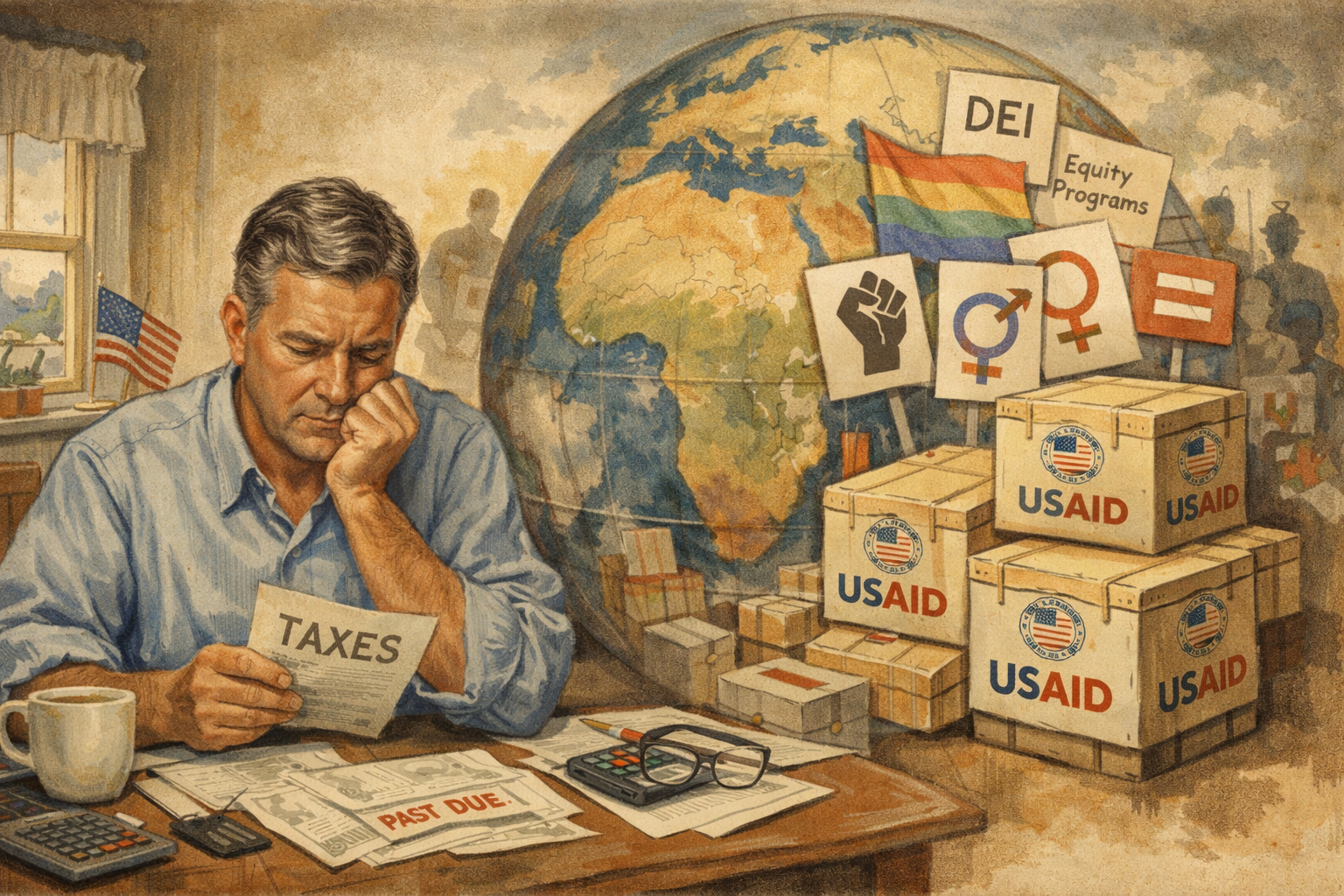
The United States Agency for International Development (USAID) occupies a curious place in American public life. It is rarely discussed in everyday political conversation, seldom appears in campaign debates, and is often described in vague terms such as “foreign aid,” “humanitarian assistance,” or “development work.” Yet USAID controls tens of billions of taxpayer dollars, operates in more than 100 countries, and increasingly influences not only foreign governments but domestic policy outcomes, public trust, and America’s global reputation.
For American voters, USAID funding matters because it touches three core concerns that transcend party labels: economic stewardship, national security, and democratic accountability. When an agency with minimal public visibility wields enormous financial and ideological influence, responsible citizens are right to ask how that power is being used, who benefits from it, and whether it reflects their values.
This is not an abstract question. It affects the cost of living, public safety, trust in institutions, and America’s moral standing abroad.
What USAID Is—and What It Has Become
USAID was created in 1961 during the Cold War with a stated mission of promoting economic development, humanitarian relief, and political stability in strategically important regions. At its inception, foreign aid was viewed as a defensive tool—an alternative to military intervention and a means of preventing hostile ideologies from taking root.
That original rationale assumed several things:
- Aid would be limited, targeted, and temporary.
- It would serve clear American strategic interests.
- It would not export radical cultural or political theories.
Over time, those assumptions eroded. USAID’s mission expanded from infrastructure, food security, and disease control into social engineering, cultural transformation, and political advocacy—often under the language of “equity,” “inclusion,” “gender justice,” and “climate resilience.” These terms may sound benign, but they represent contested ideological frameworks rather than neutral humanitarian goals.
For voters, this shift matters because agencies do not merely distribute money; they shape norms, incentives, and power structures—both abroad and at home.
Financial Scale and Taxpayer Exposure
USAID’s budget is not trivial. In recent years, total U.S. foreign assistance has exceeded $50 billion annually, with USAID administering a substantial portion of it. These funds are appropriated by Congress but largely allocated through executive discretion, grants, and contracts with NGOs, international organizations, and foreign governments.
The average American taxpayer does not vote directly on these expenditures, does not see them itemized on tax bills, and rarely receives clear reporting on outcomes. Yet these funds compete with domestic priorities such as infrastructure, disaster relief, veterans’ care, and border enforcement.
When voters struggle with rising housing costs, inflation, healthcare expenses, and energy prices, it is reasonable to ask whether billions spent overseas are producing tangible benefits—or whether they are underwriting ideological experiments with little accountability.
Economic Impact on Ordinary Americans
USAID funding affects Americans economically in several indirect but significant ways.
First, misallocated foreign aid increases fiscal pressure. Every dollar spent on programs that fail, duplicate efforts, or advance controversial agendas is a dollar unavailable for core government functions. While USAID spending alone does not drive federal debt, it contributes to a culture of unchecked spending insulated from public scrutiny.
Second, USAID-funded policies can distort global markets. For example, agricultural aid that undercuts local farmers abroad can destabilize regions, triggering migration pressures that ultimately affect U.S. housing markets, labor markets, and public services. Development decisions made thousands of miles away often boomerang back to American communities.
Third, USAID increasingly funds domestic-adjacent programs through international NGOs that operate within the United States or influence U.S. institutions. This blurring of foreign and domestic policy raises serious questions about whether foreign aid is being used to shape American cultural norms indirectly.
Public Safety and National Security Implications
Foreign aid is often justified as a national security investment. In principle, stabilizing fragile regions can reduce terrorism, organized crime, and mass migration. In practice, poorly monitored aid can have the opposite effect.
There are well-documented cases—across administrations—where USAID funds flowed into regions controlled by hostile actors, corrupt governments, or extremist-adjacent organizations. Even when unintentional, such outcomes undermine American security and credibility.
Additionally, exporting Progressive social policies into conservative or tribal cultures has sometimes provoked backlash, violence, or regime instability. When aid agencies prioritize ideological conformity over local realities, they risk destabilizing the very societies they claim to help.
For American voters concerned with border security, terrorism, and global disorder, these failures are not remote—they shape the pressures felt at home.
Democratic Accountability and Institutional Trust
Perhaps the most important reason USAID funding matters is its effect on public trust.
Most Americans assume that major policy decisions are debated openly, justified clearly, and subject to meaningful oversight. USAID challenges that assumption. Its programs are often buried in omnibus spending bills, justified in bureaucratic language, and executed through layers of contractors that dilute responsibility.
Polling consistently shows declining trust in federal institutions. While USAID is not the sole cause, it exemplifies a broader pattern: elite decision-making insulated from voter consent.
When citizens discover that their tax dollars fund programs promoting gender ideology abroad, DEI training in foreign institutions, or political activism under humanitarian cover, trust erodes—not because voters are uninformed, but because they were never consulted.
Why This Issue Has Become Politically Divisive
USAID funding has increasingly divided the parties because it reflects deeper disagreements about:
- The role of government
- The nature of human flourishing
- Whether America should export values or interests
- Whether neutrality is even possible in policymaking
Republicans and Democrats no longer merely disagree on funding levels; they disagree on what USAID is for.
Is it a humanitarian agency focused on life-saving aid and strategic stability?
Or is it an instrument for reshaping societies according to Progressive ideals?
That question lies at the heart of the controversy—and it is one American voters can no longer afford to ignore.
Articles in the Critical Issues series require more time to read than most content on this site. They are intentionally written as thorough, in-depth examinations of their subjects.
The Republican Perspective on USAID
From the Republican perspective, USAID funding is not objectionable in principle. Most Republicans accept that foreign aid can be a legitimate tool of American statecraft when it is strategic, limited, transparent, and aligned with U.S. national interests. The disagreement arises over how USAID has been used in practice—particularly in recent decades—and whether it still functions as an instrument of American soft power or has drifted into ideological activism detached from voter consent.
Republicans increasingly argue that USAID has strayed far from its original mission and now operates with insufficient oversight, weak accountability, and an ideological bias that favors Progressive social agendas over concrete humanitarian outcomes.
USAID as Soft Power: A Republican Framework
Republicans generally understand foreign aid through the lens of soft power—the ability of a nation to influence other countries through attraction, credibility, and example rather than coercion or force.
In its classical sense, soft power includes:
- Disaster relief
- Food security and famine prevention
- Disease control and medical infrastructure
- Basic education and economic development
- Post-conflict stabilization
When deployed properly, these efforts enhance America’s moral credibility, counter hostile influence from adversaries like China and Iran, and reduce the need for military intervention.
Republicans argue that this is where USAID should remain focused.
However, many Republican lawmakers contend that modern USAID has redefined soft power to mean cultural leverage—using aid dollars to pressure recipient nations into adopting Western Progressive norms related to gender, sexuality, identity politics, and climate policy. From the Republican viewpoint, this does not build goodwill; it breeds resentment, instability, and rejection of American influence altogether.
In short, Republicans tend to favor interest-based soft power, not ideology-based soft power.
Alignment with the 2024 Republican Party Platform
The 2024 Republican Party Platform does not devote extensive space to USAID by name, but its foreign policy and spending principles apply directly.
Key platform themes relevant to USAID include:
- Opposition to wasteful foreign spending
- Demand for accountability in federal agencies
- Rejection of taxpayer funding for ideological agendas
- Emphasis on national sovereignty and American interests
(Republican Party Platform 2024, sections on “Government Accountability,” “America First Foreign Policy,” and “Spending and Debt”)
The platform’s consistent warning against bureaucratic overreach and ideological capture reflects growing Republican concern that agencies like USAID operate with policy autonomy untethered from electoral accountability.
Congressional Republican Criticism and Oversight Efforts
Republican lawmakers in both the House and Senate have increasingly raised concerns about USAID’s funding priorities.
Key areas of criticism include:
- DEI and gender ideology programs funded abroad with U.S. tax dollars
- Grants awarded to NGOs with opaque leadership and political ties
- Weak monitoring of sub-grantees and contractors
- Funds flowing into countries with high corruption risk and minimal outcomes
House Republicans, particularly those serving on the House Foreign Affairs Committee and oversight subcommittees, have pressed for:
- Program-level transparency
- Grant disclosure requirements
- Inspector General audits
- Restrictions on funding for social and cultural activism
Senate Republicans have echoed these concerns, arguing that USAID increasingly resembles an ideological agency rather than a humanitarian one.
Republican State and Local Leaders: Domestic Spillover Concerns
While USAID is a federal agency, Republican governors and state officials have raised alarms about indirect domestic consequences of its policies.
Their concerns focus on:
- Migration pressures exacerbated by destabilizing aid strategies
- NGOs operating domestically with international funding streams
- Coordination between federal agencies and activist nonprofits
- Lack of clarity between foreign aid and domestic social policy
From the Republican viewpoint, when USAID funds NGOs that later influence U.S. institutions, universities, or advocacy networks, the distinction between foreign aid and domestic politics becomes blurred—raising constitutional and ethical questions.
Internal Republican Disagreements
It is important to note that Republicans are not monolithic on USAID.
There are at least three identifiable factions:
- Reformists – Favor continued foreign aid but with strict limits, transparency, and depoliticization.
- Skeptics – Question whether large-scale foreign aid delivers sufficient returns and favor major reductions.
- Isolation-leaning conservatives – Argue that foreign aid often harms U.S. interests and should be sharply curtailed or eliminated.
Despite these differences, there is broad agreement on one point: USAID’s current trajectory is unacceptable.
Even Republicans who support foreign aid generally agree that funding DEI initiatives, gender ideology, and climate activism under humanitarian cover undermines both American credibility and the moral legitimacy of aid itself.
The Core Republican Claim
The Republican critique of USAID can be summarized plainly:
- Foreign aid should serve American interests and genuine humanitarian needs
- It should not function as an ideological export mechanism
- Taxpayers deserve transparency and accountability
- Soft power works best when it respects cultural realities rather than attempts to overwrite them
From this perspective, USAID’s expanding mandate is not merely inefficient—it is counterproductive, weakening the very influence it claims to project.
The Democrat Perspective on USAID Funding
From the Democrat perspective, USAID is not merely a humanitarian agency or a strategic instrument of American foreign policy. It is viewed as a primary vehicle for global problem-solving, moral leadership, and long-term transformation of societies. Democrats generally see foreign aid not only as a matter of national interest, but as an expression of American values—particularly values related to equity, inclusion, environmental responsibility, and global justice.
This difference in starting assumptions explains much of the conflict between the parties. Where Republicans tend to ask whether USAID funding advances concrete U.S. interests and measurable outcomes, Democrats are more likely to ask whether it advances normative goals they believe are universally applicable.
The Democrat Understanding of USAID’s Mission
Democrats typically describe USAID as serving three overlapping purposes:
- Humanitarian relief – addressing poverty, hunger, disease, and disaster
- Global development – reshaping institutions, governance structures, and social systems
- Values promotion – advancing democracy, human rights, gender equity, and environmental sustainability
In Democrat rhetoric, these goals are often treated as inseparable. Development is framed not simply as economic growth, but as social transformation. Humanitarian assistance is not viewed as morally neutral, but as an opportunity to correct perceived injustices embedded in culture, tradition, or history.
This framework explains why Democrats are comfortable with USAID funding programs that go beyond food, water, and infrastructure and into areas such as:
- Gender equity initiatives
- DEI frameworks applied to foreign institutions
- LGBTQ advocacy under the banner of “human rights”
- Climate adaptation and environmental justice projects
- Media, education, and civil-society activism
From the Democrat perspective, these programs are not ideological excesses; they are necessary corrections to systemic inequities.
Alignment with the 2024 Democrat Party Platform
The 2024 Democrat Party Platform strongly supports expansive foreign aid, multilateral engagement, and the use of federal agencies to promote equity-based outcomes.
Relevant platform themes include:
- Commitment to “gender equality and equity” globally
- Support for “inclusive governance” and “intersectional approaches”
- Emphasis on climate justice as a global moral obligation
- Endorsement of partnerships with NGOs and international institutions
(Democrat Party Platform 2024, sections on “Global Leadership,” “Human Rights,” “Climate Action,” and “Equity”)
While USAID is not always named explicitly, the platform’s language aligns closely with USAID’s current programming priorities. Democrats generally view USAID as an implementation arm of these commitments rather than a neutral aid distributor.
Democrat Lawmakers and USAID Advocacy
Democrat members of Congress have repeatedly defended USAID’s expanded role and budget.
Their arguments typically include:
- Foreign aid prevents conflict and reduces future military spending
- Social development is inseparable from economic development
- U.S. credibility depends on moral leadership, not just power
- Withdrawing aid creates a vacuum filled by China or Russia
Democrat lawmakers have also resisted Republican efforts to restrict USAID funding for DEI-related programs, arguing that such restrictions would “politicize” aid or undermine human rights commitments. In practice, this position assumes that Progressive norms are politically neutral, while objections to them are ideological.
Democrat State and City Leaders: Reinforcing the Worldview
Although USAID operates federally, Democrat state and city leaders often reinforce the same assumptions in domestic policy, creating a consistent ideological through-line.
These leaders frequently champion:
- Equity-based budgeting
- Identity-driven policy frameworks
- Public-private partnerships with activist NGOs
- Climate-first governance models
From the Democrat perspective, USAID’s work abroad mirrors what they believe should happen domestically: government intervention to reshape outcomes rather than merely enforce rules or provide baseline services.
This coherence is viewed as a virtue by Democrats and as evidence of ideological capture by critics.
Internal Democrat Disagreements
There are some disagreements within the Democrat coalition, though they tend to be about degree rather than direction.
- Moderates sometimes express concern about messaging, electoral backlash, or foreign cultural resistance.
- Progressives push for more aggressive funding, fewer restrictions, and stronger enforcement of ideological compliance.
Despite occasional friction, there is broad consensus that USAID should be used to advance social justice objectives globally. Few Democrats argue for returning USAID to a narrower, interest-based humanitarian model.
The Core Democrat Claim
The Democrat position can be summarized as follows:
- Global problems require global solutions
- U.S. aid should reflect American values, not just interests
- Equity and inclusion are essential to development
- Soft power is most effective when it shapes norms, not merely perceptions
In this framework, USAID is not drifting from its mission—it is fulfilling it more completely.
The conflict with Republicans arises not from misunderstanding, but from fundamentally different beliefs about whether government should be in the business of cultural transformation at all.
The Libertarian Position on USAID Funding (Presented Tangentially)
The Libertarian position on USAID funding is more internally consistent than either the Republican or Democrat position, but it is also more politically marginal. Libertarians tend to approach foreign aid from first principles rather than strategic or moral narratives, which leads them to a far more skeptical view of USAID as an institution.
Because Libertarians are not a dominant force in American politics, this perspective is presented here briefly and tangentially, as requested. Still, it helps clarify the philosophical boundaries between the parties.
Core Libertarian Assumptions
Libertarians generally operate from a worldview that emphasizes:
- Minimal government
- Strong individual liberty
- Voluntary association over coercion
- Skepticism toward centralized power
- Market-based solutions rather than bureaucratic ones
From this standpoint, USAID is problematic not primarily because of what it funds, but because it exists at all in its current form.
Libertarians question whether it is legitimate for the federal government to tax Americans and then redistribute that money abroad for purposes that voters neither directly approve nor control.
The Libertarian Critique of Foreign Aid
Most Libertarians argue that foreign aid—including USAID funding—fails on several fronts:
- Moral legitimacy – Taxation used for non-essential foreign purposes is viewed as coercive.
- Economic efficiency – Government aid distorts markets, incentivizes dependency, and crowds out private charity.
- Accountability – Aid agencies operate with weak oversight and little consequence for failure.
- Unintended consequences – Aid often props up corrupt regimes, fuels conflict, or undermines local institutions.
From this perspective, even well-intentioned aid can cause long-term harm.
Libertarians and Soft Power
Libertarians are generally skeptical of soft power as a justification for USAID.
They argue that true soft power emerges organically from:
- Economic freedom
- Cultural excellence
- Innovation and productivity
- Voluntary exchange
When government attempts to manufacture influence through aid programs, Libertarians believe it substitutes bureaucratic coercion for genuine attraction. In their view, America’s greatest influence historically came from being prosperous and free—not from exporting policy frameworks through federal agencies.
Relationship to Republican and Democrat Positions
Libertarians occasionally align with Republicans in criticizing USAID’s ideological drift, DEI funding, and lack of oversight. However, the alignment is tactical rather than philosophical.
Key differences include:
- Republicans generally accept a limited role for foreign aid; Libertarians often reject it outright.
- Republicans frame reform in terms of national interest; Libertarians frame it in terms of legitimacy and liberty.
- Republicans seek oversight and redirection; Libertarians seek reduction or elimination.
Libertarians are sharply opposed to the Democrat position, which they view as an expansive and coercive use of state power to reshape societies.
Why Libertarians Remain Peripheral on This Issue
Despite their clarity, Libertarians remain politically marginal because:
- Their position offers little flexibility in emergencies
- It does not account for geopolitical realities embraced by most voters
- It often underestimates the strategic role of state power
As a result, Libertarian critiques influence debate but rarely determine policy outcomes.
Summary of the Libertarian View
In brief:
- USAID is seen as illegitimate, inefficient, and unaccountable
- Ideological content is secondary to structural objections
- Private charity and market exchange are preferred alternatives
- Alignment with Republicans is partial and situational
This perspective helps frame the debate, but it does not drive it.
Progressive Principles and Their Influence on USAID Funding
(Progressivism—wokeness, Cultural Marxism, political correctness, identity politics, critical theory/intersectionality, Neo-Marxism)
To understand why USAID funding has become so controversial, one must understand the Progressive worldview that increasingly shapes Democrat policy. This is not a matter of isolated programs or accidental excess. It is the logical outworking of a coherent belief system about power, justice, history, and human nature.
This section is not intended as caricature. It is an attempt to identify the governing assumptions that explain why USAID now funds programs that previous generations of Americans would never have associated with humanitarian aid.
The Progressive Reframing of “Development”
Progressivism fundamentally redefines what “development” means.
Traditional development focused on:
- Food security
- Public health
- Infrastructure
- Economic productivity
- Political stability
Progressive development reframes the problem. Poverty and instability are no longer viewed primarily as material or institutional failures, but as the result of systemic oppression embedded in culture, tradition, religion, and historical power structures.
From this perspective:
- Economic growth alone is insufficient
- Cultural norms must be corrected
- Institutions must be re-engineered
- Outcomes must be equalized across identity groups
USAID, under Progressive influence, increasingly treats foreign societies not as partners with distinct histories, but as subjects for ideological remediation.
Power, Oppression, and the Zero-Sum Lens
At the heart of Progressive thought is a zero-sum view of power.
Human societies are divided into:
- Oppressors and oppressed
- Dominant and marginalized groups
- Privileged identities and victim classes
Progressive theory assumes that disparities in outcome are evidence of injustice unless proven otherwise. Neutral explanations—such as culture, incentives, geography, or human behavior—are treated with suspicion or dismissed outright.
When this framework is applied to foreign aid:
- Local traditions are scrutinized as oppressive
- Religious beliefs are treated as obstacles to liberation
- Western Progressive norms are positioned as morally superior
USAID funding decisions increasingly reflect this lens, prioritizing programs that promise to dismantle “systems” rather than those that deliver measurable material improvements.
DEI as an Export Product
Diversity, Equity, and Inclusion (DEI) frameworks are not merely administrative tools within the Progressive worldview; they are moral imperatives.
Applied internationally through USAID, DEI manifests in:
- Identity-based funding criteria
- Gender and sexuality quotas
- Equity audits of foreign institutions
- Mandatory ideological training for aid recipients
These requirements often have little connection to local realities or needs. Instead, they function as compliance mechanisms, conditioning aid on ideological alignment.
From the Progressive perspective, this is justified because:
- Western societies are seen as morally obligated to correct global inequities
- Resistance is interpreted as ignorance or bigotry
- Cultural sovereignty is subordinate to “human rights” as defined by Progressive elites
Critics argue this approach replaces humanitarian partnership with ideological enforcement.
Climate Ideology and Moral Absolutism
Another major Progressive influence on USAID is climate ideology.
Climate change is framed not merely as an environmental issue, but as:
- A moral crisis
- A justice issue
- A legacy of Western exploitation
As a result, USAID increasingly prioritizes climate programs even in regions where:
- Energy scarcity is the primary driver of poverty
- Fossil fuels would dramatically improve living standards
- Climate policies restrict development rather than enable it
Progressive logic treats economic sacrifice as virtuous, especially when imposed on developing nations in the name of global justice.
This approach often conflicts with the stated humanitarian goals of aid, creating tension between ideological purity and practical outcomes.
The Progressive View of Soft Power
Progressives redefine soft power not as influence through example, but as norm enforcement through leverage.
In this model:
- Aid becomes a tool for reshaping beliefs
- Funding conditions replace diplomacy
- Cultural resistance is framed as moral failure
Soft power is no longer about attraction; it is about alignment.
This helps explain why USAID increasingly funds media training, educational curricula, civil-society activism, and legal reforms—areas traditionally considered internal matters for sovereign nations.
Why Progressives See This as Necessary
Progressives defend this approach by arguing that:
- Neutrality is impossible
- All aid reflects values whether acknowledged or not
- Failing to act perpetuates injustice
- Cultural transformation is a prerequisite for development
From within their worldview, USAID is not overreaching—it is finally acting consistently with moral truth.
The conflict arises because this worldview rejects limits that Republicans, Libertarians, and biblical Christians consider essential: limits on state power, respect for cultural sovereignty, and humility about human perfectibility.
Why This Matters for the USAID Debate
USAID funding controversies are not accidental. They are the predictable outcome of Progressive presuppositions embedded within bureaucratic structures that operate with limited oversight.
Until those presuppositions are examined and challenged, debates over individual grants or line items will miss the deeper issue.
The argument is not about one program or one administration. It is about whether the United States should use taxpayer funds to reshape the moral architecture of other societies—and, indirectly, its own.
Do Democrat Actions Match Their Platform?
“In politics, what you DO is what you believe. Everything else is cottage cheese.” — Senator Joseph N. Kennedy
This section moves from stated principles to observable behavior. Platforms and rhetoric matter, but policy actions matter more. When examined closely, USAID activity under Democrat leadership—particularly during the Biden administration—reveals a striking tension between anti-colonial rhetoric and neo-colonial practice.
At the center of that tension is a question Democrats rarely confront directly: Do the same Progressive actors who condemn Western colonialism now export “woke” ideology globally using taxpayer funds—and exempt themselves from their own anti-colonial principles?
The Anti-Colonial Claim
Modern Progressive ideology routinely frames Western history—especially American and European influence—as inherently colonial, exploitative, and morally suspect. This narrative is now common in:
- Academic institutions
- NGO training materials
- Media commentary
- USAID-funded educational and civil-society programs
Colonialism, in this telling, is not merely territorial control. It is defined more broadly as the imposition of Western norms, power structures, and values on other societies without consent.
This critique is frequently invoked to:
- Undermine national sovereignty
- Discredit Western moral authority
- Justify the restructuring of institutions
On paper, this would suggest extreme caution in how U.S. aid interacts with other cultures.
In practice, the opposite occurs.
The Reality: Ideological Colonization by Another Name
Under Democrat leadership, USAID has increasingly conditioned aid on ideological compliance, not merely humanitarian cooperation.
Examples include:
- Conditioning funding on adoption of DEI frameworks
- Requiring gender-identity recognition in foreign institutions
- Mandating climate policies that restrict development
- Funding activist NGOs to pressure local governments
- Training media and educators to reshape cultural narratives
This is not neutral assistance. It is norm imposition.
The irony is difficult to miss:
Progressives condemn historical colonialism for exporting Western values—yet now export a new Western ideology, enforced through financial leverage, while insisting it is morally exempt.
If colonialism is wrong because it overrides cultural self-determination, then ideological conditionality is colonialism in functional terms—even if the language has changed.
Do Progressives Apply Anti-Colonial Standards to Themselves?
The evidence suggests they do not.
When recipient nations resist:
- They are labeled backward or reactionary
- Their objections are framed as human-rights violations
- Cultural or religious dissent is pathologized
- Sovereignty claims are dismissed as oppression
In other words, resistance becomes proof of guilt.
This mirrors the logic of historical colonial powers, who justified intervention on the grounds that native cultures were unenlightened and required reform. The rhetoric has changed. The structure has not.
The key difference is that modern ideological colonization does not require armies or governors—it requires grants, NGOs, and compliance reporting.
Case Studies from the Biden Administration
During the Biden administration (2021–2024), USAID expanded funding in several ideologically charged areas:
1. Gender and Sexuality Programming
USAID significantly increased funding for programs promoting gender identity frameworks in cultures with deeply rooted religious and traditional norms. These programs were often justified as “human rights” initiatives, regardless of local consent or democratic process.
2. DEI Exportation
Foreign institutions receiving aid were increasingly required to adopt equity-based frameworks that originated in American academic and corporate environments—often disconnected from local social structures.
3. Climate Conditionality
Aid was tied to climate commitments that restricted energy development in poor nations, even where affordable energy was the single greatest driver of improved quality of life.
In each case, the Biden administration framed these actions as moral leadership rather than ideological imposition—despite using financial pressure to override local priorities.
Case Studies from Progressive States and Cities
The same pattern appears domestically in Progressive states and cities such as California, New York, Oregon, Washington, Massachusetts, and cities like Berkeley, Portland, Seattle, Chicago, and Washington, D.C.
Common features include:
- Top-down imposition of ideological frameworks
- Limited tolerance for dissent
- Moral language used to justify coercion
- Institutional capture rather than democratic persuasion
This matters because USAID does not operate in isolation. It reflects the governing instincts of the political coalition that controls it.
The foreign policy expression mirrors the domestic one: values are imposed, not debated.
Platform vs. Practice
The Democrat Party platform emphasizes:
- Respect for democracy
- Human rights
- Cultural dignity
- Inclusion and equity
Yet USAID practice often:
- Circumvents democratic processes abroad
- Privileges elite NGOs over local voices
- Imposes contested moral frameworks
- Punishes dissent through funding denial
This gap between stated values and actual behavior is not accidental. It flows directly from Progressive presuppositions that treat their moral framework as universally binding and self-justifying.
Authoritarian Tendencies: Soft but Real
This form of governance does not look like classic authoritarianism. There are no tanks, no decrees, no secret police. Instead, it operates through:
- Funding leverage
- Bureaucratic compliance regimes
- Credentialed experts
- Moral absolutism
It is soft authoritarianism—coercive without appearing so.
When Progressives control USAID, ideological conformity becomes a condition of participation. That is power exercised without accountability, shielded by moral language.
The Central Contradiction
The central contradiction is this:
Progressives denounce colonialism while practicing a new form of ideological colonization—exporting woke frameworks across the globe using American taxpayer funds, while exempting themselves from the very standards they demand of others.
This contradiction is not incidental. It is foundational.
Examining Each Party’s Position from the Perspective of the Opposition
At this stage, the disagreements surrounding USAID funding can no longer be reduced to line items, grant recipients, or administrative missteps. The conflict is rooted in competing visions of human nature, power, and governance—what Thomas Sowell famously described as the constrained versus unconstrained visions.
Understanding these visions helps explain why the parties talk past one another and why USAID has become a flashpoint rather than a technical policy dispute.
The Two Competing Visions
The constrained vision assumes:
- Human nature is flawed and persistent
- Power must be limited and checked
- Institutions should restrain harm, not perfect humanity
- Traditions embody hard-won knowledge
- Unintended consequences are inevitable
The unconstrained vision assumes:
- Human behavior is largely shaped by systems
- Proper policies can correct injustice
- Expertise can overcome moral and social limitations
- Institutions should aim at transformation
- Moral urgency justifies expansive power
These visions map closely onto today’s political coalitions.
How Each Party Fits These Visions
Republicans
Republicans generally operate from a constrained vision. They assume:
- Aid should be limited and pragmatic
- Cultures are complex and resistant to redesign
- Bureaucracies drift without oversight
- Good intentions do not guarantee good outcomes
From the Republican viewpoint, USAID’s ideological expansion is not merely inefficient—it is dangerous, because it assumes far more moral and intellectual certainty than flawed human institutions can responsibly wield.
Democrats / Progressives
Democrats—especially Progressives—largely operate from an unconstrained vision. They assume:
- Injustice is systemic and fixable
- Cultural resistance is a moral failure
- Expertise confers legitimacy
- Urgency overrides caution
From this perspective, USAID’s role in reshaping norms is not hubris; it is moral responsibility delayed too long.
Libertarians
Libertarians also hold a constrained view of human nature but apply it even more rigidly. They distrust:
- State power
- Centralized decision-making
- Moral ambition backed by coercion
They criticize both parties but reserve their sharpest critique for Democrats, whom they see as dangerously overconfident in state power.
Biblical Christians
Biblical Christians also operate from a constrained vision, though grounded theologically rather than philosophically. Human fallenness limits what any institution can accomplish, and moral reform cannot be coerced without distortion.
This leads to skepticism toward ideological aid programs that assume moral transformation can be engineered through policy.
Common Criticisms Raised by Opponents—and Responses
Criticism of Republicans
Claim: Republicans want to abandon the world and retreat from leadership.
Response: Republicans generally argue for focused leadership, not withdrawal. Limiting ideological aid is not isolationism; it is strategic restraint.
Claim: Republicans don’t care about human suffering.
Response: Opposition to waste and ideology is not opposition to compassion. Republicans support humanitarian aid that delivers measurable outcomes.
Criticism of Democrats
Claim: Democrats use aid to impose ideology.
Response from Democrats: Values are inseparable from aid; neutrality is a myth.
Counter-response: Imposing contested moral frameworks without consent is precisely what colonialism once justified.
Claim: Democrats undermine sovereignty.
Response from Democrats: Sovereignty cannot excuse injustice.
Counter-response: Who defines injustice—and by what authority—is the unresolved problem.
Criticism of Libertarians
Claim: Libertarians are naïve about global threats.
Response: Voluntary exchange and prosperity reduce conflict more reliably than bureaucratic aid.
Tone-Deaf Statements That Reveal Blind Spots
Across administrations, certain statements have undercut credibility:
- Claims that aid programs are “not ideological” while enforcing ideological compliance
- Assertions that cultural resistance is merely ignorance
- Descriptions of dissenting nations as “on the wrong side of history”
Such language reveals an assumption of moral inevitability rather than democratic persuasion.
Why These Visions Matter for USAID
USAID’s controversy is not accidental. It reflects the collision between:
- A worldview that prioritizes limits, humility, and restraint
- A worldview that prioritizes transformation, urgency, and moral certainty
Until that collision is acknowledged, debates will remain superficial.
Credible Suspicions About Party Strategies and Motives Regarding USAID Funding
This section moves beyond stated philosophy and examines patterns of behavior. It does not assume bad faith where evidence is thin, but it does take seriously the idea that repeated actions reveal strategy. When voters express suspicion about USAID, they are not usually alleging secret conspiracies. They are responding to observable incentives, consistent outcomes, and tone-deaf denials.
In politics, motive is often inferred from what is funded, protected, or dismissed.
Republican Suspicions About Democrat Strategy
Republicans do not typically argue that USAID exists to overtly funnel money into Democrat campaign operations. Their concern is more structural and more enduring.
1. Ideological Infrastructure Building
Republicans suspect that Democrats use USAID to build global ideological infrastructure that reinforces Progressive assumptions long after any given administration leaves office.
This includes:
- Funding NGOs that train journalists, educators, and activists
- Supporting legal reforms aligned with Progressive social priorities
- Creating international networks that mirror Democrat domestic coalitions
Once built, these structures persist regardless of electoral outcomes.
2. Bureaucratic Insulation from Voters
Another suspicion is that Democrats favor USAID precisely because it operates:
- Far from public visibility
- Through complex grant mechanisms
- With limited congressional micromanagement
This makes USAID an attractive vehicle for policies that would face resistance if debated openly.
3. Moral Framing as Political Shield
Republicans observe that USAID programs are often framed as humanitarian or moral imperatives in ways that discourage scrutiny. Questioning them is portrayed as:
- Callous
- Ignorant
- Bigoted
- Anti-science
This framing does not rebut criticism; it neutralizes it.
Democrat Suspicions About Republican Strategy
Democrats, for their part, harbor their own suspicions.
1. Retreat from Global Leadership
Democrats often suspect Republicans want to scale back USAID as part of a broader retreat from international engagement, leaving power vacuums that adversaries can fill.
2. Cultural Protectionism
Some Democrats interpret Republican resistance to ideological aid as an attempt to shield traditional or religious norms they view as unjust, even when those norms conflict with Progressive definitions of human rights.
3. Political Signaling to the Base
Democrats also believe Republican criticism of USAID plays well with voters skeptical of foreign aid, regardless of humanitarian consequences.
Tone-Deaf Statements That Reinforce Suspicion
Certain recurring statements from Democrat leaders amplify Republican distrust:
- “These programs aren’t political.”
- “Opposition is rooted in ignorance.”
- “Human rights are not negotiable.”
Each statement assumes moral authority rather than earning trust through transparency.
Conversely, Republicans have sometimes fueled Democrat suspicion through statements that:
- Blur aid reform with disengagement
- Dismiss humanitarian concerns too casually
- Fail to distinguish between emergency relief and ideological programming
The Asymmetry of Incentives
A critical observation is that Democrats benefit institutionally from USAID’s current structure, while Republicans benefit politically from criticizing it.
- Democrats gain durable policy influence via NGOs and international institutions
- Republicans gain voter trust by highlighting waste, ideology, and overreach
This asymmetry explains why reform efforts stall and why suspicion persists.
Why Suspicion Persists Without Conspiracy
It is not necessary to assume secret coordination or malicious intent to conclude that USAID functions as an ideological amplifier.
All that is required is:
- A shared worldview among agency leadership
- A grant system that rewards ideological alignment
- Weak oversight mechanisms
- Moral language that discourages dissent
Over time, these conditions produce predictable outcomes.
What This Means for Voters
The suspicion many voters feel is not paranoia. It is a rational response to:
- Opaque funding
- Ideological consistency across programs
- Resistance to transparency
- Dismissal of legitimate questions
When institutions demand trust but resist scrutiny, trust erodes.
High-Trust and Low-Trust Societies: How Declining Trust Shapes the USAID Debate
The controversy surrounding USAID funding cannot be separated from a broader crisis of trust in American society. Whether voters support or oppose expanded foreign aid often depends less on abstract principles and more on a simple question: Do we trust the institutions asking for our money and obedience?
Increasingly, the answer is no.
High-Trust vs. Low-Trust Societies Explained
In a high-trust society, citizens generally believe that:
- Institutions act in good faith
- Rules are applied consistently
- Public officials are accountable
- Stated purposes match actual behavior
High-trust societies can tolerate complexity and delegation because citizens assume abuse will be corrected.
In a low-trust society, citizens assume:
- Power is self-serving
- Language is deceptive
- Rules are applied selectively
- Elites are insulated from consequences
In such societies, even well-intentioned policies are viewed with suspicion.
The United States has been moving steadily from the first category toward the second.
Why USAID Suffers from the Trust Deficit
USAID embodies many features that erode trust:
- Limited public visibility
- Complex grant networks
- Ideological language that masks concrete outcomes
- Resistance to oversight framed as moral necessity
When citizens hear that their tax dollars fund “equity initiatives,” “gender-transformative programming,” or “inclusive governance” abroad—without clear metrics or consent—they do not hear compassion. They hear evasion.
In a high-trust environment, such programs might be debated charitably. In a low-trust environment, they are presumed to conceal something.
Republican Concerns in a Low-Trust Context
Republicans view USAID through the lens of declining trust.
They suspect:
- Stated humanitarian goals mask ideological objectives
- Oversight is intentionally weak
- Bureaucratic actors are insulated from voter correction
This suspicion is reinforced when Democrats respond to criticism by:
- Questioning motives rather than addressing substance
- Framing oversight as cruelty
- Treating dissent as moral deficiency
In a low-trust society, such responses deepen skepticism rather than resolve it.
Democrat Response to Trust Erosion
Democrats tend to interpret distrust as:
- Misinformation
- Populism
- Reactionary backlash
- Resistance to progress
As a result, they often respond with:
- More expert authority
- More centralized control
- More moral framing
Ironically, this accelerates the trust collapse.
Rather than restoring confidence, it confirms the suspicion that elites are unwilling to submit their decisions to democratic scrutiny.
A Parallel with Immigration Policy
A helpful analogy is immigration.
Republicans suspect that:
- Enforcement failures are tolerated for political advantage
- Demographic shifts may alter representation
- Amnesty proposals reward noncompliance
Democrats deny intentionality—but the structural incentives make suspicion reasonable even without proof of malice.
USAID operates under similar conditions:
- Ideological outcomes benefit one coalition
- Accountability is diffuse
- Denials are categorical
Trust erodes not because of conspiracy, but because of predictable incentives.
Why Trust Is Central to the USAID Debate
Foreign aid requires trust more than most policies because:
- Benefits are indirect
- Costs are immediate
- Outcomes are distant
- Accountability is diffuse
When trust collapses, voters demand:
- Clear limits
- Transparent goals
- Enforceable oversight
Absent these, skepticism hardens into opposition.
The Consequence of Ignoring Trust
If declining trust is ignored, two outcomes are likely:
- Legitimate humanitarian aid will be rejected alongside ideological programs.
- Citizens will disengage from institutional processes altogether.
Neither outcome serves the common good.
USAID reform is therefore not merely a policy issue—it is a test case for whether American institutions can still command public confidence.
Media Distortion and Misrepresentation of the USAID Debate
No serious examination of USAID funding would be complete without addressing the role of the modern media. For most Americans, media coverage is the primary—often the only—source of information about foreign aid. How USAID is framed, what is emphasized, and what is omitted significantly shapes public perception.
Here, too, declining trust plays a central role.
The Dominant Media Narrative About USAID
Mainstream media outlets typically present USAID through a simplified moral narrative:
- USAID equals humanitarian aid
- Aid equals compassion
- Opposition equals cruelty or ignorance
Within this frame, debate is not treated as a disagreement over policy design or accountability, but as a contest between moral seriousness and moral failure.
This narrative is reinforced by:
- Human-interest stories highlighting aid recipients
- Abstract language emphasizing “global responsibility”
- Appeals to expert consensus
- Minimal scrutiny of grant structures or outcomes
While humanitarian stories are real and often moving, they do not answer the policy questions voters are asking.
What Is Commonly Left Unexamined
Media coverage frequently neglects several critical issues:
- Program specifics: Which grants fund basic relief versus ideological initiatives
- Conditionality: What requirements recipients must meet to receive funding
- NGO accountability: Who runs these organizations and how funds are audited
- Failure rates: What happens when programs do not work
When such questions are raised, they are often treated as distractions rather than essentials.
Selective Language and Framing
Media outlets frequently use language that pre-loads the debate.
Examples include:
- Describing ideological programs as “human rights initiatives”
- Labeling oversight efforts as “aid cuts”
- Referring to DEI requirements as “inclusive development”
- Framing resistance as “far-right backlash”
This framing collapses complex distinctions and nudges audiences toward predetermined conclusions.
Case Examples of Distortion
While individual outlets vary, common patterns include:
- Highlighting proposed funding reductions without explaining what would be reduced
- Quoting advocacy organizations as neutral experts
- Omitting dissenting voices from affected communities abroad
- Treating USAID officials as authoritative rather than interested parties
The result is journalism that amplifies institutional narratives rather than interrogating them.
Asymmetrical Scrutiny
Republican proposals related to USAID are often subjected to intense scrutiny regarding humanitarian impact, while Democrat-led expansions receive minimal examination of ideological scope.
Questions that are rarely asked in mainstream coverage include:
- Should U.S. taxpayers fund gender ideology abroad?
- Should aid be contingent on adopting Western cultural norms?
- Who decides what counts as “equity” or “inclusion”?
The absence of these questions does not reflect consensus; it reflects editorial priorities.
The Chilling Effect on Debate
Media framing has a chilling effect on honest discussion.
Lawmakers and citizens alike learn that:
- Questioning USAID invites moral condemnation
- Nuance is flattened into binary choice
- Silence is safer than scrutiny
This dynamic reinforces low-trust conditions and drives debate into alternative media ecosystems, further fragmenting public understanding.
Why Media Distortion Matters
Media distortion does not merely misinform—it reshapes incentives.
When journalists act as gatekeepers of moral legitimacy rather than investigators of power:
- Institutions face less pressure to reform
- Ideological drift accelerates
- Public cynicism deepens
The result is not greater compassion, but deeper division.
A Biblical Perspective on USAID and Foreign Aid
A biblical evaluation of USAID funding does not begin with party loyalty, national interest alone, or ideological enthusiasm. It begins with the nature of man, the limits of earthly power, and the proper role of civil authority under God. Scripture does not give a line-item budget for foreign aid, but it does provide moral categories that sharply illuminate the present debate.
Biblical Christianity aligns more naturally with the Republican position on USAID—not because Republicans are morally flawless, but because their framework better accounts for human fallenness, institutional limits, and the dangers of centralized power.
The Biblical View of Human Nature
Scripture teaches that mankind is fallen, not merely misinformed or under-resourced (Genesis 3; Romans 3:10–18). This has several implications for foreign aid:
- Good intentions do not guarantee good outcomes
- Power concentrates temptation as well as capacity
- Systems cannot redeem hearts
- Moral transformation cannot be coerced
This sharply contrasts with Progressive assumptions that injustice can be engineered out of societies through policy, education, or ideological enforcement.
Biblical Christianity therefore approaches aid with humility, not utopian ambition.
Compassion Without Pretension
The Bible consistently commands care for the poor, the stranger, and the afflicted (Deuteronomy 10:18–19; Proverbs 14:31). Yet this compassion is never divorced from wisdom, responsibility, or truth.
Biblical compassion:
- Helps without enabling sin
- Respects moral agency
- Acknowledges unintended consequences
- Operates within God-ordained limits
Scripture does not authorize the state to act as a global moral engineer. It does not grant governments the role of redefining family, sexuality, or culture under the banner of compassion.
When USAID funds ideological programs that reshape moral norms rather than relieve suffering, it exceeds what Scripture assigns to civil authority.
The Limits of Civil Government
Romans 13 describes civil government as a minister of God for justice and order, not moral regeneration. Its authority is real but bounded.
Biblical Christians therefore question:
- Whether U.S. civil authority extends to re-educating foreign cultures
- Whether coercive funding conditions align with justice
- Whether ideological mandates violate subsidiarity—the principle that decisions should be made at the most local level possible
Progressive use of USAID assumes a near-limitless role for the state. Biblical Christianity does not.
Truth, Not Narrative Control
Scripture places extraordinary emphasis on truthfulness (Exodus 20:16; Proverbs 12:22). This applies not only to personal conduct, but to institutional speech.
When USAID programs are described in euphemistic language that obscures their ideological content—“inclusive development,” “gender-transformative outcomes,” “equity frameworks”—biblical Christians recognize a problem.
Truth does not fear clarity.
The Biblical View of Colonialism and Power
The Bible condemns oppression, exploitation, and unjust domination (Micah 6:8). But it also condemns prideful moral imperialism—the assumption that one group possesses moral authority to reshape others by force or manipulation.
Biblical Christianity therefore rejects both:
- Historical colonial exploitation
- Modern ideological colonization
Replacing one with the other does not advance justice; it merely changes the banner.
Alignment with Political Parties
From a biblical worldview:
- Democrats/Progressives place excessive trust in state power, human perfectibility, and moral expertise
- Libertarians rightly distrust power but often deny the legitimate role of civil authority
- Republicans—though imperfect—better acknowledge limits, pluralism, and moral restraint
For this reason, biblical Christians tend to align with Republicans on USAID funding, particularly regarding:
- Opposition to ideological aid
- Emphasis on accountability
- Respect for cultural and national sovereignty
- Recognition of unintended consequences
This alignment is principled, not partisan.
Theological Bottom Line
Biblical Christianity does not oppose foreign aid. It opposes hubris disguised as compassion.
Aid that feeds the hungry, treats the sick, and stabilizes societies can reflect biblical mercy. Aid that imposes contested moral frameworks, bypasses consent, and centralizes unchecked power reflects something else entirely.
Scripture warns repeatedly that pride precedes destruction (Proverbs 16:18). That warning applies to nations as well as individuals.
Encouraging the Reader to Vote According to a Biblical Worldview
At this point, the contours of the debate should be clear. USAID funding is not a narrow technical issue; it is a moral, philosophical, and political question that reflects deeper assumptions about power, human nature, and the role of government. For the biblical Christian, voting on this issue cannot be reduced to party loyalty or emotional appeals. It must be guided by faithfulness, wisdom, and ordered priorities.
Scripture does not command Christians to win elections. It commands them to act justly, love mercy, and walk humbly with God (Micah 6:8). Voting is one of the means—though not the only one—by which Christians pursue those ends in a representative republic.
Weighing Issues with Moral Seriousness
A mature biblical worldview recognizes that not all political issues carry equal moral weight. Some policies concern prudence and economics; others concern life, truth, and moral order.
Foreign aid policy, including USAID funding, falls into a secondary but still significant category. It does not rise to the level of abortion or the redefinition of marriage, but it is not morally neutral either—especially when taxpayer funds are used to advance ideologies that contradict biblical teaching.
Christians should therefore:
- Evaluate USAID policy in light of broader moral commitments
- Resist being distracted by humanitarian rhetoric that masks deeper agendas
- Ask whether compassion is being exercised truthfully and wisely
Why Biblical Christians Tend to Vote Republican
In the current American political landscape, biblical Christians overwhelmingly find greater alignment with the Republican Party on USAID and related issues.
This is not because Republicans are uniformly righteous or consistently courageous. It is because:
- The Republican Party allows biblical Christians to participate openly
- Republicans are more receptive to arguments about limits on state power
- Republicans are more willing to challenge ideological overreach
- Republicans are more likely to subject agencies like USAID to oversight
By contrast, the Democrat Party increasingly treats core biblical convictions—on human nature, sexuality, family, and authority—as obstacles to progress rather than legitimate moral commitments.
On USAID specifically, Democrats have shown little interest in restraining ideological programming or submitting aid decisions to meaningful democratic scrutiny.
Voting as Stewardship, Not Salvation
Scripture is clear that political action cannot redeem the world (Psalm 146:3). Salvation does not come through legislation, budgets, or agencies. Yet this does not excuse disengagement.
Voting is a form of stewardship—a way of exercising responsibility over the limited authority God grants citizens in a constitutional republic.
Biblical Christians should therefore vote:
- Thoughtfully, not reflexively
- With conscience informed by Scripture
- With awareness of trade-offs and consequences
- Without illusion that politics can do what only God can do
Supporting candidates who oppose ideological misuse of USAID is not a claim that they are saviors. It is a judgment about comparative faithfulness under fallen conditions.
Avoiding Two Common Errors
Biblical Christians should guard against two opposite errors:
- Political Messianism – believing the right candidate or policy will usher in righteousness.
- Political Withdrawal – refusing to engage at all out of cynicism or fear of compromise.
The biblical posture is neither triumphalism nor retreat, but sober participation.
Scriptural Principles That Apply
Several biblical principles should shape voting on USAID-related issues:
- Truthfulness – Policies should be described honestly, not hidden behind euphemisms (Proverbs 12:22).
- Limited Authority – Civil government has real but bounded authority (Romans 13:1–7).
- Respect for Conscience – Coercion in moral matters invites corruption (Romans 14).
- Humility – Nations, like individuals, are accountable to God (Proverbs 14:34).
When aid programs violate these principles, Christians are right to oppose them.
The Practical Conclusion for Voters
For most biblical Christians, responsible voting on USAID means:
- Supporting candidates who seek transparency and restraint
- Opposing ideological colonization disguised as compassion
- Favoring reform over unchecked expansion
- Aligning, as a general rule, with Republican candidates
This alignment is not blind loyalty. It is a reasoned judgment in an imperfect political environment.
The Christian’s Duty to Seek the Welfare of the Nation
Scripture does not portray faithful believers as detached observers of public life. Even while acknowledging that earthly nations are temporary, God commands His people to seek the good of the societies in which they live.
The prophet Jeremiah instructed the exiles in Babylon:
“Seek the welfare of the city where I have sent you into exile, and pray to the LORD on its behalf, for in its welfare you will find your welfare” (Jeremiah 29:7, ESV).
This principle applies no less to Christians living in a constitutional republic.
Responsible Voting as One Means of Obedience
Voting is not the only way Christians seek national welfare, but it is a legitimate and meaningful one. In a system where citizens possess real influence, abstention carries moral weight as surely as participation.
Responsible voting involves:
- Discernment rather than tribal loyalty
- Long-term consequences rather than emotional reactions
- Submission to Scripture rather than political fashion
When Christians vote on issues like USAID funding, they are not merely expressing opinion—they are stewarding influence.
Other Faithful Means Besides Voting
Scripture recognizes multiple avenues for faithful civic engagement:
- Prayer for leaders and institutions (1 Timothy 2:1–2)
- Public witness, including writing, teaching, and persuasion
- Charitable action, especially through the church and voluntary associations
- Moral clarity, refusing to baptize injustice with religious language
Christians must not outsource compassion to the state while neglecting their own obligations. Government aid can never replace the church’s calling.
Christian Liberty and Conscience
Romans 14 reminds believers that not all faithful Christians will reach identical conclusions about political participation. Some may abstain from voting out of conscience, believing involvement compromises their witness.
This is a matter of Christian liberty, not rebellion.
What Scripture forbids is not abstention, but apathy—a refusal to care about justice, truth, and the common good.
Applying This Duty to USAID
Seeking the welfare of the nation requires Christians to ask:
- Does this policy honor truth?
- Does it respect moral limits on power?
- Does it advance justice without coercion?
- Does it invite humility or reward arrogance?
On USAID, these questions push believers toward reform, restraint, and accountability rather than ideological expansion.
Key Takeaways and Concluding Remarks
This article has examined USAID funding from multiple perspectives—political, philosophical, cultural, and biblical. Several conclusions stand out clearly.
Condensed Positions
Republican Position:
Foreign aid can serve legitimate purposes but must be limited, transparent, accountable, and stripped of ideological programming. USAID should function as a tool of pragmatic soft power, not cultural transformation.
Democrat / Progressive Position:
USAID is a moral instrument for reshaping societies according to equity-based frameworks. Aid is inseparable from values, and resistance is often treated as injustice.
Libertarian Position:
Foreign aid through government agencies is inherently coercive, inefficient, and prone to abuse. Private charity and voluntary exchange are preferred.
Biblical Christian Position:
Aid should reflect compassion governed by truth, humility, and moral limits. Ideological colonization—whether historical or modern—is incompatible with biblical teaching. In practice, biblical Christians align most closely with the Republican approach.
Final Observations
USAID has become controversial not because Americans oppose helping others, but because they increasingly distrust institutions that:
- Resist oversight
- Speak in euphemisms
- Demand moral authority without accountability
Compassion divorced from truth becomes manipulation. Power divorced from humility becomes tyranny—even when it smiles.
S.D.G.,
Robert Sparkman
rob@christiannewsjunkie.com
RELATED CONTENT
Concerning the Related Content section, I encourage everyone to evaluate the content carefully.
If I have listed the content, I think it is worthwhile viewing to educate yourself on the topic, but it may contain coarse language or some opinions I don’t agree with.
I use words that reflect the “woke” culture and their re-definitions sometimes. It is hard to communicate effectively without using their twisted vocabulary. Rest assured that I do not believe gender ideology or “Progressivism”. Words and phrases like “trans man”, “trans women” , “transgender”, “transition” or similar words and phrases are nonsensical and reflect a distorted, imaginary worldview where men can become women and vice-versa. The word “Progressive” itself is a propagandistic word that implies the Progressives are the positive force in society, whereas in reality their cultic belief system is very corrosive to mankind.
Feel free to offer your comments below. Respectful comments without expletives and personal attacks will be posted and I will respond to them.
Comments are closed after sixty days due to spamming issues from internet bots. You can always send me an email at rob@christiannewsjunkie.com if you want to comment on something afterwards, though.
I will continue to add videos and other items to the Related Content section as opportunities present themselves.