
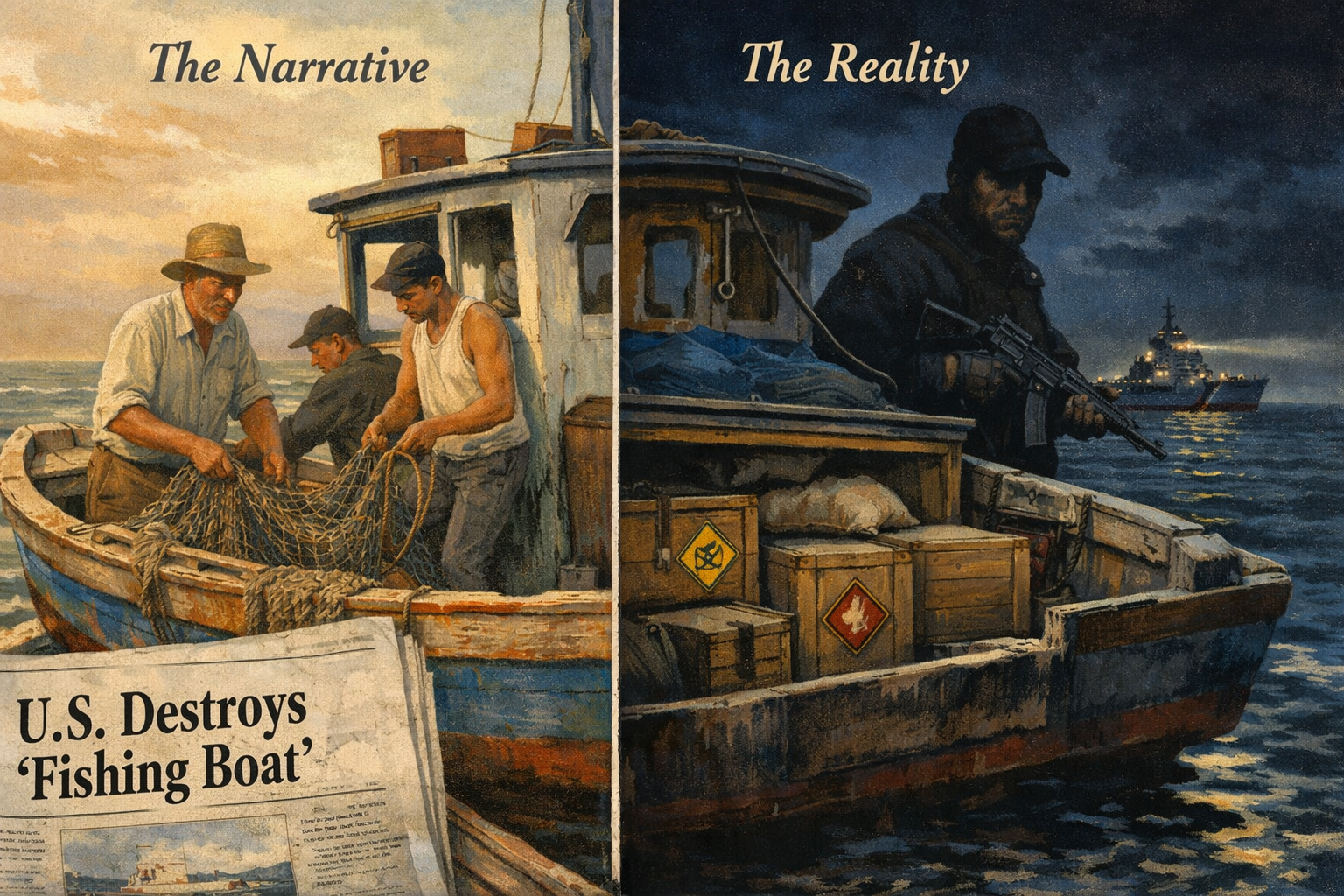
The issue of Venezuelan drug smuggling sits at the intersection of national security, public safety, foreign policy, and media credibility.
It is not merely a question of interdiction at sea or military authority overseas; it is a test case for how Americans assess intelligence claims, weigh executive power, and discern truth amid competing political narratives.
For American voters, this issue matters because it directly affects the flow of lethal narcotics—especially fentanyl—into the United States, a substance that has devastated families, hollowed out communities, and overwhelmed public health systems.
It also matters because it exposes how quickly partisan media outlets can frame hostile foreign actors as victims while casting American military and intelligence agencies as aggressors or liars.
At the heart of the controversy are U.S. actions—during the second Trump administration—to disrupt Venezuelan maritime drug trafficking networks.
Certain vessels were intercepted or destroyed based on intelligence indicating cartel involvement.
Almost immediately, claims emerged—promoted heavily by left-leaning media outlets—that these boats were manned by “innocent fishermen.”
The political utility of this framing is obvious: if the boats were harmless, then U.S. action becomes reckless, illegal, or immoral.
If the boats were cartel-linked, then the administration’s actions appear justified and restrained.
This dispute is not simply about facts on the water. It is about which institutions the public is encouraged to trust, and which are reflexively discredited.
Why This Issue Matters to American Voters
Drug smuggling from Venezuela is not an abstract foreign problem.
It is one of the downstream contributors to the opioid crisis that has killed hundreds of thousands of Americans over the last decade.
Venezuelan territory has increasingly functioned as a permissive environment for transnational criminal organizations, including groups with ties to Mexican cartels and, in some cases, state-level corruption within the Maduro regime.
Fentanyl deaths in the United States rose sharply beginning in the late 2010s and accelerated during the early 2020s.
While fentanyl production is largely centered elsewhere, maritime trafficking routes through the Caribbean and Gulf corridors play a key role in distribution logistics.
Even small vessels—often indistinguishable from fishing boats—are commonly used precisely because they offer plausible deniability.
For the average American, the consequences are concrete:
- Emergency rooms overwhelmed by overdoses
- Law enforcement stretched thin by drug-related crime
- Families permanently damaged by addiction and death
- Taxpayers funding endless mitigation instead of prevention
When voters evaluate foreign policy, they do not do so in a vacuum. They evaluate it by results at home.
Intelligence Collection and the Problem of Public Disclosure
One of the most misunderstood aspects of this controversy is the role of intelligence—and the necessary limits on what can be revealed publicly.
U.S. interdiction actions against Venezuelan drug smuggling were not spontaneous.
They were based on advance intelligence, including surveillance, signal collection, pattern-of-life analysis, and coordination with regional partners.
These techniques are not speculative; they are standard tools of modern counter-narcotics operations.
However, intelligence agencies face a permanent dilemma:
- Reveal too much, and you compromise sources, methods, and future operations.
- Reveal too little, and hostile media narratives fill the vacuum.
This creates fertile ground for partisan exploitation.
Critics demand proof while knowing full well that full disclosure would be irresponsible or impossible. The absence of public evidence is then framed as evidence of absence.
Conservative analysis has long recognized this pattern. Intelligence failures are loudly publicized; intelligence successes are often classified indefinitely.
This asymmetry benefits critics acting in bad faith.
The “Innocent Fishermen” Narrative
The claim that intercepted Venezuelan vessels were merely innocent fishing boats did not emerge organically.
It was amplified rapidly by outlets such as Associated Press, which has a long-standing pattern of framing U.S. enforcement actions through a woke victim-centered lens—particularly when a Republican administration is involved.
These reports typically rely on:
- Anonymous local sources
- Statements from Venezuelan officials or aligned NGOs
- Emotional imagery and language (“humble fishermen,” “working-class livelihoods”)
- Minimal engagement with U.S. intelligence assessments
What is almost always missing is a serious examination of how drug traffickers intentionally disguise operations as legitimate fishing activity.
This tactic is well documented globally. Fishing boats are ideal for smuggling precisely because they are common, lightly regulated, and visually unremarkable.
The AP and similar outlets rarely apply the same skepticism to claims made by foreign regimes or activist groups that they apply to statements from U.S. defense or intelligence officials.
This asymmetry reveals a worldview problem, not merely a reporting choice.
Media Trust, Partisan Framing, and the Burden of Proof
A recurring pattern emerges in coverage from left-leaning media:
- U.S. government claims are treated as presumptively suspect
- Foreign or activist claims are treated as presumptively credible
- Republican administrations are framed as reckless
- Enforcement itself is morally questioned, regardless of outcome
This approach shifts the burden of proof in a way that benefits cartels, hostile regimes, and ideological opponents of American power. It also trains the public to distrust their own institutions while extending charity to those with every incentive to deceive.
For voters attempting to make sense of Venezuelan drug smuggling, the issue becomes not just what happened, but who is shaping the narrative—and why.
The Republican Perspective on Venezuelan Drug Smuggling
From the Republican perspective, Venezuelan drug smuggling is fundamentally a national security issue, not merely a law-enforcement or humanitarian concern.
Republicans tend to view the problem through a realist framework: sovereign nations have the right—and the obligation—to defend their citizens from external threats, including transnational criminal organizations operating with state tolerance or outright cooperation.
Republicans generally reject the framing that U.S. interdiction actions are “provocations” or “militarization.”
Instead, they argue that the failure to act in the face of known trafficking routes constitutes negligence.
Within this framework, military support for counter-narcotics operations is not only lawful but prudent, especially when civilian agencies lack reach or deterrent capacity.
This view became especially prominent during the first Trump administration (2017–2020), continued through Republican congressional opposition during the Biden administration (2021–2024), and re-emerged with operational authority during the second Trump administration beginning in 2025.
Venezuelan Cartels and State Complicity
A core element of the Republican position is the recognition that Venezuela is not merely a passive transit country but an active facilitator environment for drug trafficking organizations.
Over the past two decades, Venezuelan territory has increasingly functioned as a logistical hub for cartel operations tied to:
- Mexican drug trafficking organizations
- Colombian narco-networks
- Hybrid criminal-terrorist entities operating across borders
Republican lawmakers and security analysts frequently reference what is informally known as the “Cartel of the Suns”—a term used to describe networks of Venezuelan military and political elites allegedly involved in drug trafficking.
While not every claim about this network is provable in open court, Republicans argue that the pattern of evidence—including indictments, seizures, and international reporting—supports the conclusion that cartel activity in Venezuela operates with at least tacit state protection.
From this perspective, small maritime vessels labeled as “fishing boats” are not anomalous exceptions; they are standard cartel assets.
Cartels deliberately use low-profile boats, minimal crews, and dual-use equipment to blur the line between legitimate commerce and criminal transport. Republicans argue that pretending otherwise is either naïve or dishonest.
Intelligence-Driven Operations and Rules of Engagement
Republicans consistently emphasize that interdiction operations against Venezuelan smugglers are intelligence-led, not arbitrary.
Decisions to track, intercept, or neutralize vessels are based on:
- Surveillance over time, not single encounters
- Known trafficking corridors
- Behavioral indicators inconsistent with lawful fishing
- Corroboration from allied intelligence services
Importantly, Republicans stress that intelligence assessments are rarely binary. The question is not whether a boat looks like a fishing vessel, but whether its behavioral and logistical profile aligns with cartel activity.
Republicans also point out that critics demanding public disclosure of intelligence details are often doing so knowing those disclosures cannot responsibly be made.
Revealing collection methods would compromise:
- Sources inside hostile regimes
- Technical surveillance capabilities
- Future interdiction effectiveness
From the Republican standpoint, this demand functions as a rhetorical trap rather than a serious request for accountability.
Republican Response to “Innocent Fishermen” Claims
Republicans do not deny that Venezuela has legitimate fishermen. What they deny is the claim that visual appearance alone is sufficient to exonerate a vessel.
Republican officials and commentators frequently note that:
- Cartels intentionally recruit or coerce civilians
- Fishing licenses and gear are easily acquired or forged
- Drug transfers often occur offshore, away from observers
- Crews may be unaware of the full scope of the operation
Thus, the moral calculus is not as simple as “civilian versus criminal.” Republicans argue that cartel operations deliberately exploit this ambiguity to create media-friendly outrage when interdiction occurs.
From this perspective, left-leaning media outlets that reflexively describe interdicted vessels as “innocent fishermen” are not neutrally reporting—they are advancing a narrative that serves both ideological opposition to Republican administrations and, unintentionally or not, the operational interests of cartels.
Republican Lawmakers, Statements, and Oversight
Republican members of Congress have generally defended counter-narcotics operations involving Venezuela while simultaneously affirming the need for lawful command authority and proper rules of engagement.
Statements from Republican senators and representatives typically emphasize:
- Congressional authorization for counter-drug missions
- The president’s Article II authority as commander-in-chief
- Long-standing precedent for military support in drug interdiction
- The catastrophic domestic cost of inaction
Where disagreements exist within the Republican Party, they tend to center on scope and duration, not legitimacy. Some Republicans express concern about mission creep, while others argue that sustained pressure is the only way to disrupt cartel networks embedded in hostile states.
What unites them is the conviction that cartels operating from Venezuela represent an external threat, not a misunderstanding.
Republican Assessment of Media Credibility
Republicans are deeply skeptical of media outlets that rely heavily on:
- Anonymous activist sources
- Statements from foreign regimes hostile to U.S. interests
- NGOs with explicit ideological alignments
They argue that organizations such as the Associated Press often function as agenda-setting institutions rather than neutral reporters, shaping how downstream media outlets frame events. Once a narrative—such as “innocent fishermen destroyed”—is established, it propagates rapidly, even in the absence of corroboration.
From the Republican view, this pattern reinforces public cynicism, undermines trust in national defense institutions, and weakens deterrence against transnational crime.
The Democrat Perspective on Venezuelan Drug Smuggling
The Democrat Party approaches Venezuelan drug smuggling through a markedly different framework than Republicans. While Democrats acknowledge the harms caused by narcotics trafficking, they tend to frame the issue primarily in terms of humanitarian risk, international norms, and executive restraint, rather than national security deterrence.
In Democrat rhetoric, U.S. military action—especially under a Republican administration—is frequently treated as presumptively suspect. The concern is not only whether such actions are effective, but whether they risk violating international law, escalating regional tensions, or harming civilians. This predisposition shapes both policy objections and media engagement.
During the Biden administration (2021–2024), Democrat officials emphasized diplomacy, multilateral cooperation, and sanctions over direct interdiction or military-backed enforcement. That philosophical posture continues to influence Democrat responses during the second Trump administration, even when the operational context remains largely unchanged.
Democrat Framing of Cartels and Venezuelan State Responsibility
Democrats rarely deny the existence of cartel activity linked to Venezuela. However, they often soften or contextualize the issue in ways that reduce the perceived legitimacy of U.S. enforcement actions.
Key tendencies include:
- Referring to Venezuela primarily as a “transit country” rather than an operational hub
- Avoiding language that implies state complicity or protection
- Emphasizing economic desperation and coercion over criminal agency
- Treating cartel infiltration as a development failure rather than a security threat
Where Republicans stress patterns of behavior and institutional corruption, Democrats often stress mitigating circumstances. The result is a narrative in which cartel-linked activity is portrayed as tragic, complex, and morally ambiguous—rather than hostile and predatory.
This framing has practical consequences. By downplaying the degree to which cartels exploit maritime commerce and civilian cover, Democrat rhetoric implicitly supports skepticism toward interdiction intelligence and rules of engagement.
The “Innocent Fishermen” Argument in Democrat Discourse
Democrat lawmakers and aligned commentators have frequently echoed or amplified the claim that U.S. actions targeted “innocent fishermen.” This argument is not always stated as a definitive fact; more often it is presented as a moral caution—a warning about the risk of civilian harm.
The problem, from a conservative analytical standpoint, is that this argument often:
- Ignores cartel tradecraft involving fishing vessels
- Treats appearance as evidence
- Substitutes emotional plausibility for operational analysis
- Assumes U.S. intelligence is unreliable unless fully disclosed
Democrats typically frame the issue as one of executive overreach rather than cartel deception. The moral weight is placed almost entirely on American decision-makers, not on criminal networks deliberately embedding themselves in civilian-looking operations.
Congressional Democrat Opposition and the Question of Legality
A particularly controversial element of the Democrat response emerged when six Democrat members of Congress publicly suggested that U.S. military personnel should consider refusing orders related to Venezuelan interdiction operations, arguing that such orders might be illegal.
These lawmakers—each affiliated with the Democrat Party—raised concerns that the operations lacked proper authorization or violated international law. While Democrats framed these statements as whistleblower-style warnings, Republicans countered that they bordered on encouraging insubordination within the armed forces.
From a constitutional perspective, this raised serious questions:
- Members of Congress do not command the military
- Determinations of lawful orders are governed by military justice, not partisan statements
- Publicly urging refusal of orders risks undermining civilian control and chain of command
Republicans argue that while dissent and oversight are legitimate, publicly signaling to service members that they may disregard lawful orders crosses a dangerous line. Whether such rhetoric constitutes treason is a legal question requiring strict definitions, but Republicans maintain that it unquestionably undermines national unity and operational discipline.
Democrat Reliance on Media and NGO Sources
Democrat critiques of Venezuelan interdiction efforts rely heavily on reporting from mainstream media outlets and international NGOs that share a skepticism toward U.S. military action. These sources often:
- Cite anonymous local witnesses
- Rely on statements from Venezuelan or regional officials
- Emphasize civilian narratives over intelligence assessments
- Frame U.S. actions as unilateral or provocative
Democrats rarely challenge the underlying assumptions of these reports, even when those assumptions align closely with the interests of hostile regimes or criminal organizations. The result is a feedback loop in which media framing reinforces Democrat objections, which in turn legitimize the framing.
Internal Democrat Tensions
It is important to note that the Democrat Party is not monolithic. Some centrist Democrats express concern about fentanyl deaths and cartel violence and acknowledge the need for robust enforcement. However, these voices are increasingly marginalized within a party that has absorbed Progressive ideological commitments.
The dominant faction prioritizes:
- Restraint over deterrence
- Narrative credibility over operational secrecy
- International opinion over domestic harm
This internal imbalance explains why Democrat critiques often appear disconnected from the lived reality of communities affected by drug trafficking.
The Progressive (Woke) Worldview Behind Democrat Policy
To understand why Democrat responses to Venezuelan drug smuggling consistently diverge from Republican responses, one must look beyond surface policy disagreements to the underlying worldview that now dominates the Democrat Party. That worldview is commonly described as Progressive or woke, and while those terms are often used loosely, they represent a coherent—if deeply flawed—set of assumptions about power, morality, and blame.
At its core, the Progressive worldview interprets political and social conflicts through an oppressor–oppressed framework. Institutions associated with Western authority—especially American military, intelligence, law enforcement, and borders—are treated as inherently suspect. Conversely, groups positioned as marginalized, foreign, or economically disadvantaged are granted moral presumption, even when evidence of wrongdoing exists.
This lens profoundly shapes how Venezuelan drug smuggling is discussed. The United States becomes the dominant power whose actions require justification, while cartel-linked actors are reframed as victims of circumstance, coercion, or economic injustice.
Relationship Between “Progressive,” Woke, Cultural Marxism, and Neo-Marxism
Although many Democrats resist the label “Neo-Marxist,” the intellectual lineage of Progressive ideology is not difficult to trace. Modern Progressivism borrows heavily from:
- Cultural Marxism, which relocates class struggle from economics to culture
- Critical theory, which treats institutions as power mechanisms rather than neutral structures
- Intersectionality, which ranks moral authority based on group identity
- Politically correct language, which constrains debate by redefining acceptable speech
In this framework, the legitimacy of an action is judged less by objective outcomes and more by who exercises power over whom. When U.S. forces interdict Venezuelan vessels, the action is filtered through assumptions about imperialism, militarism, and Western dominance—regardless of the narcotics being transported or the lives destroyed downstream.
This worldview does not deny the existence of cartels outright, but it reinterprets cartel behavior as symptomatic of global inequality rather than deliberate criminal predation.
How Progressive Presuppositions Shape Policy Outcomes
Progressive presuppositions manifest in Democrat policy and rhetoric in predictable ways.
First, enforcement is treated as morally hazardous. Any assertion of force is assumed to risk abuse, escalation, or illegitimacy. This leads to chronic hesitation and second-guessing of intelligence assessments, particularly when they justify decisive action.
Second, intent is privileged over effect. If a vessel’s crew appears economically disadvantaged, Progressive analysis focuses on motive (“they are just trying to survive”) rather than consequence (“they are facilitating lethal drug distribution”). The victims of fentanyl overdoses in American communities become abstract, while hypothetical harm to foreign actors is foregrounded.
Third, secrecy itself is viewed with suspicion. Intelligence classification is interpreted not as prudence but as concealment. Progressive commentators often argue that if the public cannot see the evidence, the evidence should not be trusted—an epistemology that would make intelligence operations functionally impossible.
Progressive Alignment With Media Narratives
The Progressive worldview aligns naturally with mainstream media institutions that share its assumptions. This explains why narratives such as “innocent fishermen” gain rapid traction despite longstanding cartel tradecraft that relies on civilian disguise.
Progressive-aligned outlets tend to:
- Use emotive language to frame enforcement as cruelty
- Select sources that reinforce skepticism of U.S. authority
- Minimize cartel agency while maximizing American culpability
- Treat skepticism of Progressive narratives as moral failure
The result is a narrative monoculture in which dissenting interpretations—especially those grounded in security analysis—are marginalized or caricatured.
Consequences for National Security and Public Trust
From a conservative perspective, the Progressive worldview produces two dangerous outcomes.
First, it emboldens transnational criminal organizations. Cartels learn quickly which narratives generate political pressure and exploit them ruthlessly. Civilian camouflage, humanitarian framing, and media amplification become operational tools.
Second, it erodes public trust in legitimate authority. When intelligence agencies, military officers, and elected executives are habitually portrayed as untrustworthy, citizens lose confidence in the very institutions tasked with protecting them.
This erosion of trust does not fall evenly. It falls hardest on communities ravaged by drugs, where Progressive caution translates into practical inaction.
Contrast With the Republican and Biblical Worldviews
Where Progressivism assumes that power is inherently corrupt, the Republican worldview—especially when informed by biblical principles—recognizes that authority is morally neutral and must be judged by its use.
Scripture consistently affirms that civil authorities exist to restrain evil and protect the innocent. Progressivism reverses this moral logic by treating restraint of evil as suspect and accommodation of wrongdoing as compassion.
This worldview conflict, more than any specific policy dispute, explains the radically different reactions to Venezuelan drug smuggling and the vessels used to carry it.
The Libertarian Party Position on Venezuelan Drug Smuggling
The Libertarian Party approaches Venezuelan drug smuggling from a fundamentally different philosophical starting point than both Republicans and Democrats. Libertarian analysis is rooted in radical skepticism toward state power, especially military power exercised beyond U.S. borders. As a result, Libertarians tend to oppose or severely limit U.S. involvement in foreign interdiction operations, even when those operations target criminal enterprises.
According to the most recent platform of the Libertarian Party, the proper role of government is narrowly defined. National defense is acknowledged, but foreign interventions—particularly those not tied to a formal declaration of war—are viewed as presumptively illegitimate. Drug smuggling, in this framework, is treated less as a national security threat and more as a byproduct of prohibitionist policy.
This philosophical baseline places Libertarians at odds with Republican enforcement priorities and, in a different way, with Democrat humanitarian-intervention skepticism.
Libertarian Assumptions About Cartels and State Authority
Libertarians generally acknowledge that cartels exist and that drug trafficking causes real harm. However, they frame cartel power primarily as a market response to government prohibition rather than as an external enemy requiring forceful suppression.
From this perspective:
- Cartels are empowered by black markets
- Enforcement increases risk premiums, not deterrence
- Militarized interdiction escalates violence
- State action creates unintended consequences
As a result, Libertarians are less inclined to view Venezuelan cartel activity as justification for U.S. military involvement. Even when state complicity exists—as Republicans argue is the case in Venezuela—Libertarians remain wary of expanding U.S. authority abroad.
This skepticism extends to intelligence claims. Libertarians often argue that classified intelligence cannot be meaningfully evaluated by the public and therefore should not be the basis for irreversible actions such as vessel destruction.
The Libertarian View of the “Innocent Fishermen” Debate
Libertarians tend to side instinctively with claims that intercepted vessels may have been innocent, not because they necessarily trust cartel narratives, but because they distrust government assertions of certainty.
In their view:
- Governments have incentives to overstate threats
- Intelligence failures are historically common
- Civilian harm is unacceptable regardless of intent
- Enforcement errors undermine legitimacy
Thus, Libertarians often echo media skepticism—not from Progressive ideology, but from anti-statist caution. This creates a rare alignment between Libertarian rhetoric and left-leaning media narratives, even though the underlying motivations differ substantially.
Alignment With Republicans or Democrats
On this issue, Libertarians do not align cleanly with either major party.
They diverge from Republicans by rejecting:
- Military-backed interdiction
- Broad executive authority
- National security framing of drug trafficking
They diverge from Democrats by rejecting:
- Humanitarian framing as a basis for policy
- Regulatory expansion
- International institutions as arbiters of legitimacy
Libertarians instead propose long-term decriminalization or legalization strategies, arguing that cartel power would diminish if drug markets were brought above ground. Republicans generally view this approach as dangerously naïve, given the violence, coercion, and corruption inherent in cartel operations—even beyond drug sales.
Why the Libertarian Position Remains Tangential
While philosophically coherent, the Libertarian position remains politically marginal. Libertarians do not control major federal institutions, and their platform positions rarely translate into operational policy.
For the purposes of educating voters, the Libertarian perspective is relevant primarily as a contrast case—illustrating how underlying assumptions about government authority radically alter conclusions about the same facts.
Where Republicans emphasize protection, Democrats emphasize restraint, and Progressives emphasize power critique, Libertarians emphasize non-intervention as a first principle, even when the consequences are severe.
Actions Versus Rhetoric: What Parties Actually Do
This section is best introduced by the blunt political wisdom of Joseph P. Kennedy, who famously observed: “In politics, what you DO is what you believe. Everything else is cottage cheese.”
The relevance of this statement is obvious. Party platforms, press releases, and moral posturing matter far less than actual decisions made when authority is exercised.
When applied to Venezuelan drug smuggling, this principle exposes sharp contrasts—not only between Republicans and Democrats, but between stated ideals and operational behavior.
Republican-Run Administrations in Practice
During the first Trump administration (2017–2020), Republican governance emphasized assertive counter-narcotics enforcement. The administration expanded maritime interdiction operations, increased intelligence-sharing with regional partners, and publicly acknowledged the role of Venezuelan territory as a permissive environment for cartel logistics.
These actions aligned closely with Republican rhetoric. Drug trafficking was treated as a national security threat with direct domestic consequences. Cartels were named as hostile actors, and state complicity—especially within the Maduro regime—was openly discussed. Importantly, the administration did not claim omniscience or perfection, but it consistently prioritized disruption over diplomatic optics.
By contrast, during the Biden administration (2021–2024), many of these initiatives were scaled back, reframed, or deprioritized. Republicans in Congress repeatedly criticized the administration for returning to a posture of diplomatic caution while fentanyl deaths continued to rise domestically. This criticism was not theoretical; it was grounded in outcomes.
The second Trump administration (2025–present) marked a return to intelligence-driven interdiction. Republican officials argued that lessons learned during earlier efforts improved operational precision. When vessels linked to Venezuelan trafficking networks were targeted, the administration emphasized that decisions were made before contact, based on long-term surveillance—not spontaneous judgment.
From the Republican perspective, this continuity between rhetoric and action is evidence of seriousness rather than recklessness.
Democrat-Run Administrations in Practice
Democrat administrations often articulate strong opposition to drug trafficking while simultaneously constraining the tools available to confront it.
Under the Biden administration, policy emphasized:
- Multilateral engagement
- Sanctions and diplomatic signaling
- Humanitarian considerations
- De-escalation of military posture
In practice, this translated into hesitation to employ force, even in cases involving well-established trafficking routes. While Democrats argued this reduced civilian risk, Republicans countered that it shifted risk downstream—onto American communities absorbing the effects of narcotics inflows.
At the state and city level, Democrat governance often compounded the problem indirectly. Policies that reduced penalties for drug possession, limited cooperation with federal enforcement, or deprioritized narcotics crimes created environments where cartel distribution networks could operate with less friction. While these policies were justified as criminal justice reform, Republicans argue that they functioned as demand-side enablers.
Consistency and Inconsistency With Party Platforms
Republican actions largely reflect their stated platform commitments: border security, law enforcement support, national sovereignty, and public safety. Where inconsistencies exist, they usually involve debates over scope rather than principle—how much force, how often, and for how long.
Democrat actions, by contrast, often diverge from their stated concern for working-class communities. While claiming to protect vulnerable populations, Democrat policies frequently leave those same populations exposed to addiction, crime, and instability driven by cartel activity.
This disconnect is especially evident in media engagement. Democrat leaders often amplify reports portraying U.S. enforcement as dangerous while minimizing or ignoring the predictable harm caused by inaction.
The Role of Media in Shaping Perceptions of Action
One reason Democrat actions appear disconnected from consequences is the protective function of sympathetic media coverage. When enforcement is restrained, failures are attributed to complexity or systemic forces. When enforcement is assertive—especially under Republican leadership—every adverse claim is magnified.
This asymmetry distorts public evaluation of policy effectiveness. Actions that reduce trafficking quietly receive little attention; actions that disrupt cartel operations loudly generate controversy.
Republicans argue that this media dynamic rewards caution regardless of outcome and punishes decisiveness regardless of justification.
Summary Assessment
Measured against Kennedy’s standard, Republican governance on Venezuelan drug smuggling exhibits alignment between belief and behavior. Democrat governance exhibits rhetorical concern paired with operational reluctance. Libertarians, by design, avoid action altogether.
For voters, this section underscores a central reality: consequences follow actions, not intentions. And when cartel networks are embedded in foreign territory, inaction is itself a decision—with predictable victims.
Republican Criticisms of the Democrat Approach and Democrat Responses
Republicans level several consistent criticisms at the Democrat approach to Venezuelan drug smuggling. The most prominent charge is that Democrats systematically underestimate the intentional, strategic nature of cartel operations. Republicans argue that Democrats speak as though trafficking is a chaotic humanitarian spillover rather than a disciplined criminal enterprise embedded in permissive or complicit states.
Republicans also criticize Democrats for prioritizing optics over outcomes. From this viewpoint, Democrat leaders appear more concerned with how enforcement actions are perceived by international observers and sympathetic media than with whether those actions reduce the flow of drugs into American communities. The repeated emphasis on “innocent fishermen” is cited as an example of emotional framing substituting for operational analysis.
A third Republican criticism is that Democrats erode deterrence by publicly questioning the legitimacy of enforcement itself. When Democrat lawmakers cast doubt on military orders or suggest illegality without substantiating claims through proper oversight channels, Republicans argue that they embolden cartels by signaling domestic division and hesitation.
Democrats respond by asserting that Republicans are reckless, unilateral, and dismissive of civilian risk. They argue that Republicans conflate suspicion with proof and that intelligence-driven operations lack sufficient transparency. Democrats also claim that Republicans use drug enforcement as a political tool, exaggerating threats to justify executive power and military expansion.
Republicans counter that this response avoids the central issue. Transparency, they argue, cannot mean operational self-sabotage, and civilian risk cannot be eliminated when cartels deliberately hide among civilians. The Republican rebuttal is blunt: failure to act does not eliminate harm—it relocates it to American neighborhoods already bearing the cost of addiction and crime.
Democrat Criticisms of the Republican Approach and Republican Responses
Democrats accuse Republicans of militarizing drug policy and treating complex social problems as battlefield scenarios. They argue that interdiction efforts risk escalation, miscalculation, and international condemnation, particularly when operations occur near or within contested jurisdictions. Democrats also contend that Republican rhetoric paints with too broad a brush, implicitly criminalizing impoverished civilians.
Republicans respond by pointing out that Democrats routinely accept militarized responses in other contexts—such as foreign conflicts or domestic emergencies—when they align with Progressive priorities. The objection, Republicans argue, is not militarization per se, but who wields authority and for what purpose.
Democrats further claim that Republican actions rely too heavily on classified intelligence that cannot be independently verified. Republicans reply that intelligence has always functioned this way and that demanding public disclosure as a prerequisite for action would render intelligence agencies useless.
The Republican counter-response also emphasizes proportionality. The goal is not occupation or regime change, but disruption of known trafficking mechanisms. Republicans argue that Democrats exaggerate the scope of enforcement in order to delegitimize it.
Constrained and Unconstrained Visions of Governance
These disagreements are best understood through the lens articulated by Thomas Sowell, who distinguished between constrained and unconstrained visions of human nature and governance.
The Republican position aligns closely with the constrained vision. Human nature is flawed. Evil is real, persistent, and adaptive. Institutions exist to restrain wrongdoing, not to perfect humanity. From this standpoint, cartels are not misunderstood victims of inequality; they are predatory organizations that exploit weakness wherever it exists.
The Democrat and Progressive position aligns more closely with the unconstrained vision. Human behavior is shaped primarily by systems and conditions. If harm occurs, the cause is presumed to be structural injustice rather than moral agency. Enforcement is therefore suspect, because it addresses symptoms rather than root causes.
Libertarians adopt a different unconstrained framework—one that distrusts institutions entirely and assumes that individual liberty, if left alone, will produce better outcomes than state action.
The biblical worldview shares the constrained vision but grounds it more deeply. Scripture affirms both human dignity and human depravity. Authority is neither absolute nor illegitimate by default; it is accountable, purposeful, and morally bounded. This framework explains why Republicans tend to support enforcement tempered by law, while rejecting both Progressive paralysis and Libertarian disengagement.
Republican Suspicions Regarding Democrat Motives and Strategy
Republicans harbor several credible suspicions regarding how and why Democrats approach Venezuelan drug smuggling as they do. These suspicions do not require conspiracy thinking; they arise naturally from observable incentives, repeated behavior, and public statements.
First, Republicans suspect that Democrats are structurally disinclined to acknowledge external threats when doing so would legitimize strong borders, law enforcement, or military authority. Acknowledging Venezuelan cartels as hostile actors embedded in a permissive state would strengthen arguments Republicans consistently make across related issues, including border security and immigration enforcement. Democrats therefore have an incentive to downplay cartel agency and elevate ambiguity.
Second, Republicans suspect that Democrats rely heavily on narrative control through media alignment. By framing interdiction efforts as reckless or unlawful, Democrats can mobilize Progressive constituencies that are deeply skeptical of American power. This is not accidental. It reflects a broader strategy of delegitimizing Republican administrations by questioning not merely their judgment, but their moral authority to act at all.
Third, Republicans suspect that Democrat leaders prioritize international approval and activist validation over domestic consequences. Statements condemning U.S. enforcement often appear tailored for consumption by international organizations, NGOs, and left-leaning media outlets rather than by American families affected by drug trafficking. Republicans view this as a misalignment of political loyalty.
None of these suspicions require proof of malice. They require only the recognition that political actors respond predictably to incentives—and that Democrat incentives increasingly align with Progressive ideological commitments rather than enforcement outcomes.
Democrat Suspicions Regarding Republican Motives and Strategy
Democrats, in turn, voice their own suspicions about Republican actions against Venezuelan drug smuggling. They often argue that Republicans inflate or dramatize threats to justify expanded executive authority, especially under a Republican president.
Democrats also suspect that Republicans use drug enforcement as a symbolic political weapon, appealing to voters’ fears rather than addressing root causes. In this telling, interdiction operations are less about effectiveness and more about signaling strength, toughness, and decisiveness.
Another Democrat suspicion is that Republicans are indifferent to civilian harm and international norms. Democrats argue that when Republicans emphasize secrecy and intelligence, they are shielding themselves from accountability rather than protecting legitimate sources and methods.
From a conservative analytical standpoint, these suspicions are revealing. They assume that authority is inherently abusive and that force is presumptively illegitimate. Republicans respond that this suspicion says more about the Progressive worldview than about Republican intent.
Evaluating These Suspicions Without Overreach
It is important to distinguish credible suspicion from unfounded accusation. Republicans are correct to note that Democrat rhetoric often undermines enforcement, emboldens cartels indirectly, and aligns conveniently with hostile narratives. Democrats are correct to insist that unchecked power can be abused and that oversight matters.
The question is proportionality and pattern. When skepticism becomes reflexive and enforcement is always treated as suspect—regardless of context, intelligence, or consequence—it ceases to function as oversight and becomes obstruction.
Republicans argue that Democrat suspicion has crossed that line. Democrats argue that Republican confidence has crossed the line into arrogance. Voters must assess which error is more dangerous in practice.
Strategic Effects on Cartels and Foreign Actors
Cartels are not passive observers of American politics. They study enforcement patterns, political debates, and media narratives carefully. When U.S. political divisions become predictable, cartels adapt accordingly.
Republicans warn that:
- Public Democrat skepticism weakens deterrence
- Media amplification of “innocent fishermen” narratives creates operational cover
- Hesitation signals opportunity
This is not speculation; it is standard criminal behavior. Organized crime thrives where enforcement is contested and legitimacy is undermined.
Democrats rarely address this adaptive behavior directly, focusing instead on the morality of enforcement decisions in isolation. Republicans argue that this omission is strategically naïve.
Summary of Strategic Concerns
The credible concern Republicans raise is not that Democrats sympathize with cartels, but that their worldview creates predictable blind spots—blind spots that sophisticated criminal networks exploit.
The credible concern Democrats raise is not that Republicans are malicious, but that confidence in enforcement can dull sensitivity to error.
The central question for voters is which posture better protects innocent life in the real world as it exists—not as ideology wishes it to be.
High-Trust and Low-Trust Societies Defined
A useful framework for understanding public reaction to Venezuelan drug smuggling—and the partisan divide surrounding it—is the distinction between high-trust and low-trust societies. A high-trust society is one in which citizens generally believe that institutions operate with legitimacy, competence, and moral restraint. A low-trust society is one in which institutions are viewed as self-serving, corrupt, or hostile to ordinary people.
Political theorists such as Francis Fukuyama have noted that trust is not merely cultural sentiment; it is an enabling condition for effective governance. When trust declines, every action by authority is interpreted through suspicion, and collective action becomes difficult—even when threats are real.
The United States historically functioned as a relatively high-trust society. While skepticism of government has always existed, there was broad agreement that national defense, law enforcement, and intelligence agencies were fundamentally oriented toward public protection.
That consensus has fractured.
Declining Trust and Drug Enforcement Skepticism
The debate over Venezuelan drug smuggling reflects this erosion of trust. Large segments of the American public—particularly those aligned with Progressive ideology—no longer grant institutions the benefit of the doubt. Intelligence assessments are assumed to be politically motivated. Military actions are presumed reckless. Secrecy is interpreted as deceit.
This low-trust posture helps explain why claims such as “innocent fishermen” resonate so quickly. In a low-trust environment, alternative narratives gain traction not because they are well-supported, but because they align with existing suspicion.
Republicans, by contrast, tend to operate from a residual high-trust assumption. While acknowledging past failures, they maintain that intelligence agencies and military leadership remain necessary and generally competent. From this standpoint, categorical skepticism toward enforcement is itself irresponsible.
Media, Trust, and Authority
Mainstream media plays a decisive role in shaping trust. When media outlets repeatedly frame U.S. enforcement actions as dubious while amplifying claims from foreign actors, activists, or NGOs, they reinforce a low-trust feedback loop.
Over time, this conditioning produces predictable reactions:
- Government claims are treated as propaganda
- Cartel-adjacent narratives are treated as plausible
- Enforcement errors are personalized and moralized
- Enforcement successes are minimized or ignored
Republicans argue that this pattern trains citizens to side instinctively against their own institutions, even when those institutions are confronting genuine threats.
High-Trust Communities Versus Low-Trust Consequences
Ironically, the communities most damaged by drug trafficking tend to be those that retain higher levels of trust in law enforcement and public authority. These communities often support interdiction not because they are naïve, but because they experience the consequences of inaction directly.
Low-trust elites—media figures, academics, and activists—are often insulated from these consequences. Their skepticism carries little personal cost, while the downstream effects are borne by others.
Republicans view this asymmetry as morally significant. When distrust becomes fashionable among the influential, it imposes risk on the vulnerable.
Trust, Authority, and the Biblical Perspective
The biblical worldview neither demands blind trust nor endorses reflexive suspicion. Scripture affirms that authority is accountable to God and must be exercised justly, but it also affirms that authority exists for the restraint of evil.
A society that abandons trust entirely cannot govern itself. A society that refuses accountability cannot correct itself. The current American debate over Venezuelan drug smuggling reveals how far trust has decayed—and how urgently it must be restored on rational, moral grounds rather than ideological ones.
How Mainstream Media Has Distorted This Issue
Mainstream media coverage of Venezuelan drug smuggling has not merely reflected partisan disagreement; it has actively shaped the boundaries of acceptable opinion. The distortion does not usually take the form of outright fabrication. Instead, it emerges through selective framing, omission, and asymmetrical skepticism.
When Republican-led administrations act against cartel-linked trafficking, the default media posture is adversarial. Enforcement is framed as provocative, dangerous, or legally questionable. When Democrat administrations restrain enforcement, the same outlets frame inaction as prudence, complexity, or moral sensitivity.
This double standard conditions audiences to associate decisive action with recklessness and hesitation with virtue, regardless of outcomes.
Case Study: The “Innocent Fishermen” Frame
A recurring media trope in this controversy is the claim that interdicted Venezuelan vessels were “innocent fishermen.” Outlets such as the Associated Press played a central role in amplifying this framing.
The technique is subtle but effective:
- The descriptor “fishermen” is introduced early, before any discussion of intelligence
- Civilian identity is treated as dispositive evidence
- Cartel tradecraft is minimized or ignored
- U.S. intelligence claims are framed as unverified assertions
Notably absent is sustained discussion of how cartels worldwide routinely masquerade as legitimate maritime commerce. Fishing vessels are not anomalous; they are preferred assets precisely because they provide plausible deniability and sympathetic optics.
This omission is not neutral. It systematically biases the reader toward skepticism of enforcement and sympathy for unverified counterclaims.
Tools of Media Distortion
Mainstream outlets employ several recurring tools when covering this issue.
One is language laundering. Terms like “interdiction,” “neutralization,” or “intelligence-led operation” are replaced with emotionally charged alternatives such as “attack,” “destruction,” or “military strike,” subtly escalating perceived severity.
Another is source asymmetry. Anonymous activists, foreign officials, or NGOs are quoted as credible witnesses, while U.S. intelligence officials are treated as interested parties whose claims require extraordinary proof.
A third tool is context stripping. Reports often isolate a single enforcement incident from the broader pattern of cartel activity, fentanyl deaths, or long-term surveillance, making the action appear arbitrary rather than cumulative.
Movement of the Overton Window
Over time, these practices have shifted the Overton window—the range of policies considered acceptable to discuss.
A decade ago, aggressive counter-narcotics operations were widely regarded as legitimate exercises of state authority. Today, under sustained media pressure, even limited interdiction actions are portrayed as morally dubious unless accompanied by exhaustive public justification.
This shift has consequences. Policies once considered baseline enforcement now require extraordinary defense, while policies of restraint require little explanation. Cartel adaptation to this environment is predictable.
Media Trust and Selective Skepticism
Perhaps the most damaging distortion is selective skepticism. Mainstream media prides itself on “speaking truth to power,” yet in practice it often speaks skepticism only toward certain forms of power—namely, Republican administrations, military authority, and intelligence agencies.
Power exercised by Progressive-aligned actors, international bodies, or activist organizations is rarely subjected to the same scrutiny. This asymmetry undermines the media’s claim to neutrality and erodes public confidence.
Republicans argue that a press corps unwilling to apply skepticism evenly becomes a political actor rather than an informant.
Implications for Democratic Self-Governance
A self-governing people require accurate information. When media distortion obscures the realities of cartel behavior, intelligence constraints, and enforcement tradeoffs, voters are deprived of the ability to judge policy rationally.
The debate over Venezuelan drug smuggling is therefore not just about drugs or boats. It is about whether Americans will be permitted to evaluate national security decisions without ideological mediation.
The Biblical Framework for Authority and Justice
Any Christian evaluation of Venezuelan drug smuggling and U.S. interdiction efforts must begin with Scripture’s teaching on civil authority. The Bible neither treats government as inherently evil nor as morally autonomous. Rather, civil authority is described as a delegated institution under God, accountable for how it restrains evil and protects the innocent.
Romans 13 teaches that governing authorities are “God’s servant for your good,” bearing the sword to punish wrongdoing. This passage does not sanctify every government action, but it does establish that the use of coercive force is sometimes morally necessary. A state that refuses to restrain violent or destructive evil abdicates its God-given responsibility.
Drug cartels—especially transnational organizations trafficking substances that kill indiscriminately—clearly fall into the biblical category of evildoers. Their operations exploit the vulnerable, destroy families, and corrupt institutions. Scripture leaves no room for romanticizing such activity.
The Moral Agency of Cartels Versus the Myth of Moral Neutrality
A recurring error in Progressive and media narratives is the erosion of moral agency. Cartel members are frequently portrayed as victims of circumstance, poverty, or global inequality. While Scripture recognizes the reality of hardship, it does not erase moral responsibility.
The biblical worldview affirms both:
- Compassion for the poor
- Accountability for deliberate wrongdoing
Cartels are not morally neutral actors swept along by forces beyond their control. They are organized, intentional, and predatory. Using fishing boats, coerced labor, or civilian disguise does not mitigate guilt; it compounds it. Scripture consistently condemns those who hide violence behind deception.
This is where the “innocent fishermen” narrative collapses under biblical scrutiny. Even when individuals are coerced, the primary moral responsibility rests with those who design and direct the criminal enterprise, not with the authority seeking to restrain it.
Secrecy, Wisdom, and the Limits of Disclosure
Some Christians express discomfort with intelligence secrecy, assuming that transparency is always morally superior. Scripture, however, affirms the legitimacy of discretion. Proverbs repeatedly praises prudence, concealment of plans, and wise restraint of information when disclosure would empower evil.
Requiring governments to expose intelligence methods in order to justify enforcement misunderstands the moral problem. The biblical concern is not whether every detail is public, but whether authority is exercised justly, proportionally, and for the protection of life.
Demanding full transparency as a precondition for action would, in effect, grant criminals veto power over enforcement. Scripture does not endorse such paralysis.
Biblical Evaluation of Party Positions
When evaluated against biblical principles, the Republican position aligns more closely with the scriptural understanding of civil authority. Republicans affirm:
- The reality of evil
- The legitimacy of enforcement
- The necessity of deterrence
- The protection of innocent life downstream
The Democrat/Progressive position struggles at precisely these points. By prioritizing restraint, narrative caution, and systemic explanations, it frequently fails to restrain evil effectively. Good intentions do not absolve ineffective governance.
The Libertarian position, while valuing individual liberty, ultimately withdraws moral responsibility from the state altogether, leaving society vulnerable to organized predation. Scripture does not support this abdication.
Insights from Conservative Christian Voices
Theologians and pastors such as R.C. Sproul, John MacArthur, Voddie Baucham, and Thomas Ascol consistently emphasize that:
- Evil must be named plainly
- Authority must be exercised under God
- Compassion must not become moral confusion
These thinkers reject both Progressive sentimentalism and Libertarian disengagement. They affirm that justice and mercy are not opposites, but that mercy divorced from justice becomes cruelty toward the innocent.
Conservative Roman Catholic commentators such as Matt Walsh, J.D. Vance, and Michael Knowles echo similar concerns, stressing that social order, moral clarity, and enforcement are prerequisites for human flourishing.
Worldview Contrast Summary
At root, the biblical worldview differs from the Republican, Democrat, and Libertarian positions in degree—but it differs from Progressivism in kind.
Biblical Christianity affirms:
- Objective moral evil
- Legitimate authority
- Necessary coercion against predation
- Accountability before God
Where the Republican Party imperfectly approximates these principles, it remains structurally open to biblical participation. The Democrat Party, having absorbed Progressive ideology, increasingly resists them.
For Christians seeking coherence between faith and public policy, this distinction matters.
The Case Against the Democrat Party from a Biblical and Human Flourishing Perspective
From a biblical and human flourishing standpoint, the central case against the Democrat Party on Venezuelan drug smuggling is not rooted in motive, but in outcomes shaped by worldview. Scripture evaluates governance by whether it restrains evil, protects the innocent, and promotes ordered peace. When policy consistently fails these tests, good intentions cannot redeem it.
Democrat governance increasingly treats criminal predation as a social pathology rather than a moral offense. This shift has profound consequences. When cartel activity is framed primarily as a byproduct of inequality, enforcement becomes morally suspect and restraint becomes the default posture. The predictable result is not compassion, but the redistribution of harm—away from foreign actors and toward domestic communities least able to absorb it.
Human flourishing requires order. Scripture presents peace not as the absence of conflict, but as the presence of justice. A government that hesitates to confront organized evil in the name of humanitarian sensitivity undermines the very conditions necessary for human life to flourish.
Case Studies from the Biden Administration
During the administration of Joe Biden (2021–2024), Democrat policy toward drug trafficking emphasized diplomatic engagement, sanctions, and multilateral coordination while de-emphasizing robust interdiction. In theory, this approach was intended to reduce escalation and civilian risk. In practice, it coincided with historic increases in fentanyl deaths within the United States.
From a biblical perspective, this raises a sobering moral question: Which lives were prioritized? While restraint may have reduced the risk of immediate confrontation abroad, it did not reduce the downstream lethality of narcotics reaching American cities and towns.
The administration’s posture also normalized public skepticism toward intelligence and enforcement. By allowing media narratives to cast doubt on interdiction legitimacy—without strong rebuttal—the administration contributed to a cultural environment in which enforcement itself was viewed as morally questionable.
Scripture does not require omniscience from rulers, but it does require vigilance. The Biden administration’s approach reflected a Progressive preference for procedural caution over substantive protection, a tradeoff that disproportionately harmed the vulnerable.
Case Studies from Progressive States and Cities
The effects of Democrat and Progressive governance are not limited to federal policy. State and city administrations in jurisdictions such as California, Colorado, Illinois, Massachusetts, Minnesota, New York, Oregon, and Washington State—and cities including Austin, Berkeley, Boston, Boulder, Cambridge, Chicago, Denver, Los Angeles, Madison, Minneapolis, St. Paul, Oakland, Portland, Seattle, Sacramento, San Jose, and Washington, D.C.—have implemented policies that indirectly amplify the harm caused by international drug trafficking.
These policies include:
- Reduced penalties for drug possession
- Deprioritization of narcotics enforcement
- Limits on cooperation with federal authorities
- Expansion of harm-reduction programs without corresponding deterrence
From a biblical standpoint, these approaches confuse mercy with permissiveness. Compassion for those suffering addiction is necessary, but compassion that refuses to confront supply chains and criminal organizers is incomplete. Scripture repeatedly warns against rulers who “call evil good” by refusing to name and restrain it.
In these Progressive jurisdictions, the consequences are visible: open drug use, rising overdose deaths, destabilized neighborhoods, and normalization of disorder. These outcomes are not accidental; they flow logically from a worldview that resists moral clarity and enforcement authority.
Why This Matters for Human Flourishing
Human flourishing requires safety, predictability, and moral accountability. Families cannot thrive where addiction is normalized. Children cannot flourish where public spaces are surrendered to drug use. Communities cannot prosper when criminal networks operate with minimal resistance.
The Democrat/Progressive approach undermines these preconditions by treating enforcement as morally hazardous and authority as inherently suspect. Scripture teaches the opposite: authority exists precisely because evil is real and persistent.
A biblical evaluation therefore concludes that Democrat governance—especially where Progressive ideology dominates—violates the principles necessary for human flourishing, even when clothed in humanitarian language.
Summary Judgment
The case against the Democrat Party on this issue is not partisan rhetoric; it is a moral and practical assessment grounded in Scripture and lived reality.
By prioritizing restraint over protection, narrative sensitivity over deterrence, and ideological skepticism over moral clarity, Democrat governance has failed to restrain the very evils that Scripture commands civil authorities to confront.
Voting as a Moral Act, Not a Tribal One
For the biblical Christian, voting is not an exercise in party loyalty or personal preference. It is a moral act of stewardship. Scripture does not command Christians to vote for a particular party, but it does require them to seek justice, love righteousness, and protect the innocent within the sphere of influence God has granted them.
When evaluating issues such as Venezuelan drug smuggling, Christians must look beyond slogans and assess whether a candidate’s policies restrain evil or excuse it, protect life or merely manage harm, and acknowledge moral agency or dissolve it into abstraction.
A mature Christian does not ask whether a policy sounds compassionate, but whether it actually produces conditions in which human life can flourish.
Weighing Issues According to Biblical Gravity
Not all political issues carry equal moral weight. Scripture makes clear that the protection of life, the restraint of violence, and the preservation of social order are foundational responsibilities of civil government.
Drug trafficking—especially on the scale enabled by international cartels—directly implicates these priorities. The downstream effects include death, family disintegration, crime, and generational harm. As such, this issue cannot be dismissed as a secondary or technical matter of policy.
A Christian voter may legitimately disagree on taxation levels or regulatory approaches. But when a party’s worldview repeatedly fails to restrain predatory evil, that failure must weigh heavily in moral evaluation.
Why the Republican Party Is the Default Choice for Biblical Christians
While no political party fully embodies biblical principles, the Republican Party remains structurally open to biblical participation in a way the Democrat Party increasingly is not.
On issues like Venezuelan drug smuggling, Republicans:
- Affirm the reality of moral evil
- Recognize the legitimacy of enforcement authority
- Accept the necessity of deterrence
- Resist narratives that excuse criminal predation
The Democrat Party, having absorbed Progressive ideology, increasingly resists these premises. Its policy instincts prioritize restraint, narrative caution, and systemic explanations—even when those instincts lead to predictable harm.
For this reason, Christians committed to a biblical worldview will, in the vast majority of cases, find Republican candidates more aligned with their moral convictions, even while holding those candidates accountable for consistency and humility.
Avoiding Two Common Errors
Christians should avoid two opposite errors when engaging politically.
The first is moral disengagement—withdrawing from political responsibility on the grounds that all options are flawed. While understandable, this posture abandons the field to those with radically different moral commitments.
The second is moral absolutism toward parties—treating any political party as righteous by default. Scripture permits no such allegiance. Christians are called to evaluate, critique, and correct—even those they support.
Voting Republican is not a declaration of moral perfection. It is a prudential judgment about which platform and worldview most consistently align with biblical principles in a fallen world.
Encouragement Toward Thoughtful Faithfulness
Christians should vote neither fearfully nor cynically, but thoughtfully and prayerfully. They should study platforms, observe actions rather than rhetoric, and resist media narratives that obscure moral clarity.
On issues like Venezuelan drug smuggling, the biblical call is not to paralysis, but to measured resolve—a resolve that understands both the cost of action and the greater cost of inaction.
Faithfulness in voting is one expression—though not the only one—of seeking the good of one’s neighbor and the welfare of one’s nation.
Seeking the Welfare of the Nation as a Christian Duty
Scripture repeatedly affirms that God’s people have obligations not only to personal piety but to the public good. In Jeremiah 29, God instructs His people—even while living under imperfect and foreign rule—to seek the welfare of the city in which they dwell, because in its welfare they will find their own. This principle applies with even greater force to citizens of a constitutional republic who possess lawful influence over their government.
Seeking the welfare of the nation does not mean baptizing every policy choice or excusing injustice. It means laboring—within one’s calling and capacity—to promote order, restrain evil, and protect life. On issues like Venezuelan drug smuggling, this obligation takes concrete form. A nation that refuses to confront organized criminal predation abdicates its responsibility to its own people.
Responsible Voting as One Means—Not the Only Means
Responsible voting is one important way Christians fulfill this duty, but it is not the only way. Voting allows citizens to influence who exercises authority and how that authority is directed. When Christians vote with moral clarity, they contribute—however modestly—to the preservation of justice and social order.
That said, Scripture does not teach that voting alone is sufficient or even primary. Christians also seek the welfare of the nation through:
- Prayer for leaders and institutions
- Honest labor and personal integrity
- Church-based charity and discipleship
- Speaking truthfully in public discourse
- Raising children in righteousness
Voting should be understood as one instrument among many, not a substitute for faithfulness in other areas.
Liberty of Conscience and the Christian Who Does Not Vote
It must also be acknowledged that some Christians, after careful reflection, conclude that participation in voting violates their conscience. Scripture allows for this possibility. Romans 14 teaches that faithful believers may arrive at different convictions on disputable matters and must not judge one another harshly when conscience is sincerely exercised before God.
A Christian who refrains from voting out of conscience is not necessarily disengaged or indifferent. Such believers may instead emphasize prayer, teaching, or personal ministry as their means of seeking the nation’s good. Their liberty must be respected, just as the liberty of those who vote must be respected.
What Scripture does not permit is apathy—indifference to justice, disorder, or the suffering of others.
Praying for Authorities as a Universal Obligation
Regardless of political participation, Scripture is unequivocal about one duty shared by all Christians: prayer for those in authority. Paul instructs believers to pray for kings and all who are in high positions, so that society may be ordered and peaceable.
This command does not depend on agreement with leaders or satisfaction with policy outcomes. Christians are called to pray for wisdom, restraint, courage, and moral clarity among those who govern—even when those leaders are flawed or hostile to biblical truth.
In the context of Venezuelan drug smuggling, this includes prayer for:
- Intelligence and military personnel tasked with dangerous decisions
- Lawmakers responsible for oversight
- Executives who bear the weight of command authority
- Communities harmed by drugs and violence
Prayer is not an alternative to responsibility; it is a recognition that ultimate authority belongs to God.
A Balanced Christian Posture
The Christian posture toward the nation is neither triumphalist nor despairing. Believers understand that no political arrangement will usher in the kingdom of God. At the same time, they recognize that earthly governance matters deeply for the protection of life and the restraint of evil.
On issues like Venezuelan drug smuggling, Christians are called to reject both Progressive passivity and cynical withdrawal. They are to pursue justice humbly, support lawful authority wisely, and place their ultimate hope not in political outcomes, but in God’s sovereign rule.
Summary of Party Positions on Venezuelan Drug Smuggling
Republican Position
The Republican Party approaches Venezuelan drug smuggling as a national security and public safety threat requiring decisive, intelligence-driven action. Republicans affirm that:
- Transnational cartels are morally culpable, intentional actors
- Venezuela functions as a permissive—and at times complicit—environment for trafficking
- Intelligence collection must remain protected to remain effective
- Enforcement failures shift harm onto American communities
- Deterrence and disruption save lives downstream
Republicans acknowledge the risks of enforcement but conclude that the cost of inaction is demonstrably higher. Their posture reflects a constrained view of human nature and a belief that authority exists to restrain real evil.
Democrat / Progressive Position
The Democrat Party, increasingly shaped by Progressive ideology, treats Venezuelan drug smuggling primarily as a humanitarian and procedural problem. Its dominant tendencies include:
- Emphasizing civilian risk over cartel agency
- Questioning the legitimacy of enforcement absent full transparency
- Framing intelligence secrecy as suspicious rather than prudent
- Relying heavily on media and NGO narratives
- Prioritizing restraint, optics, and international approval
While Democrats profess concern for drug-related harm, their policies frequently fail to disrupt supply chains and instead manage consequences. The result is a pattern of moral confusion in which enforcement is suspect and predation is contextualized.
Libertarian Position
The Libertarian Party views Venezuelan drug smuggling through a lens of radical skepticism toward state power. Its core claims are that:
- Drug trafficking is a market response to prohibition
- Military and intelligence action abroad is illegitimate
- Government cannot be trusted to assess threats accurately
- Non-intervention is morally preferable to enforcement
While philosophically coherent, this position withdraws the state from its duty to restrain organized evil and remains politically marginal. It offers little protection to communities harmed by cartel activity.
Biblical Position
The biblical worldview affirms that:
- Moral evil is real, intentional, and persistent
- Civil authority is ordained to restrain evil and protect life
- Compassion must not negate accountability
- Wisdom permits discretion and secrecy where necessary
- Human flourishing requires order and justice
Measured against these principles, the Republican position aligns more closely—though imperfectly—with biblical teaching. The Democrat/Progressive position consistently undermines moral clarity, and the Libertarian position abdicates responsibility altogether.
Closing Reflections for the Voter
The controversy over Venezuelan drug smuggling is not fundamentally about boats, fishermen, or press releases. It is about how a society understands evil, authority, and responsibility.
When cartels disguise criminal activity behind civilian appearances, enforcement becomes morally complex—but not morally optional. When media narratives obscure cartel agency and cast doubt on legitimate authority, public trust erodes. When political leaders hesitate to act, the harm does not disappear; it migrates.
American voters must therefore ask hard but necessary questions:
- Which party names evil clearly?
- Which party accepts responsibility for protecting the innocent?
- Which party’s worldview matches the world as it actually is?
For Christians in particular, neutrality is not an option when life, order, and justice are at stake. While no party deserves uncritical loyalty, the Republican Party remains the political home most open to biblical moral reasoning and decisive governance.
In a fallen world, prudence matters. On the issue of Venezuelan drug smuggling, prudence favors clarity over sentimentality, deterrence over denial, and responsibility over retreat.
S.D.G.,
Robert Sparkman
I
rob@christiannewsjunkie.com
RELATED CONTENT
Concerning the Related Content section, I encourage everyone to evaluate the content carefully.
If I have listed the content, I think it is worthwhile viewing to educate yourself on the topic, but it may contain coarse language or some opinions I don’t agree with.
I use words that reflect the “woke” culture and their re-definitions sometimes. It is hard to communicate effectively without using their twisted vocabulary. Rest assured that I do not believe gender ideology or “Progressivism”. Words and phrases like “trans man”, “trans women” , “transgender”, “transition” or similar words and phrases are nonsensical and reflect a distorted, imaginary worldview where men can become women and vice-versa. The word “Progressive” itself is a propagandistic word that implies the Progressives are the positive force in society, whereas in reality their cultic belief system is very corrosive to mankind.
Feel free to offer your comments below. Respectful comments without expletives and personal attacks will be posted and I will respond to them.
Comments are closed after sixty days due to spamming issues from internet bots. You can always send me an email at rob@christiannewsjunkie.com if you want to comment on something afterwards, though.
I will continue to add videos and other items to the Related Content section as opportunities present themselves.