
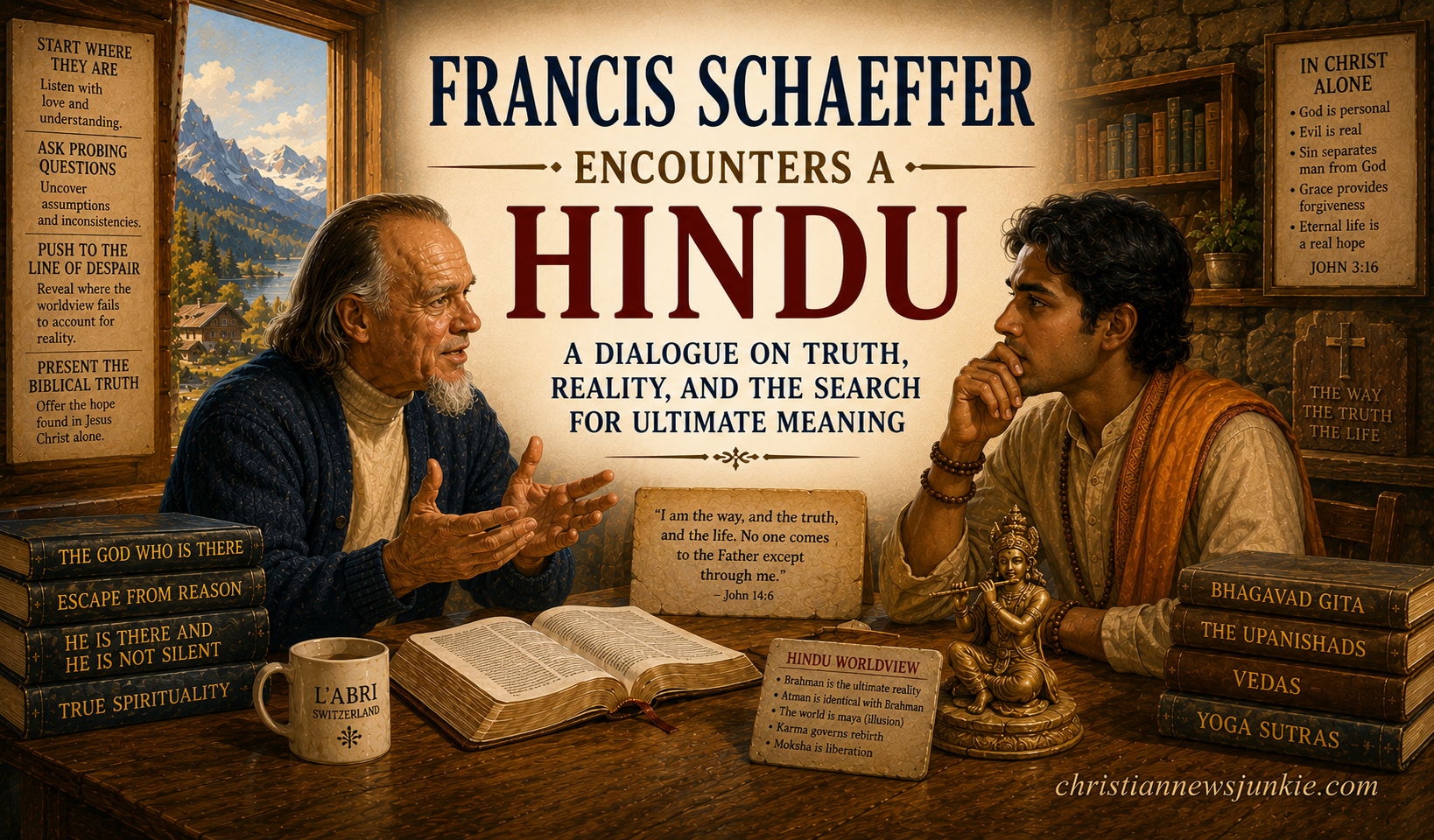
Francis Schaeffer (1912–1984) was not a typical apologist. A Presbyterian pastor and theologian, Schaeffer became known for his unique blend of philosophical reasoning, compassionate evangelism, and deep cultural engagement. He founded L’Abri Fellowship in the Swiss Alps in 1955—a community where seekers from all over the world were invited into a family-style environment to ask life’s hardest questions and explore the claims of biblical Christianity.
Schaeffer’s method was deeply relational. He believed truth mattered, but so did the person. At L’Abri, young people often stayed for weeks or months. They weren’t projects—they were people. Schaeffer, along with his wife Edith, welcomed them into their daily lives, engaging them in meals, conversations, and chores, while listening carefully and challenging their assumptions in a context of love and hospitality.
Schaeffer’s Apologetic Method
Francis Schaeffer developed a compelling method of apologetics rooted in love and truth. He believed in beginning with the person—understanding their beliefs, experiences, and worldview. He would then:
- Start where they are – Listen respectfully, understand their presuppositions.
- Ask probing questions – Not to trap, but to uncover inconsistencies.
- Push to the “line of despair” – Reveal the logical conclusions of their worldview and where it fails to match reality.
- Present the biblical alternative – Christianity as the coherent, truthful answer to life’s ultimate questions: origin, meaning, morality, and destiny.
Rather than debate to win, Schaeffer sought to engage so that the truth could be seen clearly.
Understanding Hinduism’s Worldview
Hinduism is one of the world’s oldest religious systems, with no single founder. Rooted in the Indian subcontinent, it draws from the Vedas, Upanishads, the Bhagavad Gita, and other sacred texts. It presents a vast and complex metaphysical structure.
Key Beliefs:
- Brahman is the impersonal, ultimate reality; all distinctions are ultimately illusions (maya).
- Atman is the individual soul, which is in essence identical with Brahman.
- Samsara is the cycle of birth, death, and rebirth.
- Karma is the moral law of cause and effect.
- Moksha is liberation from the cycle of reincarnation—achieved through knowledge, devotion, or right action.
Criticisms of Christianity from Hinduism:
- Christianity is seen as too exclusive and rigid.
- The idea of one lifetime followed by eternal judgment is viewed as narrow and unjust.
- The concept of grace is sometimes misunderstood as moral laxity.
- Jesus as the only way to God is perceived as arrogance.
Christian Response:
Christianity asserts that God is personal, holy, and separate from creation. Sin is real and separates man from God. Grace is not leniency but God’s costly initiative to save sinners through Christ’s atonement. Unlike the cyclical fatalism of reincarnation, Christianity offers historical redemption and a secure hope.
Setting the Stage for a Fictitional Dialogue: A Hindu Meets Francis Schaeffer
Imagine a young man named Aarav—a common and meaningful name in India, meaning “peaceful.” At age 20, Aarav is deeply thoughtful and well-read in the texts of Hinduism. Yet something unsettles him: a gnawing sense of confusion about suffering, justice, and whether personal identity is real or an illusion.
Aarav finds himself in Switzerland, having heard of the community called L’Abri. He is welcomed by the Schaeffer family into their simple but warm home. Meals are shared. Conversations happen over tea and walks in the mountain air. Eventually, Aarav sits down with Francis Schaeffer for an honest and searching conversation.
The Dialogue: Aarav and Schaeffer
Schaeffer: “Tell me, Aarav—what is it that you believe about ultimate reality?”
Aarav: “In Hinduism, we believe Brahman is the ultimate reality. It’s not a personal God but the essence behind all things. The world of distinctions—like you and me—is an illusion. In the end, Atman and Brahman are one. Real liberation comes when we realize this.”
Schaeffer: “So the goal is not to continue as Aarav, but to dissolve into the oneness?”
Aarav: “Yes, exactly. The individual self is transient. We go through cycles of rebirth, driven by karma, until we break free.”
Schaeffer: “And how do you feel about that? The idea of losing personal identity?”
Aarav: [pauses] “At times, it brings peace. Other times, it’s disorienting. I’ve grown attached to people—my family, my memories. Sometimes I wonder: if all is illusion, does anything really matter?”
Schaeffer: “That’s an honest question. If your desires, your sense of love and longing, even your moral instincts are ultimately unreal, where does that leave you?”
Aarav: “It leaves me… empty, sometimes. Like I’m climbing a mountain with no summit.”
Schaeffer: “Let me ask another question: Is the evil in the world just illusion too? Are pain, betrayal, and injustice merely passing shadows?”
Aarav: “In theory, yes. All suffering is maya. It only seems real.”
Schaeffer: “But when you see real suffering—a child trafficked, a woman abused—don’t you react as though it is terribly real?”
Aarav: “Yes. Absolutely. It feels wrong to deny that.”
Schaeffer: “Then your lived experience contradicts your belief system. Your heart cries out for justice, but your worldview tells you it’s all illusion.”
Aarav: [quietly] “That’s true.”
Schaeffer: “Now contrast that with biblical Christianity. It tells us that God is holy and just. Evil is real. Suffering is not an illusion—it’s a result of sin. And instead of demanding that you escape suffering by ignoring it, Christianity says God entered suffering to redeem us from it.”
Aarav: “Jesus?”
Schaeffer: “Yes. Jesus, the Son of God. He did not remain distant. He took on flesh, lived perfectly, suffered unjustly, and bore our sins on the cross. The resurrection wasn’t a metaphor—it was a real, bodily defeat of death. Through Him, we have true identity, lasting hope, and eternal life—not as absorbed sparks, but as redeemed persons.”
Aarav: [thoughtfully] “So, in Christianity, justice matters. Love matters. Suffering has a purpose.”
Schaeffer: “Yes. And grace is not earned karma—it’s undeserved favor. You don’t climb to God; He comes down to rescue you.”
Aarav: [eyes moist] “That is… beautiful.”
Schaeffer: “It is true. And the truth is always beautiful.”
Conclusion: Truth Meets Grace
Aarav’s fictional conversation with Francis Schaeffer captures the spirit of what happened time and again at L’Abri. The seeker is taken seriously. His questions are not dismissed but explored. His contradictions are not mocked but gently exposed. And into the vacuum left by collapsing worldviews, Schaeffer offers the gospel of Jesus Christ—the only worldview that fully satisfies the heart and withstands the mind.
This conversation is a reminder to Christians: we are called not only to know the truth, but to speak it in love. Schaeffer’s method—relational, thoughtful, honest—offers a model we can all follow.
Let us also remember that Schaeffer bathed his ministry in prayer. He understood that only God can open blind eyes (Ephesians 2:1–10). The truth must be spoken, but the Spirit must work. Let us therefore both think deeply and pray fervently for those caught in false worldviews, that God may grant them repentance and faith.
S.D.G.,
Robert Sparkman
rob@christiannewsjunkie.com
RELATED CONTENT
Concerning the Related Content section, I encourage everyone to evaluate the content carefully.
If I have listed the content, I think it is worthwhile viewing to educate yourself on the topic, but it may contain coarse language or some opinions I don’t agree with.
Feel free to offer your comments below. Respectful comments without expletives and personal attacks will be posted and I will respond to them.
Comments are closed after sixty days due to spamming issues from internet bots.
You can always send me an email at rob@christiannewsjunkie.com if you want to comment on something afterwards, though.
It should be noted that on some matters, I am expressing my convictions or opinions on the matter. My convictions and opinions are strongly influenced by a conservative, Christian (biblical) worldview.
At times, like any other human being, my remarks will reflect my own intuition and bias. I am subject to error, although I speak from a clean concience, knowing that I will ultimately be held accountable for my words.
If you have evidence that I am wrong about a material statement of fact, provide the evidence and I will gladly review it and make revisions if merited. Obviously, there are some assertions that are matters of opinion that I will not change, but I always strive to be truthful.
I will continue to add videos and other items to the Related Content section as opportunities present themselves.
I recommend these Youtube channels and commentators for good content on politics and news from a Christian and/or conservative worldview: Albert Mohler, Allie Beth Stuckey, Bill O’Reilly, CBN News, Hugh Hewitt, John Anderson Media (Australia), Nick Freitas, Ruthless Podcast (language warning), Scott Jennings, The Hot Zone with Chuck Holton, Vince Dao, and Verdict with Ted Cruz.
Albert Mohler’s channel on Youtube has a daily episode called The Briefing with Albert Mohler that I highly recommend. Allie Beth Stuckey’s channel is top-notch, too.
For livestreaming of political protests and riots by conservative commentators, check out Nate Friedman, Cam Higby, James Klug, and Nick Shirley. I don’t agree with the perspectives of all these commentators and the language of protesters is often obscene. Most news outlets will not cover these illegal assemblies, though, because it doesn’t promote their narrative.
Depictions of Jesus Christ are used in some illustrations. I realize that some including conservative Presbyterians consider this to be idolatry. I respectfully disagree with their position on this matter as the commandment forbids worshiping such depictions, and I do not worship these illustrations.