
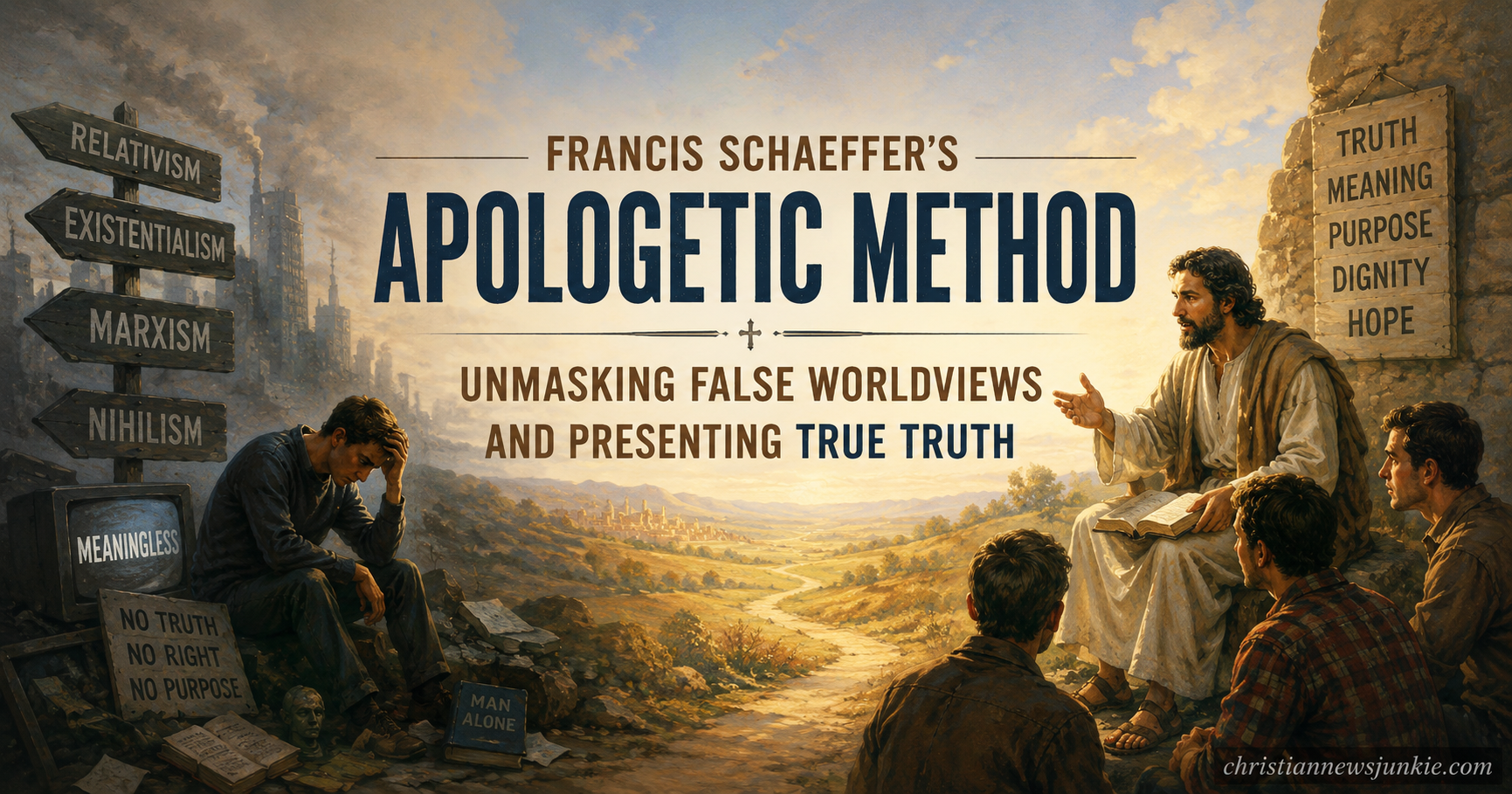
The 20th century witnessed the erosion of Christian consensus in the West. The rise of relativism, existentialism, postmodernism, and Neo-Marxist ideologies exposed many to spiritual confusion and moral despair. In this cultural upheaval, Francis Schaeffer emerged not merely as a theologian or philosopher, but as a spiritual physician—one who diagnosed the soul-sickness of modern man and pointed the way back to the healing found in Jesus Christ.
Though Schaeffer claimed he had no universal method of apologetics, his approach was nonetheless consistent, purposeful, and powerful. It was rooted in compassion, aimed at clarity, and grounded in the unshakable foundation of biblical truth. This essay explores the contours of Schaeffer’s method and why it remains profoundly relevant in our post-Christian, ideologically fragmented world.
The Foundation: True Truth in a Fragmented Age
Schaeffer’s apologetic began with the assumption that truth is objective and knowable, a view rooted in the God of the Bible who is both infinite and personal. He often referred to Christianity as “true truth”—not simply a religious preference or private belief, but the actual state of reality. Against the backdrop of relativism and nihilism, this was a revolutionary assertion.
In Schaeffer’s view, Christianity was not merely a source of personal comfort or ethical instruction. It was a comprehensive worldview—a coherent, integrated explanation of all of life and reality, encompassing metaphysics, morality, epistemology, and human identity. This placed it in direct competition with secular ideologies that likewise claimed to offer totalizing interpretations of the world.
Step One: Understanding the Person and Their Worldview
Schaeffer’s method began not with argumentation, but with listening. He believed that before challenging someone’s beliefs, one must first understand them. His goal was not to score rhetorical points but to grasp the presuppositions beneath a person’s thought life.
He often asked questions like:
- What do you believe about the nature of reality?
- What is your basis for morality?
- What do you believe about human dignity, purpose, and destiny?
He would then work to identify the worldview at play—whether naturalism, existentialism, Marxism, pantheism, or some modern syncretism.
This patient exploration not only honored the person’s dignity but allowed Schaeffer to later demonstrate that he understood their system well enough to take it seriously. In so doing, he earned the right to question it.
Step Two: Pushing the Worldview to Its Logical Conclusion
Schaeffer’s next move was what he famously called “taking the roof off.” This metaphor described the process of exposing a worldview to the harsh realities of its own assumptions. Many people, he believed, lived inconsistently with their professed beliefs. They held to fragments of Christian morality, beauty, or logic even while denying the Christian foundations that made those things meaningful.
For example, a secular humanist might claim that morality is relative but still protest injustice as though it were objectively wrong. A materialist might deny the soul but speak of love, dignity, or purpose in clearly transcendent terms.
Schaeffer’s aim was to gently but firmly show the inconsistency of such positions by asking, in essence, “If your worldview were taken to its logical end, what would the result be?” Often, that result was absurdity, despair, or inhumanity.
By removing the “roof” that protected them from seeing these consequences, Schaeffer allowed individuals to feel the full force of their own assumptions.
Step Three: Revealing the Inadequacy and Despair
After tracing out the implications of a non-Christian worldview, Schaeffer highlighted the existential consequences. He believed that when people truly saw the logical end of their beliefs, they would encounter a kind of worldview dissonance—the deep discomfort of realizing their system could not answer the questions it claimed to resolve.
This moment was not one of triumph for Schaeffer but of compassion. He was always careful not to mock, but to mourn the despair that false worldviews bring. He saw that modern man, having rejected God, still longed for meaning, beauty, justice, and love—but could no longer account for these things.
Schaeffer believed this was the moment of greatest opportunity. It was here, in the ruins of incoherent belief, that the Gospel could shine with unmistakable clarity.
Step Four: Presenting Christianity as a Coherent and Hopeful Worldview
Having dismantled false systems, Schaeffer offered biblical Christianity as the only worldview that can bear the full weight of reality.
- Metaphysically, it affirms a rational, ordered universe created by a personal God.
- Epistemologically, it explains why truth is knowable—because God has spoken.
- Morally, it grounds justice and human dignity in the image of God.
- Existentially, it explains both the greatness and wretchedness of man—created noble, yet fallen through sin.
- Redemptively, it provides real hope through the life, death, and resurrection of Jesus Christ.
Schaeffer emphasized that Christianity is not merely an answer to abstract questions—it is the truth that fits the real world. It does not break under scrutiny. It does not require compartmentalization. It accounts for science and art, reason and emotion, law and grace.
In contrast to the despair of modern ideologies, Christianity offered not only coherence but comfort—not a system to manipulate reality, but a Savior who restores it.
Why Schaeffer’s Method Still Matters
Schaeffer’s method is particularly urgent today because we face a rising tide of ideologies that, like Neo-Marxism, claim total explanatory power while denying transcendent truth. These systems:
- Reduce human beings to groups defined by power dynamics.
- Dismiss moral absolutes as tools of oppression.
- Replace grace with grievance, and forgiveness with perpetual outrage.
Such worldviews promise liberation but deliver only conflict and fragmentation. They cannot sustain beauty, cannot explain conscience, and cannot offer true reconciliation. Schaeffer’s method, with its commitment to truth, compassion, and coherence, offers a Christian response that is intellectually serious and spiritually transformative.
In a world full of fractured narratives and collapsing foundations, Schaeffer reminds us that Christianity is not a nostalgic myth but the truth of the universe—robust enough to face scrutiny, and kind enough to save the soul.
Conclusion: A Way Forward in a Post-Christian Culture
Francis Schaeffer’s apologetic method was not about technique, but about truth and love. He combined razor-sharp philosophical analysis with a pastor’s heart. He believed that people were not merely brains on sticks but souls yearning for meaning. He never sought to win arguments for pride’s sake, but to lead people from ruin to redemption.
In today’s world—where Neo-Marxism, moral relativism, and postmodern confusion reign—it is not enough for Christians to preach truth. We must also show the failure of false worldviews and the superior coherence of Christianity. Schaeffer’s legacy equips us to do just that.
S.D.G.,
Robert Sparkman
rob@christiannewsjunkie.com
RELATED CONTENT
Francis Schaeffer created a ten-part apologetics series called How Should We Then Live ? (1977). This series is still valuable to the Christian who needs to understand worldview apologetics. It is a classic in my opinion.
Professor Bill Edgar is one of the experts on Francis Schaeffer. He was converted through the efforts of Francis Schaeffer’s ministry.
Concerning the Related Content section, I encourage everyone to evaluate the content carefully.
If I have listed the content, I think it is worthwhile viewing to educate yourself on the topic, but it may contain coarse language or some opinions I don’t agree with.
Feel free to offer your comments below. Respectful comments without expletives and personal attacks will be posted and I will respond to them.
Comments are closed after sixty days due to spamming issues from internet bots.
You can always send me an email at rob@christiannewsjunkie.com if you want to comment on something afterwards, though.
It should be noted that on some matters, I am expressing my convictions or opinions on the matter. My convictions and opinions are strongly influenced by a conservative, Christian (biblical) worldview.
At times, like any other human being, my remarks will reflect my own intuition and bias. I am subject to error, although I speak from a clean concience, knowing that I will ultimately be held accountable for my words.
If you have evidence that I am wrong about a material statement of fact, provide the evidence and I will gladly review it and make revisions if merited. Obviously, there are some assertions that are matters of opinion that I will not change, but I always strive to be truthful.
I will continue to add videos and other items to the Related Content section as opportunities present themselves.
I recommend these Youtube channels and commentators for good content on politics and news from a Christian and/or conservative worldview: Albert Mohler, Allie Beth Stuckey, Bill O’Reilly, CBN News, Hugh Hewitt, John Anderson Media (Australia), Nick Freitas, Ruthless Podcast (language warning), Scott Jennings, The Hot Zone with Chuck Holton, Vince Dao, and Verdict with Ted Cruz.
Albert Mohler’s channel on Youtube has a daily episode called The Briefing with Albert Mohler that I highly recommend. Allie Beth Stuckey’s channel is top-notch, too.
For livestreaming of political protests and riots by conservative commentators, check out Nate Friedman, Cam Higby, James Klug, and Nick Shirley. I don’t agree with the perspectives of all these commentators and the language of protesters is often obscene. Most news outlets will not cover these illegal assemblies, though, because it doesn’t promote their narrative.
Depictions of Jesus Christ are used in some illustrations. I realize that some including conservative Presbyterians consider this to be idolatry. I respectfully disagree with their position on this matter as the commandment forbids worshiping such depictions, and I do not worship these illustrations.