
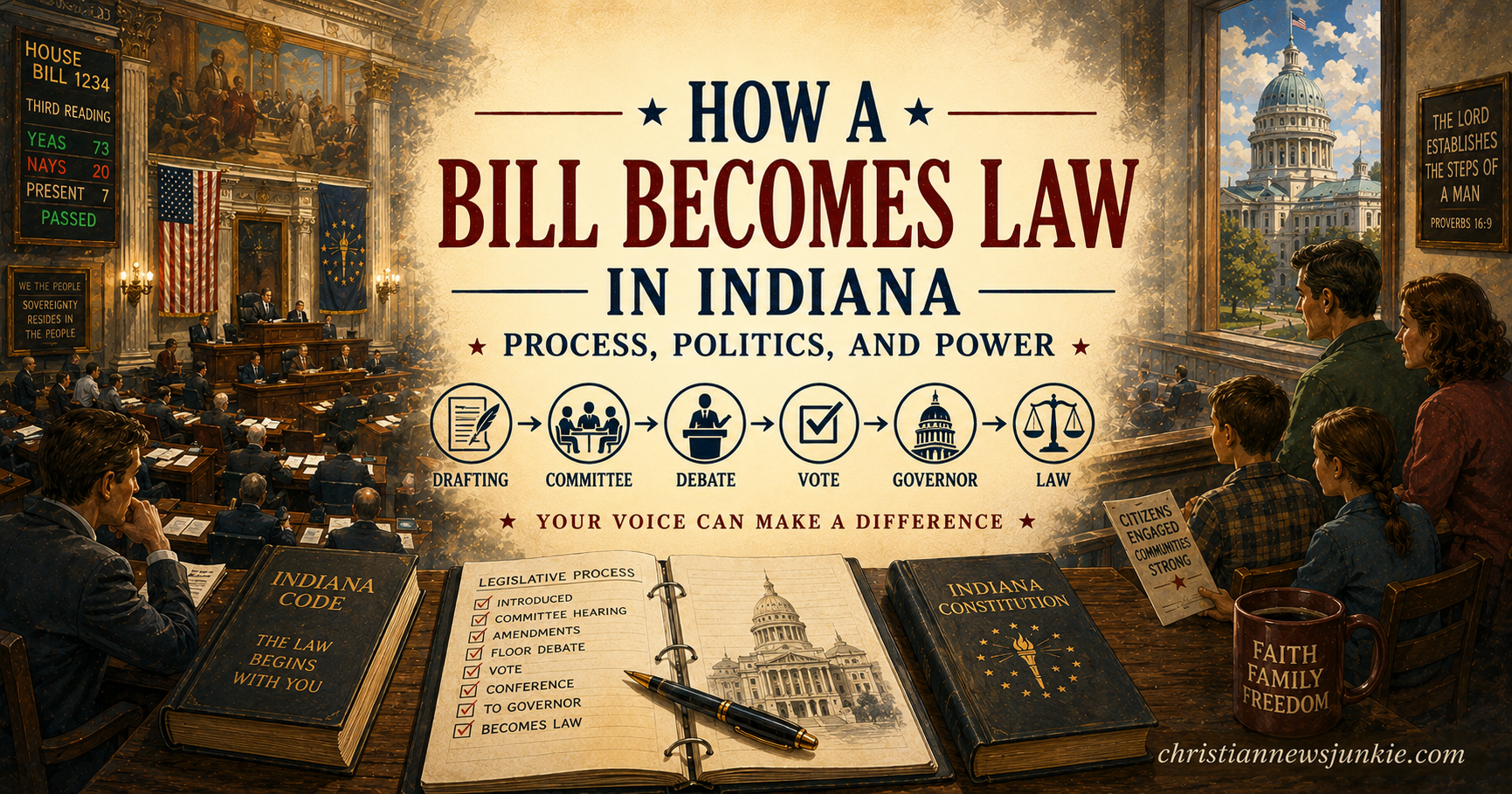
The Indiana General Assembly, like its federal counterpart, is built to deliberate carefully and thoroughly before passing laws that affect the lives of its citizens. But behind the formal procedures is a complex world of gatekeepers, political alliances, strategic bottlenecks, and unspoken motives. Knowing how a bill becomes law in Indiana is essential for informed civic engagement and for understanding how legislative power can be exercised—or quietly buried.
Glossary of Key Terms
- Bill: A proposed law introduced in the Indiana General Assembly.
- First Reading: Formal introduction of a bill where it is assigned to a committee.
- Second Reading: A stage where the bill is subject to amendment by the full chamber.
- Third Reading: Final vote on the bill in a chamber after debate.
- Committee: A small group of legislators assigned to review and vote on bills.
- Committee Chair: The leader of a legislative committee, who decides if a bill receives a hearing.
- Speaker of the House: Presiding officer in the Indiana House of Representatives, controlling bill assignments and scheduling.
- President Pro Tempore: Presiding officer in the Indiana Senate, with powers similar to the Speaker.
- Conference Committee: A group of legislators from both chambers who reconcile different versions of a bill.
- Veto: The governor’s formal rejection of a bill.
- Veto Override: A vote by the General Assembly to enact a vetoed bill without the governor’s signature.
Step-by-Step Process of an Indiana Bill
1. Drafting and Filing the Bill
- A bill is first drafted by a state senator or representative, sometimes with assistance from the Legislative Services Agency (LSA). Outside organizations, state agencies, lobbyists, and constituents may also have input.
- Once finalized, the bill is filed with the Clerk of the House or Secretary of the Senate.
Potential Roadblocks:
- The legislator may decide not to introduce it under pressure or due to political calculation.
- A bill may miss the filing deadline, especially in short legislative sessions.
Gatekeeper:
- The legislator who sponsors the bill.
Political Motives:
- Legislators may be discouraged from filing certain bills that could embarrass leadership or jeopardize their own standing within the party. Filing a bill can be seen as taking a stand, for better or worse.
2. First Reading and Committee Assignment
- During the first reading, the bill is read by title on the chamber floor and then assigned to a committee.
- House bills are assigned by the Speaker of the House; Senate bills by the President Pro Tempore.
Potential Roadblocks:
- The bill may never be assigned to a committee, a quiet method of killing it without fingerprints.
- It could be sent to a committee chaired by someone hostile to the bill’s intent.
Gatekeepers:
- Speaker of the House or President Pro Tempore
Political Motives:
- Leadership often shields the caucus from politically risky votes by keeping controversial bills off the agenda. Assigning a bill to an unfriendly committee is a common tactic to ensure it dies.
3. Committee Hearing and Vote
- If the committee chair agrees, the bill is scheduled for a hearing. Amendments may be proposed and debated.
- If a majority of committee members vote in favor, it proceeds to the full chamber.
Potential Roadblocks:
- The committee chair may refuse to hear the bill—an informal veto.
- The committee may vote it down or let it languish without a vote.
Gatekeepers:
- Committee Chair
- Committee Members
Political Motives:
- Chairs may act on instructions from leadership or lobbyists. Killing a bill in committee spares the full chamber from public scrutiny.
4. Second Reading (Amendments by the Chamber)
- If it passes committee, the bill goes to the floor for second reading.
- Amendments can be proposed by any member of the chamber. This is often where bills are reshaped or sabotaged.
Potential Roadblocks:
- Leadership may refuse to schedule the second reading.
- Poison-pill amendments may be added to force sponsors to withdraw support.
Gatekeepers:
- Majority Floor Leader
- Members of the Chamber
Political Motives:
- Opponents may try to make the bill politically toxic. Supporters may back off if amendments make it unpalatable or legally problematic.
5. Third Reading (Final Vote in the Chamber of Origin)
- The bill is read for the third time and debated. It must pass by a majority (51 in House, 26 in Senate).
Potential Roadblocks:
- The bill may fail the vote.
- It may not be scheduled by the floor leader.
Gatekeepers:
- Floor Leader
- Full Chamber
Political Motives:
- Legislators who support a bill in private may vote against it in public to avoid upsetting powerful interest groups or constituents.
6. The Second Chamber: Repeat of the Process
- The entire process (first reading, committee, second and third readings) is repeated in the second chamber.
- If the second chamber passes a different version, a conference committee is formed to reconcile differences.
Potential Roadblocks:
- Committee assignment games, hostile amendments, or scheduling delays repeat in the second chamber.
Gatekeepers:
- Second chamber leadership and committees
Political Motives:
- Sometimes one chamber uses a bill from the other as a bargaining chip, delaying it until unrelated negotiations are settled.
7. Conference Committee (If Needed)
- Composed of two members from each chamber, the conference committee seeks to reach a consensus on differences.
- A final conference report is voted on by both chambers.
Potential Roadblocks:
- Conferees may not reach agreement.
- One chamber may reject the final report.
Gatekeepers:
- Conferees appointed by leadership
- Full Chambers
Political Motives:
- Conferees may be instructed to stall or reject a deal for political reasons, particularly if pressure is coming from donors, activists, or the governor’s office.
8. Governor’s Desk
- The bill is sent to the Governor, who can:
- Sign it into law.
- Veto it.
- Take no action (in which case it becomes law automatically after 7 days if the legislature is in session).
- If vetoed, the General Assembly can override with a simple majority in both chambers.
Potential Roadblocks:
- The Governor may veto the bill.
- Override vote may fail due to party loyalty or political pressure.
Gatekeepers:
- Governor
- General Assembly (for veto override)
Political Motives:
- Governors sometimes veto popular bills to protect relationships with special interests or assert executive authority. Overrides can backfire politically, so leadership must choose battles carefully.
Conclusion
The Indiana legislative process is not merely a matter of procedure; it is a test of political will, power dynamics, and perseverance. At every stage, a bill can be killed—often quietly—by those with procedural authority or political clout. Understanding the process is essential for any citizen who wants to hold lawmakers accountable or advance good policy. While the process can be opaque, sunlight and citizen engagement remain potent antidotes to political gamesmanship.
S.D.G.,
Robert Sparkman
rob@christiannewsjunkie.com
RELATED CONTENT
Concerning the Related Content section, I encourage everyone to evaluate the content carefully.
If I have listed the content, I think it is worthwhile viewing to educate yourself on the topic, but it may contain coarse language or some opinions I don’t agree with.
Feel free to offer your comments below. Respectful comments without expletives and personal attacks will be posted and I will respond to them.
Comments are closed after sixty days due to spamming issues from internet bots.
You can always send me an email at rob@christiannewsjunkie.com if you want to comment on something afterwards, though.
It should be noted that on some matters, I am expressing my convictions or opinions on the matter. My convictions and opinions are strongly influenced by a conservative, Christian (biblical) worldview.
At times, like any other human being, my remarks will reflect my own intuition and bias. I am subject to error, although I speak from a clean concience, knowing that I will ultimately be held accountable for my words.
If you have evidence that I am wrong about a material statement of fact, provide the evidence and I will gladly review it and make revisions if merited. Obviously, there are some assertions that are matters of opinion that I will not change, but I always strive to be truthful.
I will continue to add videos and other items to the Related Content section as opportunities present themselves.
I recommend these Youtube channels and commentators for good content on politics and news from a Christian and/or conservative worldview: Albert Mohler, Allie Beth Stuckey, Bill O’Reilly, CBN News, Hugh Hewitt, John Anderson Media (Australia), Nick Freitas, Ruthless Podcast (language warning), Scott Jennings, The Hot Zone with Chuck Holton, Vince Dao, and Verdict with Ted Cruz.
Albert Mohler’s channel on Youtube has a daily episode called The Briefing with Albert Mohler that I highly recommend. Allie Beth Stuckey’s channel is top-notch, too.
For livestreaming of political protests and riots by conservative commentators, check out Nate Friedman, Cam Higby, James Klug, and Nick Shirley. I don’t agree with the perspectives of all these commentators and the language of protesters is often obscene. Most news outlets will not cover these illegal assemblies, though, because it doesn’t promote their narrative.
Depictions of Jesus Christ are used in some illustrations. I realize that some including conservative Presbyterians consider this to be idolatry. I respectfully disagree with their position on this matter as the commandment forbids worshiping such depictions, and I do not worship these illustrations.