
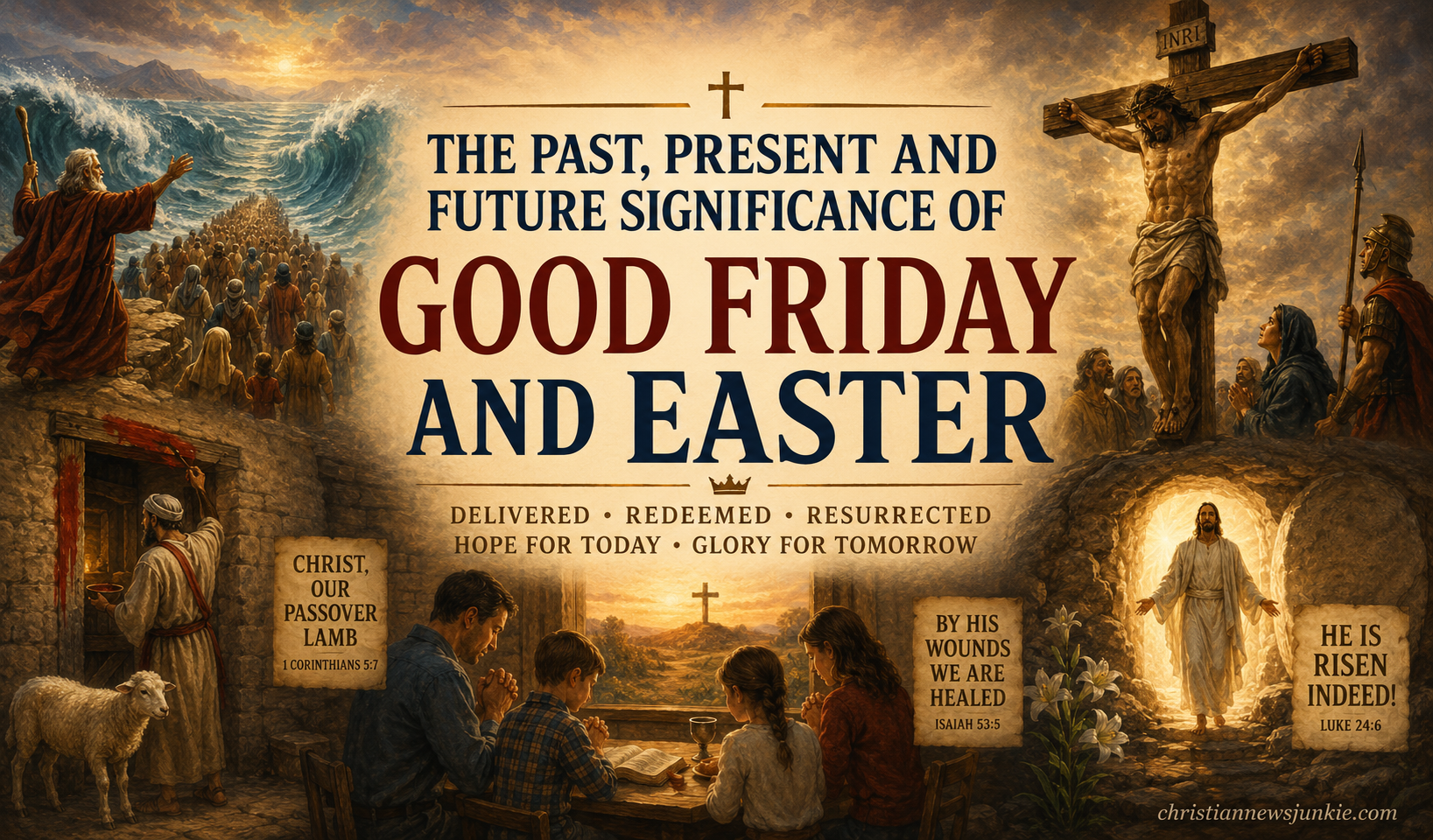
I would like to encourage a renewed enthusiasm amongst believers for the devotional observance of Good Friday and Easter.
These observances are especially important in today’s secularized environment.
Good Friday and Easter have past, present and future significance.
The past significance includes the deliverance of the nation of Israel from Egypt (Ex 1-14).
This biblical drama reflects shadows and types that pointed towards Christ and the believer’s deliverance from their sinfulness and Satan’s dominion.
Israel was enslaved in Egypt. God delivered them from this slavery.
One event in this drama involved killing a Passover lamb and painting their doorposts with the blood of the lamb. The angel of death passed over the Israelite homes, sparing the Israelite firstborns, while executing judgment upon the Egyptian firstborns (Ex 12).
The Israelite firstborns were spared due to their faith as evidenced by their obedience.
Subsequently, Pharaoh was forced to deliver the Israelites from bondage (Ex 12:31-40).
Annually, this event was commemorated in the Passover meal.
God led the Israelites into a land of their own. Upon the first harvest, the Israelite priest waved a sheaf of the barley harvest as an offering before the LORD on the first Sunday after Passover. The Israelites understood this annual observance (Feast of Firstfruits) as acknowledgement of God’s abundant provision to be reflected in the upcoming harvest (Lev 23:9-14).
These observances foreshadowed the death of Jesus on the Cross as a substitutionary atonement for the sins of believers, and his resurrection on the third day (Sunday). His crucifixion occurred alongside the slaughter of the lambs in preparation for Passover observance.
The present significance of Good Friday and Easter applies to those who place their faith in Jesus Christ and his sacrifice as sufficient for the forgiveness of their sins.
Due to the Fall in the Garden of Eden, all mankind is separated from God by virtue of their descent from Adam (Gen 3, Rom 5). Adam’s sin is ratified by individual men through their own sinfulness as well (Rom 3:23, 6:23).
God is the source of all life, physical and spiritual. Separation from God equates to spiritual death.
The man in Adam is spiritually dead, condemned and characterized by unrighteousness. He needs to experience a spiritual resurrection. This occurs upon faith and repentance.
The believer places his faith in Christ and his death on the cross as a substitutionary atonement for his sins. He experiences a new birth through his union with Christ. Spiritual life is imparted to him.
This new birth is reflected in a fundamental change in orientation towards God and a hatred of his sin.
In Christ, he is spiritually alive, justified, and characterized by righteousness (Rom 5, I Cor 15).
The future significance of Good Friday and Easter relates to the new creation, including the bodily resurrection of believers.
Christ’s bodily resurrection is the inauguration of the new creation.
Upon his return, believers experience the resurrection and glorification of their physical bodies, which will be glorified like his own.
This resurrection is certain due to their identification and union with Christ. Christ’s life is their life, and Christ’s resurrection is their resurrection (Rom 6).
Additionally, the believer will be reunited with family and friends who died in the faith.
The creation itself will experience a transformation, too. Evil, suffering and death will not have a place (Rom 8:18-25, I Cor 15, Rev 21-22).
In light of these reasons, I encourage Christians to observe Good Friday and Easter with renewed enthusiasm.
I realize some refrain from Good Friday and Easter observance for various reasons. I have held similar concerns in the past.
The videos below will address some these concerns. I recommend the video by Ryan Reeves in particular.
In general, though, I believe it is within the boundaries of Christian liberty for Christians to hold different opinions about the observance of days (Rom 14). For instance, some Messianic Jews will choose to observe Passover and Feast of Firstfruits in a Christ-centered manner focusing upon the themes of Christ’s crucifixion and his bodily resurrection, while other Christians will observe Good Friday and Easter in the same spirit.
I will add other videos and comments in the next few weeks prior to Easter. Some will involve the Christian teaching on the crucifixion, bodily resurrection and the new creation. Others will involve the controversies surrounding Easter.
Some of this related content provide a lot of biblical references to support the aforementioned doctrines related to Good Friday and Easter.
I recommend focusing on the doctrinal aspects of the crucifixion, bodily resurrection and new creation, though. Arguing about questionable matters is not a proper focus.
S.D.G.,
Robert Sparkman
rob@christiannewsjunkie.com
RELATED CONTENT
RC Sproul was one of the best Christian teachers. He founded Ligonier Ministries, which continues to be one of the best Christian ministries.
I highly recommend their Tabletalk magazine for solid biblical teaching. The subscription cost is modest at about $25 a year.
RC Sproul delivers a sermon on the resurrection of Jesus Christ.
The resurrection vindicated Christ and the truthfulness of his claims.
Alistair Begg delivers a fine sermon on the bodily resurrection of the believer, which, although separate in the temporal sense, is connected to Christ and his resurrection.
Easter commemorates the bodily resurrection of Jesus on the third day after the crucifixion.
The believer’s resurrection is connected to the resurrection of Jesus. Believers are promised a body like his upon our resurrection at his return.
Some unorthodox organizations including the Jehovah’s Witnesses teach a false doctrine called the “spirit resurrection”. It is important to understand that the resurrection is a bodily resurrection. While the resurrection body has some characteristics of the spiritual, it is not a spirit. There is a physical aspect to to the resurrection body.
Ryan Reeves is a history professor at Gordon-Conwell Theological Seminary. He has an excellent selection of videos on church history on his Youtube Channel. I may not agree with all of his remarks, but in general, he is a trustworthy source of information.
In particular, Ryan comments on Bede the Venerable and his questionable association of the word “Easter” with pagan worship.
By the way, non-English speaking Christians do not commonly use the word “Easter” but commonly refer to the holiday as Pascha, which is related to the Passover feast. Personally, I would prefer if English speaking Christians would use a similar word or phrase instead of Easter. Resurrection Sunday or Pascha are less controversial labels.
Regardless, it is altogether appropriate to observe Good Friday and Easter (Pascha, Resurrection Sunday) for the professing believer. Messianic Jews may prefer Passover and Feast of Firstfruits observed in a Christocentric manner, though, with a focus on the fulfillment in Christ’s crucifixion and the resurrection.
Michael Jones of Inspiring Philosophy channel on Youtube rebuts some of the claims that Easter customs are pagan by atheists and some Christians. I have held this belief in the past as a member of Worldwide Church of God led by Herbert Armstrong. I have arrived at different conclusions since then.
Holding different positions regarding the observance of days is within the bounds of Christian liberty (Rom 14). However, I find that such individuals and groups often deny fundamental aspects of Christianity, too, such as rejecting the full deity of Christ, the Trinity, and the bodily resurrection.
This post is related to a letter to the editor I submitted to the local newspaper. The letter to the editor is more condensed.
Concerning the Related Content section, I encourage everyone to evaluate the content carefully.
If I have listed the content, I think it is worthwhile viewing to educate yourself on the topic, but it may contain coarse language or some opinions I don’t agree with.
Feel free to offer your comments below. Respectful comments without expletives and personal attacks will be posted and I will respond to them.
Comments are closed after sixty days due to spamming issues from internet bots.
You can always send me an email at rob@christiannewsjunkie.com if you want to comment on something afterwards, though.
It should be noted that on some matters, I am expressing my convictions or opinions on the matter. My convictions and opinions are strongly influenced by a conservative, Christian (biblical) worldview.
At times, like any other human being, my remarks will reflect my own intuition and bias. I am subject to error, although I speak from a clean concience, knowing that I will ultimately be held accountable for my words.
If you have evidence that I am wrong about a material statement of fact, provide the evidence and I will gladly review it and make revisions if merited. Obviously, there are some assertions that are matters of opinion that I will not change, but I always strive to be truthful.
I will continue to add videos and other items to the Related Content section as opportunities present themselves.
I recommend these Youtube channels and commentators for good content on politics and news from a Christian and/or conservative worldview: Albert Mohler, Allie Beth Stuckey, Bill O’Reilly, CBN News, Hugh Hewitt, John Anderson Media (Australia), Nick Freitas, Ruthless Podcast (language warning), Scott Jennings, The Hot Zone with Chuck Holton, Vince Dao, and Verdict with Ted Cruz.
Albert Mohler’s channel on Youtube has a daily episode called The Briefing with Albert Mohler that I highly recommend. Allie Beth Stuckey’s channel is top-notch, too.
For livestreaming of political protests and riots by conservative commentators, check out Nate Friedman, Cam Higby, James Klug, and Nick Shirley. I don’t agree with the perspectives of all these commentators and the language of protesters is often obscene. Most news outlets will not cover these illegal assemblies, though, because it doesn’t promote their narrative.
Depictions of Jesus Christ are used in some illustrations. I realize that some including conservative Presbyterians consider this to be idolatry. I respectfully disagree with their position on this matter as the commandment forbids worshiping such depictions, and I do not worship these illustrations.