With the U.S. national debt surpassing $34 trillion and interest payments alone now rivaling the size of major federal departments, the American people are right to demand answers: Where is all this money going, and how much of it is being wasted? Every year, U.S. Senators Rand Paul (R-KY) and James Lankford (R-OK) publish independent reports identifying outrageous examples of government waste. Paul’s “Festivus Report” and Lankford’s “Federal Fumbles” provide clear evidence that taxpayer dollars are being misused not only in absurd and trivial ways but also through deeply embedded and concealed bureaucratic channels.
This blog post offers a comprehensive look at both reports’ findings for the most recent fiscal year, then moves beyond them to examine the even more staggering waste hidden within federal agency budgets—often beyond the visibility or control of Congress itself.
Section I: Waste in Plain Sight — The Festivus and Federal Fumbles Reports
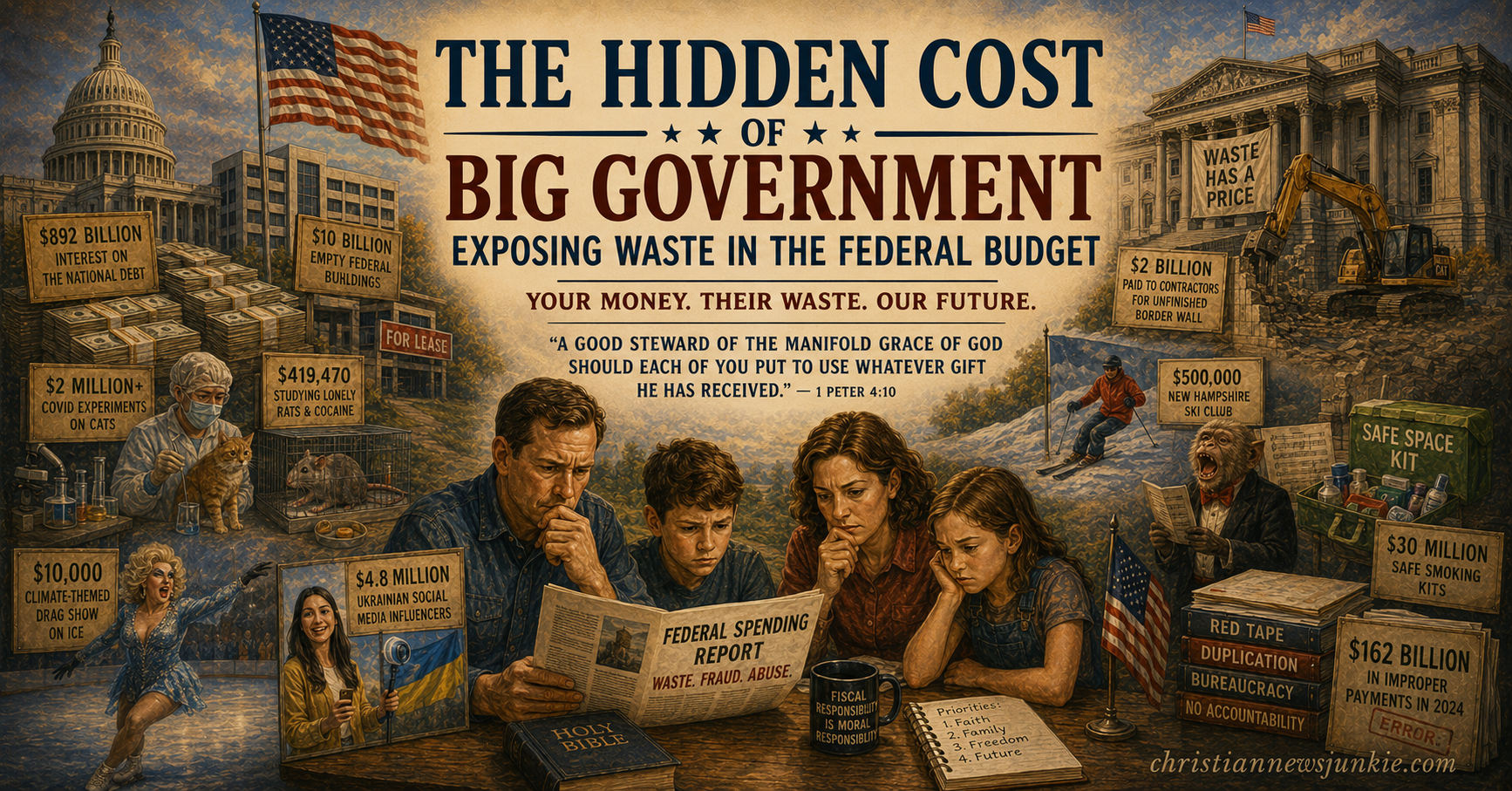
Senator Rand Paul’s 2024 Festivus Report cataloged over $1.5 trillion in what he identifies as “government waste.” Though some of this figure includes mandatory spending like debt interest, the list illustrates an alarming lack of fiscal restraint across federal programs. Examples include:
- $892 Billion in Interest on the National Debt – This isn’t optional spending. It reflects decades of borrowing and budget deficits. It’s the cost of kicking the can down the road.
- $10 Billion for Underutilized Federal Buildings – Many government buildings are now “ghost towns” thanks to permanent telework policies. Yet taxpayers continue to foot the bill for leases, utilities, and maintenance.
- $12 Million for a Pickleball Complex in Las Vegas – While recreation is important, using federal funds to build sports complexes—especially against the objections of local residents—raises serious questions about priorities.
- $2 Million+ on COVID-19 Experiments Involving Cats – This grant paid for researchers to infect cats with COVID, then euthanize them to study viral spread. Taxpayers funded this without consent or clear benefit.
- $419,470 Studying Lonely Rats and Cocaine Use – While presented as behavioral science, many Americans would see this as nothing more than government-sponsored animal cruelty with no obvious practical return.
- $10,000 for a Climate-Themed Drag Show on Ice – This cultural program was billed as climate awareness outreach but illustrates how federal funding often serves niche ideological projects instead of core services.
- $4.8 Million for Ukrainian Social Media Influencers – While public diplomacy has its place, funding social media campaigns abroad amid our own domestic fiscal crisis feels tone-deaf at best.
- $3 Million to Encourage Climate Activism Among Girls in Brazil – This is another example of prioritizing foreign ideological outreach while neglecting urgent domestic needs.
Senator James Lankford’s Federal Fumbles Report focuses more heavily on policy failures and programmatic inefficiencies. His 2024 edition revealed several egregious examples:
- $2 Billion Paid to Border Wall Contractors for Unfinished Work – After the Biden administration canceled construction, the government still paid contractors under existing obligations, essentially for doing nothing.
- $20 Million for Renovations to the Ulysses S. Grant Library – While historic preservation has its place, multimillion-dollar earmarks during a budget crisis expose misplaced priorities.
- $500,000 for a New Hampshire Ski Club and $500,000 for an Art Walk in Trenton, NJ – These local pork projects raise serious federalism concerns, as such initiatives should be state or community-funded.
- $90,000–$150,000 for Robot Dogs at the Border – Despite sounding innovative, the return on investment and operational value remains questionable.
- $15,000 for a Monkey Opera and $30 Million for Safe Smoking Kits – These programs range from the absurd to the controversial. They reflect a government willing to spend money on fringe causes with limited public support.
In total, Lankford’s report did not quantify waste on the scale of Paul’s $1 trillion+, but his selections reveal how the budget process enables backdoor spending through earmarks and niche federal grants.
Section II: The Bigger Problem — Hidden Waste Within the Bureaucracy
While the Festivus and Federal Fumbles reports expose flagrant misuse of taxpayer funds, they only scratch the surface. A much larger pool of waste exists buried within the opaque operations of federal agencies—spending that’s difficult, if not impossible, for elected officials or citizens to track. The Government Accountability Office (GAO) and other watchdog organizations provide evidence of this often unseen bureaucratic bloat.
Improper Payments: The $162 Billion Oversight Gap
In 2024, 16 federal agencies reported $162 billion in improper payments, most of which were overpayments. Programs such as Medicare, Medicaid, and Unemployment Insurance were the primary culprits. These figures likely understate the problem since other vulnerable programs like Temporary Assistance for Needy Families (TANF) weren’t even measured.
Improper payments occur when federal dollars are disbursed in error, in the wrong amount, or to ineligible recipients. These errors rarely result in full recovery and often indicate systemic flaws in internal controls.
Fragmentation and Duplication: The Price of Bureaucratic Redundancy
The GAO also identified 112 areas of overlap and duplication across federal programs in 2024. Examples include:
- Multiple job-training initiatives housed in different departments.
- Redundant agricultural subsidy systems.
- Duplicate climate resilience initiatives across EPA, NOAA, and the Department of Energy.
Eliminating or consolidating just a fraction of these could save billions annually.
The “Black Budget” and National Security Spending
Some waste is buried under the auspices of national defense and intelligence. The so-called “black budget”—funds allocated for classified operations—accounts for an estimated $50–60 billion annually. While national security is crucial, this spending is largely exempt from traditional auditing and oversight procedures, making waste and abuse easier to hide.
The Department of Defense: America’s Audit Nightmare
The Department of Defense (DoD), the single largest federal agency, consistently fails financial audits. In 2022, it was revealed that the Pentagon could not fully account for more than 60% of its $3.5 trillion in assets. A suppressed 2015 internal study estimated that the DoD could save $125 billion over five years through administrative reforms—but this report was buried to avoid congressional scrutiny and potential budget cuts.
Waste Matters — And It’s Costing Us Everything
Waste in government is not just a political talking point—it’s a moral and fiscal crisis. When the federal government spends billions on abandoned buildings, drag shows on ice, or social media campaigns in foreign countries, it signals that Washington has lost touch with basic stewardship. Worse still, the truly staggering levels of waste—buried deep within federal agencies, hidden from lawmakers, and perpetuated by a bloated bureaucracy—continue unchecked.
Identifying waste matters because every dollar misspent is a dollar not invested in securing the border, supporting veterans, reducing the deficit, or helping American families struggling to make ends meet. The combined total from just the visible waste documented by Senators Paul and Lankford—coupled with the known $162 billion in improper payments—suggests annual waste easily surpasses $1.5 trillion.
America doesn’t have a revenue problem. It has a spending problem—fueled by indifference, bureaucracy, and political cowardice. Until that changes, reports like Festivus and Federal Fumbles will continue to read like taxpayer horror stories.
S.D.G.,
Robert Sparkman
rob@christiannewsjunkie.com
RELATED CONTENT
Senator James Lankford (R-OK) discusses federal financial fraud and waste. He is the author of the annual Federal Fumbles report.
Senator Rand Paul discusses his 2024 Festivus Report and the waste it has revealed in federal waste and fraud.
Concerning the Related Content section, I encourage everyone to evaluate the content carefully.
If I have listed the content, I think it is worthwhile viewing to educate yourself on the topic, but it may contain coarse language or some opinions I don’t agree with.
Feel free to offer your comments below. Respectful comments without expletives and personal attacks will be posted and I will respond to them.
Comments are closed after sixty days due to spamming issues from internet bots.
You can always send me an email at rob@christiannewsjunkie.com if you want to comment on something afterwards, though.
It should be noted that on some matters, I am expressing my convictions or opinions on the matter. My convictions and opinions are strongly influenced by a conservative, Christian (biblical) worldview.
At times, like any other human being, my remarks will reflect my own intuition and bias. I am subject to error, although I speak from a clean concience, knowing that I will ultimately be held accountable for my words.
If you have evidence that I am wrong about a material statement of fact, provide the evidence and I will gladly review it and make revisions if merited. Obviously, there are some assertions that are matters of opinion that I will not change, but I always strive to be truthful.
I will continue to add videos and other items to the Related Content section as opportunities present themselves.
I recommend these Youtube channels and commentators for good content on politics and news from a Christian and/or conservative worldview: Albert Mohler, Allie Beth Stuckey, Bill O’Reilly, CBN News, Hugh Hewitt, John Anderson Media (Australia), Nick Freitas, Ruthless Podcast (language warning), Scott Jennings, The Hot Zone with Chuck Holton, Vince Dao, and Verdict with Ted Cruz.
Albert Mohler’s channel on Youtube has a daily episode called The Briefing with Albert Mohler that I highly recommend. Allie Beth Stuckey’s channel is top-notch, too.
For livestreaming of political protests and riots by conservative commentators, check out Nate Friedman, Cam Higby, James Klug, and Nick Shirley. I don’t agree with the perspectives of all these commentators and the language of protesters is often obscene. Most news outlets will not cover these illegal assemblies, though, because it doesn’t promote their narrative.
Depictions of Jesus Christ are used in some illustrations. I realize that some including conservative Presbyterians consider this to be idolatry. I respectfully disagree with their position on this matter as the commandment forbids worshiping such depictions, and I do not worship these illustrations.