
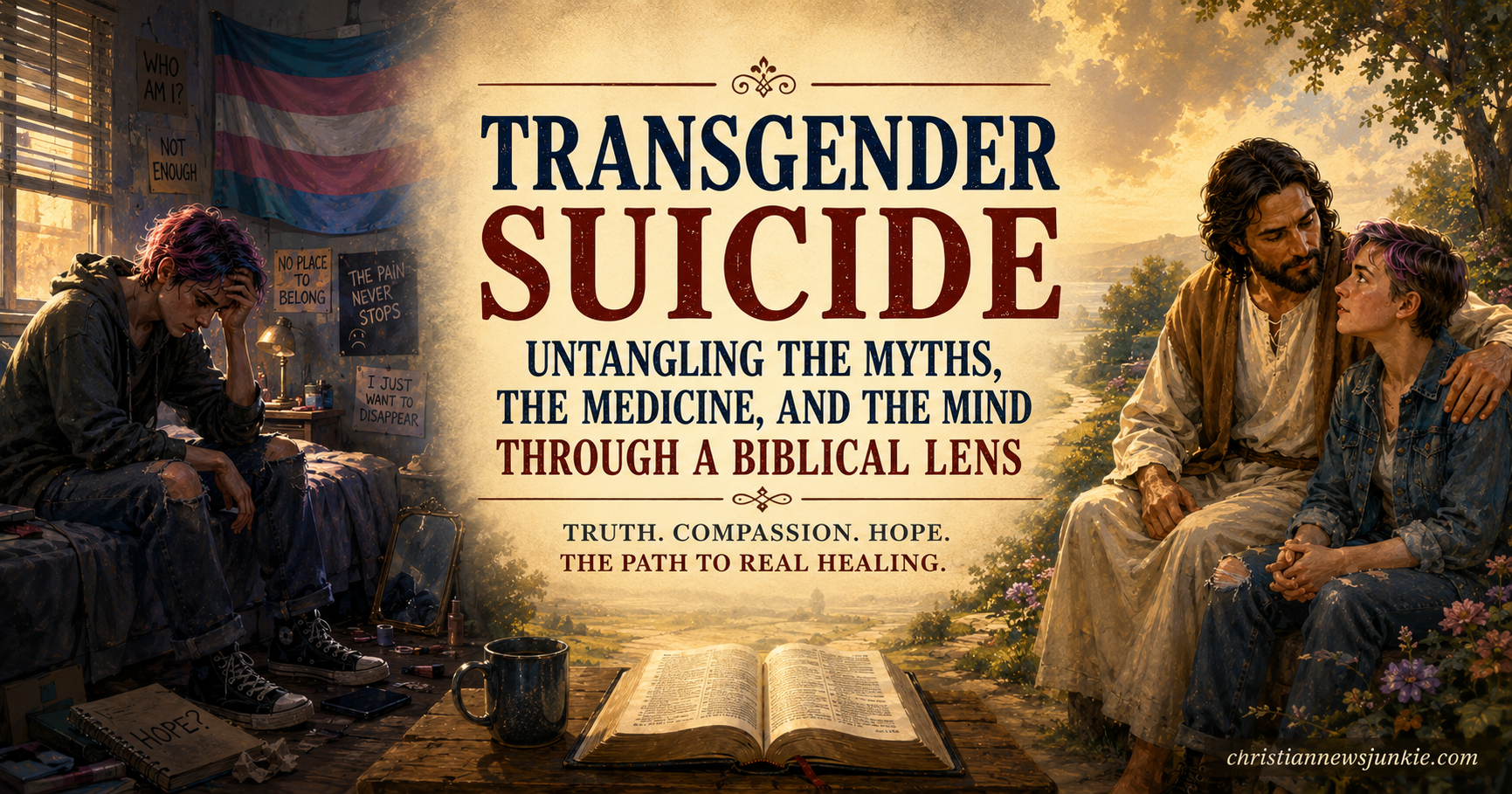
Few issues in contemporary discourse are as emotionally charged and politically weaponized as the topic of transgender suicide. Activists, politicians, medical institutions, and media outlets often repeat dire warnings: unless society affirms transgender identities and provides medical transitions—even to children—lives will be lost. “Affirm or suicide” has become the rallying cry of the modern transgender movement. Yet, beneath the surface of this assertion lies a tangle of scientific ambiguities, ideological narratives, ethical concerns, and profound spiritual confusion.
This blog post aims to examine, with great care and precision, the claims surrounding transgender suicide. We will assess the data surrounding suicide in people with gender dysphoria, compare it with rates among the general and mentally ill populations, investigate whether gender affirmation treatments improve or worsen outcomes, and finally examine whether society’s rejection is truly to blame—or whether the crisis runs deeper. Ultimately, we will view the issue through the lens of biblical truth and pastoral counseling to ask: what is the true path to healing?
Are Individuals with Gender Dysphoria More Likely to Commit Suicide Than the General Population?
Yes—substantially so. Numerous reputable studies demonstrate that individuals diagnosed with gender dysphoria or identifying as transgender experience radically higher rates of suicidal ideation and attempts compared to the general population.
For instance, the 2015 U.S. Transgender Survey, one of the largest of its kind, found:
- 81.7% of transgender respondents had considered suicide.
- 40.4% had attempted it at least once.
By contrast, the general U.S. population reports a lifetime suicide attempt rate of 4.6%—nearly ten times lower. These results are not anomalous. International studies echo the same pattern. A comprehensive review published in Transgender Health (2016) affirmed the elevated risks across various nations and cultures.
Importantly, these figures remain high even when adjusting for other risk factors like poverty, homelessness, or lack of education. The unmistakable conclusion: gender dysphoria correlates with profound psychological distress.
Does Denial of Gender Affirmation Treatment Increase the Risk of Suicide?
Activists and progressive medical authorities often assert that denying “gender-affirming care” increases the risk of suicide among transgender individuals. However, this claim is hotly contested in academic and clinical literature.
Some studies appear to show a reduction in suicidality after treatment. However, closer examination frequently reveals:
- Small sample sizes
- Short follow-up durations
- Methodological flaws
- Lack of control groups
A well-publicized 2019 study in the American Journal of Psychiatry initially claimed to show that gender-affirming surgery reduced suicide attempts. However, a 2020 correction by the journal’s editors reversed this conclusion, stating:
“The results demonstrated no advantage of surgery in relation to subsequent mood or anxiety disorders or suicide attempts.”
This dramatic about-face undercuts the claim that gender affirmation treatments protect against suicide. More sobering still, the data implies that surgical and hormonal transitions might not alleviate core psychological suffering, regardless of external support or affirmation.
Do People with Gender Dysphoria Commit Suicide More Than Other Mentally Ill Individuals?
Surprisingly, yes. Even when compared to populations suffering from major depression, bipolar disorder, or schizophrenia, those with gender dysphoria show elevated suicide risk.
A 2011 study in PLoS ONE conducted in Sweden tracked 324 post-operative transgender individuals over 30 years. It found that even in a socially affirming environment:
- Suicide mortality was 19 times higher than that of the general population.
- Psychiatric hospitalization was also significantly higher.
By contrast, individuals diagnosed with schizophrenia typically show suicide mortality rates around 8–10 times the general population. Major depressive disorder shows elevated rates, but still far below the 19x seen in the Swedish transgender cohort.
This indicates that gender dysphoria may be among the most suicide-prone psychiatric categories, warranting extreme caution and humility in treatment protocols.
Do Transitioned Individuals Still Face Elevated Suicide Risk Compared to Mentally Ill Populations?
Yes. Again, the Swedish cohort study—still widely cited because of its robust methodology and long-term scope—found that even after full medical transition, transgender individuals continued to suffer disproportionately high rates of suicide and psychiatric morbidity.
This devastating reality flies in the face of the mainstream narrative. If “gender affirmation” was truly effective, one would expect long-term suicidality to normalize. Instead:
- Chronic health problems persist.
- Psychological instability remains.
- Suicide rates do not significantly improve—and often worsen over time.
It must be asked: Is the solution failing because it misidentifies the true problem?
Is Societal Rejection the Cause of Suicide Among Transgender People?
While stigma and rejection certainly can contribute to mental distress, this explanation is inadequate on its own—especially in affirming societies.
If social rejection were the primary cause of suicide:
- Nations like Sweden, the Netherlands, and Canada—among the most LGBT-affirming in the world—should show far better mental health outcomes among transgender individuals.
- Instead, they show suicide rates consistent with or worse than less affirming countries.
This strongly suggests that internal psychological and spiritual conflicts, rather than external social rejection, drive much of the despair.
Furthermore, “affirmation” often requires total capitulation from society—redefining truth, language, bathrooms, sports, and theology. This leads to social tension, not harmony. Yet even full affirmation cannot reverse the inner fragmentation of a soul at war with its own design.
Can the Trauma of Medical Transition Contribute to Later Suicide?
Absolutely. Many people—including doctors and detransitioners—now speak openly about the devastating physical and psychological consequences of gender transition.
Common medical complications include:
- Vaginal or penile necrosis (tissue death after surgery)
- Fistulas (unnatural connections between organs)
- Urinary tract infections and incontinence
- Severe scarring and chronic pain
- Loss of sexual function and sensation
- Lifelong hormonal dependency and early-onset osteoporosis
- Infertility
Some detransitioners undergo multiple corrective surgeries, which themselves carry trauma. Others describe emotional devastation when their hoped-for “new life” fails to materialize.
A 2021 study by Lisa Littman found that detransitioners often experience:
- Deep regret
- Shame
- Increased suicidal thoughts post-transition
Rather than liberating the individual, these procedures often deepen the sense of alienation from self and God-given identity.
A Biblical and Christian Counseling Analysis
The heart of the issue is not biology, nor even psychology—but theology.
The Christian Worldview
- Genesis 1:27 declares, “So God created man in his own image… male and female he created them.” (ESV)
- Psalm 139:14 rejoices, “I praise you, for I am fearfully and wonderfully made.” (ESV)
In Scripture, gender is not assigned—it is designed. It is rooted in the very creation of mankind and reflects the glory of God. The attempt to redefine one’s gender is an attempt to usurp God’s authority over His creation and remake oneself in a false image.
Spiritual Confusion and Identity
Romans 1 teaches that those who suppress the truth exchange the glory of God for lies. Gender confusion is one manifestation of this spiritual darkness. Biblical counselors recognize that transgender identity is a false refuge—an idol promising peace but delivering despair.
Why Suicide?
When one builds identity on a lie, the soul eventually collapses. The anticipated joy of a new self never comes. The pain increases. The conscience remains troubled. Guilt, regret, and hopelessness follow. The enemy whispers, “There’s only one way out.”
But the gospel says otherwise.
True Healing in Christ
The only path to healing lies not in self-reinvention but in spiritual rebirth.
- “If anyone is in Christ, he is a new creation.” (2 Corinthians 5:17, ESV)
- “Come to me, all who labor and are heavy laden, and I will give you rest.” (Matthew 11:28, ESV)
Jesus does not affirm a lie. He transforms the sinner. He renews the mind. He restores dignity. He gives a new heart and a new hope.
In counseling, the goal is not to affirm confusion, but to lovingly call individuals back to truth, back to design, back to their Creator. Biblical counseling provides not just coping strategies, but transformation through the power of the gospel.
Conclusion: Compassion Without Compromise
The transgender suicide crisis is real, tragic, and deeply painful. But the solution cannot be to double down on delusion or mutilate the body in pursuit of peace.
- The science shows that suicide rates remain high with or without affirmation.
- The surgeries do not alleviate despair but may increase it.
- The spiritual confusion lies deeper than identity—it touches the core of the human soul.
Only a return to God’s truth, the hope of the gospel, and the healing found in Jesus Christ offers true relief.
As Christians, we must speak the truth in love, refusing the lie that affirmation is compassion. True compassion leads the lost back to the Shepherd. And, the Shepherd is able to heal every illness, including mental illness.
S.D.G.,
Robert Sparkman
rob@christiannewsjunkie
RELATED CONTENT
Concerning the Related Content section, I encourage everyone to evaluate the content carefully.
If I have listed the content, I think it is worthwhile viewing to educate yourself on the topic, but it may contain coarse language or some opinions I don’t agree with.
Feel free to offer your comments below. Respectful comments without expletives and personal attacks will be posted and I will respond to them.
Comments are closed after sixty days due to spamming issues from internet bots.
You can always send me an email at rob@christiannewsjunkie.com if you want to comment on something afterwards, though.
It should be noted that on some matters, I am expressing my convictions or opinions on the matter. My convictions and opinions are strongly influenced by a conservative, Christian (biblical) worldview.
At times, like any other human being, my remarks will reflect my own intuition and bias. I am subject to error, although I speak from a clean concience, knowing that I will ultimately be held accountable for my words.
If you have evidence that I am wrong about a material statement of fact, provide the evidence and I will gladly review it and make revisions if merited. Obviously, there are some assertions that are matters of opinion that I will not change, but I always strive to be truthful.
I will continue to add videos and other items to the Related Content section as opportunities present themselves.
I recommend these Youtube channels and commentators for good content on politics and news from a Christian and/or conservative worldview: Albert Mohler, Allie Beth Stuckey, Bill O’Reilly, CBN News, Hugh Hewitt, John Anderson Media (Australia), Nick Freitas, Ruthless Podcast (language warning), Scott Jennings, The Hot Zone with Chuck Holton, Vince Dao, and Verdict with Ted Cruz.
Albert Mohler’s channel on Youtube has a daily episode called The Briefing with Albert Mohler that I highly recommend. Allie Beth Stuckey’s channel is top-notch, too.
For livestreaming of political protests and riots by conservative commentators, check out Nate Friedman, Cam Higby, James Klug, and Nick Shirley. I don’t agree with the perspectives of all these commentators and the language of protesters is often obscene. Most news outlets will not cover these illegal assemblies, though, because it doesn’t promote their narrative.
Depictions of Jesus Christ are used in some illustrations. I realize that some including conservative Presbyterians consider this to be idolatry. I respectfully disagree with their position on this matter as the commandment forbids worshiping such depictions, and I do not worship these illustrations.