
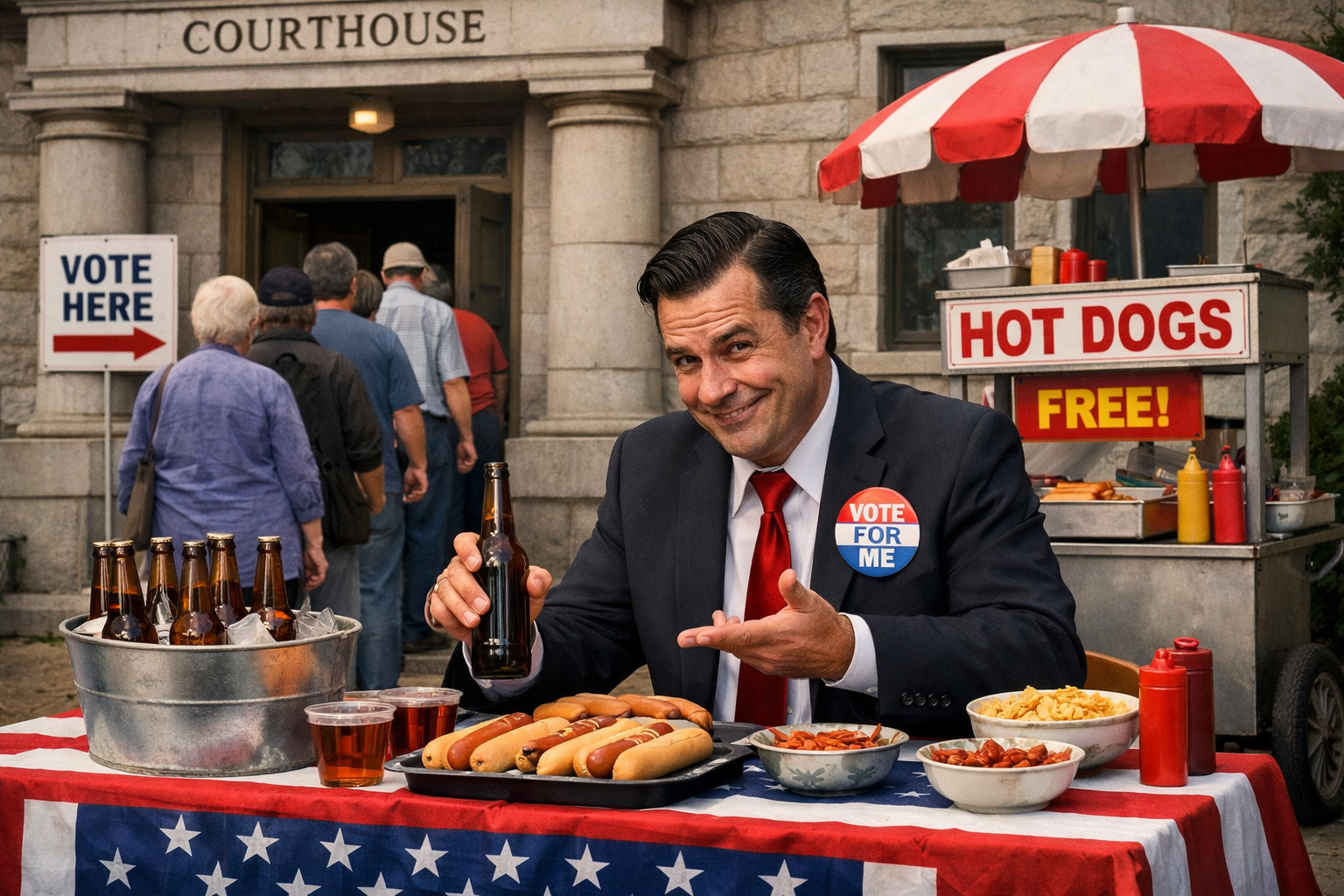
Electioneering refers to efforts aimed at influencing how individuals vote, particularly when those efforts occur at or near the time and place of voting.
While political advocacy is an essential feature of democratic life, electioneering becomes problematic when it intrudes upon the voting process itself.
In contemporary legal and civic discussions, electioneering commonly includes:
- Advocacy for or against a candidate or ballot issue near polling locations
- Distribution of campaign materials or symbolic messaging in restricted areas
- Direct interaction with voters immediately before they cast a ballot
- The offering of food, drink, gifts, services, or other items of value that could influence a voter’s decision
The central concern is not whether persuasion exists—persuasion is unavoidable—but whether persuasion is occurring at a moment meant to be insulated from pressure.
How Electioneering Was Practiced Historically and How It Appears Today
Historical Practices
In earlier periods of American history, electioneering was open and largely unregulated. Voting was often public, ballots were not secret, and candidates personally courted voters.
Common practices included:
- Candidates appearing at polling locations
- Providing food, alcohol, or entertainment
- Leveraging social hierarchies and community expectations
- Treating elections as social gatherings rather than private deliberations
The assumption was straightforward: generosity created obligation, and obligation produced votes.
Contemporary Practices
Modern electioneering, where it occurs, tends to be more restrained in appearance but more calculated in execution. Instead of overt inducements, influence is often framed as assistance, concern, or moral urgency.
Examples include:
- Political messaging positioned just outside legal buffer zones
- Volunteers offering “help” near voting lines
- Emotional appeals embedded in otherwise neutral acts
- Selective enforcement of election laws depending on political context
Although the methods have evolved, the underlying goal remains unchanged: to shape voter behavior as close as possible to the moment of decision.
The Historical Development of Electioneering Restrictions
Electioneering is not unique to the modern era. Ancient societies struggled with it, and early democratic systems learned—often through abuse—that unchecked influence eroded public trust.
Appalachia as a Case Study
In rural Appalachia, elections well into the late 19th and early 20th centuries frequently involved:
- Food stands sponsored by candidates
- Alcohol offered as hospitality
- Community events where generosity signaled leadership
The candidate who provided the most appealing fare often received the strongest support.
While such practices were culturally accepted, they blurred the line between civic judgment and personal benefit.
Reformers eventually recognized that these customs undermined electoral integrity. In response, states enacted laws establishing:
- Distance requirements between campaigning and polling places
- Prohibitions on gifts or inducements
- Secret ballots to protect voter independence
These reforms were not attacks on community or hospitality. They were efforts to ensure that votes reflected judgment rather than appetite.
The Moral Problem with Electioneering
Electioneering becomes morally objectionable when it distorts the voter’s moral agency.
Voting is not merely procedural. It is an act of stewardship—an expression of judgment with consequences for neighbors, communities, and future generations. Practices that introduce incentives or emotional pressure at the moment of voting weaken that responsibility.
Even small inducements can:
- Encourage impulsive decision-making
- Exploit inconvenience or fatigue
- Shift focus from principles to comfort
The moral danger lies not only in corruption, but in the gradual lowering of civic expectations. When voters are treated as consumers rather than citizens, the character of self-government erodes.
Why Voters Should Care About Electioneering
It is tempting to view electioneering as a technical legal issue or a partisan talking point. In reality, voters should care about it because it speaks directly to the kind of people we are and the kind of society we are sustaining.
First, electioneering diminishes the dignity of the voter. A citizen who can be swayed by a snack, a favor, or a fleeting emotional appeal is treated as someone incapable of thoughtful judgment. Even when voters believe themselves immune, the practice assumes fragility rather than responsibility.
Second, tolerating electioneering lowers standards for everyone. If influence near the polls becomes acceptable for one cause, it will inevitably be used by others—often more aggressively. What begins as “help” quickly becomes expectation, then entitlement.
Third, electioneering undermines trust in outcomes. When voters suspect that elections are influenced by inducements rather than arguments, confidence in results declines. A republic cannot function when large portions of the population believe outcomes are manipulated, even subtly.
Finally, caring about electioneering reflects seriousness about self-government. A people unwilling to protect the integrity of the voting process signals that it no longer values deliberation, restraint, or moral responsibility.
Laws Governing Electioneering: Federal and State
Federal Law
Federal law addresses electioneering primarily through prohibitions on:
- Bribery of voters
- Intimidation or coercion
- Interference with voting rights
These laws apply particularly to federal elections and protect against conduct that corrupts or obstructs the voting process. Regulation of physical proximity to polling places, however, is largely left to the states.
State Law Examples
Georgia
Georgia prohibits providing gifts, food, or drink to voters within 150 feet of a polling place or 25 feet of voters standing in line. Voters may bring their own provisions, and election officials may supply self-service water stations.
Indiana
Indiana law prohibits electioneering within 50 feet of a polling place entrance, including advocacy, solicitation, or campaign materials.
Kentucky
Kentucky enforces a 100-foot buffer zone and prohibits offering anything of value to influence a vote. Violations may carry criminal penalties.
Despite variations, these laws share a common objective: preserving the political neutrality of the polling place.
The Republican Perspective on Electioneering
Republicans generally emphasize:
- Election integrity
- Clear, enforceable rules
- Neutral voting environments
- Equal application of the law
From this view, the polling place should be free from persuasion, inducement, and performance. Voting should be orderly, quiet, and unremarkable—precisely because of its importance.
The Democratic Perspective on Electioneering
Democrats often frame restrictions on electioneering as matters of:
- Voter access
- Compassion
- Equity
They argue that offering food or water is humane and that prohibitions discourage participation. Critics respond that this framing overlooks the historical reasons such restrictions exist and confuses inconvenience with injustice.
The Libertarian Perspective on Electioneering
Libertarian views are divided. Some argue that adults retain agency regardless of minor inducements and that government regulation should be minimal. Others counter that the integrity of voting requires strict neutrality and that incentives, however small, undermine independence.
The disagreement reflects a broader tension between personal freedom and institutional trust.
Biblical Reflections on Electioneering
Christians approach electioneering with particular caution. Scripture consistently condemns bribery, partiality, and the trading of lasting goods for temporary relief.
The account of Esau exchanging his birthright for a single meal offers a sobering parallel (Genesis 25:29-34).
Esau was not coerced; he was shortsighted. Scripture treats his decision as a moral failure rooted in immediate appetite.
A vote, like a birthright, carries consequences beyond the moment and deserves sober reflection. Christians should resist systems that encourage decisions driven by convenience rather than wisdom.
Practical Signs of Electioneering to Watch For
Voters should remain alert to:
- Campaign messaging near polling places
- Gifts or services offered close to voting lines
- Assistance paired with political cues
- Inconsistent enforcement of buffer zones
- Emotional pressure framed as moral necessity
Fair elections do not require theatrics.
A Final Questions for Reflection
Are voters entitled to demand that they be provided water or treats at the polls, when they are capable of bringing their own, as Democrats claimed in recent elections?
Is a functioning adult truly unable to plan for a short wait in order to perform one of the most consequential civic responsibilities in a republic? If so, then perhaps they don’t value their voting rights enough.
Every state provides some lawful mechanism for an aged, disabled, ill, or physically confined voter to cast a ballot without standing in line at a polling place.
A diabetic or other person who decides to vote can easily bring himself some Little Debbie lunch cakes to eat in case his glucose level drops.
Honestly, I am a rotund elderly man who has some stability issues from an auto accident and I can easily handle food and water deprivation and standing for an hour or so. If I couldn’t handle it, I would make preparations in advance to vote via mail, or vote early to avoid long lines.
I think it is hilarious when much younger obese men and women complain about the lack of food and water in the voting lines. How pathetic have we become as a nation?
S.D.G.,
Robert Sparkman
rob@christiannewsjunkie.com
RELATED CONTENT
Concerning the Related Content section, I encourage everyone to evaluate the content carefully.
If I have listed the content, I think it is worthwhile viewing to educate yourself on the topic, but it may contain coarse language or some opinions I don’t agree with.
I use words that reflect the “woke” culture and their re-definitions sometimes. It is hard to communicate effectively without using their twisted vocabulary. Rest assured that I do not believe gender ideology or “Progressivism”. Words and phrases like “trans man”, “trans women” , “transgender”, “transition” or similar words and phrases are nonsensical and reflect a distorted, imaginary worldview where men can become women and vice-versa. The word “Progressive” itself is a propagandistic word that implies the Progressives are the positive force in society, whereas in reality their cultic belief system is very corrosive to mankind.
Feel free to offer your comments below. Respectful comments without expletives and personal attacks will be posted and I will respond to them.
Comments are closed after sixty days due to spamming issues from internet bots. You can always send me an email at rob@christiannewsjunkie.com if you want to comment on something afterwards, though.
I will continue to add videos and other items to the Related Content section as opportunities present themselves.