
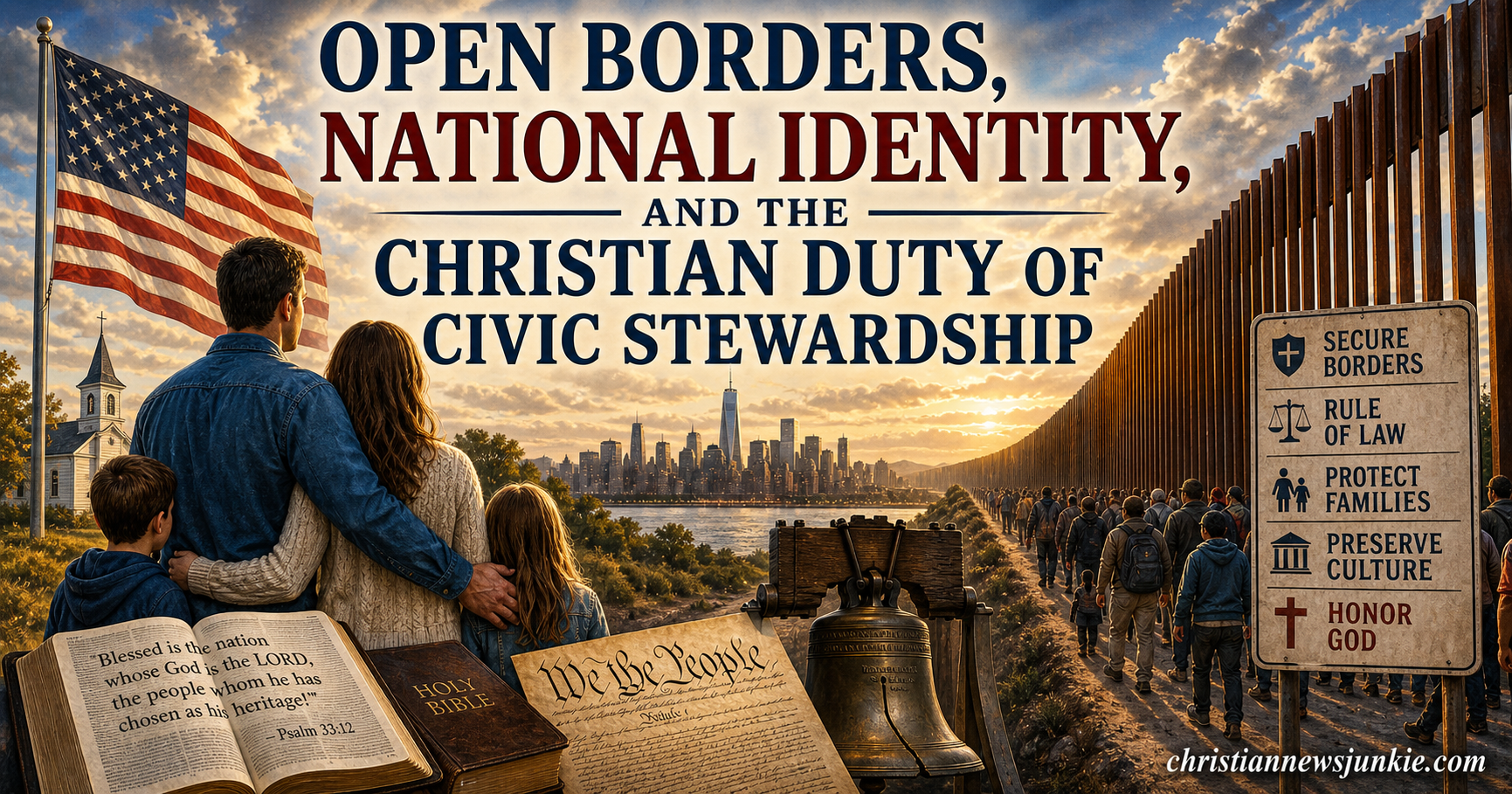
Few political issues in modern America generate more emotional intensity than immigration.
The debate touches economics, crime, culture, religion, national identity, compassion, and political power all at once.
Unfortunately, it is also one of the most distorted public discussions in American life.
Too often, those who support strong borders portray all opposition to open borders as rooted in racism, xenophobia, or ethnic hostility.
That accusation may be emotionally effective, but it frequently avoids the harder policy questions entirely.
A nation has a legitimate moral right to define its borders, enforce its laws, determine who may enter, and preserve social stability.
Opposition to open borders is not inherently racial any more than locking one’s front door is inherently hateful. Every functioning civilization in history has maintained distinctions between citizens and non-citizens, lawful entry and unlawful entry, membership and non-membership.
Christians especially must think carefully and biblically about this issue.
Scripture commands compassion toward strangers, kindness toward foreigners, and love for neighbors.
Yet Scripture also recognizes nations, boundaries, civil authority, and ordered societies. The modern Progressive attempt to pit compassion against sovereignty creates a false moral dilemma.
The issue becomes even more complicated because immigration policy now intersects with Progressive ideological concepts such as “whiteness,” “colonialism,” and “systemic oppression.”
In many academic and media circles, Western nations are increasingly portrayed not as legitimate civilizations with the right to preserve themselves, but as morally suspect entities obligated to dissolve traditional borders in the name of historical guilt.
Conservatives object to this framework for many reasons unrelated to race.
They point to the rule of law, national sovereignty, economic strain, welfare burdens, crime, cartel activity, cultural fragmentation, political incentives, and the long-term stability of constitutional self-government.
They also observe the growing instability in parts of Europe after decades of uncontrolled migration and failed integration policies.
This discussion requires honesty instead of slogans. It requires compassion without naivety, realism without hysteria, and biblical wisdom instead of ideological manipulation.
The Weaponization of Racism Allegations
Progressive Ideology and the Language of “Whiteness”
Modern Progressive ideology frequently interprets political and cultural issues through frameworks involving power, race, oppression, and colonial history.
Concepts such as “whiteness,” “settler colonialism,” “structural oppression,” and “decolonization” are now deeply embedded within universities, media organizations, corporate training programs, and activist movements.
Within this framework, strong borders are often treated not merely as policy preferences but as moral evils.
Western nations are frequently portrayed as historically illegitimate, and therefore maintaining demographic continuity or national identity is viewed suspiciously. Opposition to mass migration is then interpreted through the lens of racial guilt rather than practical governance.
This ideological framing has enormous rhetorical power because accusations of racism can silence discussion immediately. Many politicians, journalists, and corporate leaders fear social or professional destruction if they question immigration policies aggressively.
Yet labeling arguments as racist does not answer the arguments themselves.
A person may oppose open borders because he believes uncontrolled migration weakens national cohesion, burdens taxpayers, strains public systems, increases cartel activity, or undermines constitutional stability. None of those concerns require racial hostility.
Race Versus Worldview
One of the most dishonest simplifications in modern political discourse is the assumption that concerns about immigration automatically concern ethnicity.
There is a profound difference between racial categories and worldview categories.
Consider two hypothetical immigrants from the Middle East.
One is an Arab Christian who embraces constitutional government, religious liberty, peaceful coexistence, and Western legal principles. The other is an Arab Islamist who believes Sharia law should eventually supersede constitutional law and who views Western civilization as decadent and worthy of conquest.
These two individuals may share ethnicity, language, or regional ancestry, yet their worldviews differ radically.
Conservatives often argue that worldview compatibility matters far more than race. A nation cannot survive if large numbers of newcomers reject the civilization’s foundational moral and legal assumptions.
Francis Schaeffer repeatedly warned that civilizations collapse when they lose confidence in their own moral foundations. Nancy Pearcey has similarly argued that ideas and worldviews shape cultures profoundly.
Immigration is therefore not merely about labor markets or census statistics. It is also about whether a civilization retains enough confidence to perpetuate itself.
Biblical Foundations for Nations and Boundaries
Scripture recognizes nations as legitimate realities within God’s providential order.
Acts 17:26 states:
And he made from one man every nation of mankind to live on all the face of the earth, having determined allotted periods and the boundaries of their dwelling place. (ESV)
This verse simultaneously affirms the unity of humanity and the legitimacy of national distinctions.
Romans 13 further teaches that civil government is ordained by God to preserve order and restrain evil.
Governments therefore possess legitimate authority to regulate borders and enforce laws.
The Tower of Babel account in Genesis 11 also demonstrates that God Himself divided humanity into nations and languages after mankind pursued unified rebellion.
None of this justifies hatred toward foreigners.
Christians are commanded to show kindness and justice toward strangers. Yet biblical compassion never abolishes lawful distinctions between nations, peoples, and governing authorities.
Biblical Law, National Identity, and Ordered Compassion
Israel’s Distinctions Between Foreigners and Covenant Membership
The Old Testament presents a far more nuanced view of foreigners than modern activists often acknowledge.
Israel allowed foreigners to live among the people, conduct business, and receive legal protections. Yet Israel also maintained distinctions regarding covenant membership, property ownership and national identity.
Certain peoples were restricted from entering the assembly of Israel for multiple generations. Deuteronomy 23 discusses limitations regarding Moabites and Ammonites entering the assembly “even to the tenth generation.”
In relation to Egyptians, fuller inclusion into Israelite society did not occur until the third generation (Deut 23:7-8).
Presumably by this time, they would have proven their loyalty over three generations and been assimilated into Israelite society at some level.
Land ownership within Israel, though, was limited to true Israelites by descent, so it is unlikely they could own land although they could lease it.
So, there were citizenship levels within Israelite society related to residents who were not Israelites ethnically.
“You shall not abhor an Edomite, for he is your brother. You shall not abhor an Egyptian, because you were a sojourner in his land. Children born to them in the third generation may enter the assembly of the LORD.”
— Deuteronomy 23:7–8
This demonstrates that biblical compassion did not eliminate national or covenant distinctions.
Foreigners living within Israel were expected to obey significant portions of Israel’s law.
Sabbath observance applied broadly within the land. Exodus 20:10 specifically includes the “sojourner” within Israel’s gates regarding Sabbath rest.
In other words, residence carried religious obligations and assimilation to the faith of Israel.
Modern claims that biblical morality requires border abolition are therefore difficult to sustain from Scripture itself.
Refuting the “Jesus Was an Illegal Immigrant” Claim
A popular modern slogan claims that “Jesus was an illegal immigrant” because Joseph and Mary fled to Egypt after Herod sought to kill the Christ child.
The comparison is historically weak.
First, Egypt and Judea both existed under the broader authority of the Roman Empire at the time. Modern nation-state immigration systems did not exist in remotely the same form.
Second, Joseph and Mary were fleeing direct political violence and infanticidal persecution, not bypassing sovereign immigration laws for economic migration.
Third, Scripture never portrays their actions as contempt for lawful authority. In fact, Joseph consistently obeyed governing requirements, including the Roman census.
The slogan functions more as political rhetoric than historical analysis.
Why Political Elites Promote Open Borders Policies
Demographic and Electoral Incentives
Conservatives frequently argue that immigration policy is influenced heavily by political incentives.
Congressional representation in the House of Representatives is apportioned according to total population counts rather than citizen counts alone.
Consequently, states with large non-citizen populations may gain additional representation and electoral influence.
Critics argue this creates incentives for Democrat political leaders to tolerate or encourage large-scale illegal immigration because increased population can translate into increased political power.
Whether one agrees fully with that interpretation or not, the structural incentive undeniably exists.
Future Voting Blocs and Dependency Politics
Another conservative concern involves long-term electoral transformation.
If large numbers of illegal immigrants eventually receive amnesty or citizenship, many conservatives believe they are likely to become a durable voting bloc favoring Democrats.
This belief is reinforced by polling trends showing many immigrant communities currently lean toward expansive government programs and Progressive social policies, though Hispanic voting patterns have become more politically diverse in recent years.
Critics also argue that expansive welfare systems create political dependency relationships. When political parties promise benefits, subsidies, healthcare, housing assistance, or debt relief concentrated among certain demographic groups, long-term political loyalty will follow.
This concern is not unique to immigration. It reflects a broader conservative concern about dependency politics generally.
It is no secret that the Democrat Party has become much more radical in their worldview in the past decade.
This is the primary reason why I oppose open border policies. It would empowere the Democrats to seize control of our nation and raze it to the ground politically through Neo-Marxist socialism.
George Soros and Open Society Ideology
George Soros and his Open Society Foundations are frequently discussed within conservative critiques of modern immigration policy.
Soros has long promoted globalist and transnational political philosophies emphasizing open societies, reduced nationalism, migration liberalization, and progressive criminal justice reforms.
His organizations have funded activist groups, prosecutor election campaigns, and policy initiatives aligned with harmful Progressive immigration and criminal justice perspectives.
Discussion of Soros often becomes overheated. This undermines legitimate criticism.
Nevertheless, it is entirely reasonable to acknowledge that wealthy ideological donors on the Left actively support policies favoring migration liberalization and reduced border enforcement.
Political influence follows money on both sides of the political spectrum.
National Sovereignty and the Rule of Law
Borders as a Core Function of Government
A government that cannot control its borders eventually loses meaningful sovereignty.
Citizenship becomes diluted when lawful and unlawful entry are treated similarly.
Respect for law declines when entire categories of laws are selectively unenforced.
During the Biden administration, border encounters reached historically extraordinary levels. Estimates vary significantly depending upon methodology, definitions, and whether “gotaways” are included. Exact numbers remain disputed partly because accurate tracking of illegal crossings is inherently difficult.
Still, even many centrist observers acknowledge that enforcement weakened substantially compared with prior years, allowing an increase of population estimated between 10-15 million over Biden’s administration.
Selective enforcement creates a dangerous precedent. If immigration laws may be ignored because enforcement is politically inconvenient, public confidence in legal consistency erodes broadly.
Sanctuary Jurisdictions and Selective Enforcement
Sanctuary cities and states further complicate immigration enforcement.
These jurisdictions often limit cooperation with federal immigration authorities and sometimes restrict local officials from sharing immigration-related information.
Supporters argue such policies build trust with immigrant communities. Critics argue they obstruct lawful enforcement and shield criminal offenders from deportation consequences.
This tension illustrates a broader ideological divide regarding the purpose of law itself.
Conservatives typically emphasize ordered liberty under stable laws. Progressives often prioritize perceived equity outcomes even when this weakens consistent enforcement.
Economic Pressures and Public Burdens
The Economic Debate
Immigration economics are extraordinarily complex.
Selected immigrants contribute enormously to innovation, entrepreneurship, medicine, engineering, and economic growth. Highly skilled legal immigration has historically benefited America substantially.
The debate becomes more contentious regarding low-skilled mass migration and illegal immigration.
Critics argue that large-scale low-skilled immigration depresses wages for working-class Americans while increasing pressure on schools, healthcare systems, housing markets, and welfare programs.
Wages drop when labor supply exceeds demand. Wages increase when labor demnd exceeds labor supply.
Supporters counter that immigrants perform essential labor and contribute taxes.
The truth is likely mixed and varies significantly by education level, legal status, and timeframe.
Welfare Usage and Long-Term Dependency
One legitimate conservative concern involves long-term welfare participation.
Research has shown that many immigrant households participate in public assistance programs at higher rates than native-born households, particularly among lower-skilled populations. These dependencies continue for several years.
Rates vary dramatically by region of origin, education, and assimilation patterns.
Critics argue that importing large low-skilled populations into an already heavily indebted welfare state creates unsustainable fiscal burdens.
This concern becomes even stronger when migration occurs illegally because unlawful entrants were never democratically authorized through the normal immigration process.
Remittances and Capital Outflow
Another often-overlooked issue involves remittances.
Immigrants send billions of dollars annually back to relatives in their countries of origin. While understandable at a personal level, conservatives note that this represents enormous capital outflow leaving local American communities.
Money earned within the American economy is transferred abroad rather than recirculated domestically through local investment, savings, or consumption.
The economic implications are significant when discussed at national scale.
Fraud, Corruption, and Progressive Governance Failures
Welfare Fraud and Oversight Failures
Large public assistance systems inevitably attract fraud, especially when oversight weakens.
One of the largest recent scandals emerged from Minneapolis through the “Feeding Our Future” fraud case involving alleged theft of hundreds of millions of dollars from federal child nutrition programs during the pandemic.
Federal prosecutors alleged widespread fraud involving nonprofit networks and fabricated meal claims.
The scandal raised difficult questions about oversight reluctance and fears of appearing discriminatory when investigating ethnic communities.
Other allegations and investigations involving welfare abuse, Medicaid fraud, or nonprofit corruption have emerged in various Progressive jurisdictions including parts of California, Seattle-area programs, Oregon, and Columbus, Ohio.
Some claims remain under investigation. Others involve proven prosecutions.
Conservatives argue Progressive governance structures become reluctant to enforce accountability aggressively because ideological concerns about “equity” or accusations of racism create institutional paralysis.
Others, including me, suspect politicians and bureaucrats turned a blind eye to the fraud in exchange for votes from large voting blocs benefitting from it, particularly in Minnesota and its Somali community.
Crime, Statistics, and Institutional Obfuscation
Crime and Illegal Immigration
The immigration-crime debate is deeply politicized.
Some activists insist illegal immigrants commit less crime overall than native populations. Others portray illegal immigrants as overwhelmingly criminal. Both extremes oversimplify reality.
Even if crime rates among illegal immigrants were statistically lower overall, conservatives argue this misses an essential moral point: crimes committed by individuals who should not have been present in the country are preventable crimes.
The murder and sexual assault of even one innocent citizen by someone unlawfully present represents a preventable governmental failure. The numbers are conservatively in the hundreds and likely the thousands.
Statistical Manipulation and Aggregated Data
Another major concern involves how crime statistics are collected and presented.
Aggregated statewide or national statistics often obscure localized realities. A city neighborhood suffering severe gang violence, trafficking, or organized theft may disappear statistically inside broader state averages.
Critics also point to documented instances where police departments or public officials faced pressure to downgrade offenses or alter reporting classifications.
In some jurisdictions, theft thresholds were raised, prosecutions reduced, or categories redefined in ways critics argue artificially improved statistical appearances.
These concerns are not purely speculative. Public controversies involving reporting practices have already occurred in multiple cities across America.
Sanctuary Policies and Data Blindness
Reliable analysis becomes even harder because some Progressive (woke) jurisdictions refuse to track immigration status comprehensively in criminal databases.
This creates what critics call “data blindness.” If immigration status is not systematically recorded, then definitive conclusions become difficult for either side.
Conservatives argue that some officials prefer this ambiguity because it protects preferred political narratives.
Human Trafficking, Cartels, and Fentanyl
Weak border enforcement also strengthens cartel operations.
Human trafficking, narcotics smuggling, sexual exploitation, and fentanyl distribution all flourish when border systems become overwhelmed. Cartels exploit humanitarian rhetoric while operating highly profitable criminal enterprises.
Thousands of Americans die annually from fentanyl overdoses connected partly to transnational trafficking networks.
A compassionate society must care not only about migrants but also about the citizens harmed by criminal disorder.
Europe’s Experience with Mass Migration
Social Fragmentation and Failed Integration
Europe serves as a warning to many conservatives.
Parts of Britain, France, Germany, Sweden, and Belgium have struggled with integration failures, parallel societies, rising antisemitism, gang violence, and cultural fragmentation after decades of large-scale migration combined with weak assimilation policies.
The problem is not mere ethnic diversity. America itself has long absorbed diverse populations successfully.
The concern involves whether newcomers assimilate into a shared civic culture or maintain permanently separated social systems hostile to the host civilization.
The British Grooming Gang Scandals
One of the most disturbing examples emerged through the British grooming gang scandals involving organized sexual abuse of vulnerable girls and primarily Pakistani perpetrators.
Investigations revealed repeated failures by authorities to intervene aggressively despite warning signs. In several cases, officials reportedly feared accusations of racism or Islamophobia if they pursued suspects too aggressively.
This represents one of the clearest examples of ideology interfering with public safety.
Islam and Cultural Compatibility
Discussion of Islam requires care and honesty.
Many Muslims are peaceful neighbors seeking stability and opportunity. Yet political Islam contains governing concepts fundamentally incompatible with constitutional liberty, equal legal systems, freedom of speech, and religious pluralism.
Concerns about Islamist extremism are not racial concerns. Islam is not a race.
The issue again returns to worldview compatibility.
Christian Compassion, Justice, and Civic Responsibility
Compassion and Prudence Must Coexist
Christians are commanded to love neighbors, care for strangers, and show mercy to the vulnerable.
Yet biblical morality also values wisdom, justice, order, and responsibility.
Compassion detached from prudence can become destructive sentimentality.
Governments possess obligations different from individuals. A Christian may personally help migrants generously while still believing the state must enforce borders consistently.
Romans 13 and Government Responsibility
Romans 13 teaches that governing authorities are instituted by God to restrain evil and preserve order.
That responsibility includes maintaining secure borders, protecting citizens, and enforcing laws impartially.
A government that refuses to distinguish between lawful and unlawful entry eventually undermines its own legitimacy.
Legal Immigration Versus Open Borders
Most conservatives do not oppose carefully controlled immigration itself.
America has benefited enormously from lawful immigration across generations.
The objection concerns lawlessness, disorder, ideological hostility, unsustainable welfare burdens, and the erosion of national cohesion.
A nation without borders eventually ceases functioning as a nation.
Conclusion
Opposition to open borders is not inherently racist. It can arise from legitimate concerns involving sovereignty, law, economics, crime, welfare systems, political incentives, cultural cohesion, and civilizational stability.
Progressive ideology often reframes these concerns through categories such as “whiteness,” “colonialism,” and “systemic oppression,” but rhetorical labels do not eliminate practical realities.
Christians must reject genuine hatred and ethnic hostility while also rejecting naïve utopianism.
Scripture teaches both compassion and order. It recognizes both human dignity and national boundaries.
America can remain compassionate while still enforcing immigration laws. It can welcome lawful, well-vetted immigrants at an assimilable rate while opposing chaos. It can love strangers without surrendering sovereignty.
Civilizations survive when they possess enough moral confidence to preserve themselves wisely and justly. A nation unwilling to defend its borders, laws, and cultural foundations eventually loses all three.
S.D.G.,
Robert Sparkman
rob@christiannewsjunkie.com
RELATED CONTENT
Concerning the Related Content section, I encourage everyone to evaluate the content carefully.
If I have listed the content, I think it is worthwhile viewing to educate yourself on the topic, but it may contain coarse language or some opinions I don’t agree with.
Feel free to offer your comments below. Respectful comments without expletives and personal attacks will be posted and I will respond to them.
Comments are closed after sixty days due to spamming issues from internet bots.
You can always send me an email at rob@christiannewsjunkie.com if you want to comment on something afterwards, though.
It should be noted that on some matters, I am expressing my convictions or opinions on the matter. My convictions and opinions are strongly influenced by a conservative, Christian (biblical) worldview.
At times, like any other human being, my remarks will reflect my own intuition and bias. I am subject to error, although I speak from a clean concience, knowing that I will ultimately be held accountable for my words.
If you have evidence that I am wrong about a material statement of fact, provide the evidence and I will gladly review it and make revisions if merited. Obviously, there are some assertions that are matters of opinion that I will not change, but I always strive to be truthful.
I will continue to add videos and other items to the Related Content section as opportunities present themselves.
I recommend these Youtube channels and commentators for good content on politics and news from a Christian and/or conservative worldview: Albert Mohler, Allie Beth Stuckey, Bill O’Reilly, CBN News, Hugh Hewitt, John Anderson Media (Australia), Nick Freitas, Ruthless Podcast (language warning), Scott Jennings, The Hot Zone with Chuck Holton, Vince Dao, and Verdict with Ted Cruz.
Albert Mohler’s channel on Youtube has a daily episode called The Briefing with Albert Mohler that I highly recommend. Allie Beth Stuckey’s channel is top-notch, too.
For livestreaming of political protests and riots by conservative commentators, check out Nate Friedman, Cam Higby, James Klug, and Nick Shirley. I don’t agree with the perspectives of all these commentators and the language of protesters is often obscene. Most news outlets will not cover these illegal assemblies, though, because it doesn’t promote their narrative.
Depictions of Jesus Christ are used in some illustrations. I realize that some including conservative Presbyterians consider this to be idolatry. I respectfully disagree with their position on this matter as the commandment forbids worshiping such depictions, and I do not worship these illustrations.