
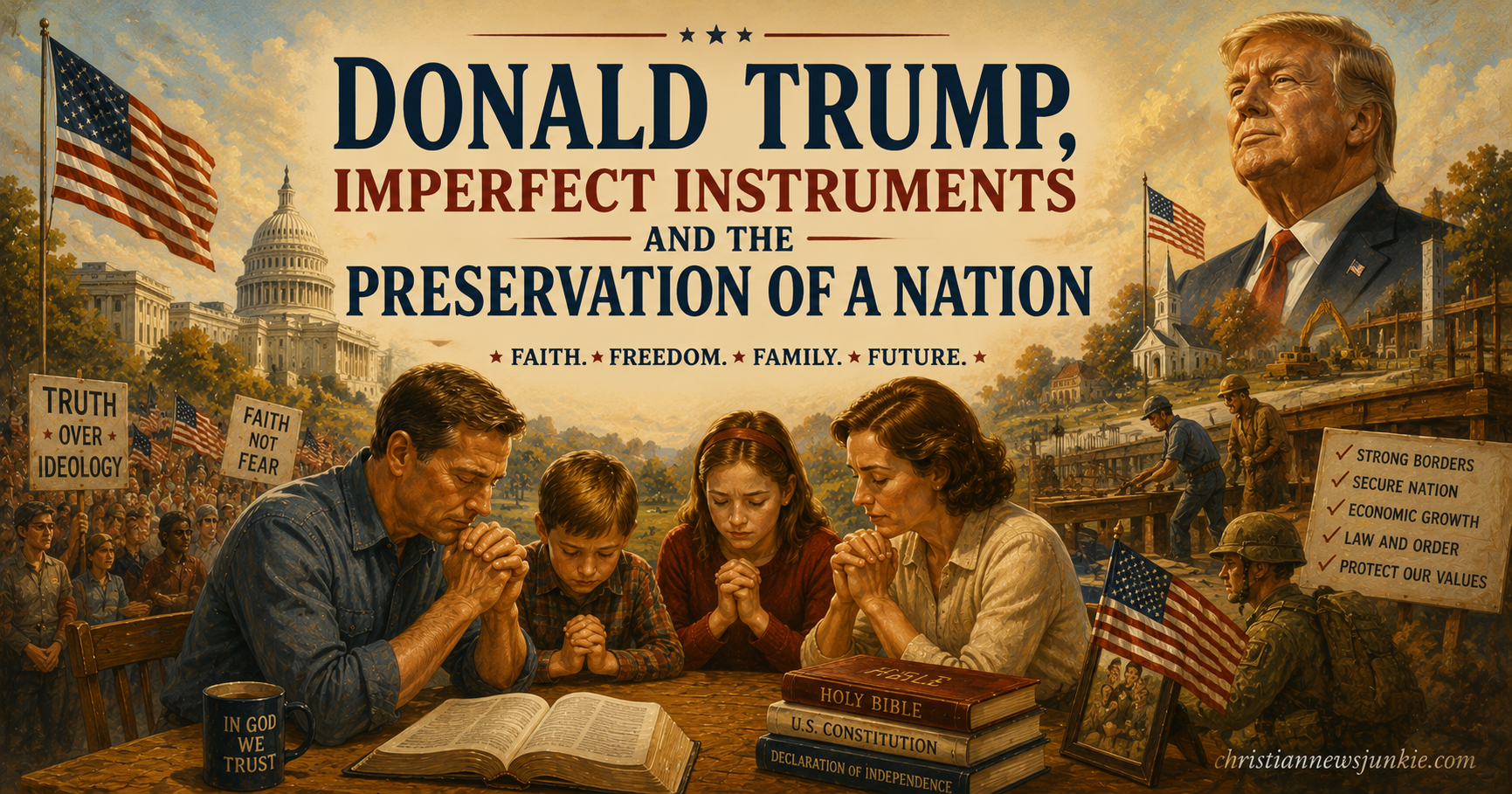
Americans rarely agree on anything today, but one thing is certain: few political figures in modern history have generated stronger reactions than Donald Trump.
To some, he represents courage, nationalism, economic realism, and resistance to Progressive ideology.
To others, he symbolizes disruption, controversy, and political combativeness unlike anything previously seen in modern presidential politics.
Christians have often found themselves in an uncomfortable position regarding Trump.
Many appreciate his policies while simultaneously cringing at his rhetoric, impulsiveness, or occasional coarseness.
Others insist that Christians should have rejected him entirely because of those flaws. Still others have elevated him to an unhealthy status approaching political messianism.
All three responses contain dangers.
The Christian worldview begins with the doctrine of sin. Scripture teaches that all men are fallen. “None is righteous, no, not one” (Romans 3:10, ESV). Political leaders are not exempt from this reality. Christians therefore should neither idolize political leaders nor expect moral perfection from them.
Yet Christians repeatedly fall into a familiar pattern. We long for a perfect ruler, a perfectly wise king, a perfectly righteous authority who governs with justice, truth, strength, mercy, and incorruptible wisdom.
That longing is real because humanity was created for the reign of the perfect King.
Scripture itself repeatedly demonstrates the failure of every merely human leader. Adam failed in Eden. Noah became drunk after the Flood. Abraham lied out of fear. Moses sinned in anger. Samson was morally reckless. David committed adultery and murder. Solomon’s heart drifted toward idolatry. Even the best kings of Judah carried serious flaws and left unfinished reforms behind them.
The Bible portrays this pattern intentionally. Every man fails because perfection exists in only one Man: Jesus Christ.
Christ alone is the sinless King. Christ alone possesses perfect wisdom. Christ alone rules without corruption.
Christians are therefore mistaken whenever they seek messianic fulfillment through politics or imagine that national salvation arrives through any earthly ruler.
Yet Christianity also teaches that Christ is already reigning now.
After His resurrection and ascension, Jesus declared that “all authority in heaven and on earth” had been given to Him (Matthew 28:18). He presently reigns over nations from heaven, though not yet in the fully visible bodily manifestation that will occur at His return.
History itself is moving toward the public triumph of Christ’s kingdom, though.
One day the King will return bodily, visibly, and gloriously to judge the nations, destroy evil finally, and consummate the New Creation. Only then will humanity experience perfect government. Only then will righteousness dwell fully upon the earth.
Until that day, Christians live in the tension of a fallen world. We do not vote for saviors. We vote for the best available option among imperfect men while remembering that our ultimate citizenship is in heaven.
The central question Christians faced in recent elections was therefore not whether Donald Trump was flawless. He clearly was not.
The real question was whether his leadership, despite serious imperfections, represented a better direction for the nation than the increasingly radical Progressive alternative represented by the Harris/Walz ticket and the broader ideological Left.
Many conservatives and Christians, including myself, concluded that the answer was obvious.
History will likely remember Trump not as a polished statesman in the mold of Ronald Reagan, but as a blunt and unconventional figure who interrupted a rapid cultural and political decline already well underway in America.
Christians do not need to defend every careless statement Trump has ever made in order to recognize that his presidency substantially benefited the nation in numerous ways.
In fact, one of the great failures of modern political discourse is the inability to distinguish between approval of a leader’s every personal behavior and recognition that God may nevertheless use that leader for providential purposes.
The Bible repeatedly demonstrates that God often works through imperfect instruments.
The Political and Cultural Landscape Trump Inherited
A Nation Already in Crisis
One of the greatest distortions in modern political commentary is the tendency to speak as though Donald Trump entered office during a period of national stability and harmony and somehow created division out of thin air.
The reality is quite different.
America was already deeply fractured culturally, politically, economically, and spiritually long before Trump descended the escalator in 2015.
Confidence in institutions had collapsed.
Americans increasingly distrusted the media, universities, federal agencies, corporations, and even elections themselves.
Immigration enforcement had weakened dramatically. The southern border became increasingly porous.
Violent crime surged in numerous cities. Inflation eroded the purchasing power of working families. The national debt exploded to previously unimaginable levels.
Meanwhile, Progressive ideology accelerated through nearly every major institution in American life.
Radical gender theories entered schools.
Diversity, Equity, and Inclusion bureaucracies expanded aggressively.
Christians who maintained historic biblical beliefs about sexuality increasingly found themselves treated as moral outcasts.
The cultural Left often framed traditional Christianity not merely as incorrect but as dangerous.
This development did not occur overnight. It emerged gradually over decades through academia, entertainment, media, and corporate culture. What once would have been viewed as radical increasingly became normalized through repetition and institutional reinforcement.
Many ordinary Americans felt politically homeless. They believed neither major party fully represented them. Trump recognized this frustration and spoke directly to it in language that was often raw, emotionally charged, and deliberately confrontational.
His style horrified establishment figures in both parties. Yet millions of Americans viewed that very combativeness as proof that he was willing to fight institutions they believed had become hostile to ordinary citizens.
The Progressive Vision Americans Rejected
The 2024 election was not merely a contest between personalities. It represented two radically different visions for America.
The Progressive vision emphasized centralized bureaucratic power, expanding identity politics, aggressive secularism, continued cultural revolution regarding sexuality and gender, and increasing governmental management of speech and information. Many Americans also feared continued weaponization of federal institutions against political dissenters.
Christians had particular concerns.
Under Progressive governance, Christian business owners, schools, adoption agencies, and ministries increasingly faced pressure to compromise biblical convictions regarding marriage and sexuality.
Pro-life activists faced severe legal scrutiny. Parents objecting to ideological content in schools were often portrayed as extremists.
Many Christians concluded that the cultural trajectory of the nation had become profoundly dangerous.
History repeatedly demonstrates that movements untethered from biblical truth eventually drift toward coercion.
Francis Schaeffer frequently warned that societies abandoning transcendent moral authority ultimately lose any stable basis for human dignity and liberty. Once morality becomes detached from God’s revealed standards, power increasingly determines truth.
Many Christians believed the Harris/Walz ticket represented an acceleration of this process.
The Bullet America Dodged
Had the Progressive coalition retained power, many conservatives believe America would have moved dramatically further left in ways that may have proven difficult to reverse.
Judicial appointments alone could have reshaped the nation for generations. Federal agencies likely would have expanded ideological enforcement in education, employment, and healthcare. Border enforcement likely would have remained weak. Religious liberty conflicts almost certainly would have intensified.
Perhaps most concerning was the continued cultural normalization of ideas fundamentally incompatible with Christianity.
A society cannot endlessly attack the family, promote the murder of the preborn under abortion, redefine human nature, reject biological reality, celebrate moral relativism, and undermine religious conviction without eventually experiencing social fragmentation.
Christians therefore viewed the election not merely as an economic or partisan contest, but as a struggle over civilizational direction.
Trump’s Personality and the Christian Question
The Reality of Trump’s Character Flaws
Christians should speak honestly about Donald Trump’s flaws.
He often speaks impulsively. He exaggerates. He sometimes insults opponents unnecessarily. His rhetoric can become petty, harsh, or inflammatory.
Defending every statement he makes is neither wise nor morally necessary.
Christians damage their credibility when they always excuse behavior in political allies that they would condemn elsewhere.
Scripture repeatedly emphasizes the importance of self-control, gracious speech, humility, and wisdom.
Proverbs warns extensively about reckless words. Ephesians 4:29 instructs believers: “Let no corrupting talk come out of your mouths, but only such as is good for building up” (ESV).
No serious Christian should pretend Trump consistently models ideal Christian speech.
Yet Christians must also avoid another error: treating personal style as morally equivalent to policy substance.
Modern politics increasingly prioritizes optics, tone, and emotional signaling over actual governance outcomes.
A polished politician may speak gently while implementing profoundly destructive policies. Another leader may speak crudely while defending religious liberty, constitutional order, and national stability.
Wisdom requires distinguishing between the two.
Why Personality Became the Central Battlefield
Trump’s opponents quickly recognized that many Americans found his demeanor abrasive. Consequently, political battles often centered less on policy outcomes and more on emotional reactions to his personality.
Media coverage overwhelmingly emphasized controversy, outrage, and scandal narratives. Some criticism was deserved. But much of it became obsessive and disproportionate.
Meanwhile, comparable scrutiny was rarely applied to Progressive leaders whose policies carried far-reaching moral consequences.
Christians noticed the asymmetry.
Supporters of abortion expansion, censorship, radical gender ideology, or hostility toward religious conscience protections were often portrayed as compassionate and civilized so long as they spoke politely.
Trump, by contrast, was frequently treated as uniquely dangerous because of his rhetorical style.
This inversion revealed something important about modern culture: many elites increasingly value social signaling and ideological conformity above substantive moral concerns.
God’s Use of Imperfect Leaders in Scripture
The Bible contains numerous examples of flawed leaders used by God for providential purposes.
Perhaps most relevant is Cyrus the Great. In Isaiah 45:1, God astonishingly refers to Cyrus as “his anointed,” despite Cyrus being a pagan ruler. Cyrus was not a covenant believer in the biblical sense, yet God used him to accomplish divine purposes, including allowing the Jewish exiles to return and rebuild Jerusalem.
God’s use of Cyrus did not imply moral perfection or divine endorsement of every aspect of his character. It demonstrated God’s sovereignty over history.
The same pattern appears elsewhere.
Samson possessed serious moral weaknesses yet delivered Israel from enemies. King David committed grievous sins yet remained central to God’s covenant purposes. Even pagan rulers like Nebuchadnezzar II served as instruments within God’s providential plan.
But Scripture never allows readers to place ultimate hope in any of these men. Every earthly ruler eventually disappoints because every earthly ruler is fallen.
The repeated failures of biblical leaders direct our eyes toward the coming perfect King.
Christians therefore should not fall into simplistic thinking that God only works through morally refined personalities. Sometimes God uses rough instruments during turbulent times. Yet even the best earthly rulers remain temporary shadows pointing toward the greater reign of Christ Himself.
Christians and Political Prudence
One of the most important distinctions Christians must recover is the difference between selecting a pastor and selecting a civil magistrate.
Biblical qualifications for pastors are extraordinarily high because pastors shepherd Christ’s church spiritually.
Civil government, however, serves a different role.
Romans 13 teaches that government exists primarily to restrain evil, punish wrongdoing, and preserve civil order. Competence, courage, discernment, and willingness to confront corruption matter enormously in political leadership.
A president is not a national pastor.
Many conservative Christians concluded that although Trump lacked the polished temperament they ideally desired, the alternative political movement threatened foundational biblical and constitutional principles far more seriously.
This is where the phrase “do not let the perfect become the enemy of the good” becomes especially relevant.
In a fallen world, elections often involve choosing between imperfect alternatives, not selecting saints. Christians therefore should vote responsibly for the better available option while awaiting the return of the only perfectly righteous King, Jesus Christ.
Campaign Promises and Governing Realities
Promises Trump Made
Trump campaigned on several major promises:
- Strengthening border security
- Reviving American manufacturing
- Expanding energy independence
- Restraining inflation
- Ending weaponization of government
- Protecting free speech
- Avoiding “forever wars”
- Prioritizing American interests internationally
Critics often accuse Trump of overpromising. There is some truth to this. Trump’s communication style has always involved optimism, grand claims, and hyperbole.
Yet hyperbolic language is not unique to Trump. Politicians routinely promise transformational outcomes. Trump simply does so more openly and dramatically than most.
Many supporters understood his style intuitively. They interpreted his rhetoric directionally rather than literally.
Obstacles Facing Any President
One unrealistic expectation among some conservatives is the belief that presidents possess nearly unlimited power.
They do not.
American government intentionally disperses authority across competing institutions. Presidents face resistance from Congress, courts, bureaucracies, intelligence agencies, state governments, media pressure, economic forces, and international realities.
Trump encountered particularly intense institutional opposition. Federal investigations, impeachment efforts, hostile media environments, internal bureaucratic resistance, and constant litigation consumed enormous amounts of political energy.
Even highly capable presidents cannot simply wave a hand and instantly reverse decades of institutional momentum.
Christians, of all people, should understand the persistence of human corruption within institutions.
Unrealistic Expectations from Conservative Critics
Some conservative critics expected immediate and total transformation once Trump returned to office. When complex problems persisted, frustration quickly emerged.
This mentality reflects both political naïveté and modern impatience.
Many younger voters especially have little historical understanding of how slowly governments actually move. They grew up in an era of instant digital gratification and therefore expect political change to occur with similar speed.
But large nations do not turn on a dime.
Inflation cannot disappear overnight. Bureaucracies cannot be dismantled instantly. Cultural decay accumulated over decades cannot be reversed in a single election cycle.
Political maturity requires patience and realism.
Entitlement and Historical Amnesia Among Younger Voters
One striking feature of modern political discourse is the extraordinary entitlement displayed by many younger Americans.
Generations raised in relative comfort often possess little appreciation for the hardships their fathers and grandfathers endured.
Previous generations survived world wars, rationing, the Great Depression, Cold War nuclear fears, severe recessions, and physically demanding labor under far harsher conditions than many modern Americans experience.
Yet contemporary political discourse often reflects constant outrage, perpetual dissatisfaction, and unrealistic expectations.
Many younger voters have never known genuine national sacrifice. As a result, inconvenience is often interpreted as oppression, and political compromise is viewed as betrayal.
This mentality produces chronic discontent.
Scripture repeatedly warns against grumbling and ingratitude. The Israelites themselves fell into this sin repeatedly after being delivered from Egypt. Despite witnessing God’s provision, they constantly complained about hardships and unmet expectations.
Human nature has not changed.
Gratitude as a Christian Virtue
Christians should be among the most realistic people in society because Christianity teaches that we live in a fallen world.
No political leader will create utopia. No administration will eliminate injustice, corruption, suffering, or economic difficulty entirely.
That does not mean distinctions between policies are meaningless.
Christians can simultaneously recognize flaws in a leader while remaining grateful for genuine blessings received under that leadership. Gratitude is not naïveté. It is spiritual maturity.
Under Trump, many Christians experienced tangible relief regarding religious liberty concerns, judicial appointments, economic pressure, border enforcement, and cultural hostility from the federal government.
Recognizing those benefits is not blind partisanship. It is honesty.
Trump, Foreign Policy, and the “No New Wars” Debate
What Trump Meant by “No New Wars”
One of Trump’s most popular campaign themes involved avoiding endless foreign wars.
Critics sometimes interpret this slogan simplistically, as though any military engagement automatically constitutes a “new war.” But foreign policy is more complicated than slogans.
Most supporters understood Trump’s promise to mean avoiding prolonged nation-building occupations like Iraq or Afghanistan, where American involvement expanded for decades with unclear objectives and enormous costs.
Trump generally favored deterrence, targeted force when necessary, and stronger negotiating leverage rather than massive interventionist campaigns.
Does the Iran Conflict Constitute a “New War”?
Debates surrounding Iran illustrate this complexity.
Limited military strikes, retaliatory actions, or deterrence operations do not necessarily constitute a full-scale war in the historical sense. Throughout American history, presidents have authorized numerous military operations without initiating prolonged conventional wars.
Reasonable conservatives can disagree about specific decisions regarding Iran. But simplistic accusations that any confrontation automatically violates a “no new wars” principle ignore geopolitical reality.
Presidents must respond to intelligence assessments, alliance obligations, regional instability, and threats to American personnel and interests.
Foreign policy rarely offers morally perfect choices.
The Complexity of Presidential Decision-Making
Online political commentary often treats global affairs like a video game. Real-world decisions are vastly more complicated.
Presidents receive intelligence unavailable to the public. They must evaluate risks involving nuclear proliferation, terrorism, economic disruption, energy markets, alliance structures, and military readiness simultaneously.
Christians should approach these issues with humility rather than ideological absolutism.
The preservation of peace sometimes requires credible strength. Weakness can invite aggression just as surely as recklessness can provoke conflict.
Tangible Benefits Christians and Conservatives Experienced Under Trump
Religious Liberty Gains
Many Christians strongly supported Trump because of concrete policy outcomes rather than emotional attachment.
His administration prioritized religious liberty concerns more aggressively than recent Republican administrations. Pro-life advocates and Christians prosecuted under FACE Act controversies received renewed attention and, in some cases, relief through pardons and policy shifts.
Christians increasingly feared criminalization or marginalization for expressing traditional biblical beliefs. Trump’s administration signaled that such concerns would at least receive a hearing rather than dismissal.
Pro-Life Achievements
Perhaps Trump’s most historically significant accomplishment involved judicial appointments.
His Supreme Court appointments fundamentally reshaped the judiciary and contributed directly to the overturning of Roe-era abortion jurisprudence.
For decades, many Christians voted primarily around this issue because abortion involves the deliberate destruction of innocent human life. Trump accomplished what numerous Republican politicians promised but never achieved.
Regardless of one’s opinion of Trump personally, this judicial transformation will remain historically consequential.
Economic and Social Stability
Many Americans also experienced tangible economic benefits during Trump’s leadership.
Energy production expanded. Inflation pressures were comparatively lower during much of his first administration. Border enforcement increased. International trade negotiations shifted toward more explicitly national-interest frameworks.
Supporters argued that these policies particularly benefited working-class Americans long ignored by political elites.
Foreign Policy and National Sovereignty
Trump also challenged longstanding assumptions regarding international relations.
He pressured NATO allies regarding defense spending. He confronted China more aggressively economically. He emphasized national sovereignty and border enforcement in ways many voters found refreshing after decades of increasingly globalist rhetoric.
Critics often viewed this approach as abrasive or isolationist. Supporters viewed it as realistic and overdue.
Why Many Christians Saw Trump as a Defensive Figure
Importantly, many Christians did not see Trump as a national savior.
Rather, they viewed him as a restraining force against accelerating cultural and political decline.
This distinction matters greatly.
Christian theology recognizes the concept of common grace — God’s restraint of evil within societies through institutions, laws, and governing authorities. Governments cannot redeem humanity spiritually, but they can either restrain disorder or accelerate it.
Many Christians believed Trump functioned primarily as a restrainer.
A Christian Perspective on Political Hope
Politics Cannot Save the Human Heart
Christians must remember that politics has limits.
No election can regenerate sinful hearts. No president can create spiritual revival. Government cannot replace the Gospel.
Both Left and Right are vulnerable to political idolatry — the false belief that salvation comes through governmental power.
It does not.
Human depravity ensures that every political movement eventually disappoints when elevated beyond proper limits.
The longing for a truly righteous ruler is legitimate, but that longing is ultimately fulfilled only in Christ.
Every other ruler eventually reveals weakness, corruption, pride, compromise, or mortality because every merely human ruler shares Adam’s fallen nature.
Only Christ rules perfectly because only Christ is perfectly righteous.
Yet Politics Still Matters
Acknowledging those limits does not mean politics is unimportant.
Laws shape culture. Institutions influence moral norms. Governments either protect or undermine liberty. Public policy affects families, churches, education, and economic opportunity.
Christians therefore cannot retreat entirely from civic responsibility.
Jeremiah instructed the Jewish exiles in Babylon to seek the welfare of the city where they lived (Jeremiah 29:7).
Responsible citizenship remains part of loving one’s neighbor.
Until Christ returns bodily to judge the nations and establish the visible consummation of His kingdom upon the earth, believers must continue exercising prudence in public life. That includes voting for the better option available rather than withdrawing into political passivity or demanding impossible perfection from fallen men.
Wisdom in a Fallen World
Mature political judgment requires abandoning utopian fantasies.
In the real world, citizens choose between imperfect alternatives under imperfect conditions. Prudence, discernment, gratitude, and realism matter enormously.
Donald Trump is not morally perfect. Neither were many leaders God used throughout history.
Yet many Christians reasonably concluded that his presidency produced significant benefits for religious liberty, constitutional governance, judicial restraint, national sovereignty, economic stability, and resistance to radical Progressive ideology.
Recognizing this does not require hero worship. It requires perspective.
Conclusion
Donald Trump will likely remain one of the most controversial figures in American history for decades to come. His flaws are real and should not be ignored. Christians should never surrender biblical moral standards for political tribalism.
But Christians also must avoid political naïveté.
The choice facing Americans was never between Donald Trump and moral perfection. The choice was between competing political visions with profoundly different consequences for the nation’s future.
Many Christians concluded that despite Trump’s rough edges, his leadership substantially slowed cultural and political developments they believed would deeply damage the country, weaken religious liberty, undermine constitutional order, and accelerate moral confusion.
Scripture repeatedly reminds believers that God governs history through imperfect people and flawed nations. Our ultimate hope rests not in presidents, parties, or movements, but in the sovereign reign of Jesus Christ, who already rules over the nations from heaven and who will one day return visibly in glory.
Only then will humanity finally receive the perfect government it continually seeks.
Until that day, Christians must think clearly, act responsibly, vote wisely, and refuse both cynical despair and political idolatry. We are called to pursue justice prudently within the limitations of a fallen world while awaiting the coming of the perfect King.
Americans should resist both blind idolization and cynical ingratitude. It is possible to acknowledge Trump’s faults honestly while also recognizing that his presidency delivered meaningful benefits to millions of Americans and likely spared the nation from a far more destructive political trajectory.
In turbulent times, God often uses unlikely instruments.
History suggests He always has.
S.D.G.,
Robert Sparkman
rob@christiannewsjunkie.com
RELATED CONTENT
This video is demonstrative of the disdain that some young men like Nathan Remillard have towards Donald Trump despite his accomplishments.
I can sympathize with his concerns to some level, but it seeems to me like he has embraced the spirit of victimhood that the left promotes and has a high degree of entitlement and bitterness.
He doesn’t seem to realize that there are older individuals who are not doing well financially either, but Christians can maintain thankfulness and gratitude during such experiences.
He seems to lack historical perspective about poverty and hardship. Virtually all people experience it throughout their lives at some point. God uses these hardships in the case of Christians to sanctify them.
Concerning the Related Content section, I encourage everyone to evaluate the content carefully.
If I have listed the content, I think it is worthwhile viewing to educate yourself on the topic, but it may contain coarse language or some opinions I don’t agree with.
Feel free to offer your comments below. Respectful comments without expletives and personal attacks will be posted and I will respond to them.
Comments are closed after sixty days due to spamming issues from internet bots.
You can always send me an email at rob@christiannewsjunkie.com if you want to comment on something afterwards, though.
It should be noted that on some matters, I am expressing my convictions or opinions on the matter. My convictions and opinions are strongly influenced by a conservative, Christian (biblical) worldview.
At times, like any other human being, my remarks will reflect my own intuition and bias. I am subject to error, although I speak from a clean concience, knowing that I will ultimately be held accountable for my words.
If you have evidence that I am wrong about a material statement of fact, provide the evidence and I will gladly review it and make revisions if merited. Obviously, there are some assertions that are matters of opinion that I will not change, but I always strive to be truthful.
I will continue to add videos and other items to the Related Content section as opportunities present themselves.
I recommend these Youtube channels and commentators for good content on politics and news from a Christian and/or conservative worldview: Albert Mohler, Allie Beth Stuckey, Bill O’Reilly, CBN News, Hugh Hewitt, John Anderson Media (Australia), Nick Freitas, Ruthless Podcast (language warning), Scott Jennings, The Hot Zone with Chuck Holton, Vince Dao, and Verdict with Ted Cruz.
Albert Mohler’s channel on Youtube has a daily episode called The Briefing with Albert Mohler that I highly recommend. Allie Beth Stuckey’s channel is top-notch, too.
For livestreaming of political protests and riots by conservative commentators, check out Nate Friedman, Cam Higby, James Klug, and Nick Shirley. I don’t agree with the perspectives of all these commentators and the language of protesters is often obscene. Most news outlets will not cover these illegal assemblies, though, because it doesn’t promote their narrative.
Depictions of Jesus Christ are used in some illustrations. I realize that some including conservative Presbyterians consider this to be idolatry. I respectfully disagree with their position on this matter as the commandment forbids worshiping such depictions, and I do not worship these illustrations.