
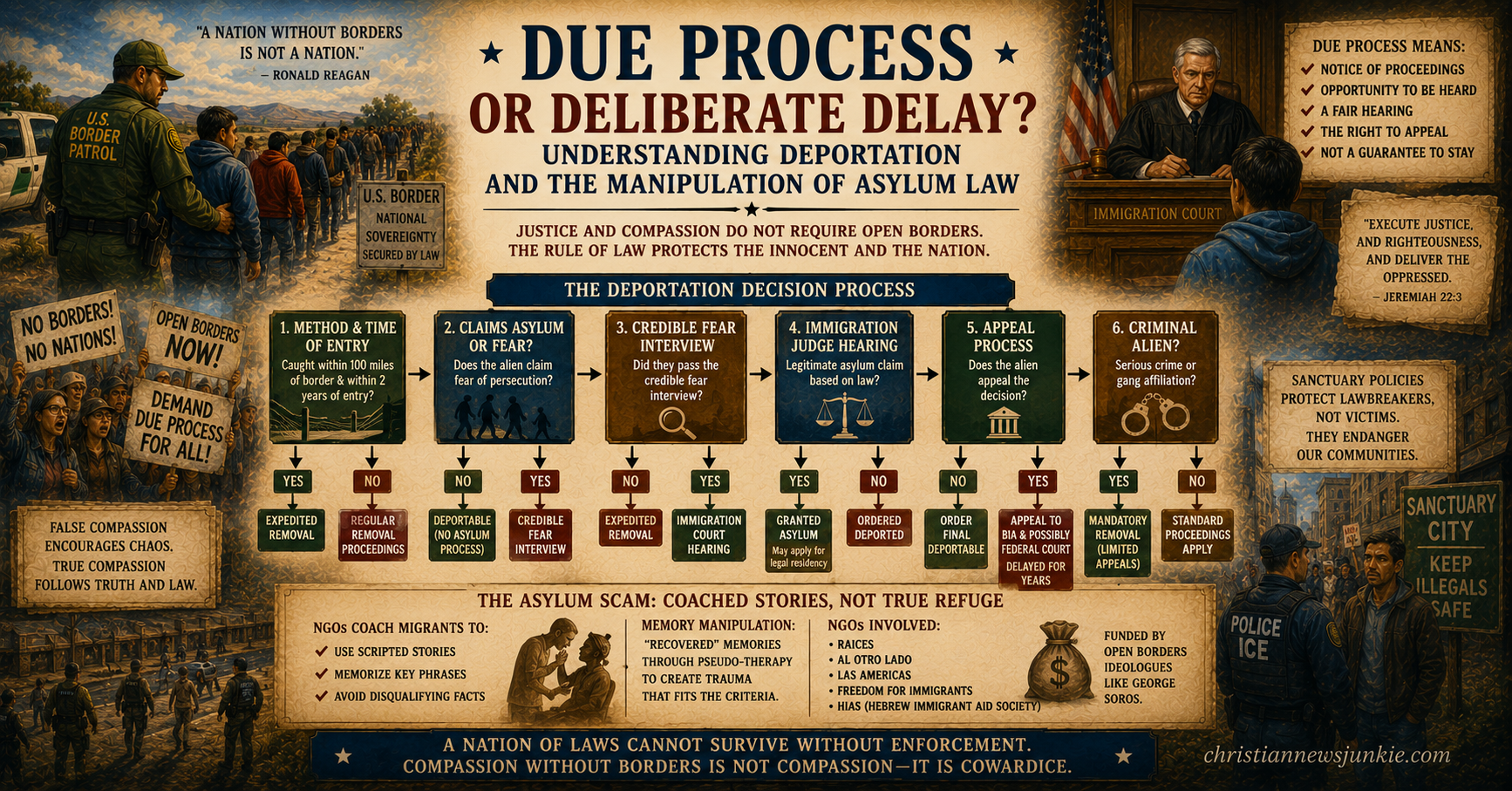
The term due process is frequently weaponized by progressive politicians and left-leaning organizations to obstruct immigration enforcement. While the United States rightly upholds the rule of law and the dignity of persons—even illegal aliens—it is clear that our immigration system is now riddled with abuse, coached narratives, and bureaucratic bottlenecks. This post walks through a verbal “flow chart” of the decision-making process involved in deporting illegal aliens, highlighting where genuine due process ends and manipulation begins. Along the way, we’ll expose how NGOs have exploited the asylum system, even training migrants to fabricate or “recover” memories to game the process.
What Does Due Process Actually Mean for Illegal Aliens?
Due process, according to the U.S. Constitution (5th and 14th Amendments), ensures that no person is deprived of “life, liberty, or property” without lawful procedures. However, this does not mean illegal aliens are entitled to the same full rights as citizens. Here’s what it does entail:
- Notice of the proceedings against them
- An opportunity to be heard (in most cases)
- A hearing before an immigration judge (unless subject to expedited removal)
- The ability to appeal (in regular removal cases)
What it does not include is:
- Free legal counsel (attorneys are not provided by the government)
- Permanent residency just because someone has been here for a long time
- An automatic right to stay during an appeal
These protections are minimal and were never designed to permit endless delay, abuse, or manufactured claims of persecution.
Flowchart: The Deportation Decision Process for Illegal Aliens
Let’s walk through a simplified flowchart of what happens when an illegal alien is apprehended in the United States:
Step 1: Method and Time of Entry
Q: Did the alien cross the border illegally and get caught within 100 miles of the border and within 2 years of entry?
- YES → They are eligible for Expedited Removal.
- No formal hearing.
- Deportable immediately, unless they claim credible fear of persecution.
- NO → They are placed into Regular Removal Proceedings.
Step 2: Did the Alien Claim Asylum or Fear of Return?
Q: Does the alien claim to fear persecution in their home country?
- NO → Deportable. No asylum process invoked. Removal proceeds.
- YES → They receive a Credible Fear Interview conducted by an asylum officer.
Step 3: Outcome of the Credible Fear Interview
Q: Did they pass the Credible Fear Interview?
- NO → Deportable (Expedited removal resumes).
- YES → The case is referred to Immigration Court for a full asylum hearing. This may take years due to court backlogs.
Step 4: Immigration Judge Hearing
Q: Does the Immigration Judge find a legitimate asylum claim based on race, religion, nationality, political opinion, or social group?
- YES → Alien is granted asylum and may apply for legal permanent residency.
- NO → Alien is ordered deported.
Step 5: Appeal Process
Q: Does the alien appeal to the Board of Immigration Appeals (BIA)?
- NO → Deportation order is final. Deportable.
- YES → Deportation is delayed for the duration of the appeal.
- If BIA rejects the appeal, the alien can attempt to appeal to a federal court.
- Some never leave, even after final orders.
Step 6: Criminal Aliens
Q: Is the alien convicted of a serious crime (e.g., aggravated felony, gang affiliation, etc.)?
- YES → Subject to mandatory removal in many cases, with limited appeal rights.
- BUT → Progressive cities may refuse to cooperate (e.g., sanctuary cities releasing criminals ICE requested).
- NO → Continue with standard proceedings.
Points of Departure: Who Gets Deported?
| Situation | Likely Outcome |
|---|---|
| Caught at border, no asylum claim | Expedited removal |
| Fails credible fear interview | Expedited removal |
| Commits felony | Mandatory removal (if ICE cooperation exists) |
| Loses asylum case, no appeal | Removal |
| Loses appeal | Removal (often ignored) |
| Ongoing appeal | Stays in U.S. (for years) |
| Granted asylum | Legal stay, possible green card |
The Asylum Scam: Coaching, Memory Manipulation, and NGO Exploitation
Here lies the most sinister part of the abuse: the manipulation of the asylum process by activist NGOs.
Coaching on Asylum Narratives
Many migrants are coached by NGOs—often funded by leftist foundations and international agencies—on how to pass the credible fear interview. Coaching includes:
- Specific phrases to say to sound like victims of political or gang persecution
- Scripts for describing supposed abuse
- Instructions to avoid disqualifying answers
This is not about helping true refugees; it’s about gaming the system.
Memory “Recovery” and Psychological Manipulation
Even more disturbingly, certain NGOs have used memory regression techniques—pseudo-psychological methods often used in fringe therapy—to help migrants “remember” trauma that fits the asylum criteria.
These tactics are opaque and misleading. The goal is not truth but testimony manufacturing.
NGOs Implicated in These Practices
Several organizations have been criticized or exposed for engaging in such coaching:
- RAICES (Refugee and Immigrant Center for Education and Legal Services)
- Al Otro Lado
- Las Americas Immigrant Advocacy Center
- Freedom for Immigrants
- HIAS (formerly Hebrew Immigrant Aid Society)
Many of these NGOs have ties to open-border ideologues like George Soros (Open Society Foundations), and some have received federal or international funding.
Summary: Lawfare Disguised as Compassion
While America’s laws afford basic due process to all individuals on U.S. soil, the current system has been deliberately overwhelmed by:
- Fraudulent asylum claims
- Mass coaching of narratives
- Lawfare through endless appeals
- Sanctuary city obstruction
- Leftist manipulation of “due process” to mean permanent delay
This is not compassion—it’s sabotage of sovereignty.
Conclusion
The average American thinks “due process” means a fair hearing and a timely result. But in the immigration context, the Left has redefined it to mean endless bureaucratic theater designed to delay deportation until it’s politically impossible. Behind the scenes, NGOs are orchestrating narratives, fabricating trauma, and undermining law enforcement with the help of progressive courts and politicians.
What we need is a return to the rule of law: clear enforcement, minimal gamesmanship, and real consequences for those who exploit America’s generosity.
S.D.G.,
Robert Sparkman
rob@christiannewsjunkie.com
RELATED CONTENT
Concerning the Related Content section, I encourage everyone to evaluate the content carefully.
If I have listed the content, I think it is worthwhile viewing to educate yourself on the topic, but it may contain coarse language or some opinions I don’t agree with.
Feel free to offer your comments below. Respectful comments without expletives and personal attacks will be posted and I will respond to them.
Comments are closed after sixty days due to spamming issues from internet bots.
You can always send me an email at rob@christiannewsjunkie.com if you want to comment on something afterwards, though.
It should be noted that on some matters, I am expressing my convictions or opinions on the matter. My convictions and opinions are strongly influenced by a conservative, Christian (biblical) worldview.
At times, like any other human being, my remarks will reflect my own intuition and bias. I am subject to error, although I speak from a clean concience, knowing that I will ultimately be held accountable for my words.
If you have evidence that I am wrong about a material statement of fact, provide the evidence and I will gladly review it and make revisions if merited. Obviously, there are some assertions that are matters of opinion that I will not change, but I always strive to be truthful.
I will continue to add videos and other items to the Related Content section as opportunities present themselves.
I recommend these Youtube channels and commentators for good content on politics and news from a Christian and/or conservative worldview: Albert Mohler, Allie Beth Stuckey, Bill O’Reilly, CBN News, Hugh Hewitt, John Anderson Media (Australia), Nick Freitas, Ruthless Podcast (language warning), Scott Jennings, The Hot Zone with Chuck Holton, Vince Dao, and Verdict with Ted Cruz.
Albert Mohler’s channel on Youtube has a daily episode called The Briefing with Albert Mohler that I highly recommend. Allie Beth Stuckey’s channel is top-notch, too.
For livestreaming of political protests and riots by conservative commentators, check out Nate Friedman, Cam Higby, James Klug, and Nick Shirley. I don’t agree with the perspectives of all these commentators and the language of protesters is often obscene. Most news outlets will not cover these illegal assemblies, though, because it doesn’t promote their narrative.
Depictions of Jesus Christ are used in some illustrations. I realize that some including conservative Presbyterians consider this to be idolatry. I respectfully disagree with their position on this matter as the commandment forbids worshiping such depictions, and I do not worship these illustrations.