
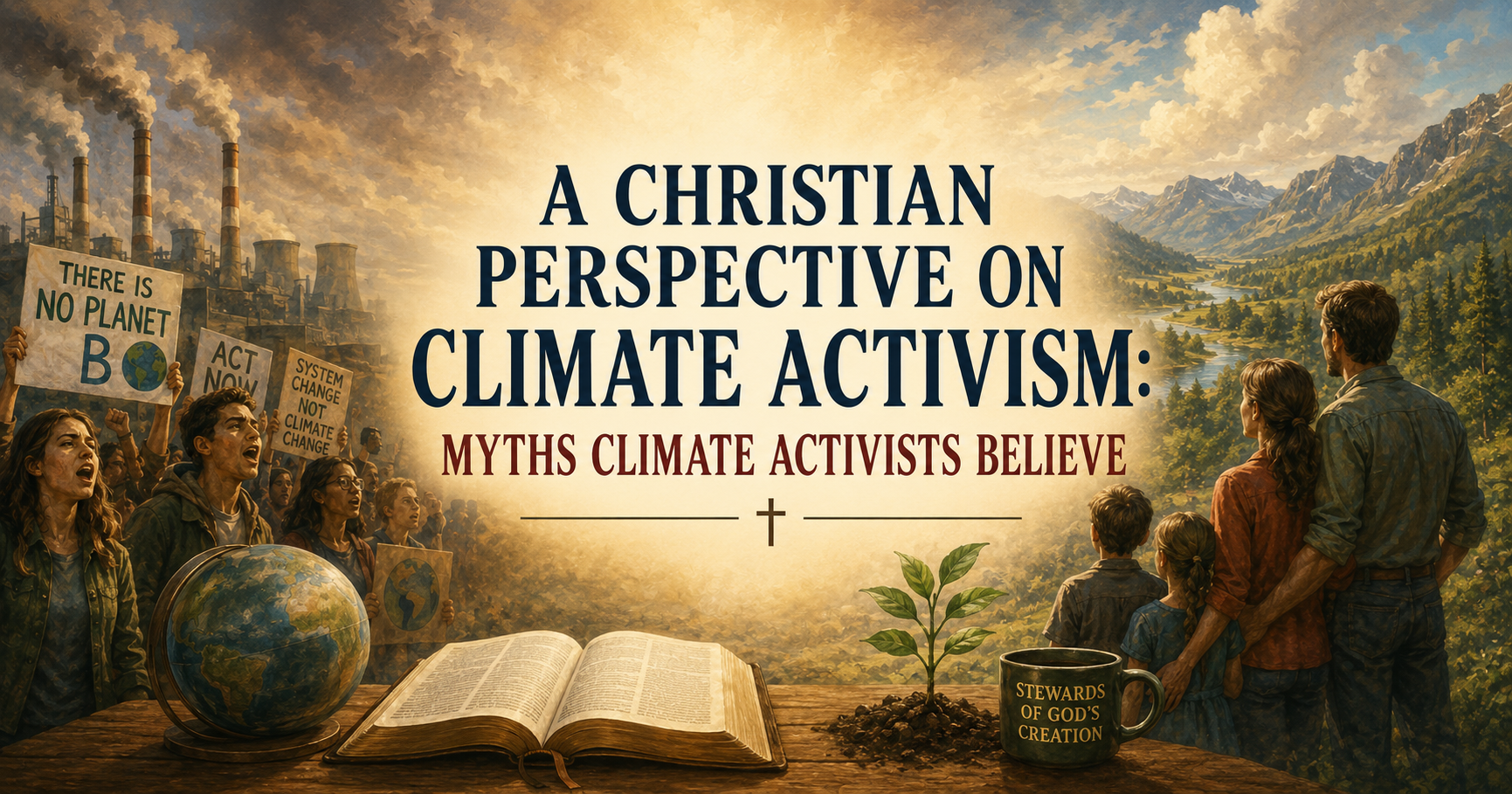
Climate change has become one of the defining political issues of the twenty-first century.
Governments spend trillions of dollars pursuing “green” initiatives, activists warn that humanity faces an existential crisis, and young people are increasingly taught that their generation may inherit an unlivable planet.
At the same time, Christians often find themselves caught between two extremes. On one side are those who dismiss environmental concerns altogether. On the other are those who embrace nearly every proposal advanced in the name of climate activism.
Neither extreme reflects biblical wisdom.
The Christian worldview begins with the conviction that God created the heavens and the earth, declared His creation to be good, and entrusted mankind with the responsibility of exercising wise dominion over it.
Christians therefore have genuine reasons to care about clean air, clean water, conservation, and responsible use of natural resources. Stewardship is not optional; it is part of humanity’s original calling.
Yet faithful stewardship also requires wisdom. Resources are finite. Every dollar spent in one place cannot be spent somewhere else. Every public policy carries benefits, costs, and unintended consequences. Good intentions alone do not guarantee good outcomes.
That observation leads to the central question of this article.
The most important question is not whether the climate changes. It always has.
Nor is the most important question whether human activity influences climate to some degree.
There is broad scientific agreement that greenhouse gases, including carbon dioxide, affect Earth’s climate system. The real question is far more practical:
Which policies most effectively promote human flourishing while faithfully stewarding God’s creation?
That is ultimately a moral, economic, scientific, and theological question—not merely a scientific one.
This article argues that climate activism often answers a different question. Rather than asking how human society can best promote human flourishing while caring for the environment, it frequently treats carbon reduction as society’s highest objective, even when the costs are enormous and the measurable benefits uncertain.
Christians should instead evaluate climate policies through the biblical principles of stewardship, wisdom, and love for both creation and the people made in God’s image.
Biblical Stewardship Begins with Loving Both Creation and People
Every discussion about environmental policy should begin where Scripture begins: with God.
“The earth is the Lord’s and the fullness thereof, the world and those who dwell therein” (Psalm 24:1, ESV).
Creation does not belong to governments, corporations, environmental organizations, or even humanity itself.
It belongs to God. Human beings are managers of property they do not own.
This truth establishes both humility and responsibility.
In Genesis, God commanded Adam and Eve to “fill the earth and subdue it, and have dominion” over creation (Genesis 1:28, ESV).
This is commonly called the dominion mandate.
Modern ears sometimes hear the word dominion as license for exploitation, but Scripture presents something very different.
Biblical dominion is delegated authority exercised under God’s authority. It resembles the work of a faithful steward caring for the estate of his master.
The Bible therefore rejects two opposite errors.
The first is exploitation. Christians should oppose needless pollution, reckless destruction, and wastefulness because creation reflects the wisdom and glory of its Creator.
The second is treating nature as though it possesses greater moral value than human beings.
While creation is valuable, only mankind is created in the image of God (Genesis 1:26–27). Human life possesses a unique dignity that no ecosystem, animal species, or forest can equal.
This distinction has profound implications for public policy.
Suppose a particular environmental policy preserves a small reduction in projected future temperatures but substantially increases poverty, energy shortages, food prices, and unemployment for millions of people today.
Christians cannot ignore those human costs. Love for neighbor requires us to weigh both environmental and human consequences appropriately.
Throughout Scripture, wisdom involves making prudent decisions with limited resources.
Jesus’ parables frequently commend wise stewardship. Likewise, Proverbs repeatedly praises prudence, foresight, and careful planning. Nowhere does Scripture encourage pursuing noble goals regardless of cost.
Instead, faithful stewardship always asks:
Am I using God’s resources in the wisest possible way?
This question applies equally to families, churches, businesses, and governments. Sadly, few of these decisions are made with sound biblical principles and prayer for God’s guidance.
Human Flourishing Should Be the Measure of Public Policy
One of the most helpful contributions to the modern energy discussion comes from Alex Epstein, who argues that public policy should be evaluated primarily by whether it advances human flourishing.
This phrase is both biblical and practical.
God created human beings to flourish—to build families, cultivate the earth, develop civilizations, relieve suffering, pursue meaningful work, and worship their Creator.
Flourishing does not merely refer to economic prosperity. It includes health, security, education, opportunity, freedom, and the ability to live productive lives.
Energy plays a central role in virtually every aspect of human flourishing.
Reliable electricity powers hospitals, refrigeration, communications, manufacturing, agriculture, transportation, water treatment, and countless technologies that people in developed nations take for granted. Affordable energy reduces poverty, extends life expectancy, and enables societies to recover more quickly from natural disasters.
Ironically, many of humanity’s greatest protections against the dangers of nature have been made possible through abundant energy.
Air conditioning reduces heat-related deaths, for example. Heating systems protect people during severe winters. Irrigation combats drought. Fertilizer dramatically increases agricultural productivity. Modern construction techniques reduce deaths from storms and earthquakes.
These are not incidental benefits; they represent one of the greatest improvements in human well-being in history.
Public policy should therefore ask a simple but profound question:
Will proposed policies measurably improve human flourishing enough to justify its costs?
This question introduces an economic principle frequently overlooked in public debate: opportunity cost.
Every dollar spent by government represents resources that cannot be spent elsewhere.
If a nation spends one trillion dollars annually pursuing aggressive carbon reduction policies, this trillion dollars cannot simultaneously fund medical research, improve electrical infrastructure, reduce poverty, expand clean water systems, modernize transportation networks, and strengthen national defense.
This does not automatically mean that all climate investments are unwise.
It simply means they must compete with every other possible use of those resources.
Economists such as Thomas Sowell and Milton Friedman have long emphasized that economics is fundamentally the study of trade-offs. There are no cost-free choices. Every decision requires giving up something else.
Unfortunately, much climate activism speaks as though reducing carbon emissions is self-evidently worth almost any sacrifice.
Questions about affordability, reliability, opportunity cost, and diminishing returns are sometimes dismissed as morally suspect rather than addressing their merits.
Christians should resist that temptation.
Loving our neighbors means asking difficult questions. If two policies cost the same amount, but one saves significantly more lives or alleviates substantially more suffering, love for neighbor would direct us toward the more effective option.
That is not a rejection of environmental stewardship.
It is stewardship.
It recognizes that God’s resources are finite, human needs are many, and wisdom requires choosing those policies that accomplish the greatest good for the greatest number of people while faithfully caring for the creation God has entrusted to us.
In the sections that follow, we will examine how modern climate activism developed, the worldview that often underlies it, and whether its proposed solutions withstand careful scientific, economic, and biblical evaluation.
Climate Activism Often Answers a Different Question
It is important to distinguish between concern for the environment and climate activism as a political movement. Many people who recycle, conserve energy, enjoy the outdoors, or support reasonable pollution controls would not consider themselves climate activists. Likewise, many scientists who study Earth’s climate do not necessarily endorse every policy proposed in response to climate change.
Climate activism, however, generally goes much further than environmental stewardship. It often begins with the assumption that reducing carbon emissions should become one of society’s highest priorities, sometimes outweighing economic growth, energy abundance, national sovereignty, or even the immediate well-being of billions of people.
This distinction matters.
A Christian worldview asks, “How can we wisely balance multiple moral obligations?” Climate activism often asks, “How can we eliminate carbon emissions as quickly as possible?”
Those are not the same question.
This difference can be seen in many of the movement’s stated goals. Calls for “Net Zero” emissions, rapid decarbonization, the elimination of fossil fuels, and sweeping governmental intervention frequently assume that carbon reduction is the overriding objective around which other policies should be organized.
But public policy rarely involves only one objective.
A government must simultaneously consider affordable food, reliable electricity, economic growth, national security, public health, education, infrastructure, technological innovation, and countless other priorities. Every major decision involves trade-offs.
Suppose a proposed climate policy is projected to reduce future global temperatures by a small amount over several decades but significantly increases electricity costs for working families, raises food prices, weakens industrial competitiveness, and slows economic growth. Should that policy be adopted?
Climate activism often answers yes.
A stewardship model asks another question:
Do the measurable benefits justify the measurable costs?
That question does not deny environmental responsibility. Instead, it insists that environmental responsibility be evaluated alongside every other responsibility that governments owe their citizens.
This distinction also explains why many climate debates become emotionally charged. For many activists, questioning the effectiveness of a proposed climate policy is interpreted as questioning the moral importance of protecting the planet itself.
Christians need not accept that false dilemma.
One may affirm the importance of caring for creation while questioning whether a particular policy actually accomplishes that goal effectively or wisely.
The History and Worldview of Climate Activism
Modern climate activism did not emerge overnight. It developed gradually from several overlapping movements.
The earliest conservation efforts in the nineteenth and early twentieth centuries focused primarily on protecting forests, wildlife, and natural resources from unnecessary destruction. These efforts often enjoyed broad public support because they addressed visible environmental problems.
By the 1960s and 1970s, environmental concerns expanded considerably.
Highly publicized pollution incidents, concerns about pesticides, and growing awareness of industrial waste contributed to the modern environmental movement.
The first Earth Day in 1970 symbolized a new era of environmental activism.
During subsequent decades, increasing attention turned toward global climate change.
International conferences, scientific assessments, and multinational agreements—including the Kyoto Protocol and the Paris Agreement—placed carbon emissions near the center of international politics.
Organizations such as Greenpeace, the Sierra Club, Extinction Rebellion, and Fridays for Future helped transform climate concerns into a mass political movement.
At the same time, climate activism increasingly became intertwined with broader progressive political causes.
Many activist organizations now argue that climate change cannot be separated from issues such as wealth redistribution, racial justice, gender equity, decolonization, global governance, and critiques of capitalism.
This development reflects the broader tendency within contemporary progressive politics to interpret many social issues through interconnected systems of power and oppression.
It is important not to overstate this point. Not every environmental advocate embraces every aspect of progressive politics. Many citizens simply desire cleaner air, cleaner water, and responsible environmental stewardship.
Nevertheless, leading activist organizations frequently present climate policy as part of a much larger political transformation rather than as an isolated environmental concern.
This broader vision helps explain why debates over climate change often extend far beyond atmospheric science into questions of economics, education, foreign policy, taxation, energy production, and cultural values.
The debate is ultimately about competing visions of civilization.
Science Is Essential—But Scientism Is Dangerous
Christians should be among the strongest supporters of genuine science.
Historically, the Christian worldview helped give rise to modern science because it affirmed that the universe was created by an orderly God whose creation could be studied rationally.
Many pioneers of modern science viewed scientific investigation as a way of understanding God’s handiwork.
Science, properly understood, is one of humanity’s greatest achievements.
Yet science and scientism are not the same thing.
Science is a method of investigating the natural world through observation, experimentation, measurement, and testing.
Scientism is the philosophical belief that science alone can answer virtually every meaningful question—including questions of morality, public policy, economics, and human purpose.
Science can tell us many things.
It can estimate atmospheric carbon concentrations.
It can model climate systems.
It can measure temperatures.
It can estimate probabilities.
But science alone cannot determine whether spending one trillion dollars on one policy is wiser than spending that same trillion dollars elsewhere.
That requires economics.
It requires ethics.
It requires political judgment.
It requires moral reasoning.
Those are questions that extend beyond laboratory measurements.
Unfortunately, climate discussions sometimes blur this distinction.
Statements such as “The science says we must…” often combine scientific findings with political conclusions.
Scientific research may identify potential risks associated with rising greenhouse gas concentrations. Determining how society should respond involves entirely different kinds of reasoning.
For example, if climate models project future warming, science may help estimate possible consequences.
Science cannot decide whether:
- Nuclear power should be expanded.
- Fossil fuels should be phased out.
- Developing nations should limit industrial growth.
- Carbon taxes should be imposed.
- Governments should subsidize electric vehicles.
- Certain industries should be heavily regulated.
Those are public policy questions involving competing values and competing priorities.
Recognizing this distinction actually strengthens science because it allows scientific evidence to inform policy without pretending that scientific expertise automatically confers expertise in economics, political philosophy, or theology.
Good science welcomes questions.
Good science welcomes replication.
Good science welcomes skepticism.
Scientific progress has often occurred precisely because accepted ideas were challenged by new evidence.
Christians therefore need not fear asking careful questions about climate models, economic assumptions, or proposed policy outcomes. Honest inquiry is not hostility toward science.
Indeed, refusing to permit legitimate questioning risks replacing scientific investigation with ideological conformity.
The Critical Question: Will Proposed Climate Policies Meaningfully Improve Human Flourishing?
Once science has informed us about possible risks, society must evaluate potential responses.
This is where cost-benefit analysis becomes indispensable.
Every policy carries costs.
Every policy carries benefits.
Every policy also carries opportunity costs.
This final category is often overlooked, yet it may be the most important.
Imagine that the United States decided to spend one trillion dollars every year on aggressive climate initiatives designed to reduce projected warming several decades from now.
The obvious question is whether those expenditures would produce measurable environmental benefits.
An equally important question is this:
What else could one trillion dollars accomplish?
Could those same resources produce greater human flourishing if invested elsewhere?
Might they save more lives through cancer research, Alzheimer’s research, or pandemic preparedness?
Could they provide clean drinking water to millions who currently lack it?
Could they improve aging infrastructure, modernize electrical grids, strengthen national defense, or expand next-generation nuclear energy?
Could they reduce hunger, improve sanitation, or strengthen disaster preparedness in vulnerable regions?
These are not arguments against environmental stewardship.
They are arguments for wise stewardship.
One of the recurring themes in the work of Alex Epstein is that policy discussions should not focus exclusively on reducing negative environmental impacts. They should also consider the enormous positive benefits that abundant, affordable energy has produced for civilization.
That broader perspective changes the discussion entirely.
Instead of asking only, “How do we reduce emissions?”
We begin asking,
“How do we maximize human flourishing while responsibly caring for God’s creation?”
That question will guide the remainder of this article as we examine the role of energy, evaluate several common assumptions within climate activism, and compare its vision of the future with the hope offered by biblical Christianity.
Fossil Fuels, Energy, and Human Flourishing
Few issues better illustrate the importance of balancing environmental stewardship with human flourishing than the debate over fossil fuels.
Within climate activism, fossil fuels are often portrayed almost exclusively in negative terms. Carbon dioxide emissions, air pollution, and their potential contribution to climate change dominate the discussion. These concerns deserve serious consideration. Pollution should be reduced where practical, cleaner technologies should be pursued, and responsible environmental management benefits everyone.
Yet a balanced evaluation must also ask another question:
What have fossil fuels made possible?
This is where the work of Alex Epstein is especially valuable. Rather than evaluating energy solely by its environmental costs, he urges policymakers to consider both its costs and its enormous human benefits.
Modern civilization was built upon abundant, reliable, and affordable energy.
Electricity powers hospitals that save millions of lives each year. Fertilizers produced using natural gas have dramatically increased agricultural yields, allowing billions of people to be fed. Modern transportation networks move food, medicine, emergency supplies, and humanitarian aid around the world. Heating protects families during harsh winters. Air conditioning prevents countless heat-related deaths during increasingly hot summers. Manufacturing produces everything from medical devices to building materials.
None of these developments occurred by accident.
They required enormous amounts of affordable energy.
In wealthy nations, it is easy to forget how recently much of the world lived without refrigeration, modern sanitation, reliable lighting, or mechanized agriculture. Hundreds of millions of people today still struggle with unreliable electricity or lack access to it altogether.
For these populations, abundant energy is not a luxury—it is often the difference between poverty and opportunity.
This is particularly important for developing nations.
Many Western governments and international organizations encourage poorer countries to limit fossil fuel development while urging rapid transitions to renewable energy. While renewable technologies continue to improve and will likely play an increasing role in future energy production, they also present significant challenges.
Solar panels generate electricity only when sunlight is available. Wind turbines depend upon favorable weather conditions. Large-scale battery storage remains expensive, and electrical grids require dependable baseload generation to maintain stability. Expanding transmission infrastructure often requires years of planning, permitting, and construction.
These realities do not make renewable energy undesirable.
They simply illustrate that replacing fossil fuels is more complicated than political slogans often suggest.
Christians should therefore encourage energy policies that are both environmentally responsible and capable of sustaining human flourishing. Innovation should be welcomed wherever it genuinely improves people’s lives. Cleaner technologies, improved efficiency, advanced nuclear power, and continued environmental improvements all deserve serious consideration.
The goal should not be ideological purity.
The goal should be abundant, reliable, affordable, and increasingly clean energy that enables people throughout the world to flourish.
From Science to Public Policy
One of the most fascinating aspects of modern climate activism is not scientific but sociological.
Many observers—including both supporters and critics—have noted that the movement often exhibits characteristics commonly associated with religion.
This comparison should not be misunderstood. Climate activism is not literally a religion, nor are environmental advocates consciously attempting to create one. Nevertheless, many movements can function in ways that resemble religious systems by providing comprehensive explanations of reality, moral frameworks, and visions of salvation.
Climate activism frequently portrays humanity as standing on the edge of an impending global catastrophe. Dire predictions of ecological collapse, irreversible tipping points, and existential threats create a powerful sense of urgency. The future is presented as hanging in the balance, with only immediate and sweeping political action capable of preventing disaster.
Within this framework, certain public figures function almost as prophets, warning society of coming judgment.
Particular beliefs become markers of moral orthodoxy, while dissenters are sometimes dismissed not merely as mistaken but as morally irresponsible or even dangerous.
Acts such as reducing one’s carbon footprint, purchasing approved products, or supporting particular public policies can take on the character of moral obligations through which individuals demonstrate their commitment to the cause.
The resemblance is not exact, but it is striking.
Biblical Christianity presents a profoundly different story.
Scripture teaches that creation is indeed fallen and groans under the effects of sin (Romans 8:19–22). Yet the Bible does not teach that humanity’s ultimate hope lies in political institutions, international agreements, or technological planning.
The Christian hope rests in the sovereign God who created the world, redeemed sinners through Jesus Christ, and has promised the ultimate renewal of creation.
That hope does not encourage passivity. Christians should care for the environment, serve their neighbors, and pursue wise public policies.
But neither should Christians adopt an outlook dominated by fear, panic, or despair. Christ reigns over history. He is not surprised by environmental challenges, nor is the future dependent solely upon humanity’s ability to engineer its own salvation.
That theological perspective provides both humility and confidence as Christians participate responsibly in public life.
Eight Myths Climate Activists Commonly Believe
The following myths do not imply that every climate activist holds every one of these beliefs. Nor do they suggest that each claim is entirely false.
In many cases there is a genuine kernel of truth that has been expanded beyond what the evidence reasonably supports or used to justify policies whose benefits remain uncertain.
Myth 1: “The science is settled.”
Kernel of truth: Many aspects of climate science are well established. Carbon dioxide is a greenhouse gas. Human activities have increased atmospheric carbon dioxide concentrations. Climate has warmed over the past century.
The problem: Science itself is never “settled” in the sense that no further questions may be asked. Scientific understanding continually develops through testing, refinement, and improved observations. Questions remain regarding climate sensitivity, long-term projections, regional impacts, feedback mechanisms, and the effectiveness of proposed mitigation strategies.
Public policy should be informed by science, but it should also remain open to continued scientific inquiry.
Myth 2: “There is no meaningful scientific debate.”
Kernel of truth: Many qualified scientists agree on important aspects of climate science.
The problem: Significant debate continues regarding the magnitude of future warming, the reliability of various climate models, the severity of projected impacts, adaptation strategies, and the relative effectiveness of competing policy responses.
Scientific disagreement on these questions is neither unusual nor unhealthy.
Myth 3: “Every hurricane, flood, drought, or wildfire proves climate change.”
Kernel of truth: Climate influences weather patterns over long periods of time.
The problem: Weather and climate are not synonymous. Individual weather events result from numerous interacting factors. While climate may influence the probability or severity of certain events, attributing every natural disaster directly to climate change oversimplifies a complex system and often exceeds what the evidence supports.
Myth 4: “Renewable energy can rapidly replace fossil fuels with little economic disruption.”
Kernel of truth: Renewable technologies have improved dramatically and will likely continue expanding.
The problem: Modern economies require continuous, reliable electricity. Energy storage, transmission capacity, grid reliability, industrial energy demands, and affordability remain substantial challenges. Transitions of this magnitude require decades rather than years.
Myth 5: “Capitalism is primarily responsible for the climate crisis.”
Kernel of truth: Industrialization increased energy consumption and carbon emissions.
The problem: Market economies also produced unprecedented improvements in human health, life expectancy, education, technological innovation, food production, and environmental management. Wealthier societies generally possess greater resources to invest in cleaner technologies and environmental protection than impoverished societies.
The question is not whether industrialization has environmental impacts. It certainly does. The question is whether abandoning the economic system that produced extraordinary human flourishing would ultimately help or harm humanity.
Myth 6: “Human beings are primarily a burden on the planet.”
Kernel of truth: Growing populations consume more resources.
The problem: Human beings also create solutions. Every engineer who develops cleaner technologies, every scientist who discovers new medicines, every entrepreneur who improves efficiency, and every farmer who increases crop yields is a human being exercising creativity.
From a biblical perspective, people are not merely consumers of resources.
They are image bearers of God with the capacity to cultivate, invent, and bless others.
Myth 7: “Reducing energy consumption is the primary path to sustainability.”
Kernel of truth: Eliminating waste and improving efficiency are worthwhile goals.
The problem: Throughout history, increased access to energy has generally corresponded with greater prosperity, longer lives, improved sanitation, better education, and lower vulnerability to natural disasters. The challenge is not simply reducing energy use but producing cleaner, more reliable, and more affordable energy.
Myth 8: “Climate change is humanity’s greatest crisis.”
Kernel of truth: Climate change deserves careful study and responsible policy responses.
The problem: Humanity faces many profound challenges simultaneously: war, political oppression, religious persecution, human trafficking, infectious disease, famine, addiction, family breakdown, poverty, and ultimately mankind’s greatest problem—sin and separation from God.
Christians should avoid allowing any temporal issue, however important, to eclipse eternal realities.
A Better Christian Response
If climate activism often asks the wrong question, what should Christians ask instead?
The answer is not to abandon environmental stewardship. Nor is it to become cynical about legitimate scientific research.
Christians should reject the false choice between environmental indifference and environmental alarmism.
Instead, believers should seek a distinctly biblical approach that begins with God, values truth, loves people, and exercises wise stewardship over creation.
The first principle is humility.
Climate systems are extraordinarily complex.
Scientists continue learning about atmospheric interactions, ocean currents, solar influences, cloud formation, and countless other variables.
Humility reminds us that our knowledge is always incomplete. Christians should appreciate scientific expertise while recognizing that scientific models, like all human endeavors, possess limitations.
Likewise, humility reminds us that public policy should be evaluated by its actual results rather than its stated intentions. Good intentions do not guarantee wise outcomes.
The second principle is truthfulness.
The Ninth Commandment prohibits bearing false witness.
That commandment applies not only in courtrooms but also in public discourse.
Christians should resist exaggeration regardless of its source.
Some people minimize every environmental concern.
Others magnify every projected danger into an imminent global catastrophe.
Neither approach honors truth.
Instead, Christians should insist upon careful evidence, honest uncertainty, and accurate representation of opposing viewpoints.
We should avoid sensational headlines that generate fear while overlooking nuance.
Truth is never served by manipulating emotions.
The third principle is love for neighbor.
Jesus identified love for God and love for neighbor as the two greatest commandments (Matthew 22:37–40).
That command has profound implications for climate policy.
Policies should not be judged solely by their intentions but by how they affect real people.
If rising energy prices make it difficult for elderly couples to heat their homes during winter and cool their homes during summer, that matters.
If unreliable electrical grids threaten hospitals, that matters.
If expensive energy slows economic development in poorer nations, that matters.
If regulations make food less affordable for struggling families, that matters.
Conversely, if cleaner technologies reduce pollution while maintaining affordable energy, that also matters.
The Christian concern is comprehensive because every human being bears the image of God.
This is one reason the concept of human flourishing provides such a valuable framework.
Rather than evaluating every issue through the single lens of carbon emissions, Christians should ask how policies affect the overall well-being of people and communities.
Human flourishing includes environmental quality.
It also includes health, family stability, economic opportunity, education, religious liberty, national security, abundant food, clean water, affordable housing, meaningful employment, and hope for the future.
Wise stewardship refuses to sacrifice all of these goods in pursuit of one objective while neglecting the others.
The fourth principle is prudence.
Scripture repeatedly praises wisdom over impulsiveness.
Prudence asks practical questions.
Will this policy accomplish its stated objective?
How much measurable benefit will it produce?
What are its unintended consequences?
What opportunities will be lost because resources have been committed elsewhere?
These questions are not obstacles to compassion.
They are expressions of compassion.
Imagine that two public policies each require one trillion dollars.
Suppose one policy is projected to reduce global temperatures by only a few hundredths of a degree over several decades, while another could dramatically reduce malaria, provide clean drinking water to millions, modernize failing infrastructure, or accelerate breakthroughs in medical research.
The prudent steward does not ask only which proposal sounds more compassionate.
He asks which proposal actually accomplishes more good.
That is precisely the kind of reasoning Jesus commended in His parables concerning faithful stewardship.
Finally, Christians should embrace hope rather than fear.
One of the distinguishing marks of modern climate rhetoric is its persistent apocalyptic tone.
Young people are sometimes told that civilization stands on the verge of collapse or that humanity has only a few years remaining to avoid irreversible catastrophe.
History teaches caution toward such predictions.
Over the past two centuries, numerous forecasts of imminent global catastrophe have proven exaggerated or incorrect.
That observation does not mean every warning should be ignored. It simply reminds us that predictions deserve continual evaluation rather than unquestioning acceptance.
The Christian worldview offers something far more enduring than optimism based upon political success.
It offers hope grounded in God’s sovereignty.
Christians believe the Lord rules over history.
We believe creation remains under His providential care.
We believe Christ will return to judge the living and the dead.
We believe He will establish the new heavens and the new earth in which righteousness dwells.
That hope frees believers from despair.
It also frees us from utopian expectations that political movements can establish paradise on earth.
Conclusion
Climate change deserves thoughtful study, careful science, and responsible public policy.
Christians should reject the caricature that caring for the environment is somehow incompatible with biblical faith. Scripture plainly teaches that God’s creation is valuable and that mankind bears responsibility for exercising wise dominion over it.
Yet stewardship involves more than good intentions.
It requires wisdom.
It requires prudence.
It requires honest evaluation of costs and benefits.
Most importantly, it requires remembering that the greatest treasure within creation is not the creation itself but the people whom God created in His own image.
This is where climate activism often goes astray.
Too frequently, the movement elevates carbon reduction above nearly every competing social priority.
It sometimes measures success by emissions reduced rather than by lives improved. It often assumes that larger government programs, greater international coordination, and increasingly expensive energy transitions are morally obligatory even when their measurable benefits remain uncertain or comparatively small.
A biblical worldview asks different questions.
How can we best love our neighbors?
How can we wisely steward God’s resources?
How can we encourage both environmental responsibility and human flourishing?
How can we protect creation without unnecessarily burdening the very people creation was intended to serve?
These questions do not produce simplistic answers. Public policy rarely does.
But they direct us toward a healthier framework—one that values scientific inquiry without embracing scientism, welcomes innovation without idolizing technology, appreciates economic prosperity without worshiping wealth, and cares for creation without forgetting the unique dignity of human beings.
The Christian’s ultimate confidence does not rest in climate models, political summits, or international agreements.
It rests in the Creator Himself.
Until Christ returns, believers should work diligently to care for God’s world, love their neighbors, seek truth with humility, and pursue policies that genuinely advance human flourishing. That is not merely good environmental policy.
It is faithful stewardship.
S.D.G.,
Robert Sparkman
rob@christiannewsjunkie.com
RELATED CONTENT
Concerning the Related Content section, I encourage everyone to evaluate the content carefully.
If I have listed the content, I think it is worthwhile viewing to educate yourself on the topic, but it may contain coarse language or some opinions I don’t agree with.
Feel free to offer your comments below. Respectful comments without expletives and personal attacks will be posted and I will respond to them.
Comments are closed after sixty days due to spamming issues from internet bots.
You can always send me an email at rob@christiannewsjunkie.com if you want to comment on something afterwards, though.
It should be noted that on some matters, I am expressing my convictions or opinions on the matter. My convictions and opinions are strongly influenced by a conservative, Christian (biblical) worldview.
At times, like any other human being, my remarks will reflect my own intuition and bias. I am subject to error, although I speak from a clean concience, knowing that I will ultimately be held accountable for my words.
If you have evidence that I am wrong about a material statement of fact, provide the evidence and I will gladly review it and make revisions if merited. Obviously, there are some assertions that are matters of opinion that I will not change, but I always strive to be truthful.
I will continue to add videos and other items to the Related Content section as opportunities present themselves.
I recommend these Youtube channels and commentators for good content on politics and news from a Christian and/or conservative worldview: Albert Mohler, Allie Beth Stuckey, Bill O’Reilly, CBN News, Hugh Hewitt, John Anderson Media (Australia), Nick Freitas, Ruthless Podcast (language warning), Scott Jennings, The Hot Zone with Chuck Holton, Vince Dao, and Verdict with Ted Cruz.
Albert Mohler’s channel on Youtube has a daily episode called The Briefing with Albert Mohler that I highly recommend. Allie Beth Stuckey’s channel is top-notch, too.
For livestreaming of political protests and riots by conservative commentators, check out Nate Friedman, Cam Higby, James Klug, and Nick Shirley. I don’t agree with the perspectives of all these commentators and the language of protesters is often obscene. Most news outlets will not cover these illegal assemblies, though, because it doesn’t promote their narrative.
Depictions of Jesus Christ are used in some illustrations. I realize that some including conservative Presbyterians consider this to be idolatry. I respectfully disagree with their position on this matter as the commandment forbids worshiping such depictions, and I do not worship these illustrations.