Political conflict is rarely driven merely by laws, elections, or economics.
Long before public policy changes, language changes. Words shape moral imagination. Repetition alters social assumptions. Cultural narratives influence what citizens consider compassionate, hateful, reasonable, or extreme.
Modern political battles are therefore increasingly rhetorical battles.
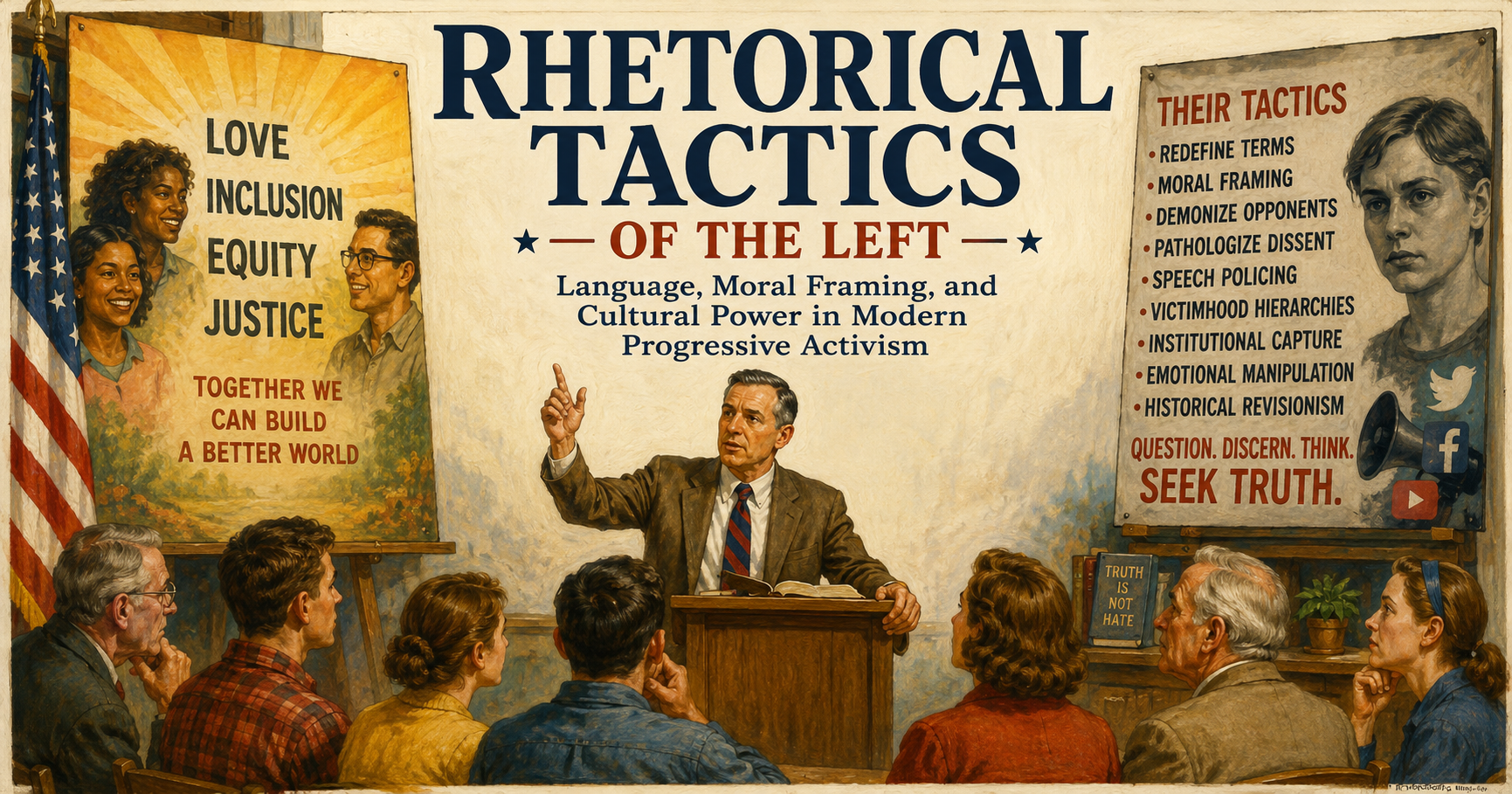
Many conservatives believe the modern American left has become especially skilled at using language, emotional framing, institutional pressure, and cultural repetition to reshape public opinion gradually over time.
These methods are often subtle rather than openly revolutionary. Instead of demanding immediate transformation, cultural activists frequently normalize ideological assumptions incrementally through media, entertainment, academia, education, corporate messaging, and social pressure.
This article does not claim that every person on the political left consciously employs manipulative tactics.
Millions of Americans simply hold sincere political opinions and desire fairness and compassion.
Nevertheless, many conservative Christians believe recurring rhetorical patterns exist within modern Progressive activism that deserve careful examination.
Scripture repeatedly warns about the moral power of speech. James wrote:
The tongue is a fire, a world of unrighteousness. (James 3:6, ESV)
Words can illuminate truth, but they can also obscure it. They can clarify moral reality or distort it. They can encourage honest debate or silence dissent through intimidation and emotional coercion.
The deeper conflict is not merely political. Beneath modern rhetoric lie competing beliefs about truth, morality, justice, human nature, authority, and even reality itself.
Why Rhetoric Matters More Than Many People Realize
Political language shapes how citizens interpret the world. Most people do not spend their evenings reading philosophical treatises or policy studies. Instead, they absorb assumptions through headlines, slogans, films, television, TikTok videos, celebrity commentary, and educational messaging.
Over time, repeated framing alters moral instincts.
For example, many Americans now instinctively associate traditional Christian teaching regarding sexuality with “hate,” while associating sexual liberation with “compassion.”
That transformation did not happen accidentally. It emerged through decades of normalization in entertainment, journalism, academia, and activism.
The same process occurred with transgender ideology. Fifteen years ago, most Americans had never heard phrases such as:
- “gender-affirming care,”
- “assigned at birth,”
- “misgendering,”
- or “nonbinary.”
Today these terms appear routinely in corporate training programs, school curricula, media reporting, and government communications.
This demonstrates how rhetoric gradually reshapes assumptions before laws ever change.
There is also an important distinction between persuasion and manipulation.
Persuasion appeals primarily to evidence and reason. Manipulation relies more heavily upon fear, shame, emotional pressure, or social intimidation.
Christians should care deeply about truthful speech because Scripture consistently emphasizes honesty, clarity, and moral accountability. Jesus described Satan as:
….a liar and the father of lies. (John 8:44, ESV)
Deceptive rhetoric is therefore not merely a political issue. It is a spiritual issue.
Shifting the Overton Window
One of the most important concepts in modern political rhetoric is the “Overton Window,” a term associated with political analyst Joseph Overton.
The concept refers to the range of ideas considered socially acceptable at a given time.
Radical positions rarely become mainstream overnight. Instead, activists normalize them gradually.
Conservatives frequently point to same-sex marriage as an example.
Early advocates often framed the issue primarily as tolerance and legal fairness:
- “Just let people love each other.”
- “This will not affect churches.”
- “Nobody is forcing anyone to agree.”
Once legalization became normalized, however, the cultural pressure expanded.
Opposition itself increasingly became portrayed as hateful or psychologically harmful. Bakers, photographers, adoption agencies, and Christian business owners faced lawsuits or public hostility for refusing participation in same-sex ceremonies.
A similar progression can be seen in transgender ideology.
The discussion initially focused primarily upon compassion toward adults experiencing gender dysphoria. Over time, however, the conversation expanded toward:
- puberty blockers for minors,
- biological males competing in women’s sports,
- drag performances for children,
- compelled pronoun usage,
- teachers concealing student gender transitions from parents,
- and speech codes regarding gender identity.
Each stage psychologically prepared the public for the next stage.
The same incrementalism appears within diversity, equity, and inclusion programs. Initial messaging emphasized fairness and anti-discrimination. Increasingly, however, DEI initiatives often involve ideological conformity, racial essentialism, implicit bias doctrine, and compelled participation in activist frameworks.
This process succeeds because gradual changes appear modest in isolation. Citizens who would reject sweeping transformation immediately may accept incremental changes introduced piece by piece.
Media and entertainment play enormous roles in this process. Repetition normalizes. Familiarity reduces resistance. What once appeared shocking gradually becomes ordinary through constant exposure.
Scripture warns about gradual moral drift:
Woe to those who call evil good and good evil. (Isaiah 5:20, ESV)
Civilizations rarely collapse morally all at once. They drift incrementally.
Redefinition of Terms
One of the most effective rhetorical strategies involves redefining familiar words while retaining their emotional force.
Terms such as “justice,” “equity,” “love,” “violence,” “democracy,” and “inclusion” increasingly carry ideological meanings that differ substantially from their historic or biblical definitions.
Consider the distinction between equality and equity.
Equality traditionally referred to equal treatment under the law or equality of opportunity. Equity increasingly refers to equalized outcomes among groups. Yet because the word sounds morally similar to fairness, many citizens support policies without fully understanding the philosophical assumptions underneath them.
Likewise, “inclusion” increasingly means not merely allowing disagreement to coexist peacefully, but actively affirming ideological claims.
Christians who respectfully refuse to affirm transgender identity claims are often described as “excluding” others even while advocating kindness toward all people.
The phrase “words are violence” represents an especially important example.
Historically, violence referred primarily to physical harm. Increasingly, however, emotional discomfort or disagreement is rhetorically classified as violence.
This shift carries enormous consequences.
If speech itself becomes violence, then suppressing speech begins appearing morally justified as self-defense. Free expression becomes reframed as harmful aggression.
This rhetorical framework also helps explain slogans such as:
- “Silence is violence.”
- “No justice, no peace.”
- “Speech is literally violence.”
- “Misgendering kills.”
Once emotional harm is elevated to the level of physical assault, aggressive suppression of dissent becomes easier to justify morally.
Euphemistic language likewise softens controversial realities before debate even begins. Examples include:
- “Gender-affirming care” instead of sterilization procedures, hormonal intervention, or surgical transition.
- “Reproductive healthcare” instead of abortion.
- “Birthing persons” replacing “mothers.”
- “Chest-feeding” replacing “breastfeeding.”
- “Undocumented immigrant” replacing illegal immigrant.
- “Minor-attracted person” replacing pedophile in some academic discussions.
These phrases matter because language emotionally frames moral questions before substantive discussion occurs.
Christians should recognize the moral importance of clear language. Scripture repeatedly condemns deceptive speech and confusion of moral categories.
Moral Framing and the Demonization of Opponents
Modern Progressive rhetoric frequently frames political disagreement not as a dispute between competing policy views, but as a struggle between good and evil.
Opponents are increasingly labeled:
- racist,
- fascist,
- extremist,
- homophobic,
- transphobic,
- misogynistic,
- or “threats to democracy.”
This changes the entire emotional atmosphere of public discourse.
If conservatives are not merely wrong but morally monstrous, then ordinary democratic disagreement becomes difficult. Debate itself begins appearing dangerous or irresponsible.
The phrase “Punch a Nazi” illustrates this danger clearly. The slogan became culturally normalized in some activist and online circles during the Trump years.
Yet “Nazi” was frequently applied not merely to actual neo-Nazis, but to ordinary conservatives, Christians, immigration restrictionists, or populists.
Once opponents are rhetorically transformed into Nazis or fascists, violence against them becomes easier for unstable individuals to rationalize.
This rhetorical compression also collapses important distinctions:
- disagreement becomes hatred,
- silence becomes violence,
- criticism becomes oppression,
- neutrality becomes complicity.
Consider how parents objecting to sexually explicit school materials are frequently described as “book banners” or extremists. Christians expressing traditional biblical views regarding sexuality are often portrayed not merely as mistaken but as actively dangerous.
The result is enormous social pressure.
Many citizens self-censor not because they changed their beliefs, but because the social cost of dissent became increasingly severe.
The Ninth Commandment forbids bearing false witness. Christians therefore have a moral obligation to resist exaggerated or dishonest characterizations even during political conflict.
Pathologizing Dissent
Another increasingly common tactic involves treating disagreement not as intellectual error but as psychological dysfunction.
Rather than rebutting arguments directly, dissenters are frequently portrayed as:
- fearful,
- fragile,
- hateful,
- ignorant,
- insecure,
- or psychologically defective.
Conservative concerns about immigration may be attributed to xenophobia. Religious objections to gender ideology are often described as emotional repression or fear. Parents questioning childhood medical transition are portrayed as psychologically harmful rather than morally concerned.
Debate thus shifts from evidence to diagnosis.
Modern therapeutic culture contributes heavily to this trend. Traditional moral categories such as:
- sin,
- repentance,
- duty,
- discipline,
- and responsibility
are increasingly replaced by therapeutic terminology emphasizing:
- trauma,
- emotional safety,
- affirmation,
- validation,
- and “lived experience.”
This shift appears constantly in modern rhetoric:
- “safe spaces,”
- “trigger warnings,”
- “trauma-informed environments,”
- and “harm reduction.”
Carl Trueman has written extensively about expressive individualism — the belief that authentic identity is discovered primarily through inward emotional self-expression.
Within this framework, disagreement itself becomes psychologically threatening because identity is treated as sacred.
Christianity presents a profoundly different anthropology. Scripture teaches that all people are morally accountable image bearers of God. Human beings are not merely victims of systems or emotional wounds. They are morally responsible creatures capable of both sin and virtue.
Selective Tolerance and Speech Policing
Modern Progressive rhetoric often emphasizes tolerance, diversity, and inclusion. Critics argue, however, that these principles are frequently applied asymmetrically.
Groups aligned with Progressive priorities often receive broad cultural sympathy, while traditional Christians and conservatives may face open hostility.
Tolerance increasingly means affirmation rather than coexistence.
This becomes especially visible in speech policing. Certain viewpoints become socially dangerous to express regardless of how respectfully they are stated.
Examples include:
- professors investigated for affirming biological sex distinctions,
- employees terminated for questioning DEI orthodoxy,
- social media bans for politically incorrect speech,
- doctors criticized for opposing childhood transition procedures,
- and Christian organizations pressured to adopt LGBT affirming policies.
Pronoun enforcement has become especially symbolic of this shift. Citizens increasingly face pressure not merely to tolerate differing identities, but to verbally affirm contested metaphysical claims regarding gender.
This is not merely about manners. It is about compelled language.
Accusations themselves often function as intimidation tools. Labels such as:
- “racist,”
- “transphobe,”
- “Christian nationalist,”
- “bigot,”
- and “threat to democracy”
can inflict enormous reputational damage even when unsupported by evidence.
Many citizens therefore remain silent not because they agree, but because they fear social punishment.
This creates what some conservatives describe as “soft authoritarianism” — social coercion enforced through institutions, corporations, media pressure, and public shaming rather than direct government censorship.
Proverbs repeatedly warns against false accusation and mob intimidation. Christians should oppose coercive intimidation regardless of political affiliation.
Victimhood Hierarchies and Identity Politics
Another major feature of modern Progressive rhetoric is the increasing emphasis upon identity categories and oppression hierarchies.
Society is frequently interpreted primarily through categories of:
- oppressor,
- oppressed,
- privilege,
- marginalization,
- and systemic power.
Race, sex, gender identity, sexuality, and historical group status become central moral categories.
Under this framework, certain groups are often presumed morally authoritative because of historical victimization, while others are treated as presumptively suspect because of perceived historical privilege.
Critics argue this undermines traditional Christian and classical liberal principles emphasizing individual moral accountability.
The rhetoric surrounding “whiteness” illustrates this tendency. In some activist environments, whiteness is discussed not merely as an ethnic category but as a systemic moral problem associated with unconscious oppression.
Similarly, phrases such as:
- “check your privilege,”
- “do the work,”
- “listen and believe,”
- and “decenter whiteness”
reflect a worldview emphasizing collective identity and inherited social guilt.
The slogan “Believe all women” also reflected this broader tendency to treat group identity as conferring automatic credibility.
Emotional storytelling strengthens these frameworks further. Singular tragic anecdotes often drive sweeping policy debates. Emotional narratives become morally untouchable, making careful analysis appear cold or insensitive.
Christianity offers a fundamentally different perspective. Scripture teaches universal human dignity alongside universal human sinfulness. Humanity is not divided into morally pure oppressors and innocent victims. All people stand equally in need of grace.
Institutional Capture and Cultural Power
Modern ideological movements increasingly recognize that long-term cultural influence matters as much as electoral politics.
As a result, activists focus heavily upon:
- universities,
- media institutions,
- entertainment,
- corporations,
- publishing,
- bureaucracies,
- and educational systems.
Many conservatives believe Progressive activists have pursued this strategy with remarkable effectiveness over several decades.
Universities increasingly require diversity statements and ideological training. Corporations adopt activist branding campaigns unrelated to their products. Entertainment industries frequently prioritize political messaging. K–12 schools increasingly incorporate gender ideology and activist-informed racial frameworks into educational environments.
Examples include:
- DEI training programs,
- corporate Pride campaigns,
- mandatory pronoun declarations,
- racial affinity groups,
- implicit bias seminars,
- and curriculum controversies involving gender identity instruction for children.
The Italian Marxist thinker Antonio Gramsci argued that cultural influence precedes political power. Many conservatives believe modern Progressivism has effectively pursued precisely this “long march through the institutions.”
Francis Schaeffer warned decades ago that ideas shape civilizations long before political consequences become visible.
Once institutions internalize certain assumptions, those assumptions gradually become perceived as unquestionable social norms.
Emotional Manipulation and Selective Imagery
Modern political messaging frequently relies heavily upon emotionally compelling anecdotal cases.
For example, singular stories involving transgender-identifying teenagers are often presented emotionally to encourage broad acceptance of sweeping medical and educational policies. Compassion for an individual case then becomes rhetorically extended toward affirming an entire ideological system.
Again, this does not mean the suffering involved is fake. Human pain deserves compassion. But emotional persuasion can still bypass careful moral reasoning.
Media amplification intensifies this effect. Certain stories receive enormous coverage while others receive comparatively little attention depending upon ideological usefulness.
Fear-based rhetoric likewise plays a major role:
- “Democracy is ending.”
- “Trans genocide.”
- “Book banning.”
- “Fascism.”
- “Threats to our democracy.”
Fear is politically powerful because frightened populations become easier to mobilize emotionally.
During COVID-era debates, slogans such as:
- “Trust the science”
- and “Follow the experts”
were sometimes used rhetorically not to encourage scientific inquiry but to discourage dissent and debate.
Christians should remember that wisdom requires more than emotional reaction. Scripture repeatedly warns against manipulation through fear and panic.
Historical Revisionism and Presentism
Another increasingly common rhetorical pattern involves judging historical societies almost exclusively through modern ideological categories.
Founding Fathers are reduced primarily to slaveholders. Christianity is portrayed chiefly as oppressive. Western civilization is discussed largely in terms of colonialism, racism, patriarchy, and exploitation.
Historical complexity disappears.
This does not mean historical sins should be ignored or whitewashed. Every civilization contains injustice because all human beings are fallen. But historical revisionism frequently strips away nuance, gratitude, context, and competing achievements.
Examples include:
- statue removals,
- school renamings,
- historical reinterpretations,
- and reducing entire civilizations primarily to oppression narratives.
A civilization that teaches its young people to despise their own inheritance eventually weakens its social cohesion and historical confidence.
Christianity offers a more balanced understanding of history. Human societies are neither utopian nor wholly evil. Every civilization reflects both human creativity and human corruption.
The Deeper Worldview Conflict
Ultimately, the conflict beneath modern rhetoric is theological.
Progressive activism often functions not merely as politics but as a competing moral and spiritual system. Traditional Christian concepts such as:
- sin,
- repentance,
- redemption,
- confession,
- heresy,
- and purity
frequently reappear in secularized form.
Oppression replaces original sin. Activism replaces repentance. Public denunciation replaces confession. Ideological purity replaces holiness.
Thinkers such as Francis Schaeffer, Carl Trueman, and Nancy Pearcey have argued that cultural rhetoric reflects deeper theological assumptions even when explicitly secular language is used.
Neutrality is often an illusion. Beneath political slogans lie competing answers to fundamental questions:
- What is truth?
- What defines human identity?
- What is justice?
- What is humanity’s greatest problem?
- What is the source of morality?
Christianity answers these questions very differently than modern secular Progressivism.
A Christian Response
Christians should not respond to manipulative rhetoric with hatred, paranoia, or hysteria. Believers are called to courage, clarity, discernment, and truthfulness.
This means rejecting propaganda from all sides while recognizing genuine patterns of manipulation when they exist.
Christians must recover confidence in:
- objective truth,
- biblical morality,
- honest speech,
- and moral courage.
Parents especially must teach discernment to the next generation. Young people are immersed constantly in ideological messaging through entertainment, education, advertising, and social media. Without strong moral grounding, many absorb assumptions uncritically.
Believers should resist emotional coercion without becoming bitter or cruel.
Scripture commands Christians to:
Speak the truth in love. (Ephesians 4:15, ESV)
Truth without love becomes cruelty. Love without truth becomes deception.
Conclusion
The battle for language is ultimately a battle for culture. Whoever shapes rhetoric often shapes moral perception itself.
Modern Progressive activism has become highly effective at using emotional framing, linguistic redefinition, institutional influence, and moral pressure to reshape public assumptions gradually over time. Conservatives and Christians increasingly recognize these patterns and view them not merely as political tactics but as reflections of a deeper worldview conflict.
Christians should resist both naïveté and paranoia. Not every disagreement represents manipulation. Yet neither should believers ignore how rhetoric can be used to silence dissent, distort moral categories, and normalize ideological change incrementally.
The answer is not rage or tribalism. It is discernment rooted in truth.
The Apostle Paul warned believers not to be:
…tossed to and fro by the waves and carried about by every wind of doctrine. (Ephesians 4:14, ESV)
That warning applies culturally as well as spiritually.
A healthy civilization requires honest language, moral clarity, and citizens willing to distinguish truth from propaganda. Christians, above all people, should care deeply about those distinctions because truth itself reflects the character of God.
S.D.G.,
Robert Sparkman
rob@christiannewsjunkie.com
RELATED CONTENT
Concerning the Related Content section, I encourage everyone to evaluate the content carefully.
If I have listed the content, I think it is worthwhile viewing to educate yourself on the topic, but it may contain coarse language or some opinions I don’t agree with.
Feel free to offer your comments below. Respectful comments without expletives and personal attacks will be posted and I will respond to them.
Comments are closed after sixty days due to spamming issues from internet bots.
You can always send me an email at rob@christiannewsjunkie.com if you want to comment on something afterwards, though.
It should be noted that on some matters, I am expressing my convictions or opinions on the matter. My convictions and opinions are strongly influenced by a conservative, Christian (biblical) worldview.
At times, like any other human being, my remarks will reflect my own intuition and bias. I am subject to error, although I speak from a clean concience, knowing that I will ultimately be held accountable for my words.
If you have evidence that I am wrong about a material statement of fact, provide the evidence and I will gladly review it and make revisions if merited. Obviously, there are some assertions that are matters of opinion that I will not change, but I always strive to be truthful.
I will continue to add videos and other items to the Related Content section as opportunities present themselves.
I recommend these Youtube channels and commentators for good content on politics and news from a Christian and/or conservative worldview: Albert Mohler, Allie Beth Stuckey, Bill O’Reilly, CBN News, Hugh Hewitt, John Anderson Media (Australia), Nick Freitas, Ruthless Podcast (language warning), Scott Jennings, The Hot Zone with Chuck Holton, Vince Dao, and Verdict with Ted Cruz.
Albert Mohler’s channel on Youtube has a daily episode called The Briefing with Albert Mohler that I highly recommend. Allie Beth Stuckey’s channel is top-notch, too.
For livestreaming of political protests and riots by conservative commentators, check out Nate Friedman, Cam Higby, James Klug, and Nick Shirley. I don’t agree with the perspectives of all these commentators and the language of protesters is often obscene. Most news outlets will not cover these illegal assemblies, though, because it doesn’t promote their narrative.
Depictions of Jesus Christ are used in some illustrations. I realize that some including conservative Presbyterians consider this to be idolatry. I respectfully disagree with their position on this matter as the commandment forbids worshiping such depictions, and I do not worship these illustrations.