
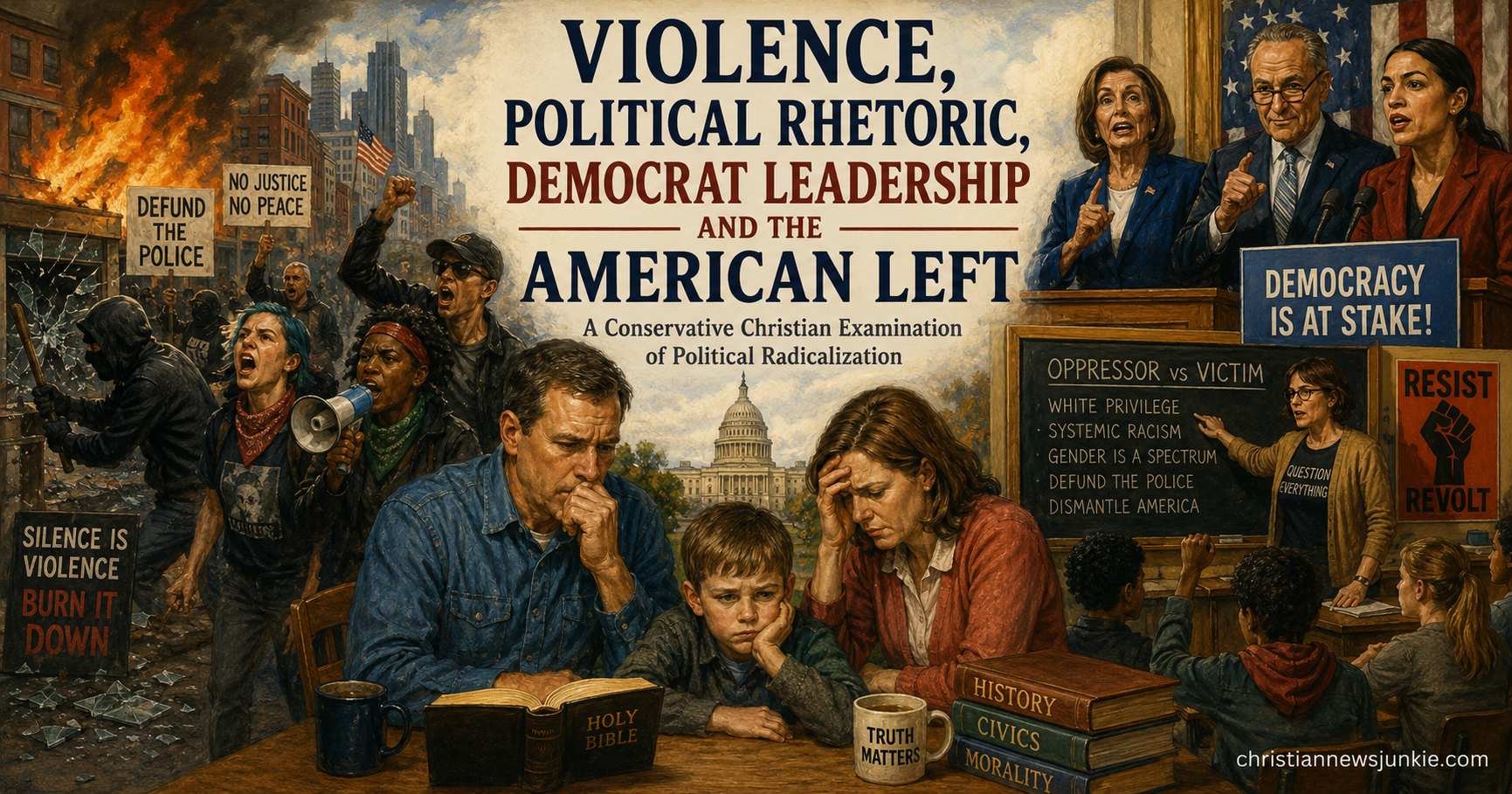
Political violence is not new in human history.
Scripture itself records murders, rebellions, riots, assassinations, and mob behavior stretching back to Cain’s murder of Abel.
Human beings are fallen creatures, and whenever moral restraint weakens, violence eventually emerges.
The modern American political climate increasingly reflects this reality.
Americans today live in an atmosphere of escalating hostility. Political opponents are no longer merely mistaken; they are often described as existential threats, enemies of democracy, fascists, racists, traitors, or dangers to civilization itself.
Once political disagreement becomes moral demonization, violence becomes easier to justify emotionally.
Christians should reject political violence consistently regardless of who commits it.
Yet honesty also requires asking difficult questions. Why does public sympathy for violence increasingly appear within segments of the modern American left? Why do some educators, activists, media figures, and political leaders appear reluctant to condemn violence when it advances Progressive causes? Why are leftist riots minimized while other incidents are described in maximalist terms?
This article is not an attempt to claim that all Democrats approve of violence.
Millions of ordinary Democrat voters are peaceful citizens who simply hold different political opinions.
The concern instead is whether influential elements within left-wing activism, media culture, academia, and Democrat political leadership have cultivated an atmosphere that increasingly excuses or normalizes aggression toward ideological opponents.
Scripture warns repeatedly about the moral danger of inflamed rhetoric. James wrote:
How great a forest is set ablaze by such a small fire! And the tongue is a fire… (James 3:5–6, ESV)
Words matter. Political narratives matter. Dehumanization matters. History repeatedly demonstrates that hatred cultivated rhetorically eventually manifests physically.
The modern American left did not invent political violence. But it is increasingly fair to ask whether many of its institutions have become dangerously tolerant of it.
The Moral Climate of Modern Political Activism
Modern political discourse increasingly resembles religious warfare more than ordinary civic disagreement.
Identity politics has become a substitute religion for many Americans. Causes are treated as sacred. Opponents are treated as heretics. Public shaming functions like excommunication. Ideological conformity becomes a moral obligation.
The late theologian Francis Schaeffer warned decades ago that when societies abandon biblical morality, they do not become neutral. Instead, they create new moral systems detached from transcendent truth.
Those systems often become coercive because they lack stable moral restraint.
This helps explain why political rhetoric today often sounds apocalyptic. Americans constantly hear claims that democracy is ending, fascism is imminent, or entire groups of citizens represent existential threats.
Once political opponents are viewed not merely as wrong but as evil, hostility naturally intensifies.
Jesus warned about the moral roots of violence when He taught:
Everyone who is angry with his brother will be liable to judgment. (Matthew 5:22, ESV)
Hatred precedes aggression. Dehumanization precedes cruelty. The tongue often prepares the way for the fist.
The Charlie Kirk Shooting and Reactions from the Left
The public reaction following the shooting of conservative activist Charlie Kirk revealed something deeply troubling about modern political culture.
While many Americans expressed sympathy and condemned political violence, others openly mocked the incident or celebrated it online. One Indiana public school teacher pointed her finger at her neck and wildly gesticulated in a mockery of Charlie Kirk’s last moment of life.
Some social media users posted jokes, memes, or statements implying that violence against conservatives was deserved. Others expressed disappointment that attacks against political figures like Donald Trump were unsuccessful.
Such reactions are morally revealing. They expose how political tribalism can erode ordinary human compassion.
Particularly disturbing were reports of educators and public employees making approving remarks about violence directed toward conservatives like Charlie Kirk or Donald Trump supporters.
Over recent years, numerous incidents have surfaced involving K–12 teachers publicly celebrating conservative suffering, mocking Trump supporters, or expressing sympathy toward left-wing street activism. Teacher unions are a major influence concerning these vile political demonstrations.
Not every teacher behaves this way, of course. Many teachers are dedicated professionals.
Yet the pattern itself deserves concern. Schools are entrusted with shaping young minds. When educators openly display ideological hostility or celebrate political aggression, they contribute to a culture of contempt rather than civic stability.
The attempted assassination of Donald Trump intensified these concerns. While many Americans condemned the attack immediately, others minimized it or responded with sarcasm and mockery online. Some openly lamented that the attempt failed.
This represents more than tasteless behavior. It reflects moral desensitization.
Scripture condemns delight in evil:
Whoever rejoices at calamity will not go unpunished. (Proverbs 17:5, ESV)
A society that increasingly jokes about assassinations is not politically healthy. It is spiritually sick.
Historical Examples of Left-Wing Political Violence
Americans sometimes speak as though political extremism began recently, but the United States has experienced waves of ideological violence for decades.
During the 1960s and 1970s, radical left-wing groups carried out bombings and attacks connected to revolutionary causes.
Organizations such as the Weather Underground embraced violent tactics in pursuit of anti-capitalist and anti-American political goals.
The U.S. Capitol, the Pentagon, the State Department, and other federal buildings were bombed in 1971 and 1972 by the radical left-wing Weather Underground organization.
In 1983, the U.S. Senate wing of the Capitol and additional government targets were bombed by the far-left revolutionary group known as the Resistance Conspiracy, associated with the May 19th Communist Organization.
Other radical organizations likewise pursued violent revolutionary activity. These incidents are often minimized in modern cultural memory compared to right-wing extremism, yet they formed a significant chapter in American political violence.
Critics continue to question the controversial pardons issued by Bill Clinton to violent activists including Susan Rosenberg and Linda Evans near the end of his presidency.
Linda Evans and Susan Rosenberg were associated with the May 19th Communist Organization and the broader Resistance Conspiracy network responsible for the 1983 bombing of the Senate wing of the U.S. Capitol and related attacks on federal facilities. Both were involved in the murder of two police officers (Edward O’Grady and Waverly Brown) and a security guard named Peter Paige, as well as the wounding of other police officers.
To many Americans, myself included, these pardons symbolized, at the very least, elite sympathy toward radical left-wing causes.
Another concern is how academia and media culture sometimes romanticize left-wing radicals.
Revolutionaries are often portrayed as idealistic rebels while conservative activists are more readily characterized as dangerous extremists.
This asymmetry contributes to public confusion regarding violence and accountability.
BLM, Antifa, and the 2020 Riots
The riots of 2020 represented one of the largest waves of civil unrest in modern American history.
While many demonstrations were peaceful, numerous cities experienced arson, looting, assaults, vandalism, intimidation, and attacks on businesses and police.
The public messaging surrounding these events often became surreal.
Americans watched buildings burn while commentators described events as “mostly peaceful protests.”
Citizens understandably questioned whether media institutions were attempting to minimize violence because the rioters were associated with politically favored causes.
The organization Black Lives Matter drew substantial support from Democrat politicians and activist networks.
Some BLM founders openly described themselves as influenced by Marxist thought. Critics argued that the movement increasingly embraced revolutionary rhetoric rather than simple police reform.
Meanwhile, Antifa activists frequently appeared at riots using black bloc tactics, intimidation, and physical aggression.
Churches, businesses, journalists, and political opponents were sometimes targeted.
One particularly disturbing incident involved the killing of Aaron Danielson in Portland during the unrest.
The atmosphere in parts of Portland had become intensely ideological and openly hostile toward conservatives. Danielson’s death became emblematic of the dangerous escalation occurring in some activist environments.
Again, it is important not to exaggerate. Most Democrat voters did not participate in riots.
Most protesters did not commit violence. Yet many Democrat leaders appeared hesitant to condemn rioting clearly and consistently during the unrest. Some politicians emphasized activist grievances while speaking ambiguously about lawlessness itself.
This inconsistency damaged public trust.
Romans 13 teaches that civil order matters because government exists partly to restrain wrongdoing. Christians should care deeply about justice, but justice cannot survive where mob violence becomes tolerated.
Surveys and Public Approval of Political Violence
Polling data over recent years has shown rising acceptance of political violence among segments of the American population.
Alarmingly, some surveys indicate that younger Americans increasingly justify violence when pursuing political or ideological goals.
Why is this happening?
Part of the answer lies in apocalyptic political rhetoric. When citizens are constantly told that opponents are fascists, racists, enemies of democracy, or threats to civilization itself, violence begins appearing emotionally rational to unstable individuals.
If political opponents are portrayed as monsters, then aggression against them begins feeling morally justified.
This is one reason Christians must resist reckless speech. The Ninth Commandment forbids bearing false witness. Exaggeration and slander are sinful even when politically useful.
The growing acceptance of political violence also reflects the decline of biblical anthropology.
Christianity teaches that man is fallen and sinful. Secular revolutionary ideologies often assume that society’s problems result primarily from oppressive systems. Once certain groups are labeled oppressors, hostility toward them becomes easier to justify.
History repeatedly shows that utopian political movements frequently become coercive because they believe their moral goals justify extreme means.
Rhetoric That Encourages Violence
Political rhetoric does not operate in a vacuum. It shapes emotions, perceptions, and moral instincts.
Modern political discourse increasingly relies upon demonization. Conservatives are routinely labeled fascists, threats to democracy, extremists, or enemies of progress.
Ordinary disagreements over immigration, education, sexuality, race policy, or economics are framed as evidence of moral corruption.
This rhetorical environment creates moral permission structures for aggression.
When celebrities, activists, professors, or media personalities repeatedly portray conservatives as existential threats, unstable individuals may conclude that violence is necessary or even virtuous.
The problem becomes even more serious when educational institutions reinforce ideological hostility. Many Americans increasingly perceive schools and universities as politically activist environments rather than neutral educational institutions. Stories involving teachers mocking conservatives or endorsing left-wing activism contribute to this distrust.
The book of Proverbs repeatedly warns against stirring up conflict:
A worthless man plots evil, and his speech is like a scorching fire. (Proverbs 16:27, ESV)
Words inflame crowds. History confirms this repeatedly.
Political movements often reveal their underlying assumptions through slogans and repeated phrases.
While many activists may use such language metaphorically or emotionally rather than literally, rhetoric still shapes moral instincts and public behavior. Repeated exposure to certain slogans can gradually normalize hostility, intimidation, and even political violence.
One of the most troubling examples is the phrase “by any means necessary,” popularized in American radical politics during the twentieth century. The slogan implies that moral restraints and procedural fairness may be discarded if the political cause is considered sufficiently righteous.
Historically, revolutionary movements across the world have often used similar language to justify intimidation, sabotage, and violence.
Another increasingly influential phrase is “words are violence.”
This concept fundamentally alters traditional understandings of free speech and civil disagreement. If speech itself is redefined as violence, then physical retaliation against speech can begin appearing morally justified as “self-defense.” Once disagreement is treated as assault, peaceful democratic discourse becomes far more difficult to sustain.
Related slogans such as “silence is violence” likewise intensify ideological pressure by suggesting that neutrality or refusal to participate in activist causes is itself morally harmful.
Citizens are no longer merely encouraged to support certain political positions; they are told that failure to affirm them constitutes complicity in oppression.
The slogan “no justice, no peace” is often defended as a call for reform, yet critics note that it can also function rhetorically as a warning that unrest will continue unless political demands are satisfied.
Likewise, phrases such as “shut it down” and “direct action” have frequently been associated not merely with protest, but with efforts to disrupt speeches, intimidate opponents, obstruct institutions, or justify confrontational tactics.
Other activist rhetoric openly embraces hostility.
“Punch a Nazi” became normalized in some political and online circles during the Trump era.
The problem, of course, is that “Nazi” is often defined so broadly that ordinary conservatives, Christians, populists, or political opponents become morally associated with one of history’s most evil regimes. Once opponents are rhetorically transformed into Nazis or fascists, violence against them becomes easier for unstable individuals to rationalize.
Similarly, slogans such as “ACAB” (“All Cops Are Bastards”) encourage blanket hostility toward law enforcement rather than criticism of specific abuses. Such rhetoric erodes trust, inflames resentment, and contributes to social polarization.
Even broader political language can become dangerous when used recklessly.
Constantly describing political opponents as “existential threats to democracy,” “enemies of humanity,” or “fascists” creates a climate of fear and moral panic. If citizens genuinely believe their opponents represent an imminent threat to civilization itself, extreme actions may begin appearing morally necessary.
Christians should recognize the spiritual danger in such rhetoric. Scripture repeatedly warns about the destructive power of speech:
A worthless man plots evil, and his speech is like a scorching fire. (Proverbs 16:27, ESV)
Words shape cultures. Slogans shape moral imagination. A society saturated with dehumanizing rhetoric should not be surprised when violence eventually follows.
Responding to January 6
Christians should speak honestly about January 6.
Some participants behaved criminally. Violence, trespassing, and vandalism should not be excused.
At the same time, many Americans reject the claim that January 6 constituted a fully organized insurrection comparable to an attempted military overthrow of government.
The event more closely resembled a chaotic riot involving multiple factions, poor crowd control, emotional escalation, and security failures.
The overwhelming majority of rally attendees never entered the Capitol building.
In fact, some individuals attempted to stop vandalism or discourage destructive behavior. Others clearly behaved recklessly or violently.
There are several unresolved questions that continue fueling public skepticism.
Critics point to figures such as Ray Epps and ask whether federal informants or provocateurs contributed to escalation. Others note the presence of activists such as John Sullivan, dressed in MAGA gear, who were not traditional MAGA supporters.
Questions persist regarding security preparation by the Speaker of the House, Nancy Pelosi, and the failure to deploy National Guard protection despite warnings of possible unrest.
Some Americans, myself included, believe political incentives existed to allow a chaotic situation to develop.
Reasonable people may disagree about these matters, and Christians should avoid reckless conspiracy claims unsupported by evidence.
Nevertheless, asking legitimate questions about government conduct is not inherently irrational or extremist.
Many conservatives also object to how deaths connected to January 6 were framed publicly.
Early reporting sometimes implied officers and others were murdered directly by rioters, while later medical findings complicated those narratives.
Some deaths involved medical emergencies, crowd stress, or later suicides rather than direct homicide during the riot itself.
In fact, the only confirmed death related directly to Jan 6 violence was Ashli Babbitt, and she was a conservative who was shot by Lt. Michael Byrd,a Capitol police officer.
Roseanne Boyland’s death is suspicious as well. Her death has been attributed to a medical emergency involving amphetamines.
Video footage appears to show DC Metropolitan Police Officer Lila Morris striking Rosanne Boyland while Boyland was incapacitated or in medical distress near the Capitol tunnel entrance, though official investigations did not conclude that those actions caused her death.
Again, none of this excuses criminal behavior. But accuracy matters.
Christians should reject both dishonest minimization and dishonest exaggeration.
The January 6 congressional investigation drew criticism because many Americans viewed its composition as politically imbalanced.
Critics argued that anti-Trump Republicans Liz Cheney and Adam Kinzinger, together with Democrat members, dominated the January 6 committee while dissenting perspectives were largely excluded. Speaker Nancy Pelosi broke with longstanding congressional practice by rejecting House Minority Leader Kevin McCarthy’s selections of Jim Banks and Jim Jordan for the committee. Republicans argued this undermined the investigation’s credibility and contributed to the popular conservative characterization of the proceedings as ‘Pelosi’s Kangaroo Court.’
Ultimately, conservatives should not become consumed with defending January 6 endlessly. It was a bad riot and a national embarrassment. Yet many Americans reasonably object to simplistic portrayals that ignore complexity, unanswered questions, or political double standards.
Why Secular Revolutionary Movements Tend Toward Violence
One reason modern activism increasingly becomes aggressive is because secular political movements often lack transcendent moral restraints.
Christianity teaches forgiveness, humility, repentance, and the reality of universal human sinfulness.
Revolutionary ideologies frequently divide humanity into oppressors and victims. Once this framework dominates political thinking, hostility becomes easier to justify because opponents are no longer viewed as fellow sinners but as enemies of justice itself.
Thinkers such as Nancy Pearcey and Voddie Baucham have argued that modern identity politics often borrows heavily from neo-Marxist assumptions regarding power and oppression.
These frameworks cultivate resentment and perpetual grievance. They encourage people to interpret society primarily through conflict categories rather than shared humanity.
The result is increasing polarization and instability.
A Christian Response
Christians must reject political violence consistently regardless of ideology. It is easy to condemn violence from opponents while excusing aggression from one’s own tribe. Scripture does not permit this double standard.
Believers should defend truth courageously while refusing hatred and vindictiveness. Christians are called to speak clearly without becoming consumed by bitterness.
The church must also teach discernment. Young people are growing up immersed in ideological propaganda, emotionally manipulative media, and online outrage culture. Christians must help them evaluate political claims through Scripture, historical understanding, and rational analysis rather than tribal emotionalism.
Most importantly, believers must remember that America’s deepest problems are spiritual before they are political.
No election can cure moral decay. No political movement can redeem fallen human nature. No ideology can replace the transforming power of the Gospel.
Conclusion
Political violence rarely appears suddenly. It develops gradually through rhetoric, moral desensitization, tribal hatred, and ideological fanaticism.
America today faces growing signs of this danger.
Public celebration of violence, revolutionary rhetoric, educational radicalization, selective outrage, and ideological demonization all contribute to a deteriorating civic culture.
Christians should reject political violence whether it comes from the right or the left. Yet honesty also requires recognizing troubling patterns within modern Progressive activism and portions of Democrat political culture where aggression is increasingly excused, minimized, or rationalized.
The solution is not counter-hatred. It is moral clarity rooted in biblical truth.
Scripture teaches that nations decline when truth collapses and justice becomes selective. Americans desperately need leaders willing to speak honestly, citizens willing to reject propaganda, and churches willing to proclaim biblical morality without fear.
Ultimately, social peace cannot be sustained merely through political systems. Peace rests upon moral order, and moral order rests upon truth.
As the prophet Isaiah warned:
Woe to those who call evil good and good evil… (Isaiah 5:20, ESV)
A civilization that loses the ability to distinguish truth from propaganda, justice from vengeance, and moral conviction from ideological fanaticism places itself in grave danger.
America would do well to remember that before the flames grow hotter.
S.D.G.,
Robert Sparkman
rob@christiannewsjunkie.com
RELATED CONTENT
Concerning the Related Content section, I encourage everyone to evaluate the content carefully.
If I have listed the content, I think it is worthwhile viewing to educate yourself on the topic, but it may contain coarse language or some opinions I don’t agree with.
Feel free to offer your comments below. Respectful comments without expletives and personal attacks will be posted and I will respond to them.
Comments are closed after sixty days due to spamming issues from internet bots.
You can always send me an email at rob@christiannewsjunkie.com if you want to comment on something afterwards, though.
It should be noted that on some matters, I am expressing my convictions or opinions on the matter. My convictions and opinions are strongly influenced by a conservative, Christian (biblical) worldview.
At times, like any other human being, my remarks will reflect my own intuition and bias. I am subject to error, although I speak from a clean concience, knowing that I will ultimately be held accountable for my words.
If you have evidence that I am wrong about a material statement of fact, provide the evidence and I will gladly review it and make revisions if merited. Obviously, there are some assertions that are matters of opinion that I will not change, but I always strive to be truthful.
I will continue to add videos and other items to the Related Content section as opportunities present themselves.
I recommend these Youtube channels and commentators for good content on politics and news from a Christian and/or conservative worldview: Albert Mohler, Allie Beth Stuckey, Bill O’Reilly, CBN News, Hugh Hewitt, John Anderson Media (Australia), Nick Freitas, Ruthless Podcast (language warning), Scott Jennings, The Hot Zone with Chuck Holton, Vince Dao, and Verdict with Ted Cruz.
Albert Mohler’s channel on Youtube has a daily episode called The Briefing with Albert Mohler that I highly recommend. Allie Beth Stuckey’s channel is top-notch, too.
For livestreaming of political protests and riots by conservative commentators, check out Nate Friedman, Cam Higby, James Klug, and Nick Shirley. I don’t agree with the perspectives of all these commentators and the language of protesters is often obscene. Most news outlets will not cover these illegal assemblies, though, because it doesn’t promote their narrative.
Depictions of Jesus Christ are used in some illustrations. I realize that some including conservative Presbyterians consider this to be idolatry. I respectfully disagree with their position on this matter as the commandment forbids worshiping such depictions, and I do not worship these illustrations.