
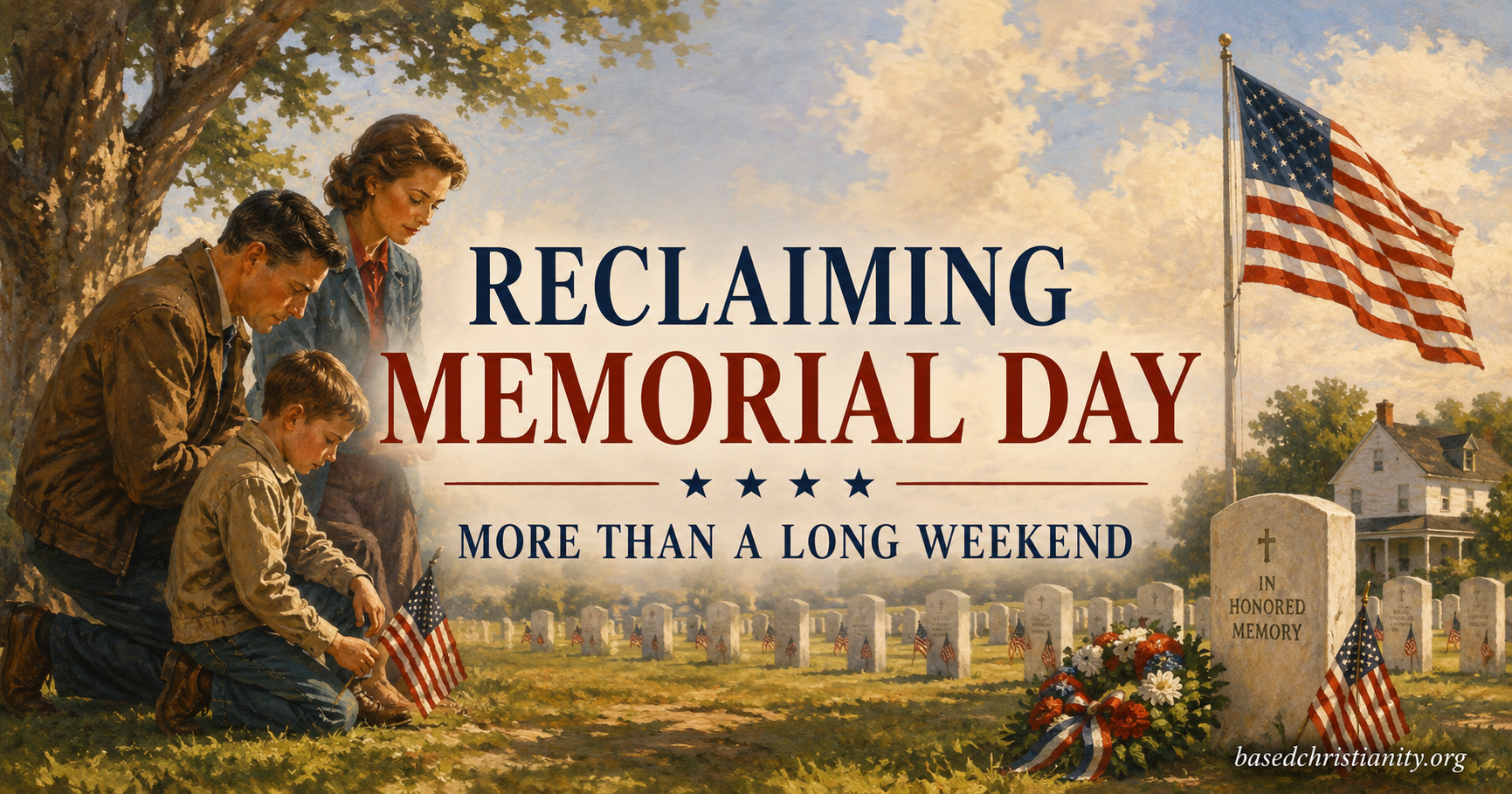
Every year in late May, Americans fire up grills, open swimming pools, travel to lakes and campgrounds, and search for the best Memorial Day sales. For many citizens, the holiday has become little more than the unofficial beginning of summer. Retail advertisements dominate television and the internet. Recreational plans dominate conversations. Flags appear briefly and then disappear again until Independence Day.
Yet Memorial Day was never intended to be primarily a recreational holiday.
It was established as a solemn national remembrance for Americans who died in military service to their country. It was meant to be reflective rather than carefree, grateful rather than commercial, reverent rather than casual. Memorial Day was intended to remind Americans that liberty has a cost, and that generations of men died to preserve the nation and defend those they loved.
A nation that forgets the meaning of sacrifice eventually loses appreciation for the blessings purchased by sacrifice.
America increasingly risks that kind of forgetfulness.
The Origins of Memorial Day
The origins of Memorial Day stretch back to the aftermath of the Civil War, the bloodiest conflict in American history. More than 600,000 Americans perished in a war that scarred nearly every community in the country. Families mourned fathers, sons, brothers, and husbands on a scale previously unimaginable in the United States.
Local communities began organizing tributes to the fallen. Graves were decorated with flowers, speeches were delivered, and citizens gathered to remember the dead. These observances became known as “Decoration Day.” Women’s groups, churches, veterans’ organizations, and civic leaders all played roles in establishing traditions of remembrance.
In 1868, General John A. Logan of the Grand Army of the Republic officially called for a national day of memorial observance. Over time, the holiday expanded beyond Civil War casualties to honor Americans who died in all wars. Following World War I especially, Memorial Day became a broader remembrance of all American military dead.
The holiday was eventually standardized as the last Monday in May.
Its purpose, however, remained unchanged.
Why Nations Must Remember
Memorial Day exists because civilizations require memory.
Human beings naturally drift toward forgetfulness and self-absorption. Nations do the same. That is why societies establish memorials, monuments, anniversaries, cemeteries, and days of remembrance. These observances anchor people to historical reality and remind them that present comforts were often purchased through suffering.
The Bible repeatedly emphasizes remembrance. Throughout Scripture, God’s people established memorial stones, feasts, and commemorations so future generations would not forget what God had done for them. Parents were instructed to teach children the meaning behind these observances so memory would survive from generation to generation.
A healthy society similarly teaches its young people that freedom, security, and national stability did not appear automatically.
They were defended.
They were preserved.
And often they were preserved at terrible human cost.
Memorial Day therefore serves not merely as a patriotic observance, but as a moral exercise in gratitude and humility.
Memorial Day Is Not Veterans Day
It is also important to preserve the distinction between Veterans Day and Memorial Day. Veterans Day honors all who served in the armed forces. Memorial Day specifically honors those who died while serving.
The distinction matters.
A veteran returned home. The fallen did not.
Memorial Day is about those who never saw their families again, never resumed civilian life, never grew old, never watched grandchildren play, and never enjoyed the freedoms they helped preserve for others.
Abraham Lincoln’s phrase from the Gettysburg Address remains deeply fitting: they gave “the last full measure of devotion.”
When Recreation Replaces Remembrance
Modern America increasingly struggles with sustained remembrance.
Part of this is cultural distance from military service itself. During World War II, Korea, and Vietnam, military service touched enormous portions of the population. Nearly every family knew someone serving overseas. Gold Star families lived in nearly every community.
Today, far fewer Americans have direct military connections. Entire cultural and professional classes can live largely disconnected from military life altogether. As those connections weaken, so does emotional understanding of sacrifice.
Another factor is the decline of civic and historical education. Many younger Americans possess only fragmentary knowledge of major wars, American history, or the individuals who defended the nation during times of crisis. Historical ignorance weakens gratitude because people cannot appreciate sacrifices they barely understand.
At the same time, many elite cultural institutions increasingly treat patriotism with suspicion or embarrassment. National pride is frequently portrayed as naïve, dangerous, or morally questionable. America’s historical failures are emphasized heavily while acts of courage, sacrifice, and national virtue receive comparatively less attention.
No nation is without flaws, sins, or injustices. Honest patriotism does not require pretending otherwise. Yet a mature nation should still be capable of honoring genuine courage and sacrifice without descending into cynicism or self-loathing.
Memorial Day once occupied a more sacred place in American civic life precisely because Americans understood that honoring the fallen transcended politics.
A soldier buried at Normandy or Arlington is not merely a political talking point. He was a son. A husband. A father. A friend. A citizen who surrendered his future for others.
That reality deserves reverence.
Unfortunately, commercialization increasingly overwhelms reflection during Memorial Day weekend. Retail corporations aggressively market holiday sales. Entertainment industries emphasize leisure and escape. Social media often reduces the day to beach photographs, cookouts, and vacation pictures.
There is nothing inherently wrong with family gatherings, outdoor recreation, or enjoying time off work. Americans have always combined remembrance with fellowship and community. Families gathered after church services and cemetery visits long before modern tourism industries existed.
The problem arises when recreation entirely eclipses remembrance.
If Americans spend the entire holiday weekend pursuing pleasure without once reflecting upon the fallen, then Memorial Day has effectively lost its meaning.
Why Reclaiming Memorial Day Matters
A civilization reveals its values by what it chooses to remember.
When a society remembers celebrities more vividly than soldiers, entertainment more passionately than sacrifice, and consumer pleasures more eagerly than national duty, cultural decay inevitably follows.
Memorial Day serves as a corrective against that decay.
It reminds Americans that freedom is not self-sustaining. Free societies depend upon virtues such as courage, duty, sacrifice, gratitude, honor, and self-restraint. These virtues do not survive automatically from generation to generation. They must be intentionally cultivated.
That cultivation begins with remembrance.
Children especially need to understand the meaning behind the holiday. They should know why cemeteries contain rows of white military markers. They should hear stories of ordinary Americans who performed extraordinary acts of bravery. They should understand that many freedoms they enjoy today were defended by people who paid an irreversible price.
A nation incapable of teaching gratitude to its children is a nation preparing for decline.
Christians in particular should recognize the importance of honoring sacrifice appropriately. Scripture commands believers to “give honor to whom honor is due.” Christians rightly reject worship of nation or military power, yet honoring those who laid down their lives for others is neither idolatry nor nationalism.
Indeed, Christ Himself declared, “Greater love hath no man than this, that a man lay down his life for his friends.”
Military sacrifice is not equivalent to Christ’s atoning sacrifice, but it reflects a profound principle of self-giving service for the protection of others.
Memorial Day therefore provides an opportunity not only for patriotism, but for moral reflection.
What kind of people preserve liberty?
What kind of character sustains civilization?
What obligations do later generations owe to those who sacrificed before them?
These are deeply important questions.
Practical Ways to Honor the Fallen
Reclaiming Memorial Day does not require eliminating recreation or family gatherings. Rather, it means restoring remembrance to its rightful central place.
Americans can do this in simple but meaningful ways.
Visit a military cemetery or memorial.
Attend a local Memorial Day parade or ceremony.
Fly the American flag properly and respectfully.
Teach children about relatives who served or died in war.
Read about battles and sacrifices that shaped American history.
Pray for military families and for the nation itself.
Pause for genuine reflection before beginning recreational activities.
Churches can also help restore seriousness to the holiday by acknowledging the fallen respectfully and praying for the country with humility and gratitude.
Communities that intentionally preserve memory strengthen civic virtue and national continuity.
More Than a Long Weekend
There is also something profoundly human about remembrance itself.
To remember the dead is to affirm that their lives mattered.
It declares that sacrifice should not vanish into silence or historical amnesia. It recognizes that comfort and peace often rest upon foundations built by people whose names most citizens will never know.
The crosses at Normandy, the graves at Arlington, the monuments in small-town courthouses, and the fading photographs in family albums all testify to the same truth:
Someone paid a price.
Modern America would benefit greatly from recovering a deeper sense of gratitude. Ours is a culture increasingly shaped by entitlement, distraction, consumption, and historical forgetfulness. Memorial Day stands against all of those tendencies.
It calls citizens to pause.
To remember.
To give thanks.
And to recognize that liberty is fragile.
The men buried beneath military headstones will never again enjoy summer vacations, family cookouts, baseball games, or peaceful evenings at home. Others now enjoy those blessings because previous generations defended them.
That reality should humble every American.
Memorial Day is therefore far more than a long weekend. It is a moral obligation of remembrance owed by a free people to those who never returned home.
If Americans lose that understanding, they risk losing something even greater than a holiday tradition. They risk losing the cultural memory, gratitude, and civic virtue necessary for the preservation of the republic itself.
A healthy nation remembers its dead.
A wise nation honors sacrifice.
And a grateful nation teaches future generations never to forget.
S.D.G.,
Robert Sparkman
rob@christiannewsjunkie.com
RELATED CONTENT
Concerning the Related Content section, I encourage everyone to evaluate the content carefully.
If I have listed the content, I think it is worthwhile viewing to educate yourself on the topic, but it may contain coarse language or some opinions I don’t agree with.
Feel free to offer your comments below. Respectful comments without expletives and personal attacks will be posted and I will respond to them.
Comments are closed after sixty days due to spamming issues from internet bots.
You can always send me an email at rob@christiannewsjunkie.com if you want to comment on something afterwards, though.
It should be noted that on some matters, I am expressing my convictions or opinions on the matter. My convictions and opinions are strongly influenced by a conservative, Christian (biblical) worldview.
At times, like any other human being, my remarks will reflect my own intuition and bias. I am subject to error, although I speak from a clean concience, knowing that I will ultimately be held accountable for my words.
If you have evidence that I am wrong about a material statement of fact, provide the evidence and I will gladly review it and make revisions if merited. Obviously, there are some assertions that are matters of opinion that I will not change, but I always strive to be truthful.
I will continue to add videos and other items to the Related Content section as opportunities present themselves.
I recommend these Youtube channels and commentators for good content on politics and news from a Christian and/or conservative worldview: Albert Mohler, Allie Beth Stuckey, Bill O’Reilly, CBN News, Hugh Hewitt, John Anderson Media (Australia), Nick Freitas, Ruthless Podcast (language warning), Scott Jennings, The Hot Zone with Chuck Holton, Vince Dao, and Verdict with Ted Cruz.
Albert Mohler’s channel on Youtube has a daily episode called The Briefing with Albert Mohler that I highly recommend. Allie Beth Stuckey’s channel is top-notch, too.
For livestreaming of political protests and riots by conservative commentators, check out Nate Friedman, Cam Higby, James Klug, and Nick Shirley. I don’t agree with the perspectives of all these commentators and the language of protesters is often obscene. Most news outlets will not cover these illegal assemblies, though, because it doesn’t promote their narrative.
Depictions of Jesus Christ are used in some illustrations. I realize that some including conservative Presbyterians consider this to be idolatry. I respectfully disagree with their position on this matter as the commandment forbids worshiping such depictions, and I do not worship these illustrations.