
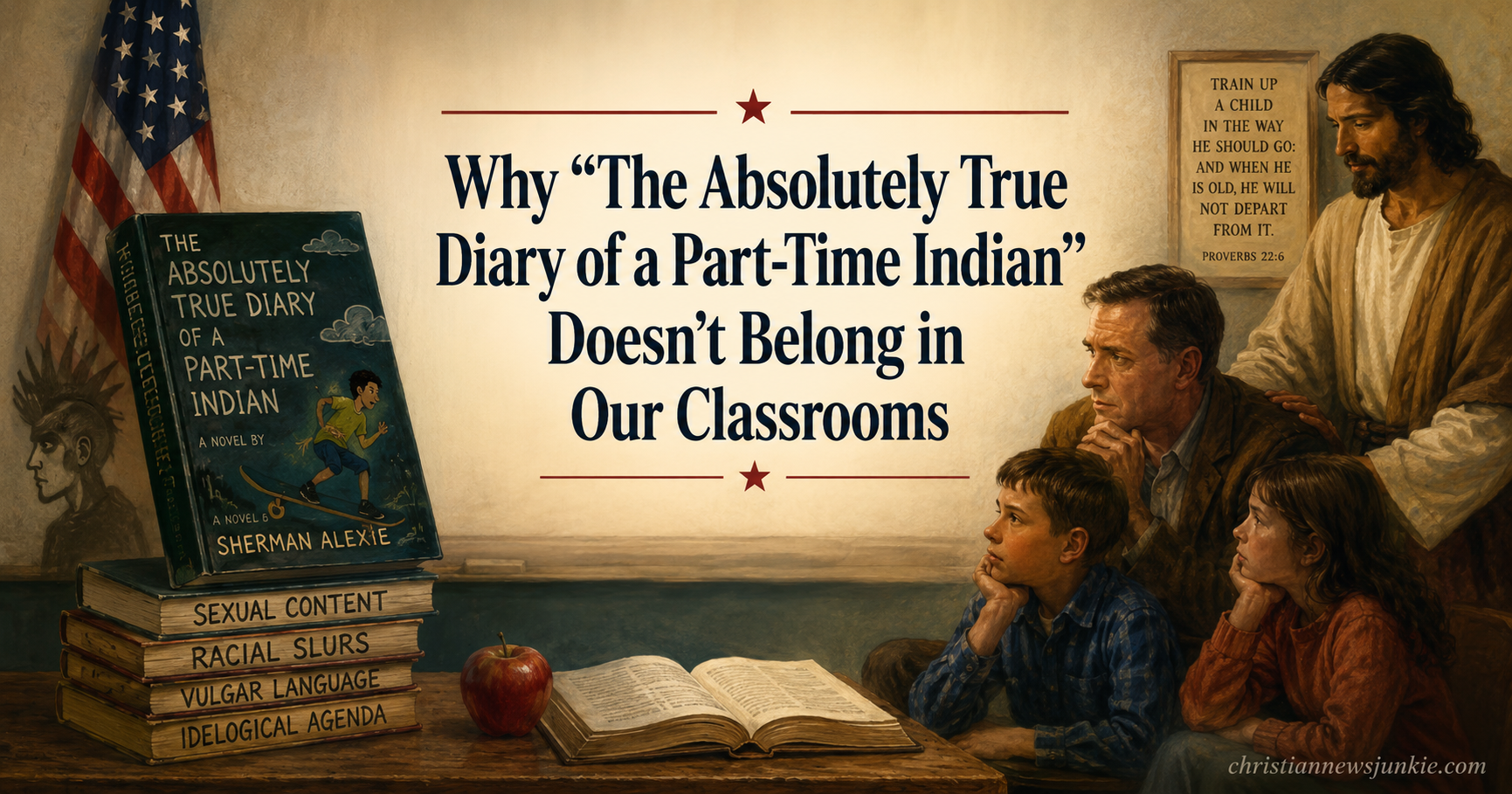
In school districts across the country, a quiet battle is underway over the content of books assigned in classrooms. One recent flashpoint in this broader cultural conflict is The Absolutely True Diary of a Part-Time Indian by Sherman Alexie. Approved for use in junior-level English classes in some districts, the book has sparked debate—not because of its literary merit, but because of its deeply inappropriate content, ideological framing, and questionable educational value.
Critics of the book’s inclusion have been accused of attempting to “ban books,” a phrase designed to evoke images of authoritarian censorship and closed-minded repression. But this charge is both dishonest and politically manipulative. Removing a book from the required reading list of a public school is not “banning” the book. It remains available in libraries, bookstores, and online retailers. What’s at stake here is not access to literature, but the responsibility and appropriateness of content selected for minor students in taxpayer-funded institutions.
We must ask ourselves: what kind of reading material should our children be required to engage with in school? That question demands more than slogans. It requires thoughtful consideration of educational value, moral boundaries, and ideological influence.
What’s In the Book?
The Absolutely True Diary of a Part-Time Indian tells the story of Arnold Spirit, a young Native American boy who leaves his troubled reservation school to attend a predominantly white school. The novel draws on the author’s real-life experiences and incorporates humor, illustrations, and informal language to explore themes of poverty, race, identity, and resilience.
But behind its semi-autobiographical and comedic veneer lies content that is deeply troubling for inclusion in a high school curriculum. The book includes:
- Graphic references to masturbation and sexual fantasies
- Coarse and repeated use of racial slurs
- Vulgar and profane language
- A joke referencing bestiality
- Descriptions that could be used to provoke inappropriate class discussions about sexuality and race
Even defenders of the book do not deny the presence of this content. Instead, they argue that it reflects the “real lives” of teenagers or that the shocking elements help students “make sense of the world.” But such justifications sidestep the real issue: is this how we want to challenge students academically and morally? Are these the standards we want to enshrine in our classrooms?
Three Questions Every School Board Should Ask
To evaluate whether a book belongs in a public school curriculum, especially for minors, school boards and educators should consider three basic questions:
- Does the book possess lasting cultural or academic value, and does it challenge students to grow intellectually and morally?
- Does the book promote or normalize ideological content—such as radical gender theory or critical race theory—that undermines family values or civic unity?
- Does the book contain material that is likely to provoke inappropriate or immodest conversations among youth, especially concerning sexuality or identity?
By these standards, The Absolutely True Diary of a Part-Time Indian falls short.
It is written at a relatively low reading level, closer to a comic diary than a classic novel. Students are not likely to develop advanced analytical skills by studying it. Its crude humor and adolescent angst may be entertaining, but entertainment is not the primary purpose of education. It lacks the moral depth and philosophical complexity of enduring literary works like To Kill a Mockingbird, Of Mice and Men, or The Odyssey.
Moreover, the novel functions as a vehicle for introducing students to contentious cultural ideas about identity, race, and sexuality, often framed in a cynical, mocking tone. Instead of fostering thoughtful discussion, it risks deepening division and reinforcing stereotypes.
A Conservative Perspective
Criticism of this book is not limited to Christian moral concerns. From a broader conservative standpoint—focused on civic order, the purpose of education, and the preservation of cultural standards—there are multiple reasons for concern.
1. Age Appropriateness Matters.
Cultural critic and conservative columnist Heather Mac Donald has long argued that public schools have a duty to maintain standards of decency, especially with respect to minors. The inclusion of sexually explicit or vulgar content in school settings erodes the boundary between public education and private life. Adolescents are impressionable, and introducing crude content under the banner of “literature” legitimizes a coarsening of culture that undermines maturity and self-restraint.
2. Ideological Indoctrination, Not Education.
Christopher Rufo, a fellow at the Manhattan Institute, has extensively documented how K-12 public education has been increasingly used as a conduit for ideological programming. He argues that many curriculum choices today reflect not educational best practices, but political agendas. This includes the normalization of radical gender theory, racial resentment narratives, and anti-Western ideology. Alexie’s novel, while not overtly political, is often used in conjunction with materials and classroom discussions that reinforce these themes.
3. Decline of Standards.
Conservative education reformers like Mark Bauerlein and E.D. Hirsch have argued that the turn toward contemporary, “relatable” literature in classrooms has come at the expense of intellectual rigor and cultural literacy. Books like The Absolutely True Diary are praised for being “relevant,” but what students need is not more relatability—they need more elevation. They need to read books that stretch their vocabulary, shape their moral imagination, and place them in dialogue with the great ideas of Western civilization.
The Problem of Cultural Gatekeepers
Organizations like the American Library Association (ALA) and the National Education Association (NEA) increasingly serve not as neutral curators of knowledge, but as ideological gatekeepers. The ALA has promoted drag queen story hours and LGBTQ+ book lists for children. Its current president, Emily Drabinski, openly identifies as a “Marxist lesbian” and has declared her intent to use librarianship for political activism.
The NEA, the nation’s largest teacher union, regularly endorses political resolutions that have little to do with education and everything to do with progressive activism. It promotes “gender affirming” language policies, critical race pedagogy, and climate change curricula grounded in activism rather than analysis.
Local unions affiliated with these national bodies often adopt similar language and priorities. While not all local educators agree with these ideologies, the institutional machinery tends to push schools toward politicized priorities.
A Better Alternative
Rather than defending questionable books like Alexie’s, schools should return to the classics. Works by authors like C.S. Lewis, George Orwell, Jane Austen, and Frederick Douglass offer powerful insights into human nature, moral complexity, and social order—without descending into vulgarity or ideological extremism.
These books don’t shy away from hard truths, but they treat their readers with respect. They elevate, rather than degrade, the imagination. They uphold beauty, virtue, and intellectual challenge.
The Bigger Picture: What Education Is For
At its core, public education should aim to form responsible citizens, not merely social commentators. It should cultivate reasoning, respect for truth, and civic responsibility. That task becomes impossible when schools are distracted by culture war agendas or captivated by the latest controversial book.
We are not living in a neutral moment. The ideological left has long recognized that shaping young minds is the key to long-term political and cultural change. Conservatives must realize the same truth and act accordingly—not through censorship, but through courageous leadership, principled pushback, and thoughtful alternatives.
Removing The Absolutely True Diary of a Part-Time Indian from school curricula is not a call for repression—it is a call for restoration: of standards, of modesty, and of the shared civic values that once made public education a unifying force in American life.
Final Thoughts
The battle over books is not just a question of taste—it is a contest over the soul of education. If we surrender our classrooms to vulgarity, ideological manipulation, and cultural fragmentation, we shouldn’t be surprised when students graduate confused, cynical, and unprepared for adult life.
It’s time for parents, school board members, and concerned citizens to take responsibility for what is being taught. We can insist on higher standards, both morally and intellectually, and we can do so with confidence, clarity, and respect.
S.D.G.,
Robert Sparkman
rob@christiannewsjunkie.com
RELATED CONTENT
Andrew, the content creator at Don’t Walk, Run! Productions provides a good review of some of the top books that have been identified as problematic for K-12 public school curriculum usage and library inclusion. Additionally, he addresses the false claim that excluding these books from public schools constitutes “book banning”.
Concerning the Related Content section, I encourage everyone to evaluate the content carefully.
If I have listed the content, I think it is worthwhile viewing to educate yourself on the topic, but it may contain coarse language or some opinions I don’t agree with.
Feel free to offer your comments below. Respectful comments without expletives and personal attacks will be posted and I will respond to them.
Comments are closed after sixty days due to spamming issues from internet bots.
You can always send me an email at rob@christiannewsjunkie.com if you want to comment on something afterwards, though.
It should be noted that on some matters, I am expressing my convictions or opinions on the matter. My convictions and opinions are strongly influenced by a conservative, Christian (biblical) worldview.
At times, like any other human being, my remarks will reflect my own intuition and bias. I am subject to error, although I speak from a clean concience, knowing that I will ultimately be held accountable for my words.
If you have evidence that I am wrong about a material statement of fact, provide the evidence and I will gladly review it and make revisions if merited. Obviously, there are some assertions that are matters of opinion that I will not change, but I always strive to be truthful.
I will continue to add videos and other items to the Related Content section as opportunities present themselves.
I recommend these Youtube channels and commentators for good content on politics and news from a Christian and/or conservative worldview: Albert Mohler, Allie Beth Stuckey, Bill O’Reilly, CBN News, Hugh Hewitt, John Anderson Media (Australia), Nick Freitas, Ruthless Podcast (language warning), Scott Jennings, The Hot Zone with Chuck Holton, Vince Dao, and Verdict with Ted Cruz.
Albert Mohler’s channel on Youtube has a daily episode called The Briefing with Albert Mohler that I highly recommend. Allie Beth Stuckey’s channel is top-notch, too.
For livestreaming of political protests and riots by conservative commentators, check out Nate Friedman, Cam Higby, James Klug, and Nick Shirley. I don’t agree with the perspectives of all these commentators and the language of protesters is often obscene. Most news outlets will not cover these illegal assemblies, though, because it doesn’t promote their narrative.
Depictions of Jesus Christ are used in some illustrations. I realize that some including conservative Presbyterians consider this to be idolatry. I respectfully disagree with their position on this matter as the commandment forbids worshiping such depictions, and I do not worship these illustrations.