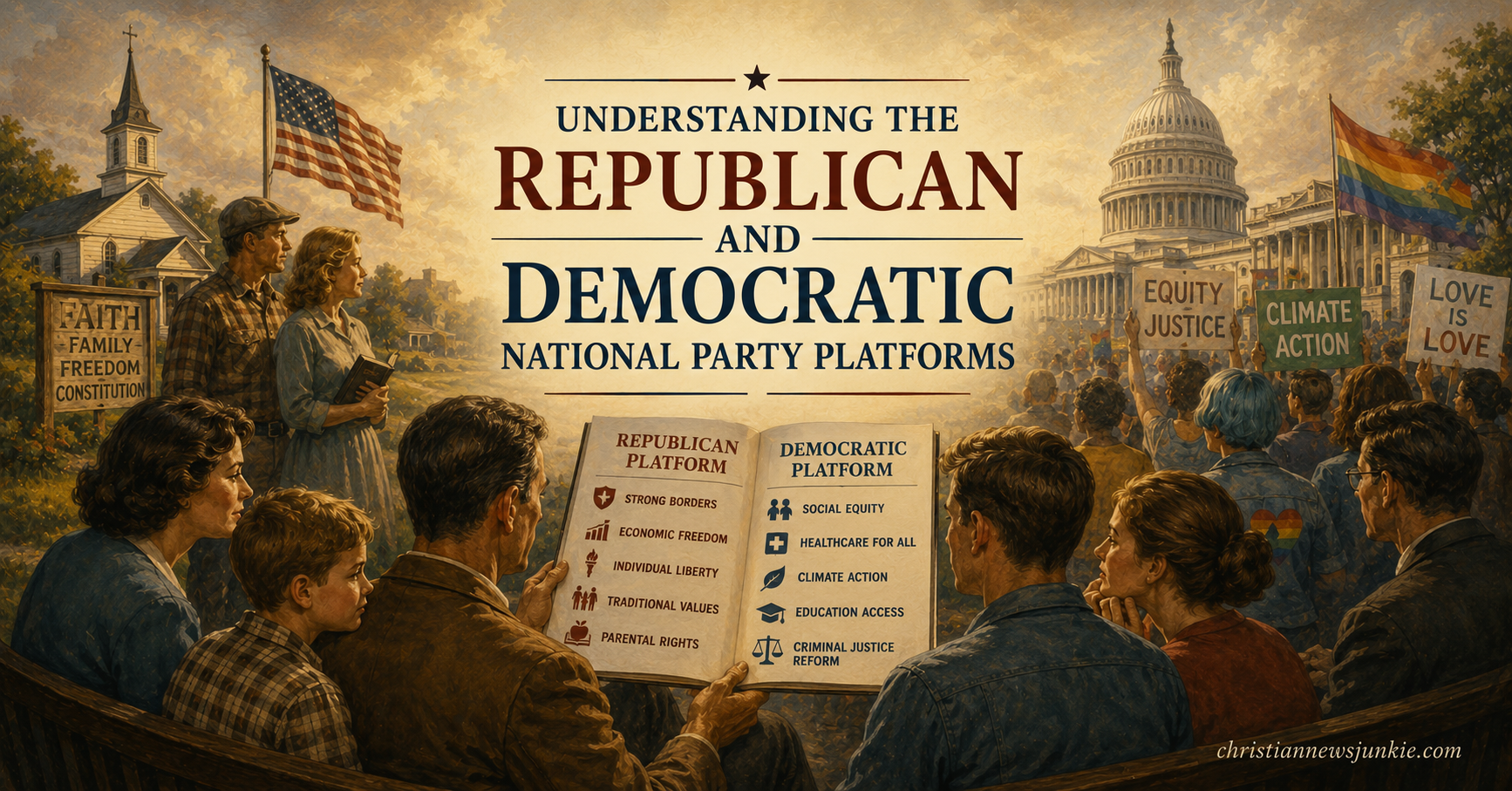
In the lead-up to the 2024 U.S. elections, the Republican and Democratic parties articulated their visions for the nation’s future through their respective platforms. These documents not only outline policy positions but also reflect the underlying philosophies and worldviews that guide each party. This analysis aims to provide a comparative overview of both platforms, highlighting key issues and the parties’ stances to inform voters’ decisions.
Republican Party Platform 2024: Embracing Traditional Conservatism
The Republican Party’s 2024 platform, titled “Make America Great Again,” emphasizes a return to foundational American principles. Key themes include:
- National Sovereignty and Security: Advocating for strong border control, the platform underscores the importance of national sovereignty and the enforcement of immigration laws.
- Economic Freedom: The party promotes free-market capitalism, reduced taxation, and deregulation to spur economic growth and job creation.
- Individual Liberties: Emphasizing the protection of constitutional rights, particularly the First and Second Amendments, the platform calls for safeguarding freedoms of speech, religion, and the right to bear arms.
- Traditional Values: Upholding the sanctity of life, the platform supports pro-life policies and the protection of religious liberties.
- Education Reform: Advocating for parental rights in education, the platform calls for school choice and opposition to curricula that promote divisive ideologies.
Democratic Party Platform 2024: Advancing Progressive Ideals
The Democratic Party’s 2024 platform focuses on progressive reforms aimed at promoting equity and social justice. Central tenets include:
- Social Equity: The platform emphasizes policies to address systemic inequalities, including racial, gender, and economic disparities.
- Healthcare Access: Advocating for expanded healthcare coverage, the party supports strengthening the Affordable Care Act and exploring options for universal healthcare.
- Climate Action: Committing to aggressive climate policies, the platform calls for investments in renewable energy and measures to reduce carbon emissions.
- Education and Workforce Development: The party promotes affordable higher education, student debt relief, and workforce training programs to adapt to a changing economy.
- Criminal Justice Reform: Emphasizing the need for systemic changes, the platform supports measures to address mass incarceration and promote rehabilitation.
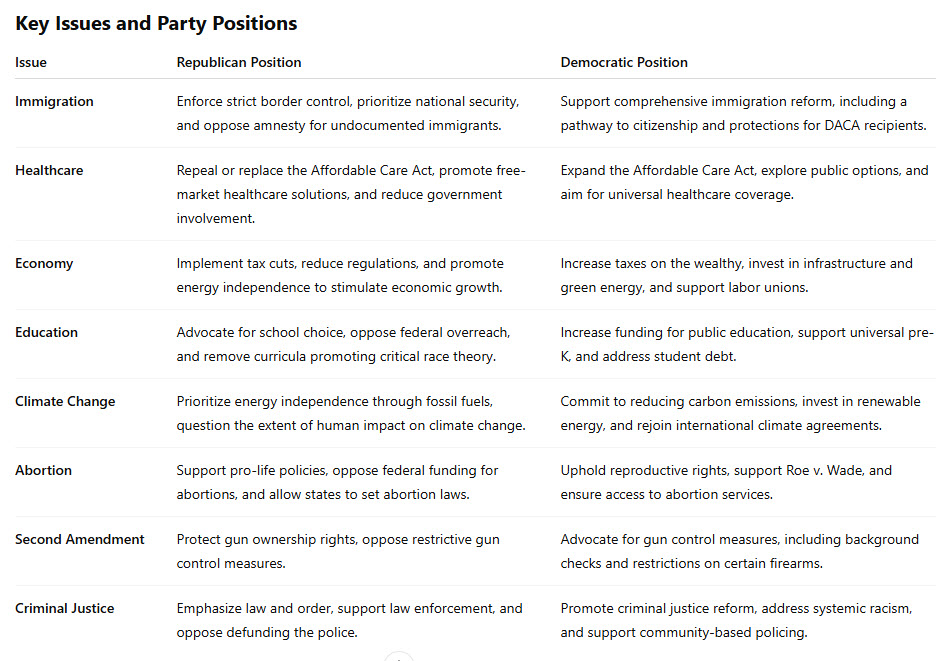
Key Issues and Party Positions
Decoding Progressive Terminology used by Democrats
Modern progressive discourse often employs terminology rooted in neo-Marxist (woke) thought, which can be unfamiliar to some voters. Understanding these terms is crucial for interpreting Democrat policy proposals:
- Systemic Racism: The belief that societal structures inherently disadvantage certain racial groups, necessitating comprehensive reforms.
- Equity vs. Equality: While equality focuses on providing the same resources to all, equity emphasizes distributing resources based on individual needs to achieve equal outcomes.
- Intersectionality: A framework analyzing how various aspects of identity (race, gender, class) intersect to create unique modes of discrimination.
- Social Justice: The pursuit of a society where resources and opportunities are distributed fairly, often requiring redistributive policies.
The phrases are very misleading. For example, abortion is coded as “reproductive justice” under the use of Neo-Marxist terms used by the Democrat party.
Understanding the Underlying Worldviews
The divergent platforms reflect fundamentally different worldviews:
- Republican Worldview: Anchored in classical liberalism and Judeo-Christian ethics, emphasizing individual responsibility, limited government, and traditional values.
- Democratic Worldview: Influenced by progressive and collectivist ideologies, focusing on social equity, expansive government roles, and transformative justice.
Conclusion: The Importance of Informed Voting
As the nation approaches the 2024 elections, understanding the philosophical underpinnings and policy positions of each party is paramount. Voters are encouraged to critically assess how each platform aligns with their values and the future they envision for the country.
For a more in-depth exploration, readers can access the full platforms here:
S.D.G.,
Robert Sparkman
rob@christiannewsjunkie.com
RELATED CONTENT
Concerning the Related Content section, I encourage everyone to evaluate the content carefully.
If I have listed the content, I think it is worthwhile viewing to educate yourself on the topic, but it may contain coarse language or some opinions I don’t agree with.
Feel free to offer your comments below. Respectful comments without expletives and personal attacks will be posted and I will respond to them.
Comments are closed after sixty days due to spamming issues from internet bots.
You can always send me an email at rob@christiannewsjunkie.com if you want to comment on something afterwards, though.
It should be noted that on some matters, I am expressing my convictions or opinions on the matter. My convictions and opinions are strongly influenced by a conservative, Christian (biblical) worldview.
At times, like any other human being, my remarks will reflect my own intuition and bias. I am subject to error, although I speak from a clean concience, knowing that I will ultimately be held accountable for my words.
If you have evidence that I am wrong about a material statement of fact, provide the evidence and I will gladly review it and make revisions if merited. Obviously, there are some assertions that are matters of opinion that I will not change, but I always strive to be truthful.
I will continue to add videos and other items to the Related Content section as opportunities present themselves.
I recommend these Youtube channels and commentators for good content on politics and news from a Christian and/or conservative worldview: Albert Mohler, Allie Beth Stuckey, Bill O’Reilly, CBN News, Hugh Hewitt, John Anderson Media (Australia), Nick Freitas, Ruthless Podcast (language warning), Scott Jennings, The Hot Zone with Chuck Holton, Vince Dao, and Verdict with Ted Cruz.
Albert Mohler’s channel on Youtube has a daily episode called The Briefing with Albert Mohler that I highly recommend. Allie Beth Stuckey’s channel is top-notch, too.
For livestreaming of political protests and riots by conservative commentators, check out Nate Friedman, Cam Higby, James Klug, and Nick Shirley. I don’t agree with the perspectives of all these commentators and the language of protesters is often obscene. Most news outlets will not cover these illegal assemblies, though, because it doesn’t promote their narrative.
Depictions of Jesus Christ are used in some illustrations. I realize that some including conservative Presbyterians consider this to be idolatry. I respectfully disagree with their position on this matter as the commandment forbids worshiping such depictions, and I do not worship these illustrations.