
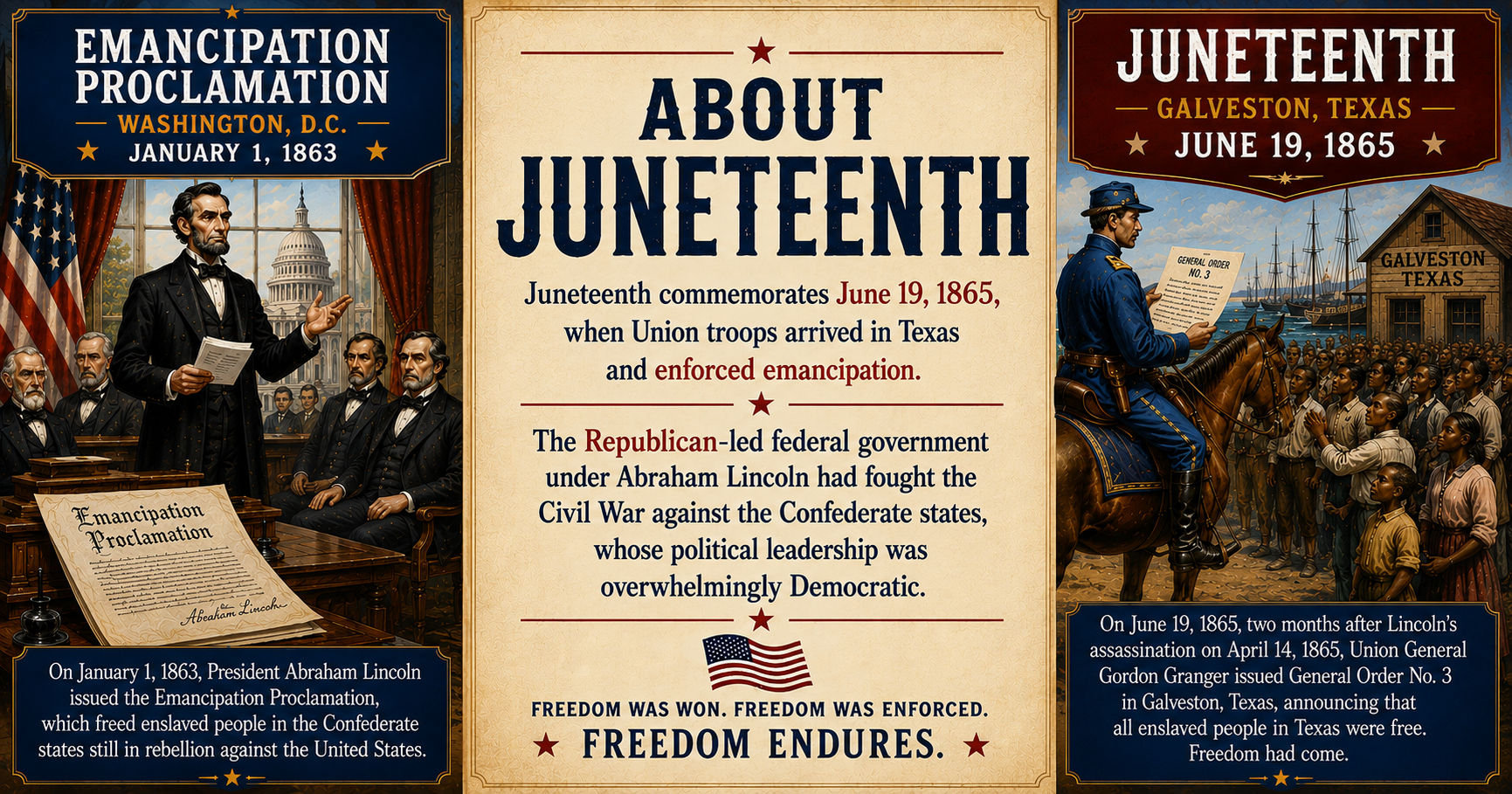
Juneteenth has rapidly become one of America’s most visible historical observances.
Since becoming a federal holiday in 2021, it has been celebrated by government institutions, churches, schools, civic organizations, and private citizens across the nation.
For many Americans, Juneteenth serves as a reminder of the long struggle to end slavery and to secure freedom for millions of black Americans.
Christians and conservatives should have no difficulty acknowledging the significance of Juneteenth. The end of slavery was a moral good. Human beings are created in the image of God, and any system that treats image-bearers as property violates fundamental biblical principles concerning human dignity. The eventual destruction of slavery in the United States was therefore a cause for celebration.
At the same time, historical observances should be grounded in historical accuracy.
Unfortunately, modern discussions about Juneteenth are often influenced by leftist political activism, anti-Americanism, ideological narratives, and historical simplifications.
There is a legitimate argument for the inaccuracies surrounding Juneteenth, as well. I would argue that Juneteenth is related to a regional event and is not appropriate for national observation. Instead, a better date would be the passing of the Thirteenth Amendment.
Many Americans are left with the impression that Juneteenth marks the day slavery ended throughout the United States. Others are told that Juneteenth somehow exposes the illegitimacy of Independence Day because not all Americans enjoyed freedom in 1776.
Neither conclusion is historically sound.
The purpose of this article is not to criticize Juneteenth observation per se. Rather, it is to place Juneteenth within its proper historical context.
Americans may observe Juneteenth in good conscience while recognizing that it was only one milestone among several in the long process of emancipation.
Likewise, Americans need not choose between celebrating Juneteenth and celebrating Independence Day.
Both commemorate important moments in the nation’s history.
A truthful understanding of the past allows us to honor genuine achievements while avoiding historical revisionism and ethnocentricism.
Christians, in particular, should be committed to telling the full truth about history, whether that truth is comforting or uncomfortable.
Slavery as a Human Problem Rather Than a Uniquely American Problem
One of the most common misconceptions in modern discussions of slavery is the belief that slavery was uniquely associated with white Europeans enslaving black Africans.
While the transatlantic slave trade was undeniably significant and morally horrific, slavery itself has existed throughout nearly all of recorded human history.
Ancient Egyptians held slaves. Ancient Greeks held slaves. Romans built large portions of their economy on slave labor. Slavery existed in Asia, Africa, Europe, the Middle East, and the Americas long before the United States existed.
Africans enslaved Africans.
In fact, many of the slaves transported across the Atlantic were initially captured by rival African tribes or kingdoms and then sold into the international slave trade.
European traders certainly fueled and expanded the market, but the institution involved participants on multiple continents.
Nor was slavery limited to Africans.
Millions of Europeans were enslaved over the centuries. The Barbary slave trade, conducted largely through North African Muslim states, resulted in the enslavement of large numbers of Europeans. Historians continue to debate exact figures, but the scope was substantial and lasted for centuries.
Native American tribes also practiced forms of slavery before European settlement. Some tribes enslaved members of rival tribes. Others later enslaved Africans or participated in systems that resembled slavery. Pioneer men, women, and children were captured by Native Americans and used for slave labor.
Indeed, slavery was often practiced by people against members of their own ethnicity.
Throughout history, the powerful frequently exploited the weak regardless of race.
The biblical explanation for this tragic reality is not racial but theological.
Scripture teaches that all people descend from Adam and are fallen sinners.
Human beings possess remarkable capacities for creativity and goodness because they bear God’s image, yet they are also capable of tremendous cruelty because of sin. The near-universal presence of slavery across civilizations demonstrates not the wickedness of one particular race but the brokenness of humanity itself.
Recognizing slavery’s universality does not minimize the suffering of American slaves. Rather, it places American slavery within the broader context of mankind’s long history of oppression and injustice.
Slavery in Early America
Slavery in America developed gradually during the colonial period.
Early labor systems included indentured servitude, apprenticeship arrangements, debt labor, and various forms of temporary bondage.
Over time, these systems increasingly gave way to hereditary race-based slavery, especially in the Southern colonies.
Indentured servitude deserves mention because it is often forgotten in modern discussions.
Many European immigrants arrived in America under contracts requiring years of labor in exchange for transportation and future opportunities.
Conditions could be harsh. Disease, overwork, poor nutrition, and physical punishment were not uncommon.
The book White Cargo documents many of the hardships experienced by white indentured servants transported to the colonies.
While indentured servitude differed significantly from chattel slavery, some servants endured conditions that today would be regarded as appalling.
In fact, it could be worse than chattel slavery in some regards as the master did not have as much incentive to preserve the health of his indentured servant as the end of his term of servitude drew near.
Free blacks in colonial Virginia could own land, conduct business, and exercise certain legal rights. Slaves were owned by black free citizens as well.
In a landmark 1655 Virginia court case, free black landowner Anthony Johnson successfully argued that John Casor was obligated to serve him for life.
Historians often regard this ruling as one of the earliest legal recognitions of lifetime servitude or slavery in the English colonies.
The case also illustrates the fluid and evolving nature of labor systems in seventeenth-century Virginia before race-based chattel slavery became fully entrenched.
Some evidence suggests that free blacks could also employ or hold indentured servants, including Europeans, although the historical record regarding Anthony Johnson’s specific labor arrangements is incomplete.
As the colonies matured, however, race-based slavery became increasingly entrenched, particularly in agricultural regions dependent upon labor-intensive crops such as tobacco, rice, sugar, and cotton.
The result was a uniquely American form of slavery that became deeply embedded within Southern economic and social structures. By the nineteenth century, slavery had become the nation’s most contentious political issue.
The Complexity of American Slavery
It is entirely appropriate to condemn slavery as an evil institution. Nevertheless, historical honesty requires acknowledging that slavery was not monolithic.
Some slaveholders were notoriously cruel. Physical and sexual abuse, family separation, inadequate living conditions, and harsh punishments occurred and are well documented. Such realities should never be denied or minimized.
At the same time, conditions varied tremendously among slaveholders. Former slaves themselves frequently described differences between masters.
Some owners were feared and hated. Others were remembered as comparatively humane. Others were trusted and loved.
These observations do not justify slavery. A benevolent master still participated in a system that treated human beings as property. Yet recognizing variation helps prevent simplistic historical narratives.
There were also unusual circumstances that complicate modern assumptions.
In some cases, churches or religious organizations legally held title to slaves in arrangements designed primarily for protection or support of the slaves. Legal ownership existed largely on paper while individuals functioned with substantial autonomy.
Economic realities further complicated matters.
Enslaved persons were used as collateral for loans, included in estate settlements, or tied to legal obligations that limited an owner’s ability to free them immediately. The creditors would not allow the debtor to free slaves in such circumstances as the slaves were collateral for the loan.
This does not excuse slaveholding, but it does illustrate that human relationships and legal systems were often more complex than modern political slogans suggest.
Christians should remember that the central moral issue was not merely mistreatment.
Even where treatment was comparatively humane, the fundamental problem remained that human beings made in God’s image were regarded as property.
Who Owned Slaves?
Popular culture sometimes leaves the impression that slave ownership was nearly universal among white Southerners.
Historical reality was more complicated.
Most white Southerners did not own slaves. Many were poor sharecroppers themselves. Slave ownership was concentrated among a minority of households, particularly among wealthier landowners.
Ownership rates varied significantly by region, with higher concentrations in portions of the Deep South.
This fact does not absolve non-slaveholders of responsibility for supporting or tolerating the institution. Nevertheless, it is important for understanding Southern society accurately.
Another frequently overlooked reality is that some free blacks owned slaves.
Their motivations varied. In some cases, free blacks purchased family members in order to protect them. In other cases, economic considerations played a role. Historical evidence demonstrates that slave ownership was not always neatly divided along racial lines.
Again, acknowledging complexity should not obscure the larger truth.
The overwhelming majority of slaves in the American South were owned by a minority of whites, and slavery functioned primarily as a racial institution.
Yet historical accuracy requires resisting oversimplifications that reduce every aspect of slavery to modern political categories.
The Founding Fathers, Slavery, and the Preservation of the Union
Modern discussions often portray the American Founding as though the nation was established for the purpose of preserving slavery.
The historical record is considerably more complicated.
Many of the Founding Fathers recognized that slavery stood in tension with the principles expressed in the Declaration of Independence.
The assertion that all men are created equal and endowed by their Creator with unalienable rights created an obvious difficulty for a nation in which slavery existed.
Several leading founders openly acknowledged this contradiction.
Thomas Jefferson described slavery as a moral and political evil. George Washington privately expressed hopes that slavery would eventually be abolished. Benjamin Franklin became involved in abolition efforts late in life. James Madison likewise recognized the incompatibility between slavery and the principles of republican government.
At the same time, the founders faced a practical political reality.
The thirteen states were not a unified nation in the modern sense. They were independent states with differing economies, cultures, and interests.
Southern states made it clear that they would not join a new federal union if the Constitution immediately threatened the institution of slavery.
As a result, delegates to the Constitutional Convention adopted several compromises concerning slavery.
These included the Three-Fifths Clause, the temporary protection of the international slave trade until 1808, and provisions concerning fugitive slaves.
Many delegates accepted these compromises not because they believed slavery was good, but because they believed that preserving the Union was essential to the survival of the American experiment in self-government.
Some founders hoped slavery would gradually disappear over time.
This expectation was not entirely unreasonable from their perspective. Several Northern states were already moving toward abolition, and many believed economic changes would eventually make slavery unprofitable.
Those expectations proved mistaken. The invention of the cotton gin and the rapid expansion of cotton production dramatically increased the profitability of slave labor throughout much of the South, causing the institution to become more deeply entrenched rather than gradually disappearing.
Another often-overlooked complication involved the legal and financial realities of slave ownership.
Enslaved persons were legally considered property under the law.
Like land, livestock, equipment, and other assets, slaves were frequently used as collateral for loans, included in inheritance arrangements, and pledged as security for debts.
Consequently, some slaveholders who wished to free slaves encountered legal obstacles.
Creditors frequently possessed claims against the value of enslaved persons and could challenge efforts to manumit them if such actions diminished the assets available to satisfy outstanding debts.
Thomas Jefferson provides one of the most notable examples.
Jefferson spent much of his life burdened by substantial debt.
By the time of his death, his estate was deeply insolvent.
Because creditors held legitimate legal claims against the assets of the estate, including enslaved persons, Jefferson’s ability to free large numbers of slaves was severely restricted.
Although he freed a small number of individuals, especially members of the Hemings family, the overwhelming majority of those held by his estate were ultimately sold to satisfy creditors.
These financial realities do not excuse slavery or eliminate the moral responsibility of slaveholders.
They do, however, help explain why the path toward emancipation was often more complicated than modern observers sometimes assume.
Historical honesty requires acknowledging two truths simultaneously.
Slavery was inconsistent with the nation’s founding principles and should be recognized as a profound moral evil. Yet many of the founders believed they were confronting a difficult choice between immediate national disunion and a constitutional framework that would preserve the Union while leaving the slavery question unresolved for future generations.
Whether those compromises were wise remains a subject of debate.
What is clear is that the founding generation understood the tension and wrestled with it long before the nation ultimately resolved the issue through civil war and constitutional amendment.
The Long Road to Emancipation
Many Americans assume slavery ended on a single day.
In reality, emancipation occurred through a series of military, political, legal, and constitutional developments.
As the Civil War progressed, federal policy toward slavery evolved dramatically.
Early in the conflict, Union leaders focused primarily on preserving the Union.
Over time, however, emancipation increasingly became both a military strategy and a moral objective.
Congress passed measures such as the Confiscation Acts, which weakened the institution of slavery in areas affected by the war.
Enslaved individuals who escaped to Union lines were often treated as “contraband” and were no longer returned to Confederate owners.
The most famous step came with President Abraham Lincoln’s Emancipation Proclamation.
Issued on January 1, 1863, the proclamation declared slaves in areas still in rebellion against the United States to be free.
Its significance was enormous. It transformed the character of the war, discouraged foreign recognition of the Confederacy, and established emancipation as a central Union objective.
Yet the proclamation’s scope was limited.
It did not apply to Union states and loyal border states where slavery remained legal, including Kentucky and Delaware.
Nor did it automatically free every slave in the country on the day it was issued.
Rather, its practical effect depended upon Union military success.
As Union armies advanced, emancipation followed.
Tennessee presents an especially interesting example.
Tennessee occupied a unique position during the war and was not treated identically to many Confederate states.
Andrew Johnson, a Tennessee slaveholder who remained loyal to the Union, illustrates the complexity of the era.
Johnson owned slaves before the war yet later supported emancipation and played a role in Tennessee’s transition away from slavery.
Such examples remind us that emancipation was not a simple story divided neatly between heroes and villains. It was a complicated process involving political leaders, military campaigns, constitutional amendments, and countless individuals whose experiences varied dramatically from one region to another.
Timeline: From Emancipation Proclamation to Constitutional Abolition
Understanding Juneteenth requires understanding the broader timeline of emancipation.
Slavery did not disappear everywhere at once. Instead, freedom arrived through a succession of events that unfolded over nearly three years.
On January 1, 1863, the Emancipation Proclamation took effect. Although limited in scope, it fundamentally changed the direction of the war and established emancipation as a Union objective.
As Union forces advanced into Confederate territory, enslaved people increasingly gained their freedom.
Throughout 1863 and 1864, slavery weakened across much of the Confederacy.
Union military victories disrupted plantation economies, undermined slaveholder authority, and expanded areas where federal emancipation policies could be enforced.
The Civil War officially came to an end on April 9, 1865, when Confederate General Robert E. Lee surrendered at Appomattox Court House.
Although isolated Confederate forces remained in the field for a time, the Confederacy as a functioning government had effectively collapsed.
Only days later, on April 14, 1865, President Abraham Lincoln was assassinated.
He died the following morning.
Lincoln did not live to witness the final constitutional abolition of slavery. Nevertheless, his leadership remains inseparable from the emancipation process.
On June 19, 1865, Union Major General Gordon Granger arrived in Galveston, Texas, and announced General Order No. 3.
This event is recognized as central to the holiday of Juneteenth.
Slavery technically existed in certain jurisdictions after Juneteenth, though.
The final legal abolition of slavery nationwide did not occur until December 6, 1865, when the Thirteenth Amendment was ratified.
This timeline highlights an important historical reality: there was no single moment when every enslaved person in America became free.
Emancipation unfolded in stages through military action, executive action, state action, and ultimately constitutional action.
What Juneteenth Actually Commemorates
The events related to Juneteenth occcurred in Galveston, Texas on June 19, 1865.
This declaration by General Gordon Granger was issued two months after Lee’s surrender and nearly two and a half years after the Emancipation Proclamation.
When Granger arrived with Union troops, he issued General Order No. 3, which announced that all slaves in Texas were free.
The announcement brought life-changing news to thousands of enslaved Texans. This declaration redefined relationships between former masters and former slaves.
Why had Texas remained behind other regions in implementing emancipation?
Part of the answer lies in geography.
Texas was remote compared to many other parts of the Confederacy.
During the war, some slaveholders had moved enslaved people into Texas in hopes of avoiding advancing Union forces.
Enforcement of emancipation lagged behind developments elsewhere.
For many newly freed Texans, June 19 represented a day of profound joy and relief.
Families celebrated, gathered for worship, shared meals, and marked the occasion as a turning point in their lives.
Over time, annual commemorations evolved into the Juneteenth celebrations known today.
Separated from leftist activism, these celebrations deserve respect.
They commemorate the freedom of real people who had endured generations of bondage.
Christians in particular can appreciate the symbolism of liberation.
Scripture repeatedly portrays freedom from oppression as a cause for thanksgiving. The Exodus itself stands as one of the Bible’s central themes of deliverance.
For these reasons, there is nothing inappropriate about commemorating Juneteenth.
The issue is not whether Juneteenth matters. Emancipation should be a cause for celebration.
There are two complications: the leftist, anti-American sentiment that is commonly behind the observance of the holiday by some, and the historical facts surrounding it: is there a more appropriate day of observance?
I suspect that the leftist, anti-American sentiment is the primary motivation of many observers, and the proximity to Independence day (July 4) is an intentional positioning that lends to the assertion that Juneteenth should replace Independence Day in the hearts and minds of Americans.
The Limits of Juneteenth as a National Symbol
The challenge arises when Juneteenth is presented as the moment slavery ended throughout the United States.
Historically, that is not what happened.
General Order No. 3 applied specifically to Texas.
By June 1865, emancipation had already been enforced in many other parts of the South. Countless slaves elsewhere had already gained freedom through military occupation, state action, or the practical collapse of Confederate authority.
Juneteenth therefore commemorates an important regional milestone within a larger national story.
This distinction matters because national historical observances should accurately reflect national historical events.
Imagine if Americans celebrated the ratification of the Constitution by a single state as though it represented the adoption of the Constitution by the entire nation.
The event might be historically significant, but its scope would be limited.
Similarly, Juneteenth marks the enforcement of emancipation in Texas rather than the universal abolition of slavery throughout the United States.
Recognizing this limitation does not diminish Juneteenth. Instead, it places the holiday in its proper historical context.
In fact, understanding the broader emancipation timeline can deepen appreciation for Juneteenth by showing how it fits within a larger story of national transformation.
The Thirteenth Amendment: America’s Universal Emancipation Event
If one seeks a single event that universally abolished slavery throughout the United States, the strongest candidate is the ratification of the Thirteenth Amendment.
Ratified on December 6, 1865, the amendment declared:
Neither slavery nor involuntary servitude, except as a punishment for crime whereof the party shall have been duly convicted, shall exist within the United States.
For the first time, slavery was constitutionally prohibited throughout the entire nation.
Unlike the Emancipation Proclamation, the amendment applied everywhere, not solely the Confederate states.
Unlike General Order No. 3, the amendment was not limited to Texas.
Unlike military occupation, the amendment did not depend upon troop deployments or wartime authority.
The Thirteenth Amendment ended legal slavery in remaining states where the institution still existed, including Kentucky and Delaware.
It transformed emancipation from a wartime policy into permanent constitutional law.
For this reason, one can reasonably argue that the ratification of the Thirteenth Amendment possesses a stronger claim to universality than Juneteenth.
This does not mean Americans must choose between the two observances.
A generous approach allows room for both.
Juneteenth commemorates a significant moment in the lived experience of many former slaves in a particular region. The Thirteenth Amendment commemorates the nationwide legal abolition of slavery.
Recognizing this distinction encourages greater historical precision.
Juneteenth and the Campaign Against Independence Day
In recent years, some leftist activists have attempted to use Juneteenth as a vehicle for attacking the observance of Independence Day.
Their argument typically proceeds as follows: because slavery existed in 1776, Americans should not celebrate Independence Day (July 4).
Some contend Independence Day represents hypocrisy rather than liberty, and that Juneteenth should replace it as America’s primary celebration of freedom.
These arguments contain an element of truth but ultimately reach a flawed conclusion.
The kernel of truth is that slavery did exist at the time of the American founding.
Some of the founders failed to live consistently with the principles they articulated.
Some founders owned slaves despite affirming universal human rights.
Christians should acknowledge these realities honestly.
Yet the existence of hypocrisy does not invalidate the principles themselves.
The Declaration of Independence proclaimed that all men are created equal and endowed by their Creator with certain unalienable rights.
Those principles became powerful weapons in the hands of abolitionists.
Indeed, many of slavery’s fiercest opponents argued not against the Declaration but from the Declaration.
They insisted that America should finally live up to its own ideals.
Frederick Douglass offers an important example.
Although famous for his criticism of American slavery, Douglass did not reject the principles of the Declaration of Independence.
Rather, he argued that those principles condemned slavery.
Likewise, many leaders of the Civil Rights Movement appealed to America’s founding ideals rather than repudiating them.
Independence Day commemorates the birth of the nation and the declaration of principles that ultimately contributed to slavery’s destruction.
Juneteenth commemorates an important stage in the application of those principles to people who had long been denied the blessings of the founding documents of the United States of America.
The two observances are not enemies. In fact, they are complementary.
Americans need not diminish one holiday in order to honor the other.
However, I believe that the spirit of Juneteenth could be achieved in a more appropriate title and date like Emancipation Day to be observed on December 6 annually. This would be more appropriate for a national observance and would remove the leftist, anti-American tendency to position Juneteenth as a substitute for Independence Day.
A Christian Approach to Historical Observance
Christians should approach historical observances differently than political activists.
The modern tendency of activists is the use of history as an ideological weapon.
One group highlights certain facts while ignoring others.
Another group responds by emphasizing a different set of facts.
The result is often a selective version of history designed to advance contemporary political goals.
The Christian commitment is different.
Christians are called to bear truthful witness.
The Ninth Commandment prohibits false witness, but the principle extends far beyond courtroom testimony.
Christians should strive to represent the past honestly and fairly.
That means acknowledging both the accomplishments and failures of previous generations.
A Christian approach to Juneteenth begins by recognizing the evil of slavery.
Scripture teaches that all human beings are created in God’s image (Genesis 1:26-27). Every person possesses inherent dignity because every person reflects something of the Creator.
The buying and selling of human beings as property under the Atlantic slave trade violated this fundamental truth.
The Apostle Paul reminded believers that in Christ there is neither slave nor free as a basis for spiritual standing before God (Galatians 3:28).
While Scripture regulated slavery in the ancient world, the broader biblical trajectory consistently affirms the equal worth of all people before God.
Christians should therefore rejoice that slavery was abolished.
At the same time, Christians should reject the tendency to portray America’s history as little more than a story of oppression.
Such interpretations often reflect modern ideological frameworks rather than balanced historical analysis.
America’s history includes both profound failures and remarkable achievements.
Slavery was a grievous injustice.
The eventual abolition of slavery was a significant achievement.
The nation that tolerated slavery was the nation that fought a devastating civil war to destroy it.
Both truths belong in the historical record.
Rejecting Collective Guilt
Another important Christian principle involves personal moral responsibility.
Modern political movements sometimes encourage forms of collective guilt in which individuals are expected to bear moral responsibility for the actions of distant ancestors or members of their ethnicity.
Scripture does not support this thinking.
The Bible teaches that individuals are responsible for their own sins before God.
While societies can experience the consequences of historical wrongdoing, moral guilt itself is not inherited through race or ethnicity.
This principle allows Americans of every background to discuss slavery honestly without assigning perpetual guilt or perpetual victimhood to entire groups of people.
The descendants of slaveholders are not personally guilty for slavery simply because of their ancestry.
Likewise, the descendants of slaves deserve neither exaltation or condescension or lowered expectations due to historical injustices suffered by previous generations.
Christianity affirms a common humanity rooted in Adam and a common hope rooted in Christ.
Rejecting Historical Sanitization
Rejecting collective guilt does not mean sanitizing history.
Some people respond to leftist activist distortions by minimizing the evils of slavery or pretending that its consequences were insignificant.
Such responses are equally problematic.
Historical honesty requires acknowledging painful realities.
Families were separated.
Human beings were bought and sold.
Economic interests often overrode moral concerns.
Racial prejudice became embedded within portions of American society.
These facts should not be denied.
The Christian commitment to truth requires acknowledging uncomfortable realities while resisting ideological exaggeration.
National Gratitude Without National Idolatry
A balanced Christian perspective also avoids two opposite errors.
The first error is national self-hatred.
The second error is national idolatry.
Christians should be grateful for their nation’s blessings.
Americans enjoy freedoms, opportunities, and constitutional protections that have benefited millions of people.
At the same time, Christians recognize that no nation is perfect.
The Kingdom of God is eternal; political nations are temporary.
Because of this perspective, Christians can celebrate legitimate national achievements without pretending that their nation is beyond criticism.
Juneteenth provides an opportunity to express gratitude for freedom while remembering the dangers of injustice.
Independence Day provides an opportunity to celebrate the nation’s founding principles while recognizing the failures that accompanied them.
Neither observance requires historical dishonesty.
Conclusion: Remembering Freedom Without Rewriting History
Juneteenth deserves respect as an important American observance.
For thousands of former slaves in Texas, June 19, 1865, marked a life-changing announcement of freedom.
Their celebrations were understandable, meaningful, and worthy of remembrance.
The holiday that emerged from those celebrations reflects a genuine historical event that continues to resonate with many Americans today.
Yet historical precision matters.
Juneteenth was not the moment slavery ended everywhere in the United States.
Emancipation unfolded through a series of developments that included wartime measures, military victories, state actions, the Emancipation Proclamation, and ultimately the ratification of the Thirteenth Amendment.
The broader story is more complicated—and more interesting—than many modern presentations suggest.
Recognizing those complexities does not diminish Juneteenth or a more appropriate observation name and date that reflects national emancipation.
Rather, it enriches our understanding of the holiday and places it within the larger narrative of American history.
Likewise, Juneteenth need not be used as a weapon against Independence Day.
The Declaration of Independence articulated principles that eventually contributed to the destruction of slavery.
America’s founders did not always live consistently with those principles, but the principles themselves remained powerful tools for reformers, abolitionists, and civil rights advocates.
Americans can celebrate both June 19 and July 4 without contradiction.
They can acknowledge slavery without defining the entire nation by slavery.
They can celebrate freedom without ignoring historical injustices.
They can reject both historical whitewashing and historical revisionism.
Perhaps most importantly, Christians can remember that every human being—whether slave or free, black or white, rich or poor—bears the image of God.
The tragedy of slavery ultimately reminds us not merely of failures within one nation but of the fallen condition of humanity itself.
Slavery appeared in countless civilizations of various skin tones because sin appears in every human heart.
The good news of Christianity is that Christ came to free people from a deeper bondage than any political institution can impose.
Earthly freedom is a blessing worthy of gratitude. Spiritual freedom through Jesus Christ is an even greater gift.
As Americans reflect upon Juneteenth, the Thirteenth Amendment, and Independence Day, they should strive for historical honesty, national gratitude, and Christian charity.
In an age increasingly marked by ideological conflict and competing historical narratives, truth remains the surest foundation for genuine understanding and national unity.
S.D.G.,
Robert Sparkman
rob@christiannewsjunkie.com
RELATED CONTENT
I submitted a letter to the editor of the local newspaper which is related to this topic.
Concerning the Related Content section, I encourage everyone to evaluate the content carefully.
If I have listed the content, I think it is worthwhile viewing to educate yourself on the topic, but it may contain coarse language or some opinions I don’t agree with.
Feel free to offer your comments below. Respectful comments without expletives and personal attacks will be posted and I will respond to them.
Comments are closed after sixty days due to spamming issues from internet bots.
You can always send me an email at rob@christiannewsjunkie.com if you want to comment on something afterwards, though.
It should be noted that on some matters, I am expressing my convictions or opinions on the matter. My convictions and opinions are strongly influenced by a conservative, Christian (biblical) worldview.
At times, like any other human being, my remarks will reflect my own intuition and bias. I am subject to error, although I speak from a clean concience, knowing that I will ultimately be held accountable for my words.
If you have evidence that I am wrong about a material statement of fact, provide the evidence and I will gladly review it and make revisions if merited. Obviously, there are some assertions that are matters of opinion that I will not change, but I always strive to be truthful.
I will continue to add videos and other items to the Related Content section as opportunities present themselves.
I recommend these Youtube channels and commentators for good content on politics and news from a Christian and/or conservative worldview: Albert Mohler, Allie Beth Stuckey, Bill O’Reilly, CBN News, Hugh Hewitt, John Anderson Media (Australia), Nick Freitas, Ruthless Podcast (language warning), Scott Jennings, The Hot Zone with Chuck Holton, Vince Dao, and Verdict with Ted Cruz.
Albert Mohler’s channel on Youtube has a daily episode called The Briefing with Albert Mohler that I highly recommend. Allie Beth Stuckey’s channel is top-notch, too.
For livestreaming of political protests and riots by conservative commentators, check out Nate Friedman, Cam Higby, James Klug, and Nick Shirley. I don’t agree with the perspectives of all these commentators and the language of protesters is often obscene. Most news outlets will not cover these illegal assemblies, though, because it doesn’t promote their narrative.
Depictions of Jesus Christ are used in some illustrations. I realize that some including conservative Presbyterians consider this to be idolatry. I respectfully disagree with their position on this matter as the commandment forbids worshiping such depictions, and I do not worship these illustrations.